SK Hynix Becomes the 'Capitalist Traitor', Samsung Employees Launch Major Strike

marsbitОпубліковано о 2026-05-13Востаннє оновлено о 2026-05-13

Анотація

A major labor dispute is escalating at Samsung Electronics, with its union threatening an 18-day strike from May 21st after mediation failed. The core conflict is over profit-sharing, not the wage increase amount. The union, emboldened by a precedent set at rival SK Hynix, demands a permanent, formula-based annual bonus tied to 13% of the semiconductor division's operating profit. Management offered a large one-time payout instead, refusing to institutionalize an annual split, fearing it would set a costly precedent across Samsung's diverse business groups and the wider Korean conglomerate system. SK Hynix's deal, guaranteeing employees 10% of annual operating profit for a decade, has already delivered substantial bonuses due to its dominance in the lucrative HBM memory market for AI chips. This has triggered rare employee movement from Samsung to SK Hynix. The strike, potentially involving tens of thousands, risks impacting global DRAM and NAND production. Analysts see this as the start of a broader recalibration within the AI supply chain, where workers in critical, scarce roles are beginning to renegotiate their share of the massive profits generated, moving beyond traditional models like stock options towards more direct, transparent cash profit-sharing agreements.

Written by: Xiao Bing, Shenchao TechFlow
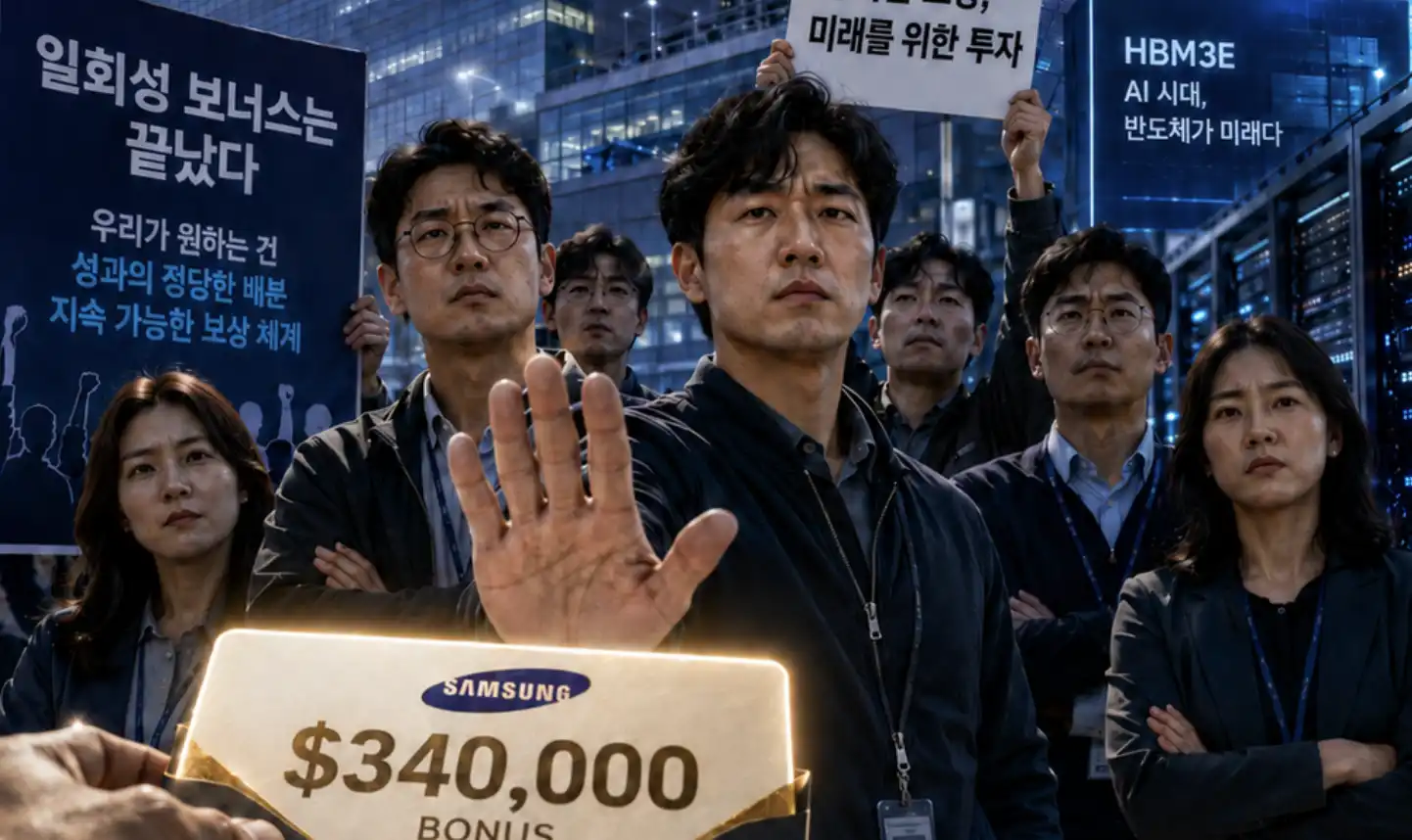
Samsung Electronics' labor negotiations have finally reached the brink of a strike.

Late on May 12th, mediation led by Korea's National Labor Relations Commission broke down. Samsung Electronics Union President Choi Seung-ho told reporters as he left the meeting room, "There's no point in waiting any longer." Barring any unforeseen circumstances, starting May 21st, the union will launch a major 18-day strike, lasting until June 7th.

The union currently has about 74,750 members, with approximately 80% from the semiconductor division (DS). According to Choi, about 41,000 members have expressed willingness to participate in the strike, with the final number potentially exceeding 50,000. Considering Samsung's participation rates in labor actions over the past two years, industry analysts estimate the actual participation this time will be between 30,000 and 40,000, making it the largest labor action in Samsung's history. A one-day partial strike previously caused a 58% reduction in night shift production on some lines. If the full 18-day strike proceeds, TrendForce estimates it could affect 3-4% of global DRAM capacity and 2-3% of NAND capacity. JPMorgan estimates that based on the current disagreements, Samsung Electronics' annual operating profit could be reduced by over 40 trillion KRW.

The real story isn't the strike itself, but the proposal the union rejected.

A 13% Offer, No Deal

According to the UK's Financial Times, the two sides had recently narrowed their initial gap considerably. The union's initial demands were a 15% bonus pool from the semiconductor division's operating profit, removal of the 50% bonus cap, plus a 7% wage increase. Management's initial response was 10% plus some other benefits. After back-and-forth negotiations, it was rumored both sides were close to the 13% figure.

But talks stalled.

The union wanted the 13% written into the agreement, to be paid annually according to this formula. Management was willing to pay a lump sum at this ratio, but only for this year, translating to an average one-time bonus of about $340,000 per person based on current profit levels.

It doesn't sound that different, but the union rejected it.

For employees, the difference isn't complicated:

The logic of a one-time bonus is: the company made a lot this year, so we're giving you a bonus. Whether the company makes a lot next year, whether we give a bonus, and according to what formula, will be renegotiated every year.

The logic of annualized profit-sharing is: according to the agreement, a certain percentage of operating profit inherently belongs to employees. Employees receive it for as long as the AI boom lasts; if the boom fades, employees accept that.

Both models are "bonuses," but they correspond to different statuses. The former is a temporary gift from the company; the latter is a share that is institutionally allocated by rule. With similar amounts, the two arrangements mean either employees wait for management's decision every year, or they have a predictable rule written in black and white.

This is the core point the union won't let go.

SK Hynix Has Already Made This Work

The union's confidence comes from its neighbor.

In the second half of last year, SK Hynix reached an agreement with its union, abolishing the previous bonus cap and establishing a 10% annual operating profit pool for employee sharing, valid for the next ten years. In February 2026, SK Hynix issued the first bonus under this new mechanism, amounting to 2,964% of base salary, averaging nearly $100,000 per person.

SK Hynix's Q1 2026 operating profit surged more than 5 times year-over-year, with an operating margin of 72%, an extremely rare figure in the hardware industry. The reason is clear: it holds over 50% of the global HBM (High Bandwidth Memory) market, being the main supplier of HBM for Nvidia's H100 and H200 chips. It earns as much as AI data centers are built.

As profit expectations have been raised throughout the year, some Korean and foreign media have calculated, under optimistic scenarios, that the average SK Hynix employee bonus this year could be around $470,000; if the high-end profit forecasts from institutions like Macquarie for 2027 materialize, it could theoretically approach $900,000. These figures require caution; they are projections based on optimistic profit assumptions, not money already in hand. But even based on the already disbursed amount and conservative expectations for the second half, the absolute numbers still far exceed Samsung's current offer.

Since December last year, about 200 Samsung employees have jumped ship to SK Hynix, according to the Samsung union's own statistics. This is a very rare migration direction among engineers, as SK Hynix has been playing catch-up to Samsung for the past decade. But this time, with the bonus structure changed, people are following.

Samsung Management Finds It Hard to Compromise

From the outside, Samsung just seems stingy, but from management's perspective, it's more complex than it appears.

Samsung Electronics is not a pure-play memory chip company. It has multiple business lines: mobile phones, home appliances, display panels, foundry, memory, and more. The semiconductor division making a lot this year doesn't mean other divisions can enjoy the same cycle. In Q1, the DX division's operating profit was already declining. If semiconductors alone get a 15% written profit share, people within the group would immediately ask: why do they get a share, and we don't?

According to external analyst calculations, if Samsung Semiconductor truly allocated 15% of operating profit to employees, the corresponding bonus pool would reach 40 to 45 trillion KRW, an amount higher than SK Hynix's total annual operating profit. This isn't just the company being "reluctant," but such a large-scale fixed expense, once institutionalized, would be very difficult to roll back in the future.

What management is most unwilling to do is write "formulaic profit-sharing" into a contract. Once this precedent is set, next year the DX union, the display panel union, will all use the same logic to negotiate. The entire internal compensation order within the Samsung Group would be reshuffled, and labor contracts across the entire Korean chaebol system would be used as new references.

That's why Samsung would rather endure strike losses, be called "stingy" by the union and media, and hold its ground on the wording of "annualization."

This Won't Stop at Korea

The specific day the union and management reach a compromise isn't the most important thing in the long run.

What's important is: Scarce positions on the AI industrial chain have begun renegotiating their value.

Over the past thirty years, Silicon Valley's script has been to tie employees' fates to the company's stock price with equity incentives. But this script has two implicit premises: the company must go public, and employees must be part of the early batch. Engineers joining later, after stock dilution, get far less than those who came before.

SK Hynix has carved a second path: no need to wait for an IPO, no need to watch the stock price; use cash profit-sharing to turn employees into cycle partners. Its benefits are a transparent formula, a timetable, and predictability. The cost is the company needs to acknowledge that employees aren't just a cost item, but also part of the profit item.

Once this path is proven at SK Hynix, and some version is negotiated at Samsung, the next entities facing the same question might not just be Korean companies.

What do TSMC engineers think about how much Nvidia earns for every GPU sold? What do ASML workers think about the $200 million price tag of an EUV lithography machine? Will veterans in those age-old industries supplying liquid cooling, power, and transformers for data centers suddenly realize they hold scarce resources?

Not all questions will have immediate answers, but the questions have been asked.

The capital market has already provided one round of answers to "Who gets the AI红利?" in the past two years: Nvidia shareholders were the first to reap the红利, followed by TSMC, SK Hynix, and Samsung through capacity and pricing power—this is distribution among companies.

Distribution within companies has just begun.

The 18 days starting May 21st might end with a union victory, or with some compromise, where management concedes a step on "annualization," writing it into a shorter-term agreement to leave an escape route. The specific outcome affects this contract's amount, but not the real direction.

SK Hynix employees have already received their first profit-sharing ticket. Samsung employees are using a strike to fight for theirs. Who gets the next ticket, when, and in what form, might be one of the most interesting underlying trends to follow in the AI industrial chain over the next three to five years.


Пов'язані питання

QWhat are the main differences between the bonus structures proposed by Samsung management and the union?

AThe union demands a 13% annual profit-sharing scheme written into a long-term agreement, ensuring a predictable, rule-based bonus tied to profits each year. Management offers a one-time bonus of approximately $340,000 per employee based on current profits, but refuses to institutionalize an annual formula. The core dispute is over creating a permanent, predictable rule versus retaining management discretion for annual negotiations.

QHow has SK Hynix's new bonus system influenced the Samsung labor dispute?

ASK Hynix successfully implemented a ten-year agreement last year, abolishing bonus caps and allocating 10% of annual operating profit to employees. This resulted in substantial per-employee bonuses (e.g., nearly $100,000 in early 2026). This precedent has empowered Samsung's union, leading to employee defections (around 200) from Samsung to SK Hynix and strengthening the union's demand for a similar, formula-based, long-term profit-sharing scheme at Samsung.

QWhy is Samsung management resistant to the union's demand for a formula-based annual profit share?

ASamsung is a conglomerate with multiple divisions (e.g., smartphones, appliances, displays, foundry). A formula for its high-profit semiconductor division alone would create internal equity issues, prompting demands from other divisions' unions. Institutionalizing a large-scale, fixed profit share (estimated at 40-45 trillion won) is seen as a rigid, costly commitment that would be difficult to reverse and could redefine compensation norms across the entire Samsung Group and the wider Korean chaebol system.

QWhat potential global impact could the resolution of this dispute have beyond South Korea?

AThe dispute highlights a broader trend: workers in critical AI supply chain roles (e.g., semiconductor manufacturing, equipment, infrastructure) are beginning to renegotiate their share of the profits. If profit-sharing models like SK Hynix's become established, it could set a precedent, prompting similar demands at companies like TSMC, ASML, and key infrastructure suppliers, challenging traditional compensation models and shifting the internal distribution of AI industry profits from companies to their skilled workforce.

QWhat is the estimated operational and financial impact of the potential Samsung strike?

AA full 18-day strike by an estimated 30,000-40,000 workers (primarily in semiconductor production) could reduce global DRAM output by 3-4% and NAND output by 2-3%. Financially, JP Morgan estimates that the full-year impact of the labor dispute, based on the current disagreements, could reduce Samsung Electronics' annual operating profit by over 40 trillion won.

Пов'язані матеріали

After Three Consecutive Quarters of Decline, Can the Crypto Market Find a Window for Stabilization in Q3?

The cryptocurrency market has just concluded its worst-performing quarter since 2022, with total capitalization dropping 12.6% to $2.1 trillion. All core metrics indicate capital is leaving the sector, not just rotating within it. Bitcoin fell 14.2% and Ethereum dropped 25.4% in Q2, breaking their previous correlation with US tech stocks. A key driver is the reversal in US spot Bitcoin ETF flows, which saw a net outflow of approximately $4.67 billion in Q2, including a record monthly outflow near $4.5 billion in June. While recent data suggests long-term holders are accumulating again, sustained ETF outflows mean continued selling pressure. Market focus is now singularly on the Federal Reserve. The upcoming July FOMC meeting is seen as the most critical event for Q3. A dovish signal could support Bitcoin reclaiming a $68,000-$84,000 range, while a hawkish stance might establish a new trading band around $50,000-$56,000. Additionally, regulatory uncertainty persists, with the progress of the crucial *CLARITY Act* stalling in the Senate, reducing its perceived 2026 passage probability to 40-45%. Despite the broad downturn, a few sectors showed growth. Prediction markets saw nominal volume surge 48.7% year-over-year to $113.8 billion, and tokenized collectibles transaction volume rose 143% quarterly to $1.4 billion. The Real-World Asset (RWA) tokenization sector also continued steady growth, now representing ~$28.1 billion in on-chain value. The market's foundation for an extreme crash appears limited, with Bitcoin price hovering near its 200-week moving average. However, the trading paradigm has shifted from narrative-driven speculation to decisions based on price action, policy developments, and interest rate expectations, making a broad sentiment-driven rally unlikely in the near term.

marsbit18 год тому

After Three Consecutive Quarters of Decline, Can the Crypto Market Find a Window for Stabilization in Q3?

marsbit18 год тому

BIT Trading Moment: BTC Still Suppressed by Weekly 200 EMA, Rejection May Restart Decline; Storage and Semiconductors that Surged Last Night Begin Falling in Evening Trading

**Crypto & Stock Market Wrap: Bitcoin Tests Resistance, Stocks Retreat After AI Surge** Bitcoin consolidates around $66,000, facing key resistance near $68,000—an area seen as a major psychological and technical hurdle where previous rallies have failed. Analysts note the cryptocurrency is caught between its 200-week moving average (~$63,333) and 200-week EMA (~$68,328). A clear break above $68k is needed to signal a stronger bullish trend, while a rejection could lead to a retest of $63k support. Market sentiment remains cautious, with low futures open interest pointing to a low-liquidity rebound rather than a full bull market. Bitcoin spot ETFs saw another $203 million inflow. US stock futures pointed lower after a strong Tuesday session led by a massive rebound in semiconductors and memory stocks. The rally was fueled by renewed optimism about AI-driven hardware demand, with Micron, SanDisk, and SK Hynix surging. However, those gains reversed in pre-market trading. Super Micro Computer (SMCI) soared over 20% after hours on strong guidance and a record backlog. Other standouts included Rocket Lab and nuclear energy plays Oklo and X-Energy. Rising oil prices (Brent above $91) and climbing Treasury yields (10-year near 4.64%), however, are reigniting inflation concerns and acting as a headwind for equities. In Asia, markets were mixed. South Korea's KOSPI pared early gains to close slightly higher as semiconductor stocks like SK Hynix gave back initial surges. Japan's Nikkei edged lower as the yen hit a fresh 38-year low against the dollar, raising fears of potential market intervention. Key events to watch include the Samsung Galaxy launch, AMD's AI event, and a slew of major tech earnings from Alphabet, Tesla, and IBM after the close on Wednesday, followed by the ECB meeting and Intel's earnings on Thursday.

marsbit18 год тому

BIT Trading Moment: BTC Still Suppressed by Weekly 200 EMA, Rejection May Restart Decline; Storage and Semiconductors that Surged Last Night Begin Falling in Evening Trading

marsbit18 год тому

Former CFTC Chairman, Circle President Tarbert: Preaching Long-Termism While Cashing Out $30 Million Himself

Former CFTC Chairman and Circle President Heath Tarbert has consistently advocated for a long-term vision in public, urging patience from investors as Circle’s stock price has fallen significantly from its peak. However, it has been revealed that since Circle’s IPO, Tarbert has continuously sold his CRCL shares through pre-arranged trading plans, cashing out approximately $30 million, without making any public market purchases. This contrast between his public messaging and personal actions has drawn criticism. Tarbert joined Circle in July 2023 as Chief Legal Officer, leveraging his regulatory experience to help guide the company through its IPO and expansion. Despite promoting stablecoins as long-term infrastructure, he established a 10b5-1 trading plan just before Circle went public, leading to substantial stock sales over the following year. In March 2026, he initiated another plan to sell more shares. His career trajectory highlights a pattern of moving between high-level regulatory roles and influential positions in the financial sector. After resigning as CFTC Chairman in early 2021, he joined Citadel Securities as Chief Legal Officer just 27 days later, during a period of intense regulatory scrutiny for the firm. He later joined Circle, aiding its efforts to navigate regulatory challenges for its public listing. While Tarbert's expertise in policy and compliance is valuable to companies like Circle, his actions—advocating long-term confidence while personally divesting—raise questions about the alignment between his public statements and his private financial decisions, leaving investors who followed his advice to bear the market risks.

marsbit19 год тому

Former CFTC Chairman, Circle President Tarbert: Preaching Long-Termism While Cashing Out $30 Million Himself

marsbit19 год тому

Gate Research Institute: The 'Wall Street-ization' Wave of Crypto Financial Products – Competition or Integration?

The article titled "Gate Research Institute: Are Crypto Financial Products Sparking a 'Wall Street' Wave—Competition or Convergence?" explores the evolving relationship between the crypto ecosystem and traditional finance (TradFi). The piece begins by reflecting on Bitcoin's original 2009 vision of decentralization, disintermediation, and moving away from banks. It then contrasts this with the 2024 landscape, where key crypto assets like Bitcoin are increasingly held through Wall Street products like ETFs issued by giants like BlackRock. The article questions whether this signifies that TradFi is systematically taking over the rights to issue, price, custody, and distribute crypto financial assets. The core argument is that this is not a zero-sum takeover but rather a bidirectional convergence where each side addresses the other's weaknesses. Crypto offers 24/7 global markets, programmable settlement, and open access but lacks compliant channels, institutional-grade custody, deep fiat liquidity, and mainstream distribution. TradFi possesses these but is constrained by legacy systems, limited operating hours, and slow settlement. Two primary convergence paths are highlighted: * **Path A (CEX to TradFi):** Exemplified by Gate, which has progressed from offering tokenized stocks and CFDs to providing direct, real stock trading (US, Hong Kong, South Korea) within its platform, using USDT. * **Path B (TradFi to Crypto):** Exemplified by Robinhood, which has integrated crypto trading, acquired exchanges like Bitstamp, and is moving traditional assets like stocks onto the blockchain via tokenization and its own Layer 2. Both paths are ultimately competing to become the next-generation, unified financial account—a "super account" where users can seamlessly trade cryptocurrencies, stocks, ETFs, RWA (Real World Assets), and tokenized treasury products in one interface. The growth of RWA and tokenized treasuries (e.g., BlackRock's BUIDL) is presented as the asset-layer fusion, providing stable, yield-bearing assets on-chain and acting as a bridge between the two worlds. In conclusion, the "Wall Street-ization" of crypto is framed as a mutual transformation. Decentralized ideals persist in the protocol layer, while at the application layer, a more efficient, global, and accessible unified capital market is emerging from this convergence. The future competition lies not between crypto exchanges and stockbrokers, but between platforms vying to offer the most comprehensive asset coverage, liquidity, and user experience within a single account.

marsbit19 год тому

Gate Research Institute: The 'Wall Street-ization' Wave of Crypto Financial Products – Competition or Integration?

marsbit19 год тому

Торгівля

Спот
活动图片




