"Six Walnuts" Diversifies into AI Investment, Stock Price Triples in One Year

marsbitОпубліковано о 2026-06-24Востаннє оновлено о 2026-06-24

Анотація

"Six Walnuts," a popular Chinese beverage brand under Yangyuan Food and Beverage, has pivoted aggressively into AI and semiconductor investments. Despite its core walnut milk drink business facing sustained decline—with revenues shrinking 41% over a decade—the parent company has channeled nearly all its annual profits for three consecutive years into a 40 billion yuan investment fund targeting AI hardware, chips, and storage. This bold move has transformed the firm into an AI-themed stock, propelling its share price up nearly 300% in one year, even as consumer stocks broadly struggled. A key bet is a 1.6 billion yuan investment in memory chipmaker Yangtze Memory, whose potential IPO could deliver substantial returns. Other investments span AI vision, edge AI chips, and GPUs, though many remain unrealized or at a paper loss. While maintaining its beverage base, Yangyuan is pursuing a dual-track strategy: steady income from its traditional business and high-risk, high-reward exposure to hard tech. Its future valuation now heavily depends on the success of these tech investments, particularly Yangtze Memory's listing. Failure could lead to significant market correction as AI expectations unwind.

Author: Think AI, Aaron

"Use your brain often, drink more Six Walnuts" is a well-known advertising slogan.

As the blockbuster beverage of Yangyuan Beverage Company, Six Walnuts once swept across the country. Few would have imagined that this beverage company would be linked to AI chips.

In fact, the parent company of Six Walnuts is almost all-in on AI, having invested nearly its entire annual net profit into AI-related industries for three consecutive years.

Although it hasn't yet made actual money from the AI industry, its stock price soared from around 17.7 yuan at the beginning of last year to a high of 52 yuan in May, a 293% increase, nearly tripling.

The market already views Yangyuan Beverage as an AI concept stock.

In contrast, similar consumer stocks have had a terrible year over the same period. Across the A-share market, 1653 individual stocks hit new lows for the year, with consumer sector stocks accounting for a very high proportion. "Six Walnuts" has become a bright spot in the market.

Why has the parent company of Six Walnuts continued to ramp up investments in hard-tech sectors like AI since 2021? If these investments fail, what will the future hold?

Main Business Shrinking, Founding Team Needs Imagination

There was a time when Yangyuan Beverage was a dominant force. In 2015, its revenue reached a historical peak of 9.1 billion yuan, making founder Yao Kuizhang the richest person in Hebei province that year.

From 2015 to 2018, Yangyuan maintained rapid development, with net profit reaching a historical maximum of 2.8 billion yuan in 2018.

At that time, Yangyuan held a 90% market share in the walnut milk industry, almost monopolizing the entire sector.

Annual net profits exceeding 2 billion yuan also made the company a cash cow.

But by the present, in 2025, Yangyuan's revenue is only around 5.3 billion yuan, a 41% decline over 10 years, and profits have halved to just 1.2 billion yuan compared to the peak.

More troubling is that the decline is not isolated. Yangyuan is under pressure in its main sales regions like East China, Central China, and North China, with declines in regions like Northeast and Northwest China even exceeding 30%. Traditional peak seasons have also failed to reverse the downturn.

Yangyuan heavily relies on core products like Six Walnuts, with walnut milk accounting for over 80% of all product sales.

New products have remained lukewarm, while walnut milk itself is losing market share to alternatives like nut milks and oat milk. The gifting attribute of Six Walnuts has also gradually weakened, placing the main business in a long-term shrinking track.

Faced with weak products, the company did not choose to increase R&D efforts, innovate with new products, or compete on the product front.

Instead, it chose a more imaginative route of AI investment. Yangyuan's overall investment philosophy is relatively simple: invest in whatever is hot.

Setting aside the question of right or wrong, let's first look at which sectors Yangyuan has heavily entered, what results it has achieved, and then we will predict Yangyuan's possible endgame.

Cross-Border Gambling Spree

Since 2021, Yangyuan Beverage has focused on laying out the upstream and downstream of AI hardware. It launched a 3-billion-yuan fund, later expanding it by another 1 billion yuan in October last year, continuously increasing bets on AI, semiconductors, and new energy.

So far, 2.95 billion yuan has been spent, with 1.05 billion yuan still idle, awaiting new projects to invest in.
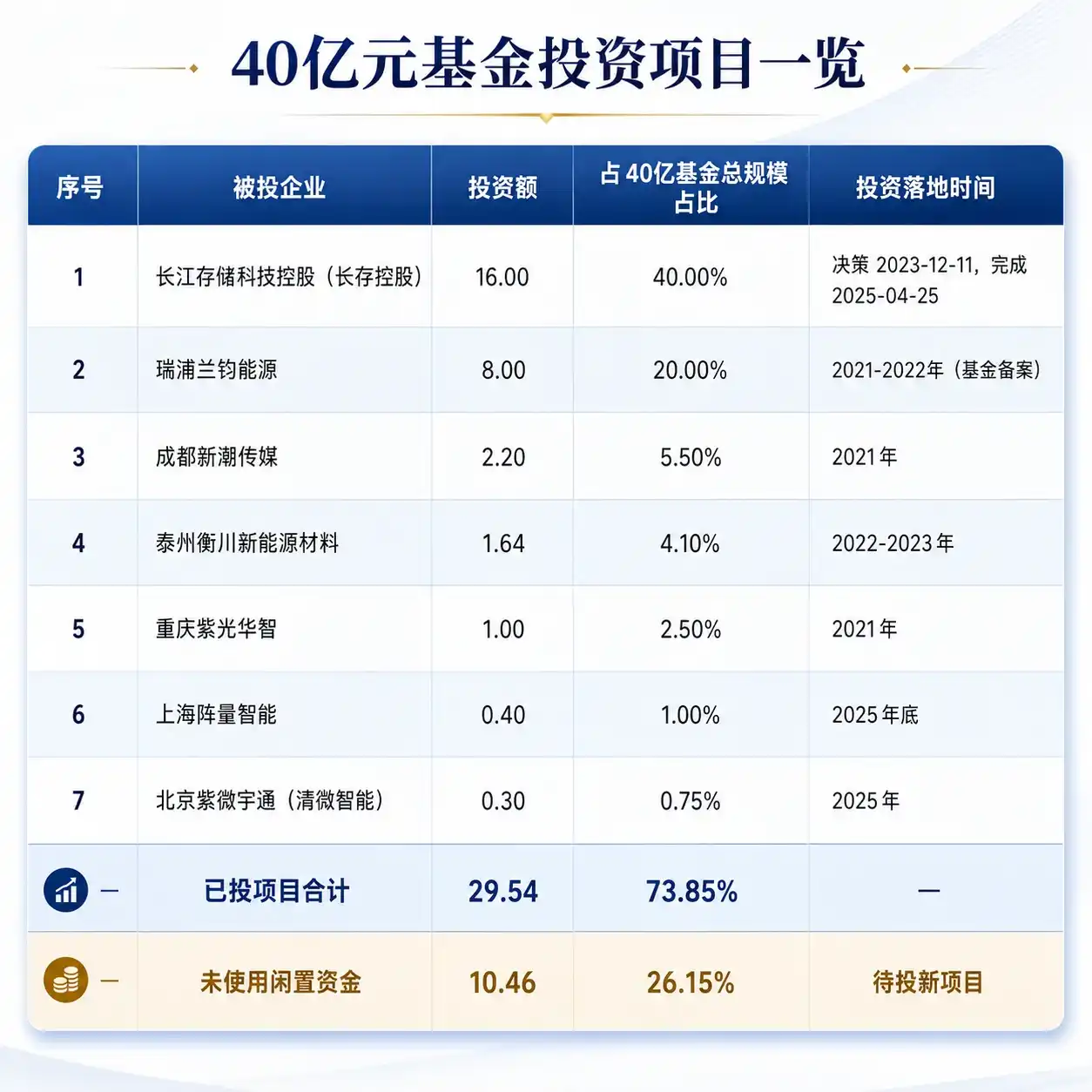
Among its 4-billion-yuan fund, one major investment drew attention: a 1.6-billion-yuan investment completed in April last year into Yangtze Memory Technologies Co., Ltd. (YMTC), acquiring a 0.99% equity stake.

1.6 billion yuan is equivalent to Yangyuan's entire annual profit. Investing the whole amount into a long-cycle industry like memory storage shows the company's boldness.

And YMTC has become hot this year, with reports of a potential domestic IPO and valuations ranging from 500 billion to 1 trillion yuan. Compared to last year's investment valuation, this represents a tripling in value.

If YMTC can successfully list, this single investment will mark the success of Yangyuan's industrial investments.

Because most of the other investments are currently at a floating loss, but Yangyuan has not exited, opting to continue holding long-term.

Among them, an 800-million-yuan investment in REPT Battero, a new energy power battery company, was fully cashed out after its 2023 Hong Kong IPO, realizing a book gain of approximately 241 million HKD.

The acquisition of Xinchao Media by Focus Media was valued at only 8.3 billion yuan, far below the 16.1 billion yuan valuation at the time of investment. Exit has not been executed yet, the fund still holds the equity, and it is currently at a floating loss.

The other AI-related companies are concentrated in areas like AI vision, edge-side AI chips, and GPUs for large model training, forming a relatively complete AI industry chain layout.

What's Next for Yangyuan?

In the coming years, Yangyuan Beverage is unlikely to completely transform into a VC company. Instead, it will likely maintain a dual-wheel model of "consumer main business as the foundation, equity investments for elasticity."

Six Walnuts will still be the company's basic business, but the walnut milk category has passed its high-growth period and will find it difficult to return to its past peak of 10 billion yuan annual revenue.

The 4-billion-yuan Quanhong Fund will remain an industrial fund worth watching.

Yangyuan's future capital will likely continue to flow into the upstream of AI computing power, including hard-tech directions like memory storage, edge-side AI chips, and industrial vision. Non-core tracks like new energy and media will gradually be marginalized.

If YMTC successfully lists, the investment gains could rewrite the income statement in one go, transforming the company's valuation from a traditional beverage stock to a dual pricing of "consumer + hard-tech shadow stock."

Conversely, if YMTC's listing is delayed or the semiconductor cycle turns cold, the stock price could also sharply retreat due to unmet tech expectations.


Трендові криптовалюти

Пов'язані питання

QWhat is the main reason behind Yangyuan Beverage's (parent company of 'Six Walnuts') heavy investment in AI and related industries since 2021?

AThe primary reason is the continuous decline of its core beverage business, 'Six Walnuts.' The company faces shrinking revenues and profits in its main product line, with market share being eroded by alternatives like nut milk and oat milk. Instead of intensifying product R&D, the company has chosen to invest in high-growth, high-imagination sectors like AI to seek new growth drivers and boost its market valuation.

QWhat was the most significant AI/hard tech investment made by Yangyuan Beverage's fund, and what is its current status?

AThe most significant investment was a 1.6 billion RMB injection into Yangtze Memory Technologies Co., Ltd. (YMTC) in April of last year, acquiring a 0.99% stake. YMTC is reportedly planning a domestic IPO with a valuation estimated between 500 billion and 1 trillion RMB. If successful, this investment could triple in value and be a major success for Yangyuan's industrial investment strategy.

QHow has Yangyuan Beverage's stock price performed following its shift towards AI investments, and how does this contrast with the broader market?

AYangyuan Beverage's stock price surged from a low of around 17.7 RMB in early last year to a high of 52 RMB in May, representing a gain of approximately 293% (nearly tripling). This performance starkly contrasts with the broader A-share consumer sector, where many stocks hit yearly lows, making 'Six Walnuts' a standout performer in the market.

QAccording to the article, what is the likely future business model for Yangyuan Beverage?

AThe article suggests Yangyuan Beverage will likely maintain a dual-wheel business model: its traditional consumer beverage business (primarily 'Six Walnuts') as a stable foundation, combined with equity investments (particularly in AI and hard tech via its Quanhong Fund) to seek higher growth and valuation elasticity. It is not expected to transform completely into a venture capital firm.

QWhat are the potential risks for Yangyuan Beverage if its major AI/hard tech investments, like in YMTC, do not meet expectations?

AIf key investments like YMTC face delays in their IPO or if the semiconductor industry cycle turns downward, Yangyuan Beverage could experience a significant drop in its stock price as market expectations for tech-driven growth fail to materialize. This would lead to a sharp valuation correction. The company's financial performance would also be impacted without the anticipated large investment returns to offset the decline in its core beverage business.

Пов'язані матеріали

Warsh Concludes Capitol Hill Visit! A Breakdown: What Did He Say Over These Two Days?

Walsh Concludes Capitol Hill Testimony: Key Takeaways on Independence, Inflation, and AI In his first congressional hearings as Fed Chair, Kevin Walsh faced intense scrutiny over the central bank's independence, internal reforms, and policy transparency. Over two days before House and Senate committees, lawmakers, particularly Democrats, questioned his ties to the Trump administration and recent initiatives like an AI task force led by venture capitalist Marc Andreessen. Walsh staunchly defended the Fed's independence, stating, "Trump selected an independent person to do an independent job," and vowed to ignore political pressure on interest rates. He emphasized a "zero tolerance" approach to inflation, downplaying the significance of a single favorable CPI report and signaling that rate hikes remain an option to restore price stability. He addressed criticism of the Andreessen-led AI working group by clarifying it only has an advisory role. On AI's economic impact, Walsh suggested the investment boom might not be inherently inflationary and could boost productivity and wages over time. Regarding policy, Walsh reiterated his preference to move away from detailed forward guidance, promising all decisions would be released publicly and simultaneously. He framed his internal reform efforts, including five new working groups starting "from a blank slate," as necessary because past Fed policy contributed to current inflation. The hearings ended with a mix of skepticism and a "wait-and-see" attitude from Washington. While Walsh navigated the initial challenge through hawkish rhetoric and debate skills, observers noted his credibility will ultimately depend on concrete actions to fight inflation and safeguard the Fed's autonomy.

marsbit9 хв тому

Warsh Concludes Capitol Hill Visit! A Breakdown: What Did He Say Over These Two Days?

marsbit9 хв тому

Understanding the Q2 Crypto Market in 5 Charts: RWA Booms, Fundamentals Continue to Improve

"5 Charts to Decrypt the Crypto Market in Q2: RWA Explosion and Fundamentals Rebound" In Q2 2026, the crypto market presented a complex picture. While major cryptocurrencies fell 36% in H1, underperforming most major asset classes except gold, crypto-related equities surged 23%, doubling the S&P 500's return. This highlights diverse investment opportunities within the sector, from AI-benefiting miners to Wall Street-linked tokenization platforms. Key takeaways from five crucial charts: 1. **Divergence:** A significant performance gap emerged between crypto assets and publicly traded crypto companies. 2. **Robust Fundamentals:** The top 10 crypto applications generated $5.9B in revenue over the past year, with leaders like PancakeSwap nearing $1B, demonstrating real business traction. 3. **RWA Boom:** Tokenized real-world assets (RWA) reached a record $33B, up 12% QoQ and 45% YTD, fueled by tokenized treasuries, credit, and equities. 4. **Prediction Market Growth:** Prediction market open interest hit a new high of $1.8B, with Q2 volume reaching $43B, driven largely by sports and upcoming political events. 5. **Attractive Correlations:** The Bitwise Crypto Innovators 30 Index showed low or negative 90-day rolling correlations with most major assets (like stocks, bonds, gold), offering potential diversification benefits alongside high returns. Overall, despite bearish price action, the data reveals resilient industry fundamentals with continued growth in users, revenue, and institutional adoption, laying groundwork for future cycles.

marsbit36 хв тому

Understanding the Q2 Crypto Market in 5 Charts: RWA Booms, Fundamentals Continue to Improve

marsbit36 хв тому

Bitcoin's Anti-Spam Data Soft Fork BIP110: Miner Collective Boycott, Already Doomed to Fail?

The article discusses the controversial Bitcoin Improvement Proposal (BIP) 110, a "data reduction" soft fork aimed at limiting non-monetary data, such as certain scripts, within Bitcoin transactions. Proponents argue this data violates network principles, but the author strongly disagrees. The core argument is that Bitcoin's fundamental value lies in its open-access, censorship-resistant ledger. Anyone can write data by paying fees, and attempting to police how data is interpreted externally is both impossible and contrary to Bitcoin's ethos. The author compares this to free speech and notes that Bitcoin's existing protocol limits (block size, sigops) already manage network load effectively, even spurring layer-2 innovation. Technically, BIP110 would impose significant new restrictions on script size, Taproot features, and upgradability, applying to UTXOs created within about a year of activation. Its deployment mechanism is criticized for having an unusually low 55% miner signaling threshold and a forced activation timeline, representing the most aggressive script limitations since 2010. The author finds the rationale weak, stating the "problem" it addresses is already managed, and the fork's rushed process ignores broader ecosystem consensus. Importantly, they note that users of so-called unwanted data have already adapted their software to work around the proposed rules. The conclusion is that BIP110 is destined to fail. It attempts the impossible—controlling how an open ledger is used—based on flawed reasoning and via a reckless process. The article reports that miners, developers, and the broader community have rejected it, and Bitcoin will emerge stronger by continuing its normal operation without this change.

marsbit49 хв тому

Bitcoin's Anti-Spam Data Soft Fork BIP110: Miner Collective Boycott, Already Doomed to Fail?

marsbit49 хв тому

Breaking the Offer Price! SpaceX's Stock Price Falls Below the $135 IPO Price for the First Time, Company Bonds Decline Continuously, Yield Reaches 7.5%, Comparable to Junk Bonds

SpaceX's stock price fell below its $135 IPO price for the first time, trading as low as $132.15 before closing slightly above the offering price. The stock has experienced high volatility typical of new listings, surrendering nearly all its initial 50% surge. Compounding equity pressures, the company's newly issued $25 billion bond due 2056 has also declined in price, pushing its yield to a junk-bond-like 7.5%. Analysts note investor skepticism is growing regarding the costs and distant timeline of SpaceX's xAI and large infrastructure ambitions. A significant 20% of the IPO's $75 billion raise went to retail investors, making the price decline a notable blow to market confidence. Further downside risk looms as lock-up periods for early investors expire soon, potentially triggering significant selling pressure alongside the company's first quarterly earnings report. Initial upward momentum was partly fueled by an estimated $5.4 billion in mandatory buying from index funds after SpaceX's rapid inclusion in major indices like the Nasdaq 100. Despite the current weakness, Wall Street sentiment remains broadly positive. With bank analyst quiet periods ending, over 80% of coverage initiates with a "Buy" rating, and the average price target implies roughly 78% upside from current levels.

链捕手1 год тому

Breaking the Offer Price! SpaceX's Stock Price Falls Below the $135 IPO Price for the First Time, Company Bonds Decline Continuously, Yield Reaches 7.5%, Comparable to Junk Bonds

链捕手1 год тому

Торгівля

Спот

Популярні статті

Як купити ONE

Ласкаво просимо до HTX.com! Ми зробили покупку Harmony (ONE) простою та зручною. Дотримуйтесь нашої покрокової інструкції, щоб розпочати свою криптовалютну подорож.Крок 1: Створіть обліковий запис на HTXВикористовуйте свою електронну пошту або номер телефону, щоб зареєструвати обліковий запис на HTX безплатно. Пройдіть безпроблемну реєстрацію й отримайте доступ до всіх функцій.ЗареєструватисьКрок 2: Перейдіть до розділу Купити крипту і виберіть спосіб оплатиКредитна/дебетова картка: використовуйте вашу картку Visa або Mastercard, щоб миттєво купити Harmony (ONE).Баланс: використовуйте кошти з балансу вашого рахунку HTX для безперешкодної торгівлі.Треті особи: ми додали популярні способи оплати, такі як Google Pay та Apple Pay, щоб підвищити зручність.P2P: Торгуйте безпосередньо з іншими користувачами на HTX.Позабіржова торгівля (OTC): ми пропонуємо індивідуальні послуги та конкурентні обмінні курси для трейдерів.Крок 3: Зберігайте свої Harmony (ONE)Після придбання Harmony (ONE) збережіть його у своєму обліковому записі на HTX. Крім того, ви можете відправити його в інше місце за допомогою блокчейн-переказу або використовувати його для торгівлі іншими криптовалютами.Крок 4: Торгівля Harmony (ONE)Легко торгуйте Harmony (ONE) на спотовому ринку HTX. Просто увійдіть до свого облікового запису, виберіть торгову пару, укладайте угоди та спостерігайте за ними в режимі реального часу. Ми пропонуємо зручний досвід як для початківців, так і для досвідчених трейдерів.

377 переглядів усьогоОпубліковано 2024.12.12Оновлено 2026.06.02

Як купити ONE

Обговорення

Ласкаво просимо до спільноти HTX. Тут ви можете бути в курсі останніх подій розвитку платформи та отримати доступ до професійної ринкової інформації. Нижче представлені думки користувачів щодо ціни ONE (ONE).

活动图片