$SIREN, a token that launched during the "Broccoli" era of guessing CZ's dog's name on Binance Alpha and futures, has almost been forgotten.
But just two days ago, when the internet was abuzz with its "surge," the token's liquidation volume across the network ranked fourth, just behind Bitcoin, ETH, and XAU, with approximately $23.25 million. If it weren't for Trump's TACO boosting gold's volatility, SIREN would have been third.
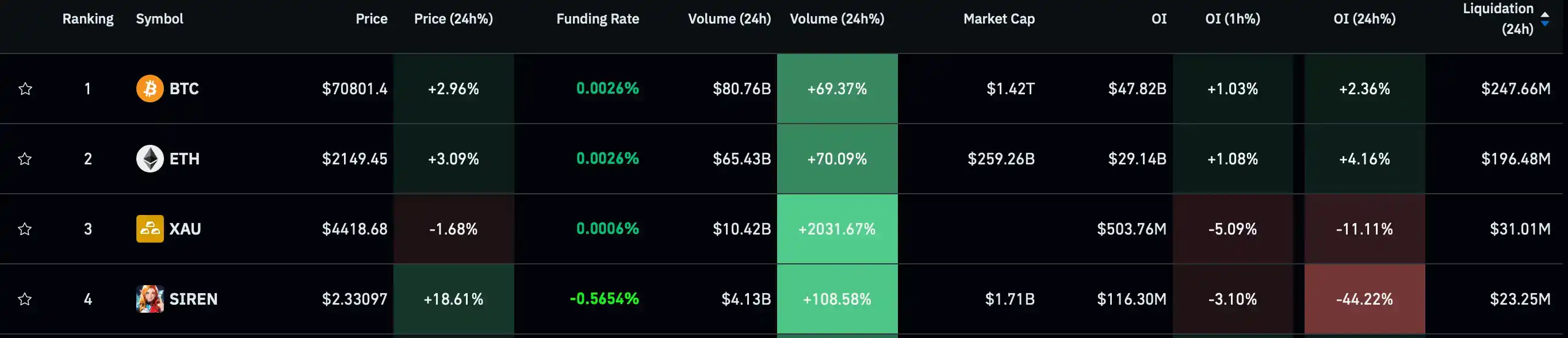
The token's price once approached $5, corresponding to a market cap of about $3.675 billion, briefly squeezing into the top 30 of the total cryptocurrency market cap rankings, surpassing established tokens like OKB and UNI.
In a sluggish market, this is not the first time we've seen such a phenomenon. $PIPPIN, $RIVER, $BEAT, $MYX... By examining the questions surrounding $SIREN, what lessons can we draw from these similar situations?
Are "Leverage Scams" Predictable?
As early as March 5, @c_ckoko posted a tweet pointing out, "$SIREN is clearly under absolute control of holdings; this is a cross-exchange method to harvest users."
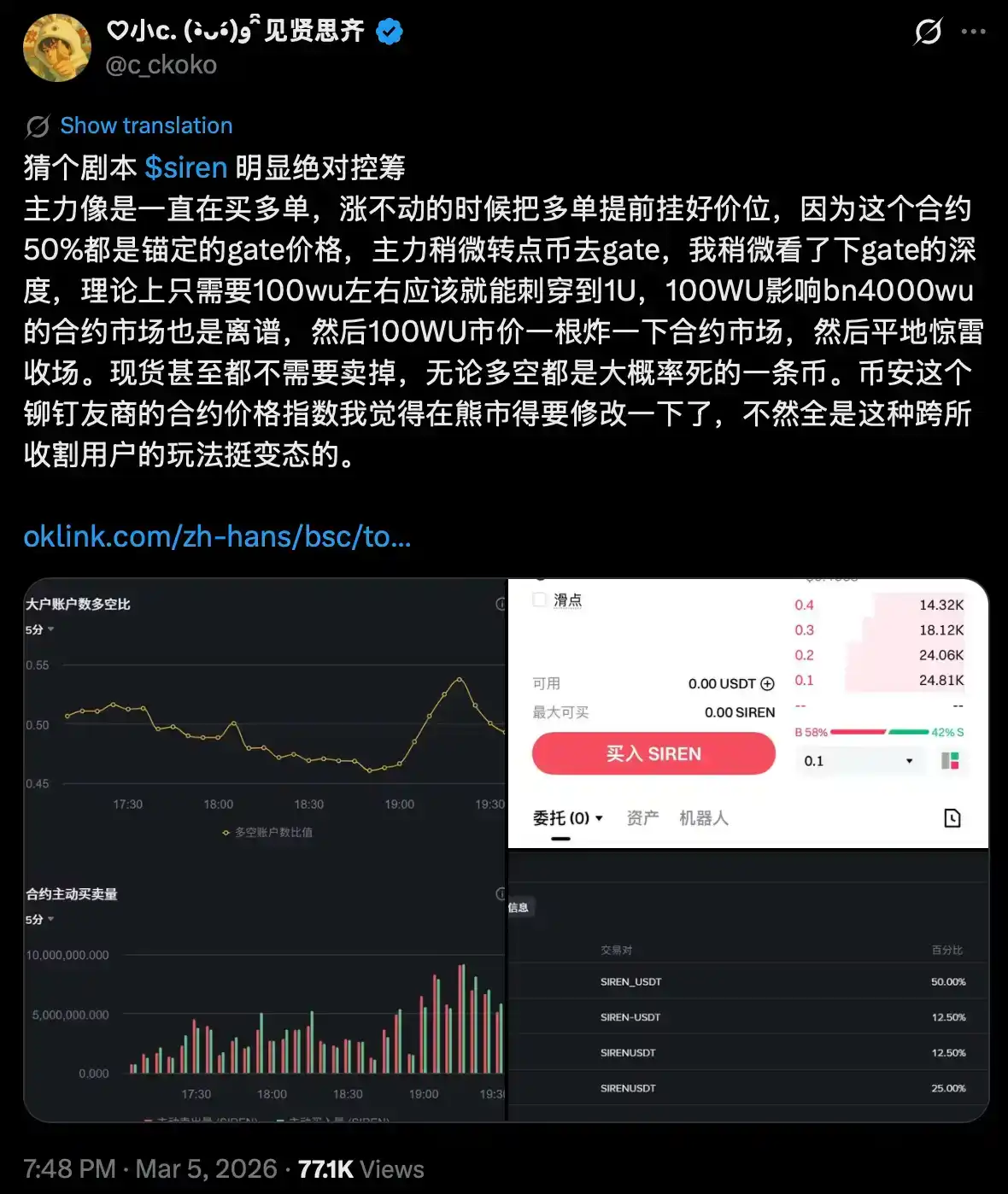
His tweet well explains how this "leverage scam" operates: the poor spot liquidity on exchanges allows for creating large fluctuations with small amounts of capital, which then affects the Binance futures price for harvesting.
Moreover, as suggested at the end of his tweet, the $SIREN futures price index was adjusted. When he posted the tweet, the weightings for the $SIREN Binance futures price index were: Gate spot 50%, Kucoin spot 12.5%, Binance futures 12.5%, and Binance Alpha 25%. After that, following two adjustments, the current futures price index weightings are: Gate spot 25%, Kucoin spot 12.5%, Binance futures 12.5%, and Binance Alpha 50%.
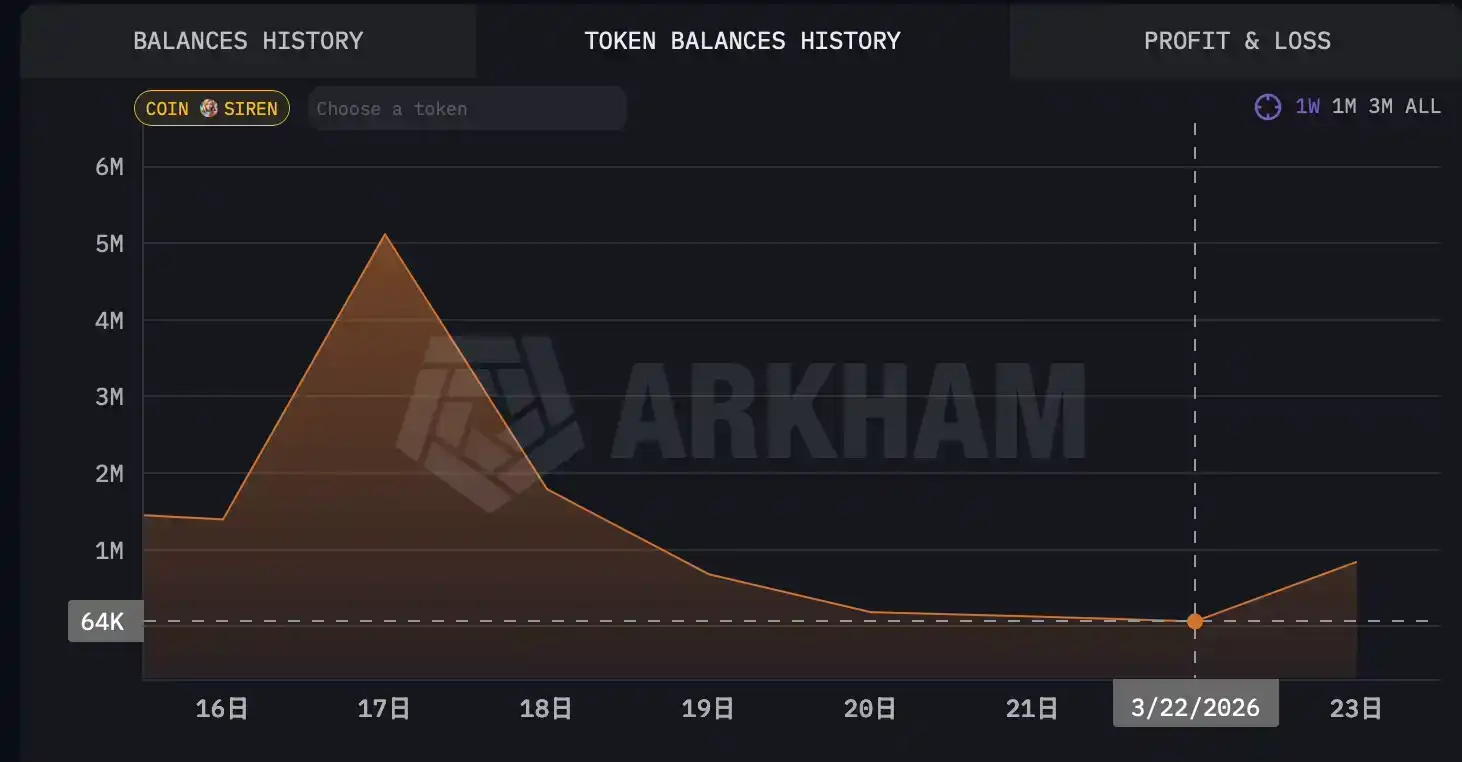
According to Arkham data, Gate's $SIREN holdings on March 22 were only 64,000 tokens.
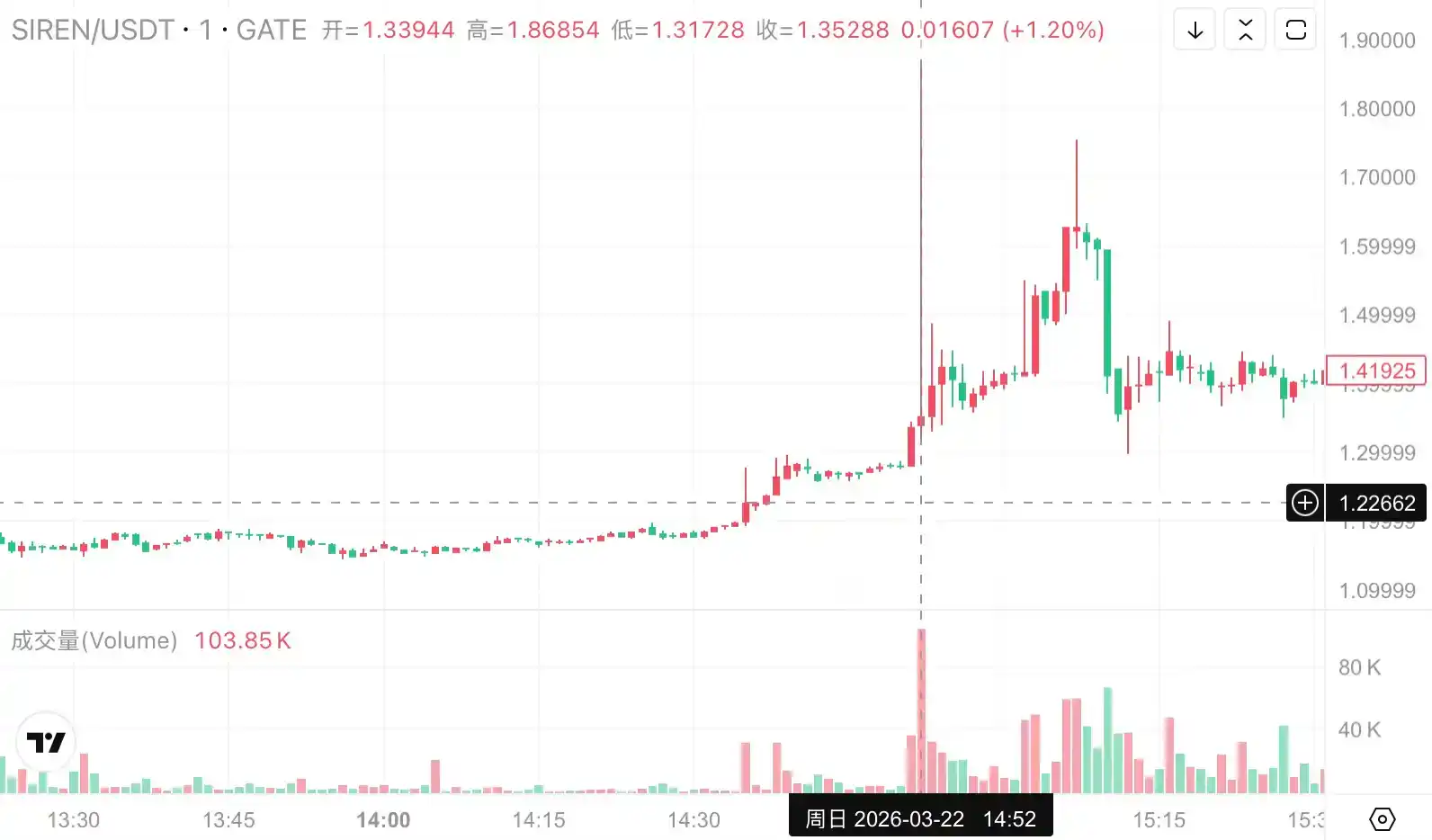
In this situation, a trading volume of $100,000 could create a minute-level candle with nearly a 40% fluctuation.
Looking at the open interest, $SIREN showed obvious abnormalities starting from February 8. The open interest, which had long hovered between $3-5 million, suddenly surged to $58.83 million.
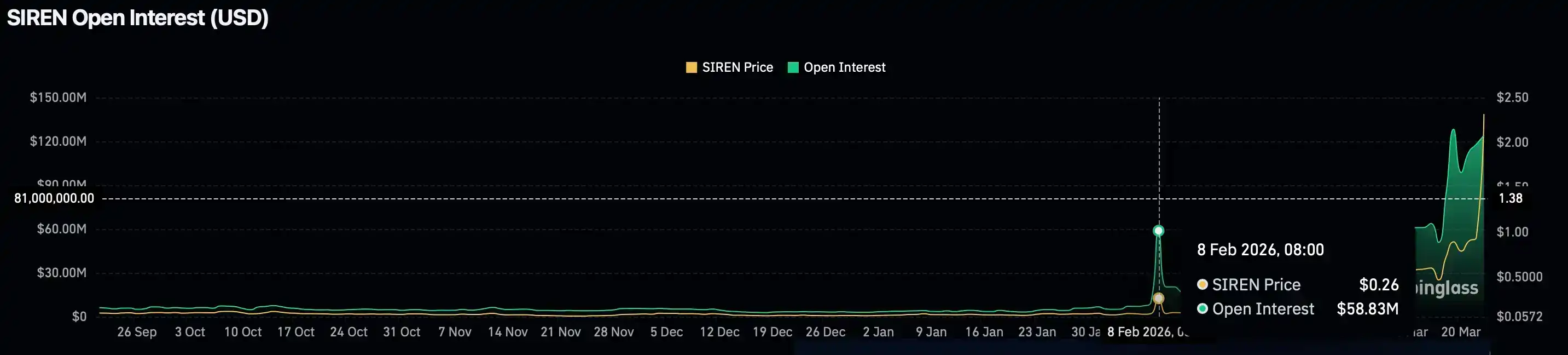
Of course, abnormal signs do not necessarily lead to a specific inevitable outcome. After all, the chips are in the hands of the controlling whales, and we cannot be sure how they will execute.
Methods
First, control of holdings: hoarding a large amount of spot tokens, also opening large long positions, pushing the price very high.
On-chain analyst Ember (@EmberCN) compiled the control situation of $SIREN and found that, just from on-chain data, the $SIREN controlled by the whale amounts to 88.5%. If including the portions deposited by the whale into CEXs, this number would be even higher.
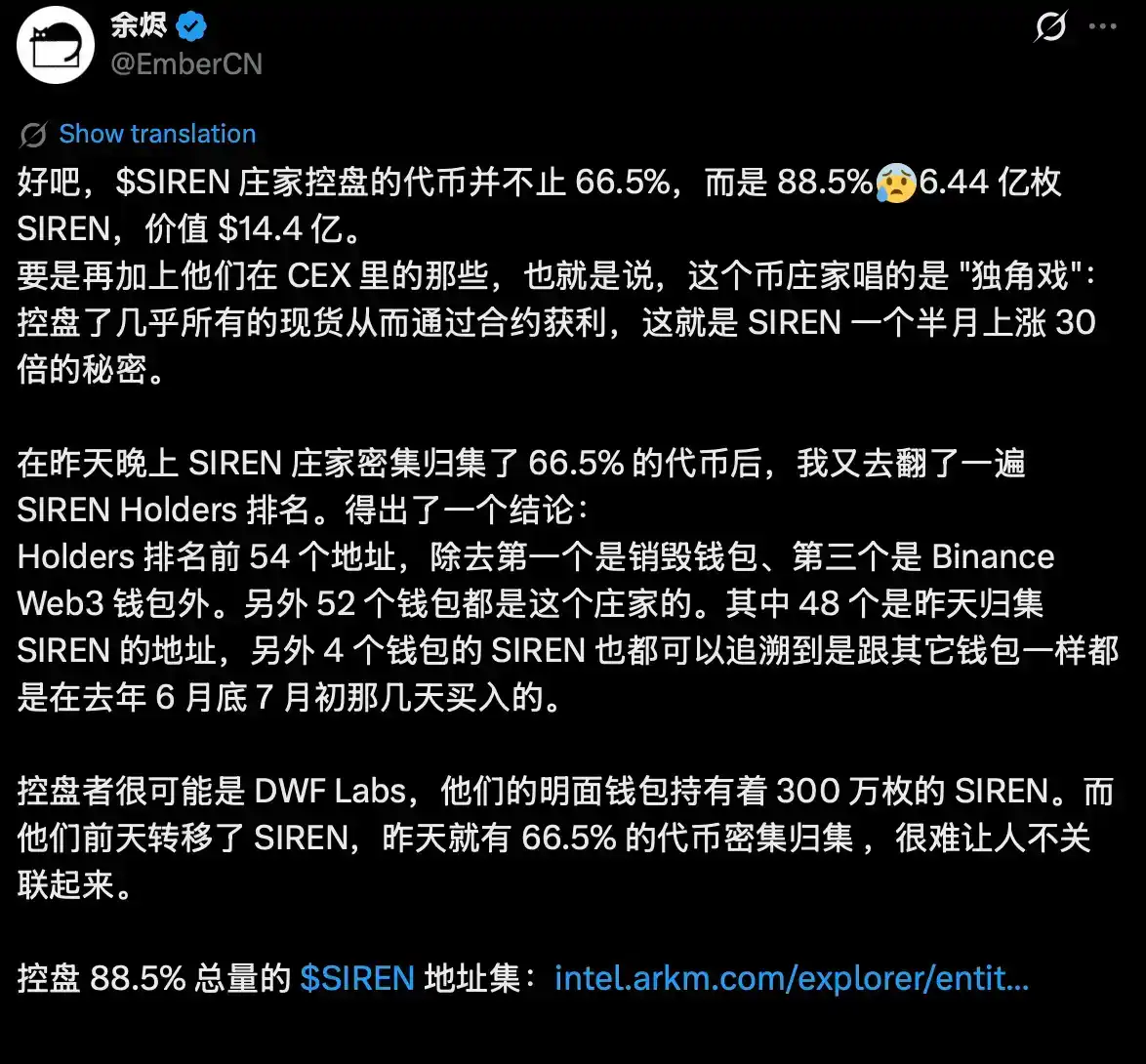
The above tweet also pointed out that DWF Labs might be the controller in this event, but DWF Labs co-founder Zac denied this claim in a group chat.
After pushing the price high, the whale lures in short sellers, laying down short positions to make retail investors think the阶段性 top is coming.
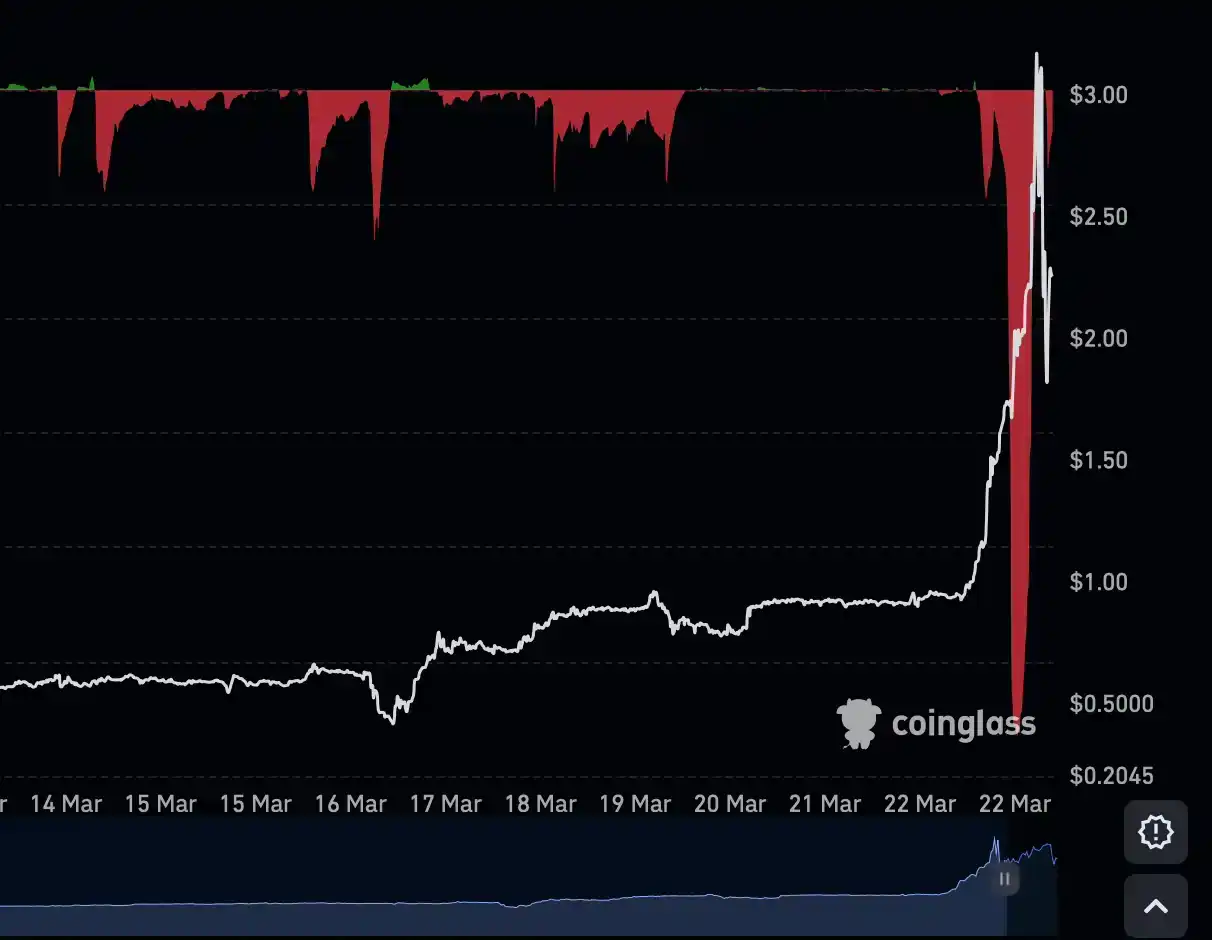
From the funding rate chart above, it can be seen that starting from March 14, $SIREN frequently had high negative funding rates. Short sellers continuously paid funding to the whale's long positions, and the whale used these "free" funds to continue pushing the price higher. In the early hours of March 23, another violent fluctuation of 78% occurred on Gate spot within 10 minutes, corresponding to a trading volume of only about $450,000. The price of $SIREN rose from $2.75 to nearly $5. This means many people were liquidated.
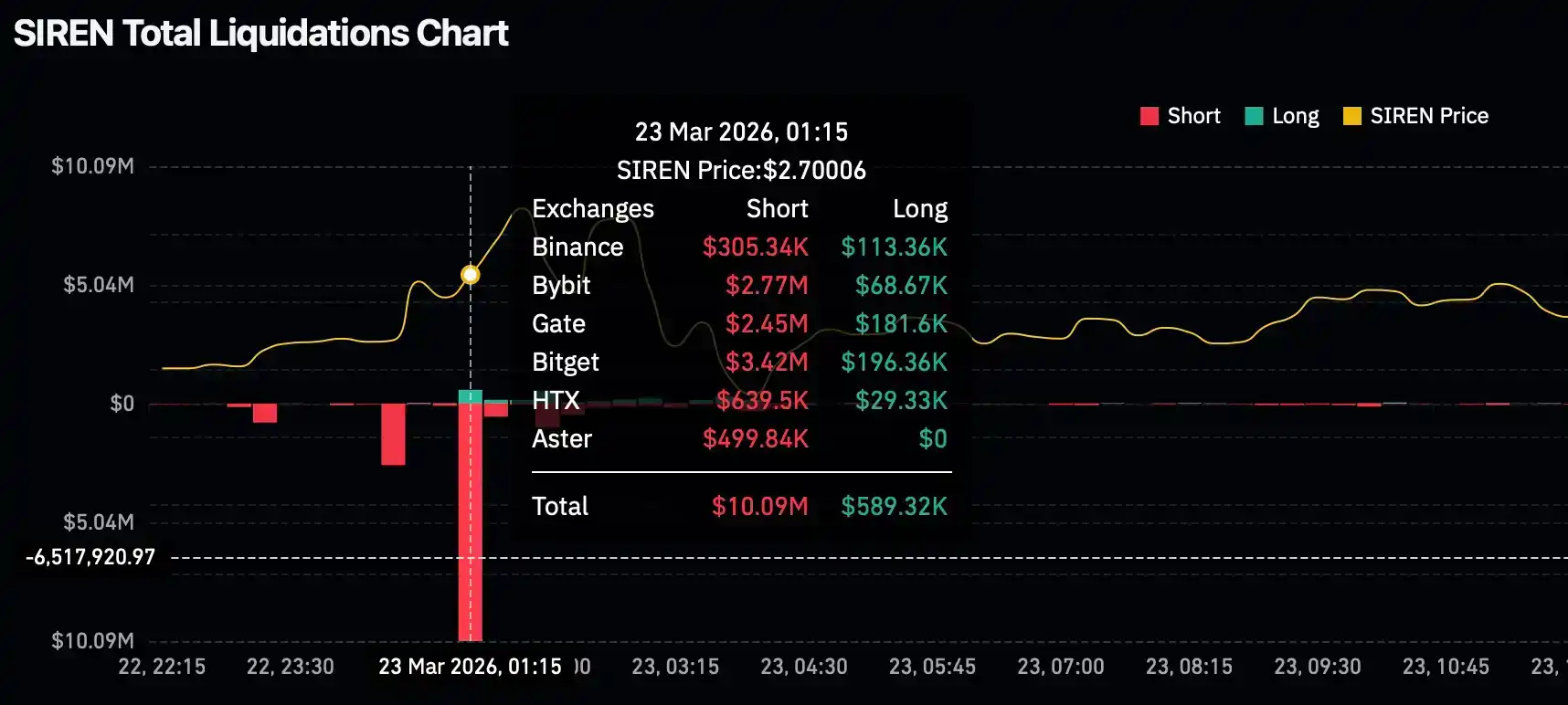
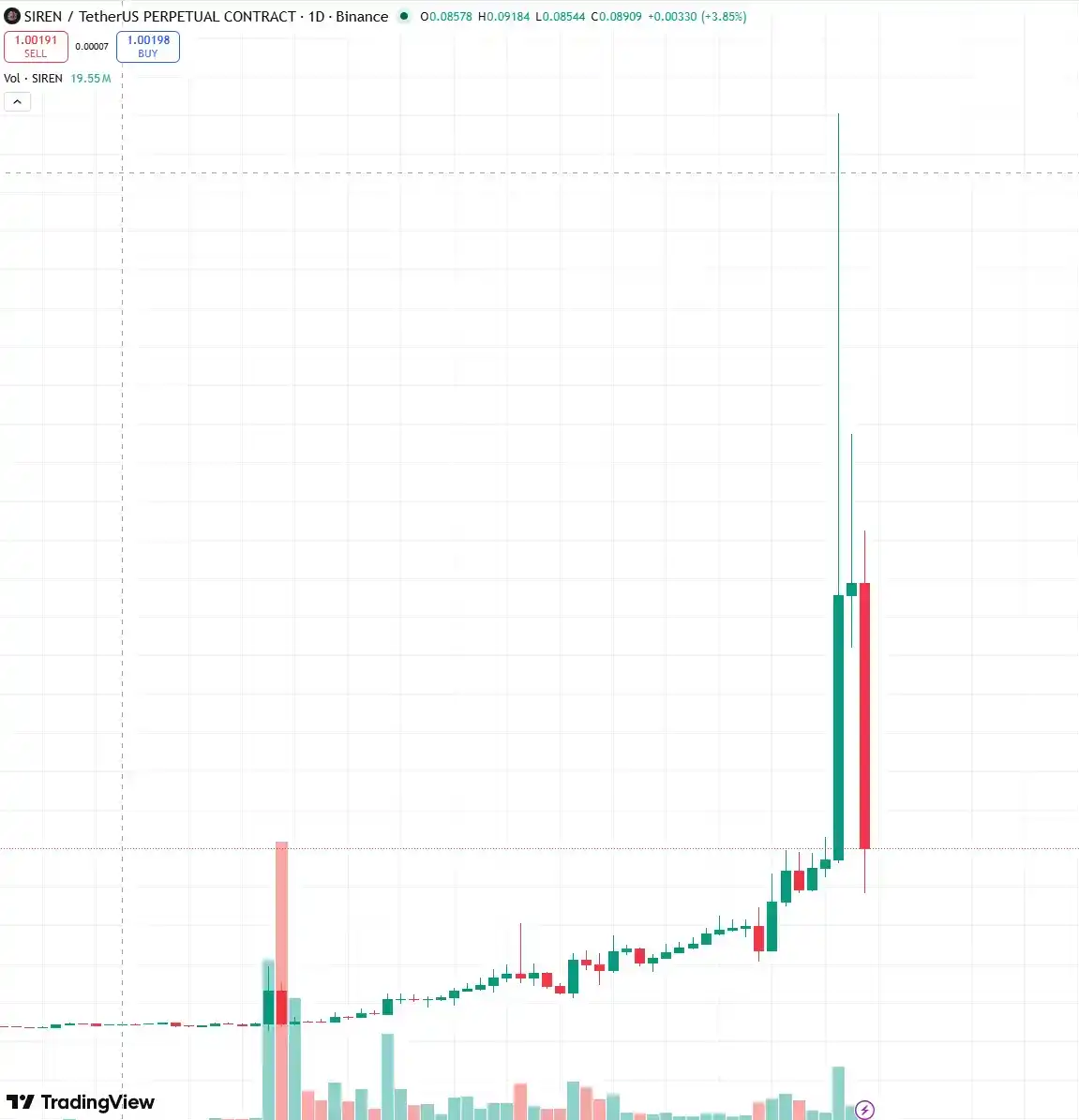
At this point, $SIREN might not be over yet. Because,刻舟求剑地来看, the whale could next close the long positions, dump the spot tokens, creating a huge bearish candle, and then close the short positions at a cost far lower than the opening price. Comparing the trends of $RIVER, $POWER, and $BEAT with $SIREN in one chart, it seems that $SIREN is still missing the final net closing.
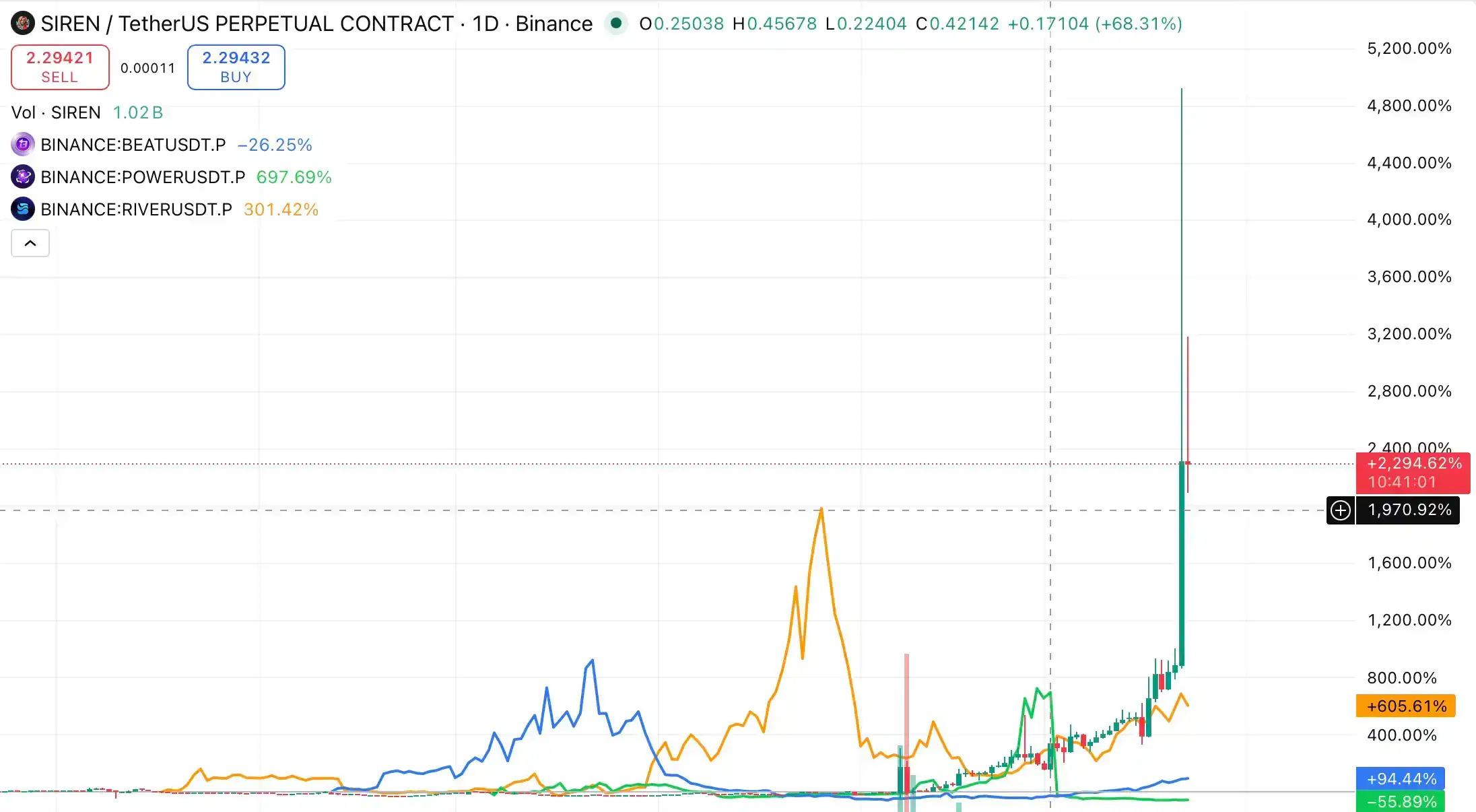
By the time this article was about to be published, the above speculation was confirmed:
Conclusion
Regardless of whether the current market is sluggish, the emergence of such harvesting schemes is always bad. Admittedly, some trading experts can get a share of the whale's soup amidst the information fog, but for the vast majority of retail investors, it is nothing more than an utterly unfair gamble.
When such a blatant harvesting scheme once appeared in the top 30 of the cryptocurrency market cap, I can only sigh.