Single Post with 150 Million Views: Dan Koe and His Super Individual Business

marsbitОпубліковано о 2026-01-19Востаннє оновлено о 2026-01-19

Анотація

Dan Koe, a prominent figure in the "one-person business" space, recently achieved 1.5 billion views on X with a post titled "How to fix your entire life in 1 day." Despite the massive reach, he earned only $4,495 from the platform in two weeks. His real income comes from his broader business: Koe made over $4 million in 2024 through paid newsletters, books, and digital products aimed at teaching people how to build personal brands and escape traditional employment. His success is built on years of content creation, a large following (750k on X, 1.2M YouTube subscribers), and a trusted brand. The viral post served as a top-of-funnel tool to attract potential customers into his paid ecosystem, rather than a direct revenue source. The "super individual" trend reflects a growing desire for self-directed work, but the market is increasingly crowded. While AI tools allow easy imitation of high-engagement content, established creators like Koe retain advantage through authenticity and timing. X's recent push for long-form content, including a $1M incentive program, benefits top creators most, reinforcing a cycle where platforms and influencers mutually profit—while most followers remain consumers, not successful creators.

Author: Curry, Deep Tide TechFlow

What was the hottest article on X last week?

"How to fix your entire life in 1 day." Fix your entire life in one day.

Author Dan Koe, an American, creates content about "super individuals," teaching people how to not work a 9-to-5 job and make a living by writing. A week after its release, this article had already reached 150 million views.
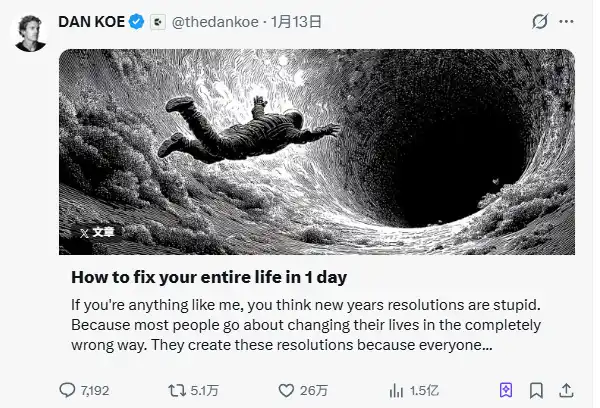
What does 150 million mean? X has just over 600 million monthly active users globally, meaning one in every four users has come across this article.

Some wondered how much money this could make. Dan Koe shared a screenshot of his earnings: in 14 days, X platform paid him $4,495.

150 million views, $4,495. But Dan Koe actually earned over $4 million last year.

The money clearly doesn't come from platform revenue sharing.

You must have seen the term "super individual."

It generally means you don't need to work a job or have a team; you just need to turn your ideas and creativity into content posted online to attract a group of people who resonate with you, and then sell courses to them. In the U.S., this is called a One-Person Business.

Dan Koe is a top player in this field. He has 750,000 X followers, 1.2 million YouTube subscribers, and an email list of 170,000 people.

His story is also standard. He studied design in college, worked as a freelancer after graduation, tried e-commerce, and lost money. He started writing on Twitter in 2019, but no one read it. He persisted for two years before gaining traction.

These experiences are part of the content itself. Failure, struggle, persistence, and triumph—you can see this narrative structure in any successful self-help blogger.

Li Xiaolai talked about it, Luo Zhenyu talked about it, Fan Deng talked about it.

Americans package it as Philosophy and Productivity; Chinese package it as "cognitive upgrade." The skeleton is the same.

How does Dan Koe make money?

Open his official website, and you'll see several types of products: paid newsletter subscriptions, two books ("The Art of Focus" and "Purpose & Profit"), and an AI tool he co-founded called Eden.
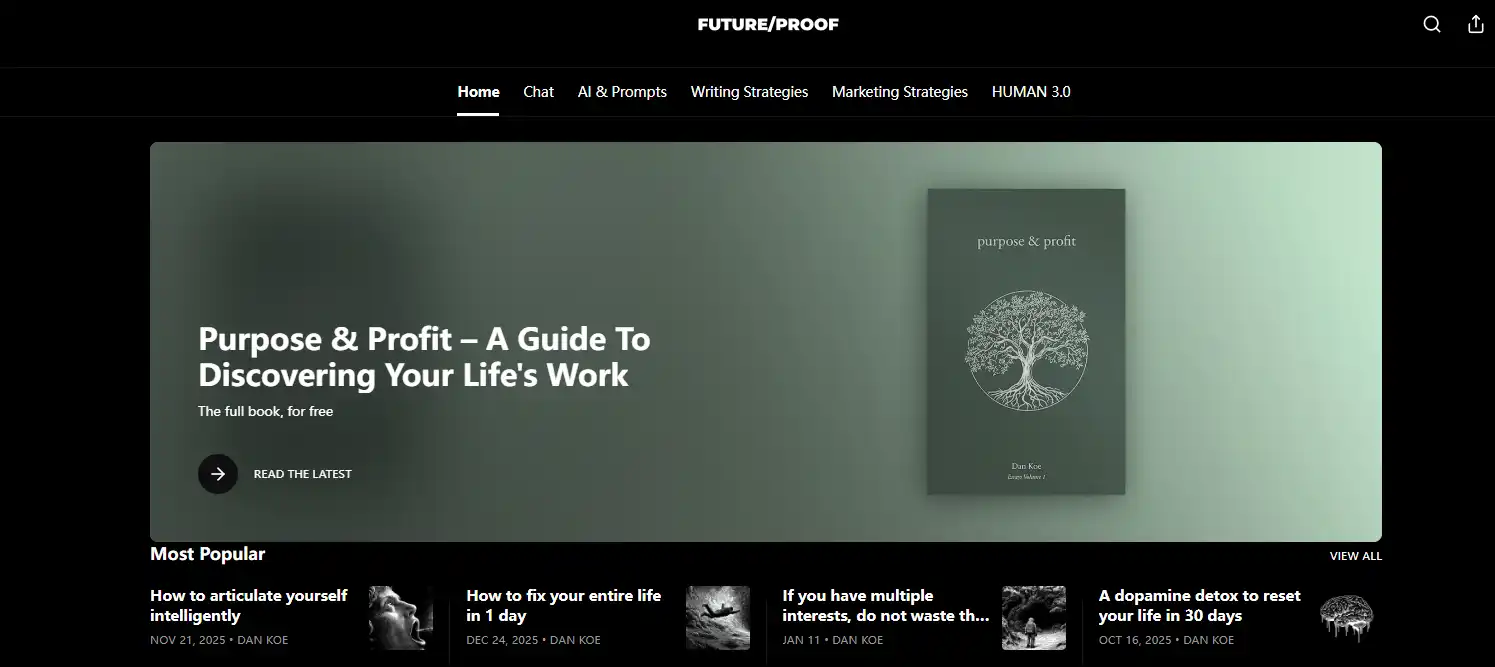
He used to sell writing courses and membership communities, but they are no longer visible on the official website. They might have been taken down or merged into the paid subscriptions.

I couldn't find official pricing data, but the logic of such products is generally similar:

Free content filters out those willing to pay; low-priced products filter out those willing to pay more.

How much does he earn? In 2023, he posted on Twitter that his income that year was $2.5 million. In a 2024 interview with the subscription software beehiiv, Dan also revealed that he earns over $4 million annually.

But given his follower size, it's not far-fetched. With nearly 200,000 email subscribers and millions of YouTube fans, assuming 5% have purchased paid products, that's nearly 50,000 paying users.

So what is the 150 million views to him?

A traffic entry point at the top of the funnel. The $4,495 platform share on X is pocket change; what's more important is increasing his brand recognition and reach. The real money comes from those willing to pay later.

You might ask, who is buying these things?

The answer is undoubtedly those who want to become the next Dan Koe.

The goal of such course participants is basically to "build a personal brand," "monetize self-media," and "escape the 9-to-5 grind." What they pay to learn is exactly what Dan Koe is doing.

For this model to work, there is one prerequisite: there are always new people wanting to join.

Just like gym memberships always surge at the beginning of the year, the "super individual"赛道 always has people who believe they can become the next top player. Dan Koe published that article on January 12, right when New Year's resolutions are strongest.

The title is "How to fix your entire life in 1 day." What do you think people clicking on it are thinking?

Meanwhile, X is also betting on it.

On January 16, a few days after Dan Koe's article went viral, X announced a new policy: the creator revenue pool doubled, long-form article权重 increased, and an additional $1 million reward for the best-performing original articles.
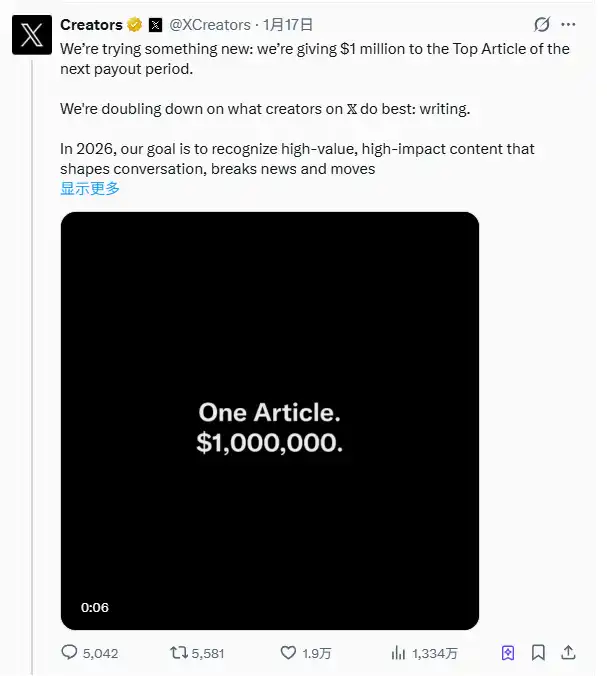
What Musk wants to do is obvious. TikTok has cut everyone's attention into 15-second碎片; X wants to go the opposite way, using long-form content to retain users. Dan Koe wrote a comment大意 saying that short videos are刷得太狠了, and now the internet has a chance to swing back.

X loves to hear that.

But what can $1 million buy?

Search on X, and you'll already find a lot of imitators. Various AI skill tutorials and inspirational articles are emerging, such as "How to change your life in 2026," "The one skill you need," "Why most people will never succeed"...

The structure is the same, the image style is the same as Dan's viral post, and even the "I'm here to tell you the truth" tone is the same.

This writing style has even become a meme,引得大家争相模仿和尝试.

It's not surprising. Dan Koe himself said he uses AI to assist写作, by having AI interview himself, extract ideas, and then format them into highly传播 content structures.

Anyone can learn this method. ChatGPT can generate a "life-changing" long article in ten minutes, with correct grammar, complete structure, and even automatically add a few psychological terms to appear profound.

But it's Dan Koe who went viral, not the imitators.

Why?

One explanation is that trust takes time. Dan Koe has been writing for six years, has real failure experiences, and has a traceable growth trajectory. AI can imitate his sentence structure, but it can't replicate these.

Another explanation is that the super individual赛道 is too crowded.

When everyone is teaching "how to become a super individual," whether it's about AI tools, guide to success, life fixes, or business insights, attention concentrates at the top. Those who enter early eat the meat, those who come later drink the soup, and those even later get nothing.

Another explanation is luck. Dan Koe hit the window of X's algorithm adjustment, the New Year emotional cycle, and the policy tailwind of Musk pushing long-form content. Three things叠加 together, and 150 million views happened.

Change the person, change the timing, the same quality article might only get 1.5 million views.

An interesting point is that Dan Koe's article was published a few days too early and is not eligible for X's $1 million content reward selection.

But he doesn't care. His business model doesn't rely on platform revenue sharing. The 150 million views have already fulfilled their mission:让更多人知道 Dan Koe 这个名字,让漏斗顶端灌进去更多的人.

So who will X's $1 million eventually go to? According to the rules, it must be original long-form articles, at least 1000 words, calculated based on the首页展示量 of paying users.

Translation: you not only have to write well, but you also need to already have a large number of fans.

So most likely, the top players will take it.

This is the structure of the game. The platform needs top creators to prove that "long-form content has a future"; top creators need platform traffic to feed their funnel; AI allows everyone to mass-produce "life-changing" content, but only a very few can actually make money from it.

What is the role of most people?

Readers.

After reading a "How to fix your entire life in 1 day," feeling inspired to become a super individual, then sharing, liking, bookmarking it, and continuing to scroll to the next one.


Пов'язані питання

QWhat was the title of Dan Koe's viral article on X and how many views did it achieve?

AThe title was 'How to fix your entire life in 1 day' and it achieved 150 million views.

QHow much revenue did Dan Koe generate from X platform's ad share for that viral article, and what was his actual annual income in 2024?

AHe earned $4,495 from X's ad share for the article, but his actual annual income in 2024 was over $4 million.

QWhat is the core business model of a 'super individual' or 'one-person business' as described in the article?

AThe core model involves creating content to build a personal brand, attracting an audience, and monetizing through selling courses, subscriptions, books, or tools to followers who want to achieve similar success.

QHow did X platform's policy change shortly after Dan Koe's article went viral, and what was its goal?

AX announced a new policy that doubled the creator earnings pool, increased the weight of long-form articles, and allocated an additional $1 million to reward the best-performing original articles, aiming to promote long-content and retain users.

QWhy did Dan Koe's article succeed despite many AI-generated imitations, according to the analysis?

AHis success is attributed to six years of building trust through authentic experiences and a track record, timing with X's algorithm changes and New Year resolutions, and the 'winner-takes-most' effect in the crowded super-individual niche.

Пов'язані матеріали

From a $300 Million Valuation to a 'Fire Sale' at Tens of Millions: What Happened to Messari?

On June 12, leading crypto data and capital markets platform Blockworks announced its acquisition of competitor Messari for over $10 million. This price represents a significant discount from Messari's 2022 valuation peak of approximately $300 million, highlighting the survival pressures faced by high-valuation startups during the bear market and a consolidation wave in data infrastructure. Blockworks, founded in 2018, began as a media and events company but has pivoted to focus on institutional-grade data, investor relations, and compliance tools. Its recent Series A extension round, valuing the company at $192 million, aimed to fund this shift and strategic acquisitions like this one. Messari, also founded in 2018, grew as a go-to platform for professional crypto research and data, raising a $35 million Series B at its $300 million valuation in late 2022. However, the prolonged bear market and subsequent internal changes, including founder Ryan Selkis's departure in 2024, increased operational pressures. The acquisition integrates Messari's extensive data platform and API capabilities with Blockworks's strengths in issuer-side disclosure, investor relations, and compliance workflows. The combined entity aims to build a unified "system of record" for the on-chain market. This reflects a broader industry trend where high-quality, structured data is becoming critical for institutional adoption, AI agents, and creating data moats akin to traditional financial platforms like Bloomberg. The deal exemplifies how market consolidation is reshaping the fragmented crypto data landscape.

marsbit2 хв тому

From a $300 Million Valuation to a 'Fire Sale' at Tens of Millions: What Happened to Messari?

marsbit2 хв тому

If the AI Bubble Is Already Bursting, Who Will Truly Survive?

If the AI Bubble is Bursting, Who Will Remain? The debate over an AI bubble is intensifying, with figures like Ray Dalio warning of high levels and Jensen Huang seeing immense, early-stage opportunity. Both views hold truth: a speculative bubble in capital markets likely exists, mirroring the dot-com era, but the underlying technological shift is real and transformative. History shows that while bubbles burst—wiping out overvalued companies and speculative capital—they often leave behind critical physical and digital infrastructure. The dot-com bust, for instance, eliminated many firms but left the global fiber optic networks and data centers that enabled the rise of Amazon, Netflix, and cloud computing. Today's massive AI infrastructure investments (projected at trillions by 2030) in data centers, power, cooling, and GPUs may follow a similar path, creating the foundation for future applications. A key divergence from past bubbles is the "Jevons Paradox" effect in AI. As the cost of AI inference has plummeted by over 99.7% since 2023, enterprise spending on AI has skyrocketed. Cheap "tokens" have unlocked vast, previously uneconomical use cases, moving AI from simple chatbots into core business workflows—code generation, legal document review, scientific simulation, and financial analysis. The market is now in a phase of self-correction, weeding out superficial "API-wrapper" startups, but this cleansing process strengthens the ecosystem. The long-term trajectory is clear. The value is gradually shifting from capital expenditure (CapEx) on hardware to operational expenditure (OpEx) on transformative applications. As AI becomes a utility, the winners will be firms that deeply integrate it to solve vertical industry problems in law, healthcare, finance, and manufacturing. The泡沫 will recede, but the foundational shift towards an AI-powered era across all sectors is irreversible. The underlying productive force of AI contains no bubble.

marsbit34 хв тому

If the AI Bubble Is Already Bursting, Who Will Truly Survive?

marsbit34 хв тому

If the AI Bubble Is Already Bursting, Who Will Truly Remain?

**Summary: If the AI Bubble is Bursting, What Will Remain?** The debate around an AI bubble is intensifying, with figures like Ray Dalio warning of high valuations while Jensen Huang sees immense opportunity. This echoes the dot-com bubble, which saw massive wealth destruction but ultimately left behind critical infrastructure like undersea cables and broadband, enabling future giants like Amazon and Netflix. Similarly, today's AI boom involves trillions invested in data centers, power, cooling, and GPUs, while application-layer revenue remains comparatively modest. This investment-disparity signals a bubble. However, the core technological progress is real and accelerating. AI inference costs have plummeted by over 99.7% since 2023, making intelligence increasingly cheap and accessible. This cost collapse is unlocking vast new demand. Instead of reducing spending, enterprises are tripling their AI cloud expenditure. Cheap "tokens" enable AI to move beyond simple chatbots into complex workflows—automating code writing, legal document review, financial analysis, and scientific research. This follows "Jevons's paradox": improved efficiency leads to greater total consumption. The market is now undergoing a necessary purification, weeding out "API-wrapper" startups with no real moat. The deeper evolution involves a shift from capital expenditure (CapEx) on infrastructure to operational expenditure (OpEx) on value-creation in applications. While hardware vendors currently profit most, long-term value will migrate to AI-native firms solving vertical industry problems. Ultimately, a market correction will cleanse speculative excess but will not reverse the AI+ trend. The massive physical and algorithmic infrastructure being built will endure, becoming a cheap, utility-like foundation. Just as the internet became indispensable to all industries post-2000, AI is poised to empower and redefine every sector, moving society irreversibly toward an intelligence-augmented era. The bubble may burst, but the underlying productive momentum is solid.

链捕手41 хв тому

If the AI Bubble Is Already Bursting, Who Will Truly Remain?

链捕手41 хв тому

Microsoft CEO: In the AI Era, How Do You Define a Company's Moat?

Microsoft CEO Satya Nadella argues that in the AI era, a company's true competitive edge, or "moat," is not determined by choosing the single most powerful model, but by its ability to build a continuous "learning loop." This system integrates and evolves by connecting human workflows, domain expertise, organizational judgment, and employee experience. He posits that future companies will accumulate two types of capital: Human Capital (employee knowledge, judgment, creativity) and "Token Capital" (a firm's own built and owned AI capabilities). Importantly, AI amplifies rather than devalues human capital. Human direction is essential to guide progress, as computational power alone is aimless. The core opportunity lies in creating a closed-loop system where human and token capital reinforce each other in a compound, self-improving cycle. A company must be able to preserve its unique institutional knowledge—its "company veteran" expertise—even if it switches underlying general-purpose AI models. This requires private evaluation benchmarks, reinforcement learning environments based on internal data, and queryable knowledge bases. Nadella warns against a future where economic value is concentrated by a few dominant models that commoditize entire industries' knowledge. Instead, the priority should be building a broad "frontier ecosystem" where every company, industry, and nation can own its learning loop. This allows organizations to retain control of their intellectual property, amplify employee capabilities, and ensure the economic value created by AI is captured within their own businesses and communities. True corporate sovereignty in the AI age comes from turning organizational knowledge into a compounding system that creates enduring, defensible value.

marsbit1 год тому

Microsoft CEO: In the AI Era, How Do You Define a Company's Moat?

marsbit1 год тому

Торгівля

Спот
Ф'ючерси
活动图片