Silver Faces a 'Delivery Failure' Crisis? March May Be a 'Critical Moment' for Precious Metals

marsbitОпубліковано о 2026-01-29Востаннє оновлено о 2026-01-29

Анотація

A potential delivery crisis is looming in the silver market, with veteran analyst Bill Holter warning that COMEX could face a physical silver default as early as March 2026. Such an event would destroy the credibility of the current pricing mechanism and trigger a chain reaction spreading to gold and credit markets, potentially causing a systemic financial collapse. Unusually high delivery demand has already emerged, with over 40 million ounces of silver requested for delivery in January—a traditionally non-delivery month—compared to the usual 1-2 million ounces. As the key March delivery month approaches, demand could reach 70-80 million ounces, potentially exhausting COMEX's registered inventory of 110-120 million ounces. This warning comes amid an unprecedented rally, with silver prices surging 154% year-to-date and 40% in January alone. If COMEX fails to deliver, contract values could collapse, undermining trust in paper contracts and triggering a liquidity crisis reminiscent of the 1980 Silver Thursday event. Despite prices exceeding $100/ounce, analysts believe the market remains in early stages, with predictions of $300/ounce or even extreme valuations based on monetary recalibration. Strong industrial demand from solar, EV, and electronics sectors, combined with investment demand as an inflation hedge, contrasts with constrained supply, setting the stage for continued volatility and potential long-term price appreciation.

Author:Bu Shuqing, Wall Street News

The precious metals market is facing a potential delivery crisis.

Veteran precious metals analyst Bill Holter recently warned that the New York Commodity Exchange (COMEX) could see a physical silver delivery default as early as March 2026. This would completely destroy the credibility of the existing pricing mechanism and trigger a chain reaction spreading to the gold and credit markets, potentially leading to the collapse of the entire financial system.

Abnormal delivery demand has already emerged. According to Holter, in January, traditionally a non-delivery month, COMEX has already seen over 40 million ounces of silver requested for delivery, whereas this figure is typically only 1 to 2 million ounces in previous years during the same period. As the main delivery month of March approaches, delivery demand could reach 70 to 80 million ounces, potentially depleting COMEX's current registered inventory of 110 to 120 million ounces.

This warning comes as the silver market is experiencing an unprecedented rally. Silver prices have surged 154% year-to-date in 2025, rising about 40% in January alone, far outpacing the stock market's performance over the same period. UBS strategists have already alerted clients this week, stating that the gains in precious and industrial metals have been "out of control" recently.
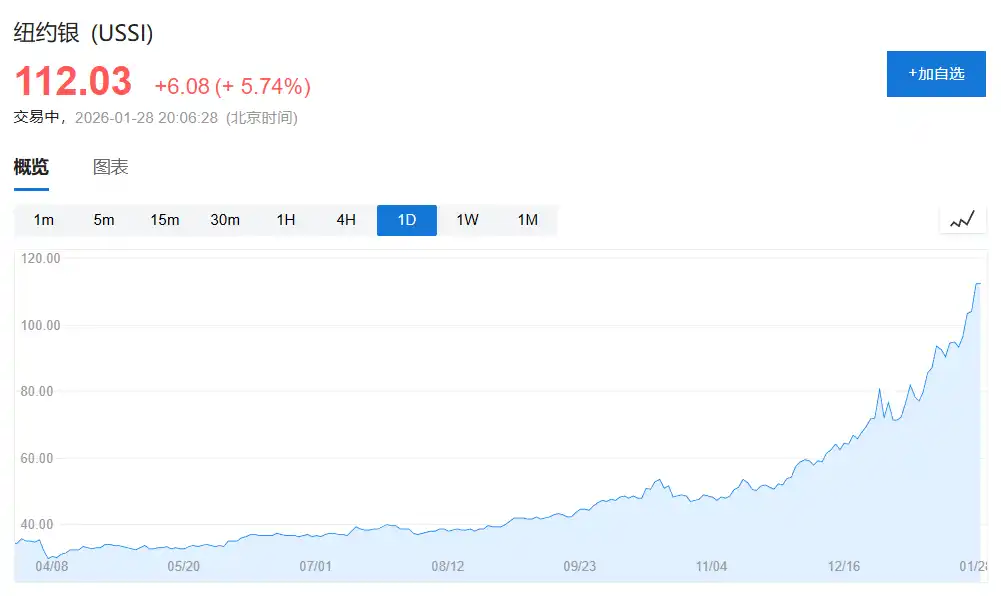
If Delivery Fails, Is the Financial System at Risk of Collapse?

The COMEX silver market is facing unprecedented physical delivery pressure. Holter pointed out that the appearance of 40 million ounces of delivery requests in January, a non-delivery month, is an extremely abnormal phenomenon, signaling the potential for a larger-scale run in the main delivery month of March.

"If COMEX cannot fulfill its delivery obligations, the contract value will go to zero," Holter stated. He emphasized that a delivery default would completely negate COMEX's pricing authority, as contracts that cannot be honored hold no value.

More seriously, a silver delivery failure would immediately transmit to the gold market. Holter warned that since gold is essentially an "anti-dollar" or "anti-U.S. Treasury" asset, a default in the gold market would directly impact the credit market, thereby threatening the stability of the entire financial system.

Currently, COMEX's registered deliverable silver inventory is approximately 110 to 120 million ounces, but the market questions whether this inventory might be subject to re-hypothecation or other encumbrances. If March delivery demand exceeds available inventory, the market will face the most severe liquidity crisis since the Silver Thursday event of 1980.

Holter painted a grim picture of the consequences of a delivery default. He predicted that if a delivery failure occurs in March 2026, it would trigger currency devaluation and the collapse of the entire financial system.

"The real economy runs on credit. Everything you touch, everything you do, involves the participation of credit," Holter said. If credit becomes unavailable, the real economy would completely stall.

This warning is not alarmist. The pricing mechanism of the precious metals market has long relied on paper contracts, with physical delivery being extremely low. Once trust in paper contracts collapses, investors will flock to demand physical delivery, and exchange inventories are far from sufficient to meet the delivery demands of all contracts.

Considering the U.S.'s total debt and commitment scale of $200 trillion, the financial system's reliance on credit has reached a historical extreme. A crisis of confidence in any key market could trigger a chain reaction, and the precious metals market is precisely the final anchor of trust for the entire monetary system.

Price Predictions "Ridiculously Underestimated"

Although the silver price has broken through $100 per ounce, Holter believes the market is still in the early stages of the rally. He stated that all current price predictions—including the $600 per ounce target proposed years ago—will ultimately prove to be "ridiculously underestimated."

Well-known silver analyst Peter Krauth is also optimistic, expecting silver prices to potentially hit $300 per ounce in the upcoming "mania phase." Krauth believes that $50 per ounce has become the new price floor, and a sharp adjustment in the gold-to-silver ratio will be the core driver pushing silver prices higher.

Holter provided an even more extreme valuation framework from a monetary perspective. He pointed out that if calculated based on the U.S. federal government's $38 trillion debt, supported by 8,000 tons of gold reserves, the gold price should reach $200,000 per ounce. This logic also applies to the repricing of silver.

Some large traders and banks that are short precious metals have already fallen into financial difficulties. Holter indicated that the persistently rising metal prices—especially silver prices—are putting severe pressure on these institutions, which could exacerbate market instability.

Silver's strong performance is rooted in a deep fundamental imbalance. As a metal with both monetary and industrial properties, silver is being squeezed by multiple sources of demand.

Industrial demand remains strong, particularly in areas such as solar energy, electric vehicles, and electronics. At the same time, investment demand is also surging, with investors viewing silver as a hedge against inflation and currency devaluation.

The supply side faces structural constraints. Silver is primarily a by-product of base metal mining like copper, lead, and zinc, making its production difficult to quickly respond to price signals. This supply rigidity can easily trigger sharp price fluctuations when demand surges.

Krauth emphasized that all the elements needed to sustain the rally for "quite some time" are already in place. Although there is a risk of a short-term pullback, the medium to long-term trend is already established.


Пов'язані питання

QWhat potential crisis is the COMEX silver market facing according to analyst Bill Holter?

ABill Holter warns that the COMEX may face a physical silver delivery default as early as March 2026, which could destroy the credibility of the existing pricing mechanism and trigger a chain reaction leading to the collapse of the entire financial system.

QWhat unusual demand pattern has been observed in the COMEX silver market recently?

AIn January, a traditionally non-delivery month, there were over 40 million ounces of silver requested for delivery, compared to the usual 1-2 million ounces in previous years.

QWhat is the estimated size of the COMEX's registered silver inventory, and why is it a concern?

AThe COMEX's registered deliverable silver inventory is approximately 110-120 million ounces. There is concern that this may be insufficient if delivery demands reach 70-80 million ounces in the key March delivery month, potentially leading to a liquidity crisis.

QWhat are some of the extreme price targets mentioned for silver by the analysts in the article?

AAnalyst Peter Krauth expects silver could reach $300 per ounce in an upcoming 'mania phase,' while Bill Holter suggests that even a target of $600 per ounce would be a 'laughable underestimate' from a monetary valuation perspective.

QBeyond investment demand, what other factors are contributing to the strong fundamentals for silver?

ASilver is experiencing strong industrial demand from sectors like solar energy, electric vehicles, and electronics. Additionally, its supply is structurally constrained as it is largely a byproduct of base metal mining (like copper, lead, zinc), making it difficult to quickly increase production in response to price signals.

Пов'язані матеріали

Podcast Notes | Conversation with GSR Asset Management Head: To Determine if This Crypto Rally is Real, Just Watch the Lending Rates on Aave

Podcast Summary: Dialogue with GSR's Head of Asset Management: To Determine if This Crypto Rally is Real, Just Check Lending Rates on Aave Andy Baehr, Managing Director of Asset Management at GSR, discusses the current crypto market, characterizing it as stuck in a state of "ambivalence" with short-lived, unsustainable rallies. He outlines a simple framework: the market moves between "ambivalence" and "conviction" (sustained upward momentum). Currently, every rally resembles a single-stage rocket booster that quickly fizzles out. Baehr identifies three key signals to watch: 1) DeFi lending rates, 2) the potential passage of the CLARITY Act, and 3) the market forming a consensus on the "Fed hawkish peak." He emphasizes that the most immediate indicator for the sustainability of the recent CPI-triggered rally is the USDC borrowing rate on Aave, currently around 3.75%—close to U.S. Treasury yields. The absence of a credit spread indicates low leverage demand and a lack of market energy. He explains that a healthy, sustained rally requires layered buying pressure. Last year's rally progressed from an ETH short squeeze to crypto-native trader influx and finally to ETF inflows. Currently, this structure is missing. Other potential structural buyers like Digital Asset Treasury (DAT) companies are absent, and ETF flows have proven transient. Baehr notes that while small-cap crypto tokens outperformed large caps in Q2—a potential sign of capitation in major assets—capital is also flowing to more exciting opportunities like AI stocks and tech IPOs, leaving crypto sidelined. Regarding DeFi, he highlights that platforms like Aave provide a clear, real-time signal of leverage demand through their supply/demand-driven interest rates. A significant, sustained rate increase would signal genuine market conviction. He also observes the quiet emergence of fixed-income-like products and vaults in DeFi. On regulation, the probability of the CLARITY Act passing before the August 7th deadline has dropped linearly from 75% to below 40% on Polymarket. Baehr suggests its passage would be treated as a bullish surprise, a potent driver for price movement. However, political hurdles, including ethical clause debates and disclosures about the First Family's crypto profits, remain significant obstacles. Ultimately, the market awaits clarity on the Fed's terminal rate under Chair Warsh. Until the "Fed Solstice"—the point where the market collectively understands the peak of hawkish policy—sustained conviction will be difficult to achieve.

marsbit14 хв тому

Podcast Notes | Conversation with GSR Asset Management Head: To Determine if This Crypto Rally is Real, Just Watch the Lending Rates on Aave

marsbit14 хв тому

7 Months After the Collapse of Huiwang, Southeast Asia's Escrow Platforms Undergo a Major Reshuffle

Following the collapse of Huione Pay—dubbed the "Alipay of Southeast Asia"—seven months ago, the region's underground financial guarantee platform sector is undergoing a significant reshuffle. This power vacuum has been swiftly filled by emerging platforms such as XinBi, Tiger/Navigator, JinBei (renamed JinBo), Dali/Tiancheng, and FullyLight. These platforms, operating largely via Telegram and offering services like escrow for illicit transactions, have absorbed the vast user base and markets left behind by Huione. While positioning themselves as "trust intermediaries," their primary clientele consists of networks involved in online scams, money laundering, illegal gambling, and even human trafficking. For instance, the Tiger/Navigator platform explicitly provides "escrow" services for kidnapping-for-ransom operations ("强押车交易"). Data underscores the immense scale: Huione alone processed over $103 billion in cryptocurrency payments and facilitated over $31 billion through its escrow market before its downfall, linking it to Cambodia's notorious Prince Group. Since its collapse, competitors have seen explosive growth. For example, the XinBi platform has accumulated over $1.6 billion in total USDT revenue, while platforms like NewPay, OkPay (under Dali), and FullyLight Wallet collectively processed over $4.8 billion in USDT in a single year. This ecosystem thrives in regions like Cambodia and Myanmar, where regulatory gaps allow these platforms to act as critical financial infrastructure for sprawling cybercrime industries, from scam compounds to online casinos. The article concludes that the moniker "Southeast Asian Alipay" is a misnomer, obscuring the platforms' fundamental role in enabling serious criminal enterprises rather than representing legitimate financial innovation.

Odaily星球日报1 год тому

7 Months After the Collapse of Huiwang, Southeast Asia's Escrow Platforms Undergo a Major Reshuffle

Odaily星球日报1 год тому

Торгівля

Спот
活动图片




