Silk Road-linked Bitcoin wallets move $3M to new address

cointelegraphОпубліковано о 2025-12-10Востаннє оновлено о 2025-12-10

Анотація

Cryptocurrency wallets associated with the defunct darknet marketplace Silk Road have transferred approximately $3.14 million in Bitcoin to a new address, marking their most significant activity in five years. The funds were moved from wallets still holding an estimated $38.4 million in BTC. This activity follows the January pardon of Silk Road founder Ross Ulbricht by former U.S. President Donald Trump. While the U.S. government previously seized billions in Bitcoin from Silk Road, industry observers believe Ulbricht may still control additional wallets containing tens of millions in unrecovered cryptocurrency.

Darknet marketplace Silk Road-linked cryptocurrency wallets are moving again, less than a year after US President Donald Trump granted its founder, Ross Ulbricht, a full pardon.

Silk Road-tagged cryptocurrency wallets awoke Tuesday to transfer approximately $3.14 million worth of Bitcoin (BTC), according to blockchain data platform Arkham.

The 176 transfers mark the wallet’s most significant activity in five years. Silk Road-related wallets executed only three small test transactions earlier this year.

The transfers were all made to an unknown cryptocurrency wallet “bc1qn.” The primary Silk Road–tagged wallets still hold about $38.4 million in Bitcoin, while the newly created address is holding only the $3.14 million received in the recent transactions.

Cointelegraph was unable to independently verify the owner of the new wallet and has reached out to Ulbricht for comment.
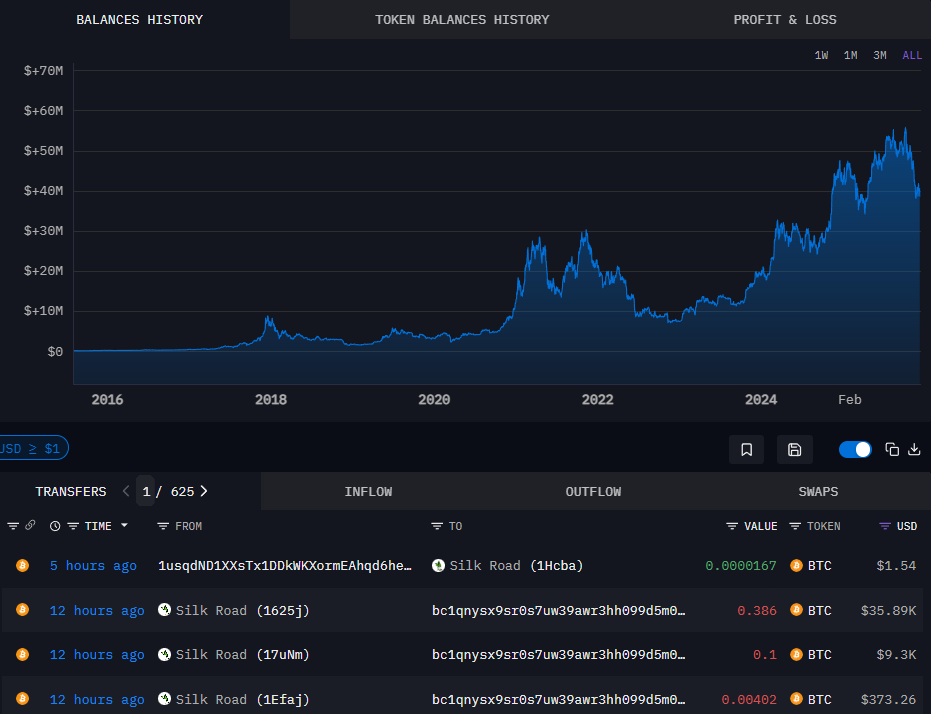
Silk Road wallets, token holdings. Source: Arkham

Related: Crypto nears its ‘Netscape moment’ as industry approaches inflection point

In January, Trump gave a full pardon to Silk Road founder Ross Ulbricht, who had been serving a double life sentence without parole.

Ulbricht was convicted in 2015 for his role in creating and operating Silk Road, a darknet marketplace that facilitated the anonymous trade of illicit goods using Bitcoin.

Source: Free_Ross

Following the pardon, supporters have contributed approximately $270,000 in Bitcoin donations to the Free Ross campaign, according to onchain data.

Related: ‘Elite’ traders hunt dopamine-seeking retail on prediction markets: 10x Research

Silk Road founder may still hold millions in unseized crypto wallets

While the US government seized at least $3.36 billion in Bitcoin from Silk Road, some industry watchers claim that Ross had multiple other Bitcoin wallets that weren’t discovered during the asset seizure.

Coinbase exchange director Conor Grogan revealed that 430 BTC, worth about $47 million, remains untouched in wallets likely linked to Ulbricht, which have been dormant for over 13 years.
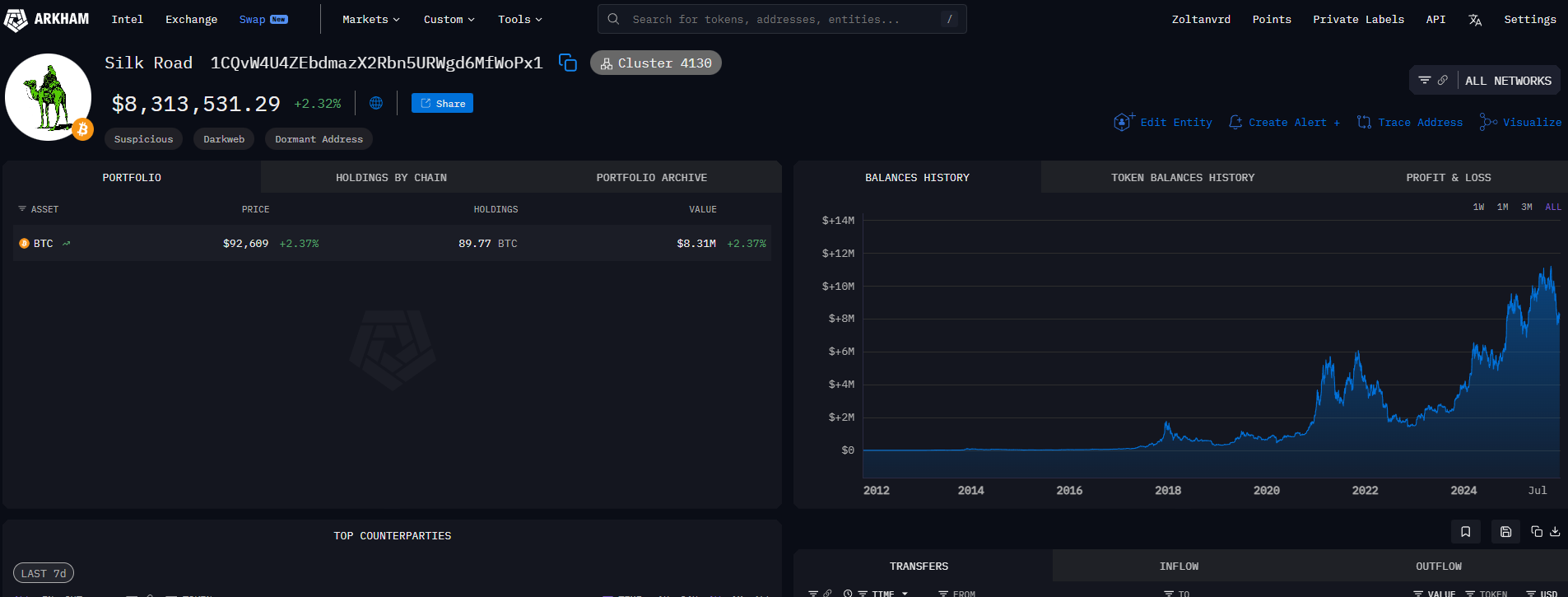
Silk Road wallet “1cqvW,” holdings. Source: Arkham

Another Silk Road-tagged wallet likely belonging to Ulbricht holds $8.3 million in Bitcoin. Barring three small test transactions in the past 10 months, the wallet has been inactive for 14 years, according to Arkham.

Magazine: $3.4B of Bitcoin in a popcorn tin — The Silk Road hacker’s story
Пов'язані матеріали

Interop Roadmap Accelerates: After Fusaka Upgrade, Ethereum Interoperability May Take a Key Leap

Recent Ethereum Fusaka upgrade, while primarily focused on Blob capacity expansion, introduced the underappreciated EIP-7825, a critical enabler for Ethereum's zero-knowledge (ZK) and interoperability roadmap. This proposal sets a hard per-transaction gas limit (~16.78 million gas), preventing "mega-transactions" from monopolizing a block. This change transforms block proof generation from a sequential logic problem into a parallelizable computational task, making real-time ZK proofs an engineering feasibility rather than a theoretical impossibility. This foundational shift is pivotal for the L1 zkEVM vision, where Ethereum itself generates verifiable proofs for its state transitions. L1 zkEVM acts as a universal "trust anchor," allowing Layer 2s (L2s) to instantly and trustlessly verify the mainnet's state without waiting for challenge periods. This eliminates the speed-trust decentralization trade-off, enabling near-instant, decentralized cross-chain interoperability. Concurrently, ZK technology is evolving from EVM-compatible zkEVMs to more efficient, ZK-optimized zkVMs. EIP-7825's parallelizable environment allows these zkVMs to operate at peak efficiency, drastically reducing proof generation cost and time. The convergence of EIP-7825, L1 zkEVM, and advanced zkVMs paves the way for the final stage of interoperability (Interop)—abstracting away chain boundaries to deliver a single-chain user experience where cross-chain actions are seamless, secure, and instantaneous.

marsbit11 хв тому

Interop Roadmap Accelerates: After Fusaka Upgrade, Ethereum Interoperability May Take a Key Leap

marsbit11 хв тому

Торгівля

Спот
Ф'ючерси
活动图片