Silicon Valley Wang Chuan: How Can You Not Feel Anxious When the Neighbor Lao Wang Earned 30x by Investing in Storage Stocks?

marsbitОпубліковано о 2026-05-11Востаннє оновлено о 2026-05-11

Анотація

The author explores anxiety, attributing it to the amygdala's stress response, and suggests writing down worries to shift control to the rational prefrontal cortex, easing anxiety more effectively than mere reassurance. The piece then examines a source of financial anxiety in May 2026: a 150% surge in the Philadelphia Semiconductor Index, with storage stock SNDK skyrocketing 38x. The author analyzes the underlying logic behind this boom, tracing it to soaring valuations of AI startups like Anthropic (Anth). Anth's reported $400 billion ARR is scrutinized, revealing that cumulative revenue since founding is only about $108 billion, with the company still losing billions monthly and relying on continuous funding (having raised $723 billion). The author contrasts Anth's $1+ trillion valuation speculation with Berkshire Hathaway's fundamentals ($3.7 trillion revenue, $669 billion profit, $4 trillion cash, $1 trillion market cap), questioning the belief that a loss-making, funding-dependent startup could be worth more than the established giant. The narrative concludes by linking the massive valuations of Anth and OpenAI to a surge in AI industry capital expenditure (capex), which in turn fueled the storage sector's prosperity, setting the stage for a further discussion.

Author: Silicon Valley Wang Chuan, investguru

1/ Human anxiety is often an amygdala-driven stress response. To alleviate anxiety, simply offering platitudes like "Don't be anxious, it's useless" is ineffective, as it fails to address the underlying mechanisms triggering the stress response. The truly effective method is to have the anxious person slowly write down the specific things causing anxiety and their reasons on paper. The act of writing transfers control from the amygdala, which only knows tension and alertness, to the rational prefrontal cortex. The more detailed the writing and the deeper the analysis, the more complete this transfer of control becomes, naturally reducing anxiety. Even if you can't finish in one sitting, just starting to write and having a rough idea of how long it might take to logically sort things out can begin to lower anxiety. Relying solely on feel-good "inspirational soup" without forcing oneself to slowly write it down prevents this genuine transfer of control and thus fails to fundamentally change anxiety.

2/ One anxiety-inducing event in May 2026 was the comprehensive surge in semiconductor industry stocks. The famous Philadelphia Semiconductor Index was up 150% compared to a year prior. Various semiconductor storage company stocks rose even more sharply, with SNDK closing at $1,562 on May 8th—38 times its price from a year ago. While the author holds no investments in semiconductor companies, this article attempts to deconstruct the underlying logic behind these stock rallies to share and discuss with readers.

3/ This story begins with the rapidly climbing valuations of various AI startups. Many speculative investors on the periphery, who only care about stock price fluctuations, lack some fundamental knowledge:

  • First, the vast majority of AI startups incur heavy losses, but many people completely confuse the two basic concepts of revenue and profit (some even intentionally), and this misunderstanding persists and spreads.
  • Second, when a company says its ARR (Annual Recurring Revenue) has reached $100 million, it does not mean its total revenue over the past year was $100 million. At most, it implies its revenue in the most recent month was about $8.33 million. If you misinterpret this out of wishful thinking, that's your own problem.
  • Third, what a company does *not* say often reveals more than what it does say. Reporting ARR without mentioning profitability implies it is incurring heavy losses. If it said six months ago its ARR reached $100 million but has been silent since, it most likely means its revenue has shrunk and losses have worsened.

4/ Taking the currently red-hot large model company Anthropic (referred to as Anth below) as an example, some media disclosures at the end of April indicated the company's ARR was approaching $40 billion. In other words, the company's single-month revenue in April was close to $3.3 billion ($40B / 12). In March, the company's ARR was below $30 billion, meaning March revenue was below $2.5 billion. Anth's CFO, in a public document in March, disclosed cumulative revenue exceeding $5 billion from its founding in 2021 to March 2026. In other words, Anth's cumulative revenue (emphasizing again, not profit) over the past five years since founding is approximately $10.8 billion.

5/ There is also an issue regarding the definition of revenue here. A significant portion of Anth's revenue comes from Google Cloud Services and AWS. Cloud service providers take at least a 20% cut of the money paid by customers, with the remainder going to Anth. Therefore, the ARR Anth publicly reports needs an additional 20% discount. But we won't dwell on that here because Anth is still losing a lot of money every month.

6/ How much is the loss? Asking several different AIs and based on limited public information, assuming its single-month revenue reached $3.3 billion, guesses for the single-month loss range from $1.1 billion to $1.7 billion. This is also the fundamental reason why Anth needs to continuously raise external funding. As of the end of April, Anth has raised a cumulative $72.3 billion over five years, but cumulative revenue is only $10.8 billion, and it still needs to continue fundraising. Those who only glance at headlines mistakenly believe Anth is already making a fortune but don't understand the immense pressure on management to constantly seek new external capital just to survive.

7/ Anth is not without competition. Its president recently admitted in a public speech that AI models from other US companies are only one to three months behind Anth, while Chinese companies' AI models lag six to twelve months behind. The features and strengths of each company's products ebb and flow, changing very rapidly, making it difficult to judge the ultimate winner based on one or two years of performance. For example, Cursor was the most popular programming assistant tool among AI developers from 2023 to early 2025, and the company was once highly sought-after. But Anth's launch of Claude Code in the first half of 2025, which could automatically generate large amounts of code, allowing many non-programmers to participate in programming, has been the core driver of Anth's sudden rise and rapid growth in revenue and valuation over the past year. Recently, some programmers have complained that Claude Code's experience and cost-performance in some areas are inferior to OpenAI's Codex, leading them to switch to the latter. For many users, the switching cost is not high. Besides OpenAI, SpaceX's X.AI also began close collaboration with Cursor last month to develop a competitor to Claude Code.

8/ Investors bullish on Anth might cite specific scenarios, claiming Claude Code achieves profit margins as high as 70% for inference work. However, this argument first ignores the enormous ongoing cost Anth incurs to continuously train new models, and second assumes competitors are completely absent with no pricing pressure. This clearly does not align with reality. When Anth raised funds in February, its valuation was $380 billion. Just three months later, it began seeking new funding with an asking valuation of over $900 billion. Recently, in a secondary market for private equity, a valuation of reportedly $1.2 trillion even appeared (some podcasts even mentioned a long-term valuation of $5 trillion). This is a company with only a five-year history, cumulative revenue (not profit!) of $10.5 billion, yet still losing over a billion dollars per month. Simply because of high growth over the past year, some believe it can last forever. Raising $72, losing money for five years to do $10.5 worth of business, yet being able to cash out at a market valuation of $1 trillion—such a wonderful thing, no wonder so many entrepreneurs aspire to it! 😊

9/ Berkshire Hathaway (referred to as BRK below), under Warren Buffett, had revenue of $370 billion in 2025, operating cash flow of $45.9 billion, after-tax profit of $66.9 billion, nearly $400 billion in cash on hand, and a market capitalization of only about $1 trillion. Looking at it another way, BRK's revenue in ten days equals Anth's total revenue throughout its entire history. Yet some investors are willing to believe that Anth, which still highly depends on external investment to survive, deserves a higher valuation than BRK. The immense courage required to construct such a belief is truly awe-inspiring.

10/ The valuation growth of Anth and OpenAI is crucial for the explosive increase in capital expenditure (capex) across the entire AI industry and the subsequent prosperity of the storage sector. Looking back at the developments over the past few years, this logical chain is clear. For the rest of the story, please listen to the next installment.


Пов'язані питання

QWhat is the author's suggested method to effectively reduce anxiety, and why does it work?

AThe author suggests writing down the things and reasons causing anxiety in detail on paper. This process works by transferring control of the brain from the amygdala, which is responsible for stress and alert responses, to the prefrontal cortex, which handles rational thinking. The more detailed the writing and analysis, the more complete this transfer of control becomes, naturally reducing anxiety.

QAccording to the article, what is a key point of confusion for many speculators regarding AI startup companies?

AA key point of confusion is that many speculators conflate 'revenue' and 'profit' as basic concepts. Most AI startups are incurring heavy losses, but people often mistake reported revenue (like ARR) for profitability, leading to misunderstandings about the companies' financial health.

QWhat are some of the financial figures and challenges mentioned regarding the AI company Anthropic (Anth)?

AAs of April, Anthropic's ARR was reported to be near $40 billion, implying a monthly revenue of about $3.3 billion. However, its cumulative revenue since founding five years ago was approximately $10.8 billion, while its cumulative fundraising reached $72.3 billion. The company was still losing an estimated $1.1 to $1.7 billion per month, necessitating ongoing external financing. Despite this, its valuation had soared, with figures mentioned ranging from $380 billion to claims of $1.2 trillion in private markets.

QHow does the author contrast the valuation of Anthropic with that of Berkshire Hathaway (BRK)?

AThe author contrasts them by highlighting their fundamental financial metrics. Berkshire Hathaway had $370 billion in annual revenue, $66.9 billion in after-tax profit, and around $400 billion in cash, with a market cap of about $1 trillion. In comparison, Anthropic, with only $10.8 billion in total historical revenue and ongoing heavy monthly losses requiring constant fundraising, was being valued by some investors at levels comparable to or even higher than BRK. The author finds the belief supporting such a high valuation for Anth remarkable.

QWhat connection does the article imply between the AI industry's growth and the semiconductor storage sector?

AThe article implies a clear logical chain: the soaring valuations of AI companies like Anthropic and OpenAI lead to a massive increase in capital expenditure (capex) for the entire AI industry. This surge in AI-related investment and spending is described as very important for the subsequent prosperity of the semiconductor storage industry, suggesting that the storage sector's boom is driven by the capital-intensive needs of the growing AI field.

Пов'язані матеріали

ByteDance Adopts Arm CPUs, Jensen Huang: So Sad I Didn't Buy Arm

**Summary:** At Computex 2026, Arm CEO Rene Haas announced that ByteDance and Oracle have adopted Arm's self-designed Arm AGI data center CPU. The company expects significant revenue growth from this product, projecting $20 billion in demand for the 2027/2028 fiscal years. Haas noted that restricting AI-capable CPUs from the US to China is nearly impossible due to their widespread applications. Arm's stock has surged dramatically this year, notably rising 16% after NVIDIA's Arm-based Vera CPU and RTX Spark announcements. A highlight was the informal, humorous on-stage conversation between Haas and NVIDIA CEO Jensen Huang. Huang joked about NVIDIA's failed attempt to acquire Arm and playfully lamented selling his Arm shares. Both executives showed a clear sense of camaraderie and shared regret over the missed merger. Key technical topics were discussed: 1. **AI PC Design:** Huang explained NVIDIA's RTX Spark superchip (with a 20-core Arm CPU) is designed for future AI agents that will autonomously run and use tools on PCs, blending local and cloud processing. 2. **Agent vs. OS:** Huang emphasized the operating system remains crucial, as AI agents rely on its APIs and tools to function. 3. **Growth Constraints:** He identified the shift to "useful AI" that generates profitable tokens as a primary driver for immense, almost limitless, computational demand. Haas outlined Arm's strategy across PC and data centers. For PCs, Arm collaborates with partners like NVIDIA and MediaTek, offering its compute subsystem (CSS) for custom SoCs. In data centers, its Arm AGI CPU (built on TSMC's 3nm process) has gained major partners including OpenAI, Meta, and now ByteDance and Oracle. Arm presented a multi-year roadmap for its in-house CPU line. The article concludes that while GPUs dominated the AI training race, the explosion of AI agents is shifting significant focus to CPUs for inference, state management, and tool orchestration. The industry is trending towards vertical integration, with companies like cloud providers designing chips and chip/IP firms offering full solutions, all competing to deliver more efficient computing per watt.

marsbit18 хв тому

ByteDance Adopts Arm CPUs, Jensen Huang: So Sad I Didn't Buy Arm

marsbit18 хв тому

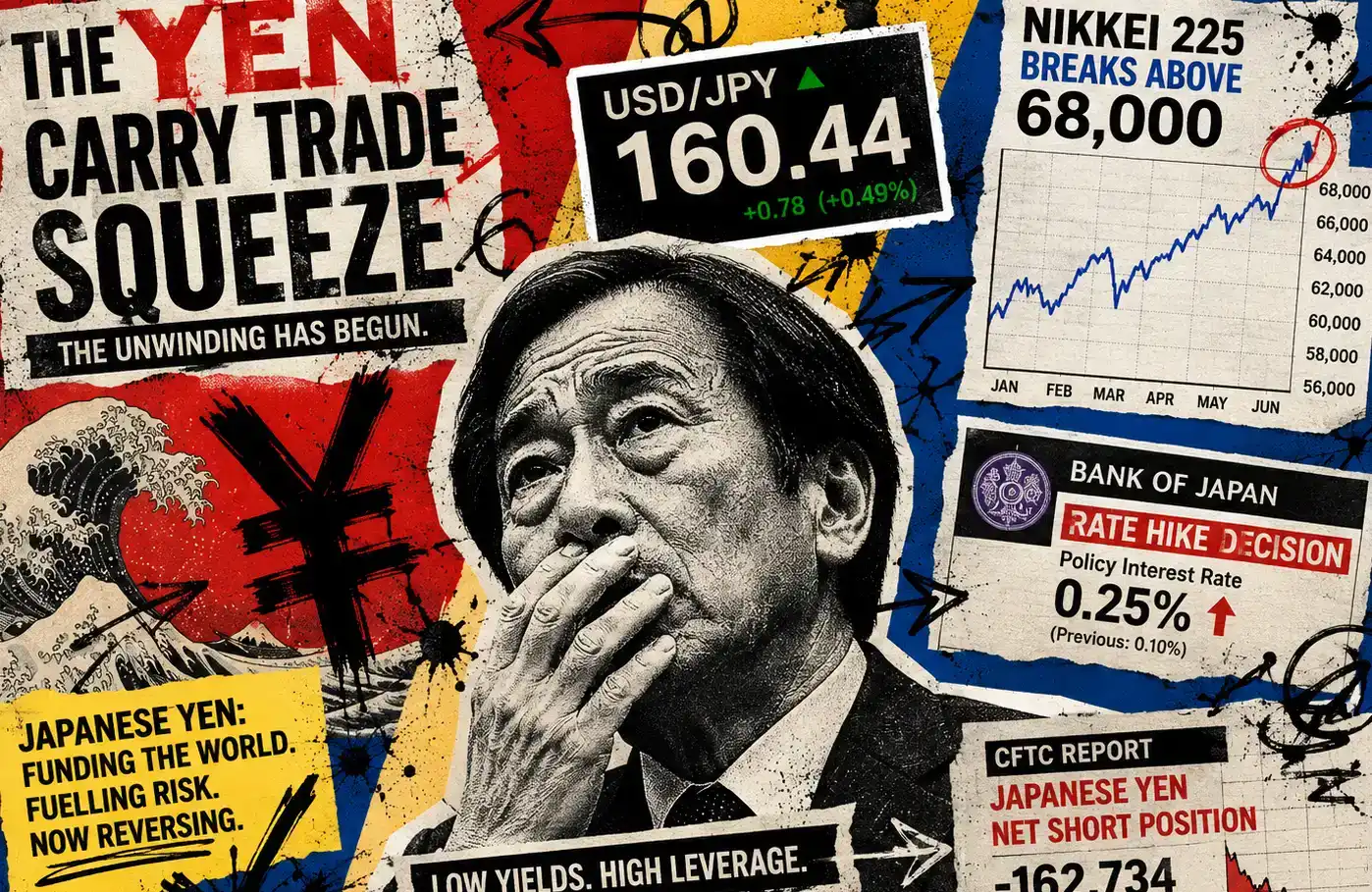
New Wall Street Play: Yen Shorts Still Adding, But Japan Stocks Don't Rely on Carry Trade Unwinding

On June 3rd, USD/JPY hit 160.44, its highest level since July 2024, while the Nikkei 225 surged past 68,000 points. Contrary to popular narratives of an imminent "carry trade unwind" akin to August 2024, data reveals a more complex picture. Speculative net short positions in yen futures have actually increased, reaching -114,667 contracts by late May, suggesting traders are doubling down rather than retreating. Meanwhile, Japan's Finance Ministry conducted its largest-ever single-round FX intervention (11.73 trillion yen) in April-May but failed to hold the 160 yen line. The Nikkei's rally is not driven by carry trade dynamics. Foreign investors are aggressively buying Japanese stocks, with net purchases in 2026 running nearly 16 times higher than 2025 levels. This inflow is concentrated in AI and semiconductor-related stocks like SoftBank and Socionext, fueled by positive sector outlooks, rather than being a flight from unwinding yen shorts. Furthermore, the Nikkei has continued climbing despite the Bank of Japan's (BOJ) rate hikes to 0.75%. This disconnect exists because the current equity boom is fueled by AI-driven foreign investment, not reliant on cheap yen funding. However, this relationship remains fragile. Should the BOJ hike rates further (e.g., to 1.0%) while dollar weakness increases carry trade costs, the trajectories of the yen and Japanese stocks could reconverge, potentially triggering volatility.

marsbit22 хв тому

New Wall Street Play: Yen Shorts Still Adding, But Japan Stocks Don't Rely on Carry Trade Unwinding

marsbit22 хв тому

Broadcom's Q3 Guidance Misses Expectations by $12 Billion, After-Hours Trading Plummets Over 13%, AI Narrative "Cooling"?

On June 3, Broadcom released record Q2 FY26 results with revenue of $22.19B, up 48% YoY, and AI chip sales of $10.8B, up 143%. Adjusted EPS of $2.44 beat estimates. However, its Q3 AI semiconductor revenue guidance of $16B, while up over 200% YoY, fell roughly $1.2B (7%) short of analyst consensus expectations of $17.2B. This miss, coupled with slightly weaker-than-expected software revenue, triggered a severe market reaction. CEO Hock Tan maintained the FY26 AI revenue outlook of over $100B but did not raise it, disappointing investors who had priced in more robust growth. The stock plummeted over 13% in after-hours trading, erasing roughly $270B in market cap. The sell-off extended to peers like Marvell. A key concern for markets, particularly for Chinese optical module suppliers, was Tan's comment that the contribution of AI networking (e.g., Ethernet switches, optical interconnect chips) to AI revenue, currently near 40%, is expected to normalize to around 30% over time, signaling a potential peak in growth for that segment. Despite the guidance shortfall, Tan reiterated that AI demand remains "insatiable" and reaffirmed the long-term target of exceeding $100B in AI revenue by FY27. The reaction highlights the heightened sensitivity and premium valuation placed on AI-exposed stocks, where anything less than stellar guidance can prompt significant profit-taking. The broader question is whether this represents a cooling AI narrative or a correction in overstretched valuations.

marsbit22 хв тому

Broadcom's Q3 Guidance Misses Expectations by $12 Billion, After-Hours Trading Plummets Over 13%, AI Narrative "Cooling"?

marsbit22 хв тому

Торгівля

Спот
Ф'ючерси
活动图片