Show me 'The Lord of the Rings', Karpathy Recommends New Benchmark for Large Model Evaluation

marsbitОпубліковано о 2026-08-03Востаннє оновлено о 2026-08-03

Анотація

In a new benchmark for evaluating large language models, Andrej Karpathy proposes replacing the once-popular "pelican riding a bicycle" SVG test with a more complex challenge: generating a 3D scene from the opening text of *The Lord of the Rings*. Using Anthropic's Opus 5 model and the Three.js library, the task consumed approximately 1 million tokens, 2 hours, and 5,500 lines of code to produce a rudimentary, low-polygon animation of the Shire. While the output is visually crude with notable glitches like floating characters, it demonstrates the model's ability to parse narrative text and translate it into a functional, programmatic 3D world with defined objects, cameras, lighting, and basic animation. This "Lord of the Rings benchmark" is argued to test a model's capacity for long-horizon project planning, spatial reasoning, and maintaining consistency across thousands of code lines—capabilities not fully captured by simpler single-output tests. The initiative has sparked community experimentation, with users generating other 3D worlds like a low-poly San Francisco, a data-driven New York City model, and even a virtual Kanye West concert. Karpathy suggests a future pipeline where code-generated scenes provide the structural "bones" for video-to-video models to enhance visual fidelity. While some debate the computational cost and specificity to Three.js, proponents see it as a test of a model's general ability to structure its understanding of the world into an executable ...

Without further ado, let's start the daily slump (doge)!

Just moments ago, the great Karpathy announced that "we" at Anthropic have started using a brand new way to push large models to their limits—

"The Lord of the Rings."
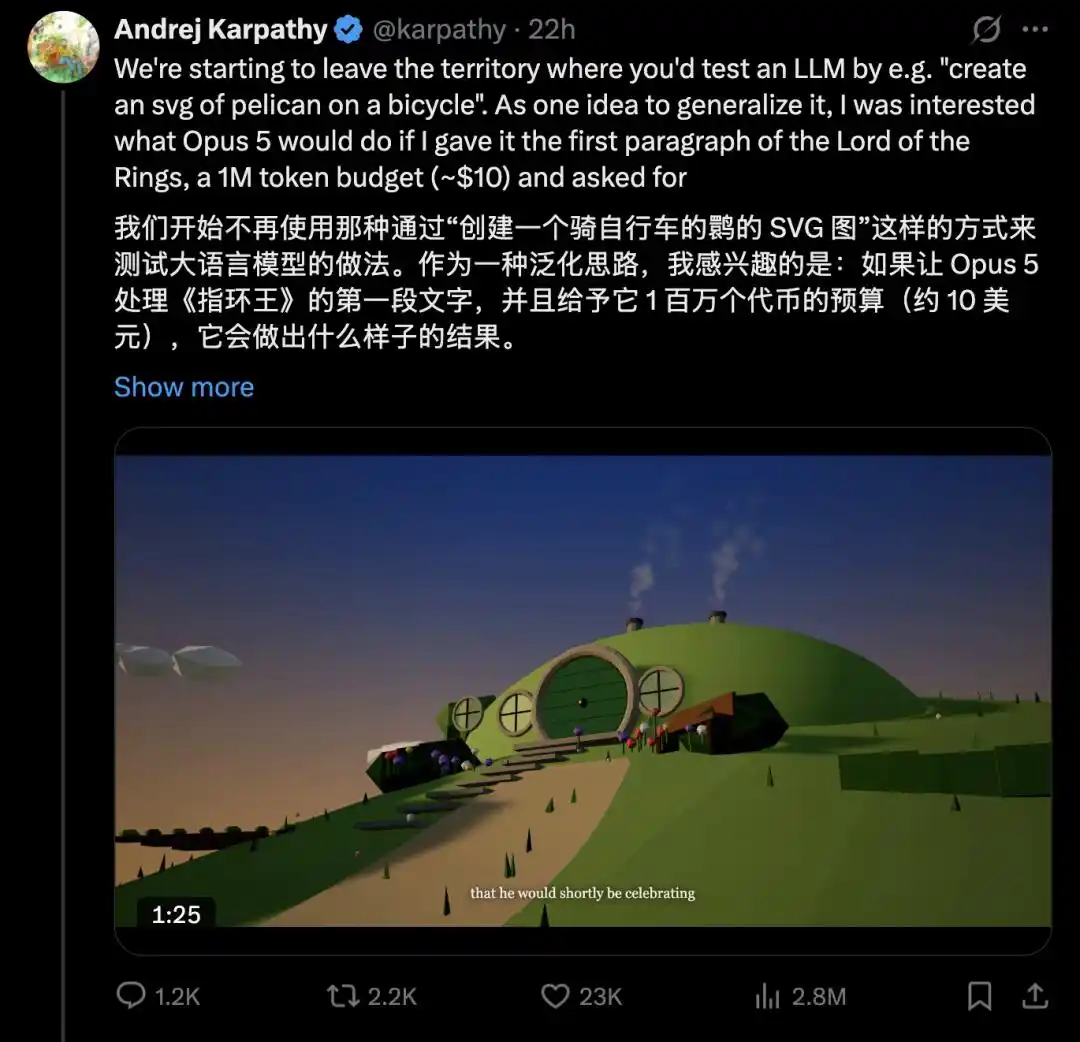
According to Karpathy, this "Lord of the Rings benchmark" is taking over from the once-popular "Pelican Riding a Bicycle" SVG test.
Specifically, Karpathy directly fed the beginning of "The Lord of the Rings" to Opus 5, instructing the model to use Three.js to craft an entire "Middle-earth" world on the spot.

As for the final effect... well, it somewhat resembles domestic 3D animations from the late 1990s and early 2000s: very rough and quite abstract.

But objectively speaking, if you look closely for a while and happen to be familiar with the "Lord of the Rings" filming location Hobbiton in New Zealand, you can indeed catch a hint of its flavor~

However, this seemingly unpolished creation genuinely cost Opus 5: 1 million tokens, 2 hours, and 5,500 lines of code.

Of course, it's not just the Claude model shining solo on this stage.

The most hilarious part is probably the new offering from netizens—a DeepSeek V4 Flash version.

It's a complete "Chinese people can fly" situation, with all characters floating in the air.

Faced with these currently obvious goofs, Karpathy was quite fair.

He pointed out that Opus 5 still cannot truly "enter" the world it generates; it can only continuously take screenshots at different time points and slowly check where things went wrong.

And this precisely exposes a significant shortcoming of current large models:

They can already write code, build scenes, and generate games, but they still cannot truly understand videos, nor can they actually play the games they create.

Two Hours, Crafting Middle-earth by Hand

Let's first look at how this "Lord of the Rings" test was conducted.

If taken literally from Karpathy's tweet, the main prompt input for Opus 5 should be the beginning of Chapter One, "A Long-expected Party," from "The Lord of the Rings" novel.

When Mr. Bilbo Baggins of Bag End announced that he would shortly be celebrating his eleventy-first birthday with a party of special magnificence, there was much talk and excitement in Hobbiton...

Interested folks can try it themselves.

In addition, Karpathy also specified Three.js in the prompt—a JavaScript library for building 3D scenes with code.

Thus, the task for Opus 5 was to first comprehend the text at the beginning of "The Lord of the Rings," and then translate it into a 3D world that could run in real-time in a browser.
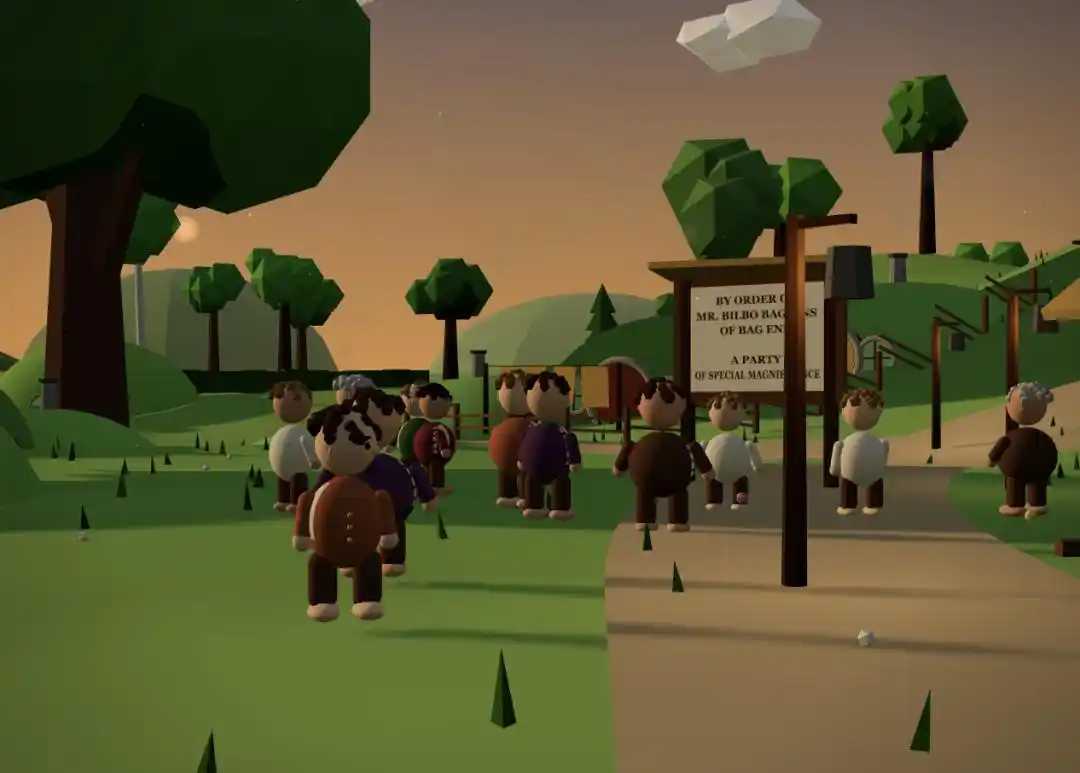
Throughout the process, Opus 5 needed to use polygons to piece together characters, buildings, and props, place them one by one into x, y, z coordinate systems, and then arrange cameras, lighting, and animations.

When characters should move, where the camera should turn, how lighting should change, and how objects in the scene should interact—all needed to be defined by the model using code.

Although the final visuals aren't exactly refined, and issues like clipping and floating frequently occur—for example, characters' bodies and heads separating... but at least the entire scene was genuinely built.
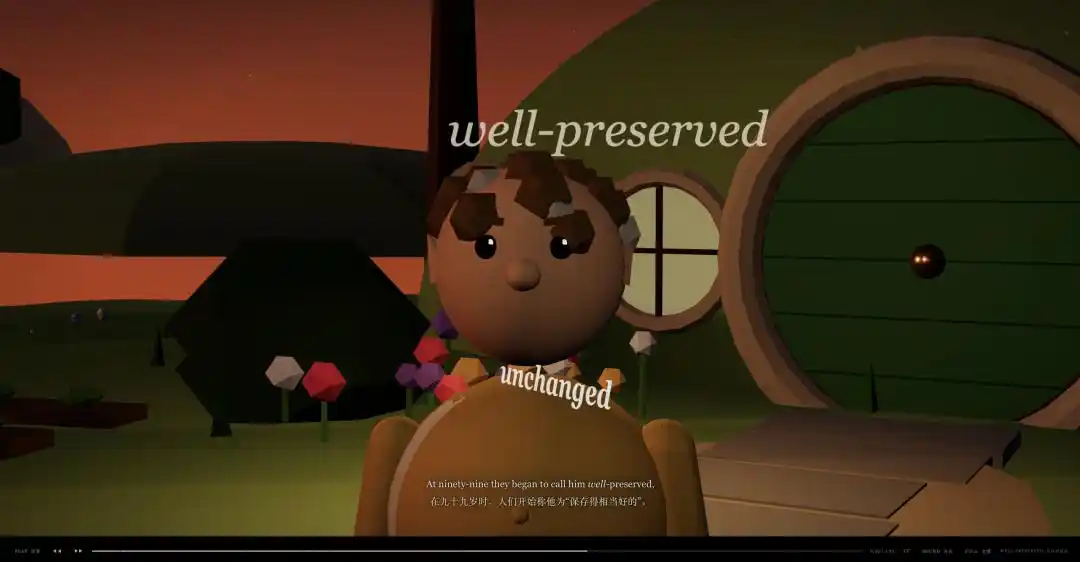
It's important to note that this is not the same as video models directly generating pixel frames.

Three.js first needs to build characters, objects, and scenes as 3D objects, then calculate their positions, angles, and motion states in real-time based on the code.

Therefore, the demo we see is not a regular AI-generated video, but a recording of a running 3D web scene.

However, Karpathy also mentioned in the comments that procedural 3D and video generation are not an either-or choice.

A netizen suggested that this rough Three.js recording could be fed to Sora as a reference video, letting the video model render it again with higher visual quality.
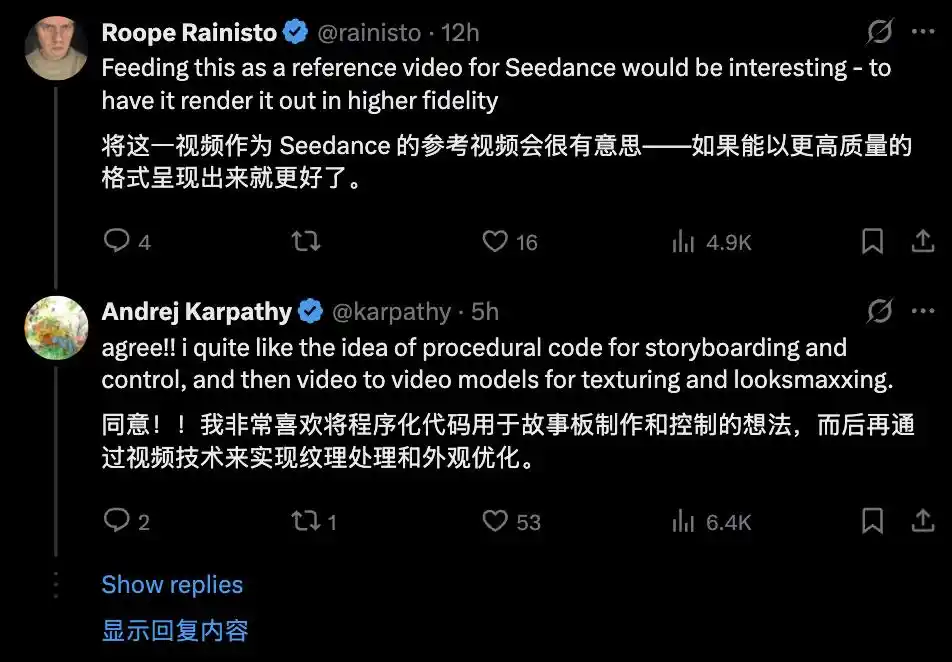
Karpathy quickly agreed.

According to his vision, procedural code could handle storyboarding and control, first finalizing the skeleton: where characters stand, how the camera moves, and how the plot progresses.

Then, the recording could be passed to a Video-to-Video model to add textures, lighting, shadows, and details, enhancing the overall "appeal" of the Middle-earth world.

As for audio, Opus 5 didn't handle it all this time.

Karpathy stated that, due to personal requirements for sound quality, he ultimately used ElevenLabs.
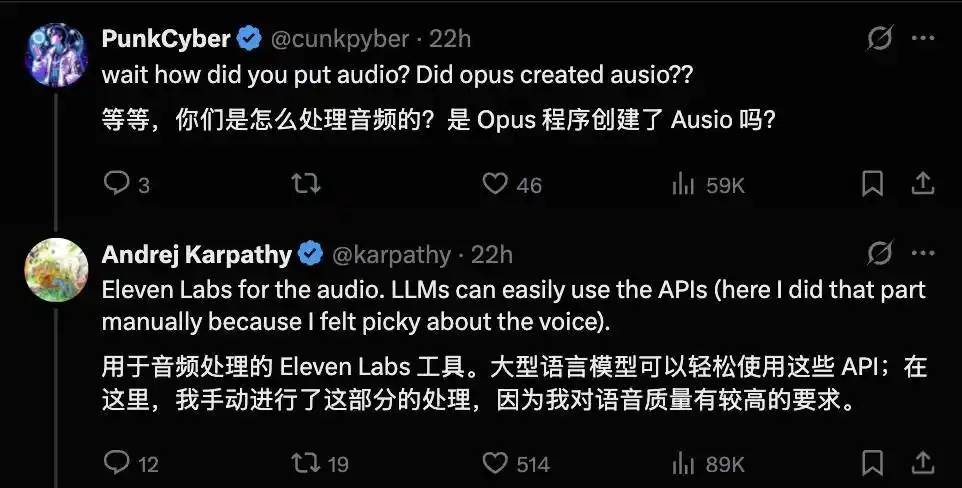
Thus, that "Lord of the Rings" demo with visuals, camera work, and narration at the beginning came into being.

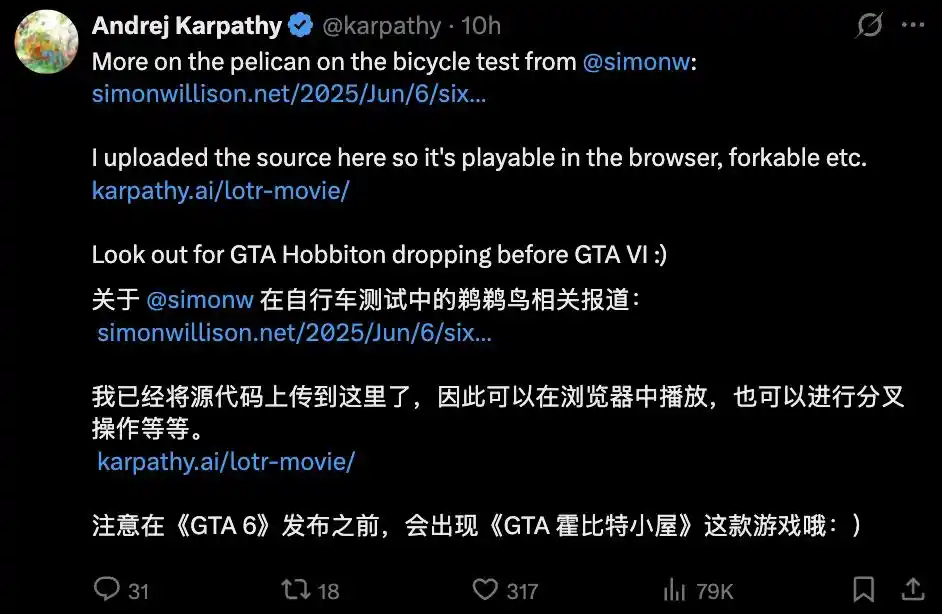
Karpathy has also open-sourced the entire project; the specific link can be found at the end.
Netizens Are More Interesting Than Karpathy

After Karpathy released the demo, many netizens also rushed to test it out.

Looking at the overall response, one can only say:

This bunch of netizens is more imaginative than Karpathy.

Someone used Claude to launch an 'Earth Online' project, aiming to build the entire Earth bit by bit with a group of AI Agents.

Currently, the Agents haven't finished the whole Earth, having only built a low-poly-style San Francisco waterfront area. But from the available visuals, the building proportions, character scales, and overall style remain quite consistent.

This effect is somewhat like those Lego-world animations. The art style isn't complex, but characters, scenes, and actions can operate stably within the same world.

Continuing in this direction, simple-styled animations and lightweight games are already showing a hint of AI-native potential.

Another netizen used Fable 5 and GPT-5.6 Sol to build a 3D digital model of New York City, incorporating real-time data into it.

The model not only had to position New York's streets and buildings correctly but also maintain spatial relationships between different areas. The author thus proposed that this task of generating virtual worlds could perhaps become a new benchmark for spatial reasoning.

Even more exaggerated examples followed.

One netizen couldn't get tickets to Kanye West's concert, so they simply used AI to host a private concert for themselves in the browser.

The entire project was still built with Three.js. It consisted of a single HTML file, without calling any pre-made 3D models; the stage, characters, and lighting were all generated by code.

The concert prepared 14 songs in total, each with independent lighting design and a dedicated set of spherical stage visuals.

Regular users could listen to clips; after connecting a Spotify Premium account, they could play full songs and the entire show.

Couldn't get tickets? Just generate a private show for yourself. Incredible!

And there's more!!!

Karpathy also envisioned in the original post that gameplay could be added to these 3D worlds later, allowing players to enter as observers, NPCs, or even story characters.

Before Karpathy could arrange a game version, netizens had already made one.
This project also used Opus 5 and Three.js. It could not only run and be interactive but also had audio added.

More 3D design cases kept appearing. From building proportions and spatial layouts to scene style, Opus 5 could already maintain relatively stable consistency across fairly large-scale projects.

There are many similar examples; we won't showcase them all here.

Objectively speaking, these works still have some distance from truly mature games.

Whether the dazzling array of gameplay is fun, if it runs stably over long periods, and if players would genuinely stay for 15 minutes—all these questions currently lack answers.

But the barrier to creating real-time 3D content and playable prototypes has indeed been significantly lowered.

Moreover, having a new way to test model capabilities that is also sufficiently fun and interesting—isn't that a beautiful thing?

The Pelican Has Ridden Far Enough

So, why suddenly ask large models to generate "The Lord of the Rings"?

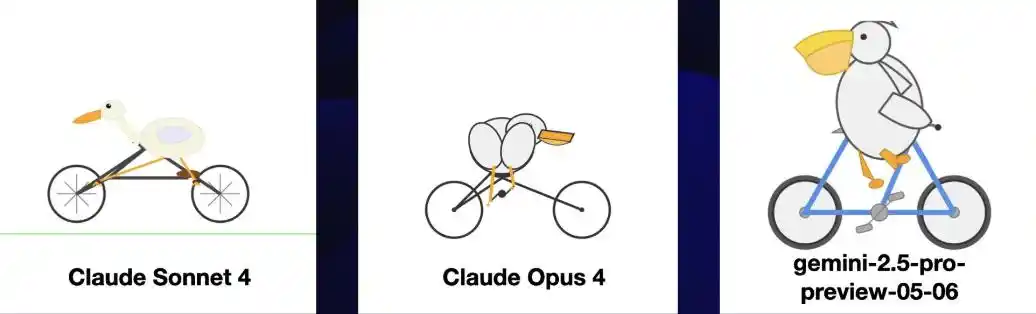
This goes back to the wildly popular "Pelican Riding a Bicycle" test from a few years ago.

This problem originated from developer Simon Willison, with only one sentence as the requirement:

Generate an SVG image of a pelican riding a bicycle.
Although this problem seems simple, it actually tests models quite significantly.

Because an SVG looks like an image, but its underlying structure is a string of code.

The model not only needs to know what a pelican and a bicycle look like separately but also must break them down into lines, circles, and polygons, then arrange the positional relationships of each component using coordinates.
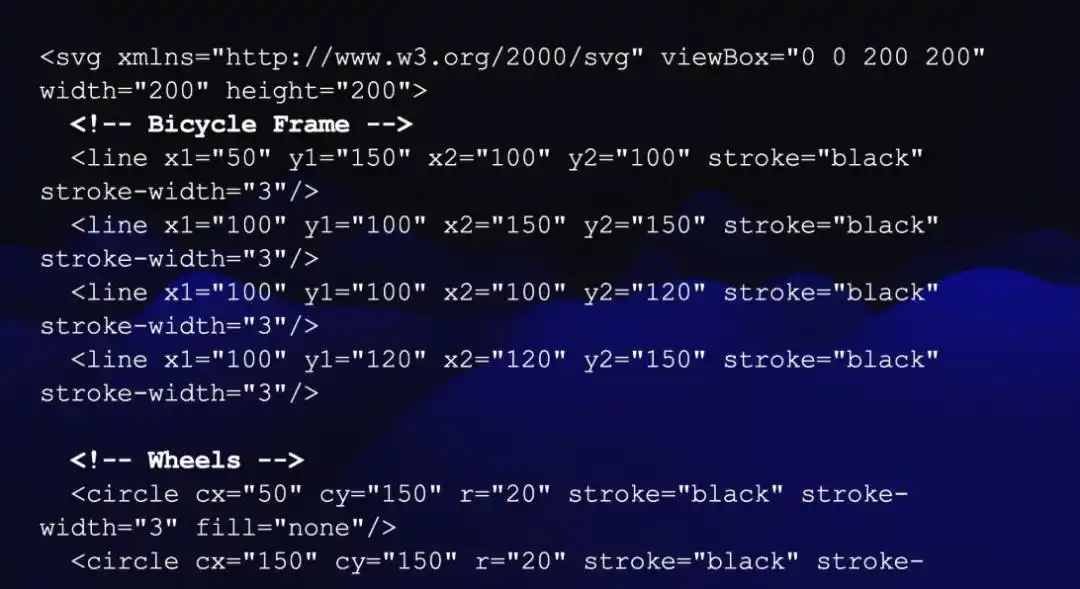
More crucially, pelicans and bicycles themselves are not a natural fit.

The bicycle's frame, tires, and pedals must maintain correct geometric structures; the pelican has a large beak, short legs, and a physique that doesn't look at all suited for pedaling.
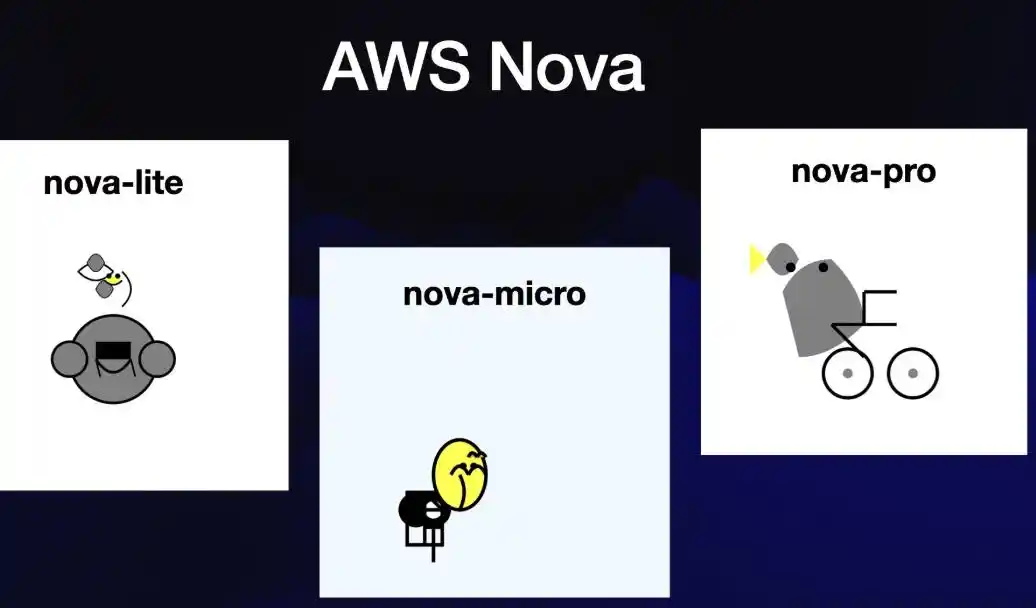
Combined, whether the model truly understands spatial relationships becomes almost immediately apparent:

Are the wheels crooked? Are the feet stepping on the pedals? Is the bird actually riding, or has it been dismembered by the bike frame?

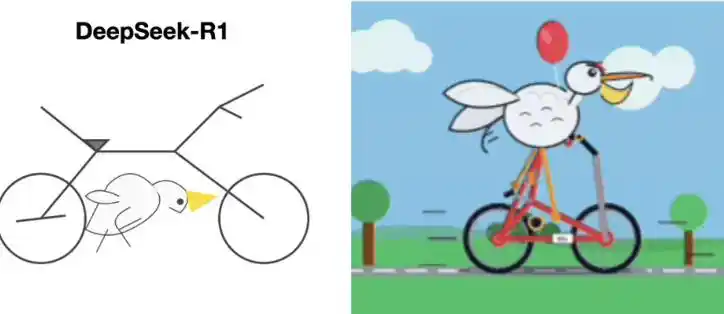
Take a look at these demos from late 2024 above~

For this reason, "Pelican Riding a Bicycle" once became a classic folk test for observing large models' spatial understanding, object composition, and code generation abilities.
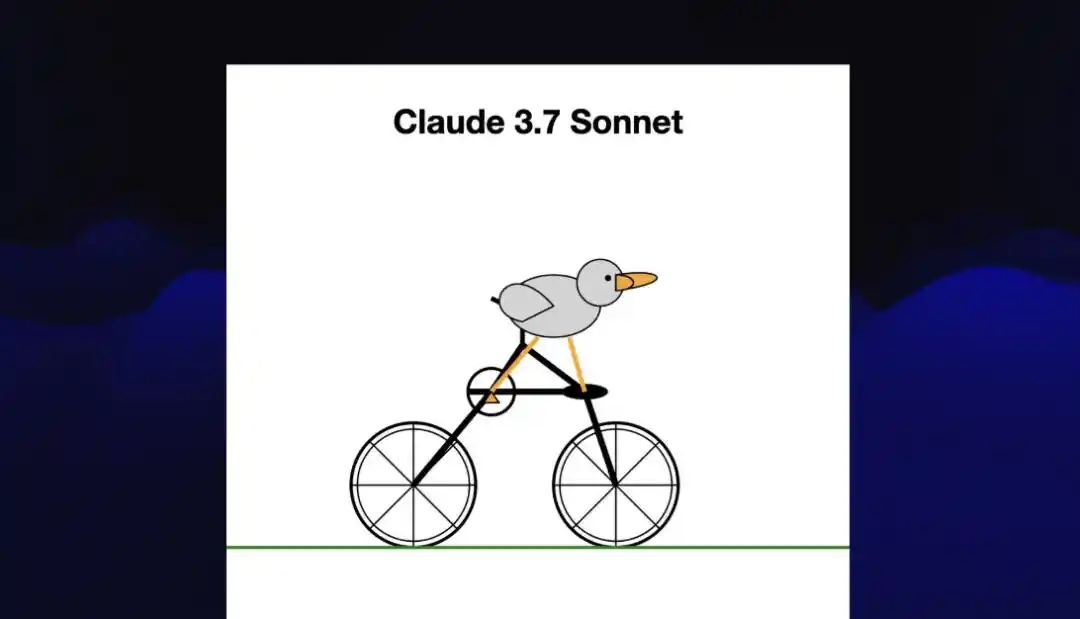
But as models grew stronger, this pelican's ride is nearing its end.

Just look at the performance of DeepSeek R1 and DeepSeek V4 below. Nowadays, models can handle this problem quite decently.
More importantly, a single SVG can only test a model's one-time output.

It cannot measure whether a model can plan a complex project, work continuously for hours, and repeatedly check and correct its own mistakes across thousands of lines of code.

Thus, Karpathy replaced a small "draw a picture" problem with a major "build a world" project—

The pelican can dismount now; Middle-earth officially takes over.
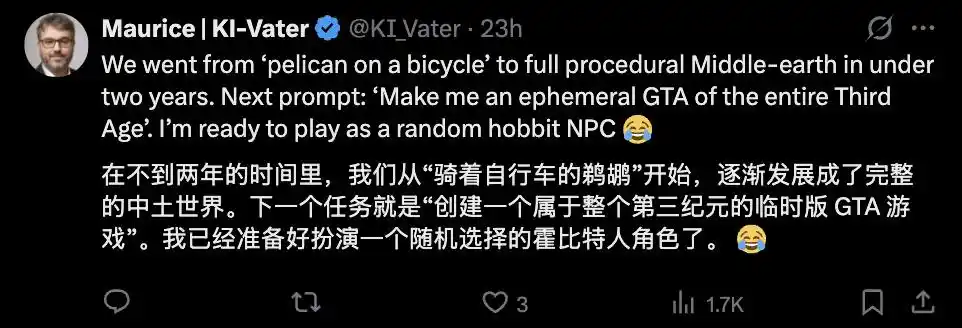
Karpathy's Pelican

Soon, news that Karpathy was preparing to change the "Pelican test" problem also spread to various communities.

High-rated comments on Hacker News argued that although the visual quality of these demos is generally low, this precisely indicates we need a new test more challenging than generating a single image.

The new benchmark shouldn't just see if the model can draw the picture correctly; it should also examine whether it can comprehend a world.
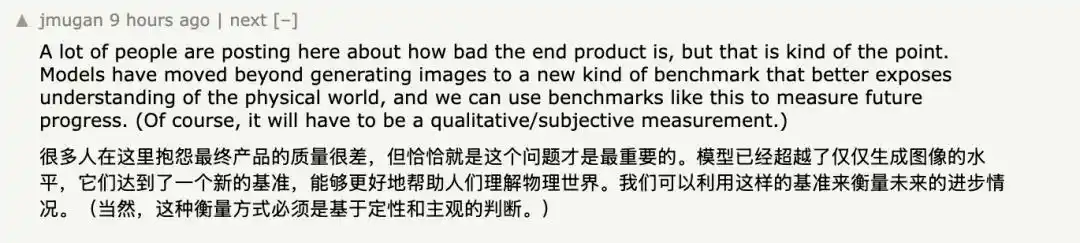
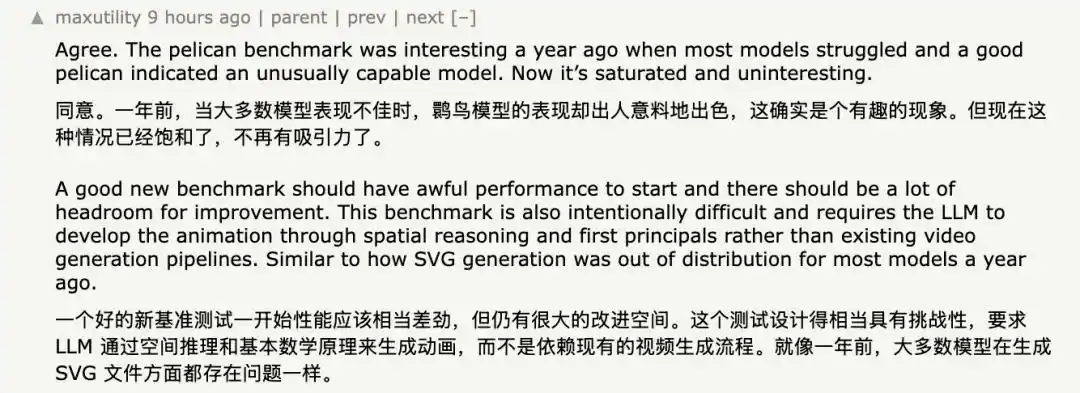
After all, "Pelican Riding a Bicycle" has been used for too long.

Models continuously optimize for this type of task on leaderboards, making the differences between them harder to discern.

In contrast, generating a complete 3D world requires the model to understand spatial relationships between characters and objects, handle camera, motion, and scene changes—not simply call a video generation model to spit out a sequence of frames.
Of course, there were opposing opinions as well.

The Pelican test is sufficiently concise, low-cost, and its results are easy to compare.

Consuming so many Tokens to generate an entire 3D world just to test a model once seems a bit like setting off fireworks with computing power.
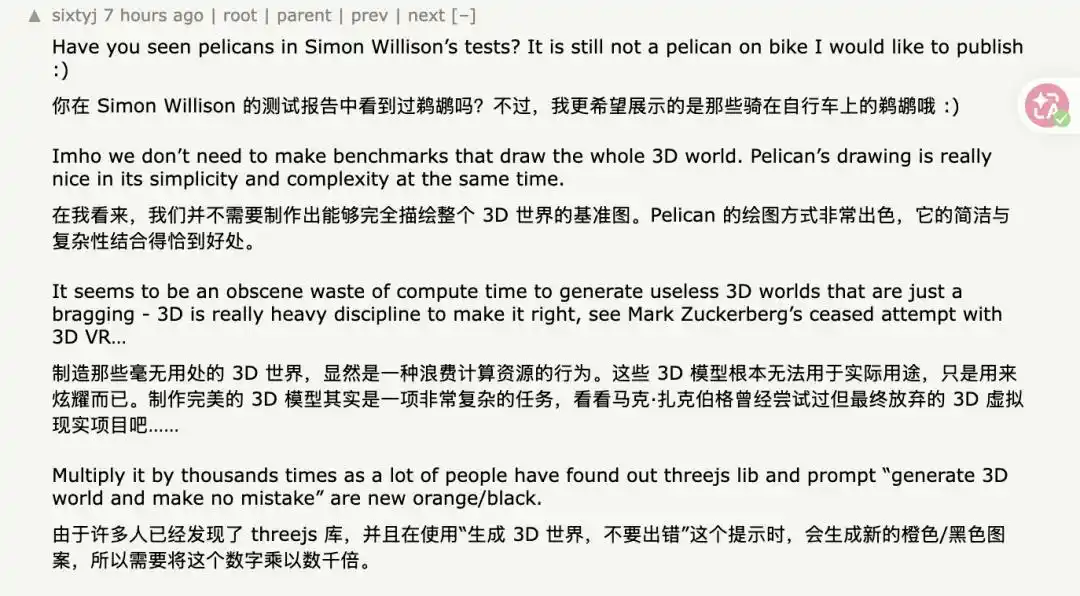
Simultaneously, whether Three.js itself can measure a large model's comprehensive abilities was also questioned.

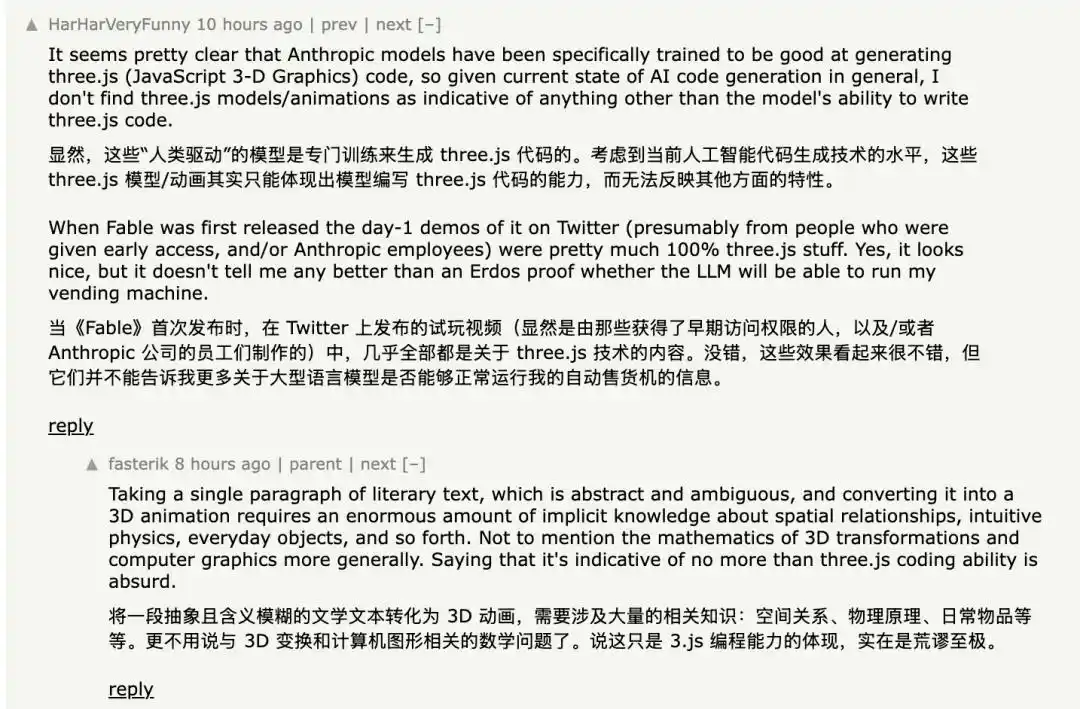
Some argued that such demos can at most prove that Anthropic has trained well on Three.js code, not that the model truly understands space and the physical world.

But soon, netizens rebutted:

Transforming an abstract, ambiguous literary text into a 3D animation requires the model to simultaneously handle spatial relationships, physical laws, everyday objects, as well as mathematical problems in 3D transformations and computer graphics.

If this is still considered merely "knowing how to write Three.js," that somewhat underestimates these 5,500 lines of code.
Another netizen raised an even more open question:

Is so-called "spatial reasoning" truly different from the reasoning large models typically perform when processing text and code?

One view holds that whether a scene holds up depends on whether the model understands spatial relationships like "front/back, inside/outside, near/far, occlusion," as well as the distance, angles, and relative sizes of objects from different viewpoints.
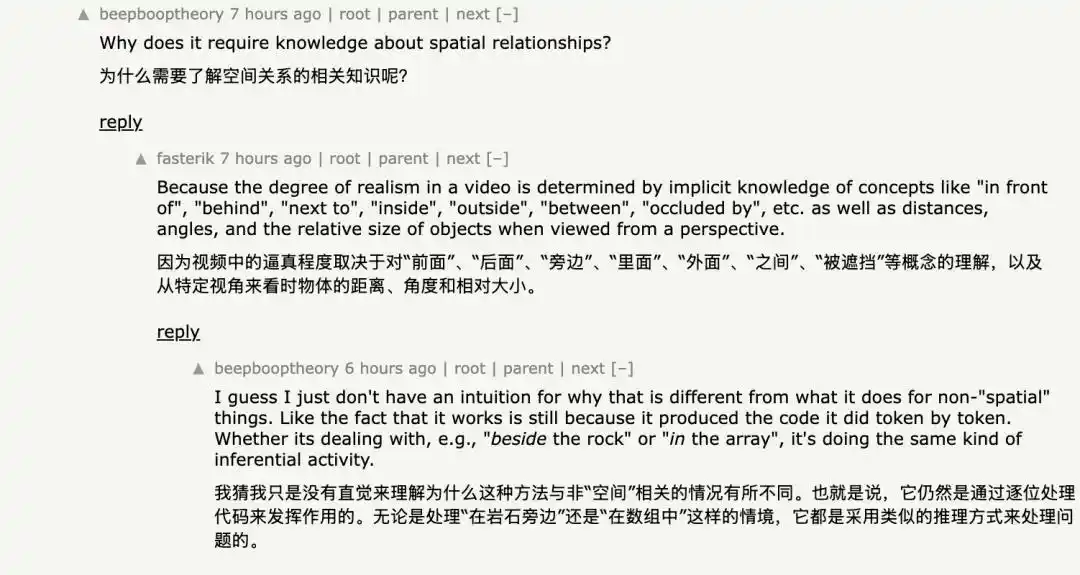
But another view argues that whether the model processes "beside a stone" or "inside an array," it might be doing the same thing: generating Tokens one by one based on context, completing reasoning in the process.

If so, then what Opus 5 demonstrates is not just a suddenly emerging "spatial ability."

A more likely scenario is that the general reasoning ability originally used by large language models to understand text and code has begun naturally extending into the three-dimensional world.

From drawing a pelican to building Middle-earth, the problem seems to have changed, but what's being tested behind the scenes might always be the same question:

Can the model transform its understanding of the world into a structure that can truly run.

And finally, perhaps there's an even more outrageous question—

If general large models can already write code to build 3D worlds themselves, then call APIs like Sora and ElevenLabs to complete visuals and audio, how much need is there left for users to personally open a specialized video generation product and input a Prompt?

Reference Links

[1]https://karpathy.ai/lotr-movie/

[2]https://simonwillison.net/2025/Jun/6/six-months-in-llms/

[3] https://x.com/wizardbrainz/status/2083012159341203708

[4]https://x.com/aniketjart/status/2083645765097033845

[5]https://x.com/davidfromkansas/status/2075691129899528254

[6]https://x.com/MindaugasLT/status/2083488027343470939

This article is from the WeChat public account "QbitAI," author: henry

Трендові криптовалюти

Пов'язані питання

QWhat is the 'Lord of the Rings benchmark' proposed by Karpathy, and what does it test?

AThe 'Lord of the Rings benchmark' is a new test proposed by Andrej Karpathy for evaluating large language models. It involves giving a model, like Anthropic's Opus 5, the opening text from 'The Lord of the Rings' and instructing it to generate an interactive 3D scene using Three.js code. This benchmark tests a model's ability to comprehend complex narratives, understand and reason about spatial relationships, plan and execute large-scale projects (generating thousands of lines of code over hours), and translate abstract textual descriptions into a functional, multi-element digital world.

QHow does the 'Lord of the Rings' benchmark differ from the previous 'Pelican Riding a Bicycle' SVG test?

AThe 'Pelican Riding a Bicycle' test required models to generate a single SVG image, testing basic spatial understanding and object composition in a simple, static output. The new 'Lord of the Rings' benchmark is significantly more complex. It replaces a simple image generation task with the creation of a dynamic, multi-scene 3D world. It assesses a model's capability for long-term planning, multi-step reasoning, maintaining consistency across a large codebase, and managing interactive elements like camera angles, lighting, and character animations over time.

QWhat were some limitations or humorous failures observed when other models attempted the new benchmark?

AWhen other models attempted the task, notable failures included the DeepSeek V4 Flash version generating a scene where all characters were floating in the air, humorously described as 'Chinese people can fly.' Other common issues across demos included characters' bodies detaching from their heads, objects clipping through each other ('穿模'), and generally rough, abstract 3D graphics reminiscent of early 2000s animations. These highlight current model shortcomings in precise spatial reasoning and physical consistency.

QAccording to the article, what major shortcoming of current large models does this benchmark expose?

AThe benchmark exposes that while current large models can write code, build scenes, and generate game prototypes, they lack the ability to truly 'understand' or interact with the worlds they create. Karpathy pointed out that Opus 5 cannot 'enter' its generated world to playtest it; it can only inspect it by taking screenshots at different points in time. This reveals a gap in capabilities: models can create interactive content but cannot perceive it visually (understand video) or agency-based understanding (play the game) to debug or refine the experience autonomously.

QWhat future applications or possibilities does the article suggest based on the success of these 3D world-generation demos?

AThe article suggests several future possibilities: 1) Lowering the barrier for creating real-time 3D content and playable prototypes, enabling more AI-native simple animations and lightweight games. 2) A hybrid workflow where procedural code (from the LLM) handles scene composition and camera control, and a video-to-video model enhances the visual fidelity. 3) The potential for users to rely on general-purpose LLMs that can orchestrate multiple specialized APIs (for 3D, video, audio) to create complex media, reducing the need to use separate, specialized tools for each task. 4) The concept of AI agents collaboratively building large-scale virtual worlds like an 'Earth Online.'

Пов'язані матеріали

Soaring 20% Then Dropping 5%: When Will the Bottom of the Korean Stock Market Be?

"South Korean stocks face a turbulent period as the KOSPI index, after a 20% surge, fell 5% to 6257 points. The market is grappling with severe issues: over 500,000 leveraged retail accounts have been liquidated, and more than 24 trillion won has flowed from stocks into bank deposits for safety. This reflects a significant loss of market liquidity and shaken investor confidence. In response, Korean financial regulators are taking action. They have tripled the minimum保证金 (margin) requirement for single-stock leveraged ETF trades to 30 million won and are considering granting themselves "emergency intervention" powers. These could include capping leverage ratios and setting investment limits on these ETFs, seen by many as amplifying market volatility. Initial results show a 75% drop in these products' trading volume post-regulation. The market downturn has political repercussions, pushing President Yoon Suk-yeol's approval rating to a new low. Meanwhile, foreign investors made a record net purchase of 7.18 trillion won during a recent rebound, while domestic retail investors sold off massively. Morgan Stanley has upgraded South Korean stocks to "overweight," citing the ongoing "leverage unwinding" and potential for a 36% upside, with giants like Samsung Electronics and SK Hynix providing valuation support. However, analysts caution that the market's structure remains vulnerable to foreign capital flows, and the current low may not be the bottom."

marsbit10 хв тому

Soaring 20% Then Dropping 5%: When Will the Bottom of the Korean Stock Market Be?

marsbit10 хв тому

Goldman Sachs Stakes a Clear Position: This Is the Largest Capital Demand Cycle in Human History, and the Fed Is Just an Observer

Goldman Sachs argues that the world is entering the most capital-intensive investment cycle in history, driven by concurrent massive demands from AI infrastructure, reindustrialization, defense reinvestment, power grid rebuilding, supply chain realignment, and sovereign debt financing. This structural competition for capital is pushing its cost higher, fundamentally altering investment paradigms. Goldman's Mark Wilson states that the Federal Reserve is merely a "passenger, not the driver" in this shift, with rising yields rooted in these real economy demands rather than just monetary policy. While major indices appeared calm in July, underlying market movements were historic, featuring extreme stock dispersion and a severe momentum factor crash, leading to significant de-risking by fund managers. Wilson cautions against expecting a quick reversal in August, citing ongoing digestion of higher rates, disrupted risk models, and typically muted market performance ahead of US midterm elections. Corporate fundamentals remain robust with strong earnings, though growth rates are peaking in the US while accelerating in Europe. Notably, hyperscale cloud companies like Amazon and Microsoft are announcing staggering capital expenditure projections for 2027-2028, justified by explosive AI-related revenue growth and high returns. Amazon revealed its AI revenue run-rate exceeds $25 billion, growing triple-digits annually, and expressed confidence that AWS could become a trillion-dollar revenue business. The report concludes that a transitional period is underway, marked by a growing tension between aggressively investing private tech giants and increasingly capital-constrained sovereign governments. The AI super-cycle continues, with August likely being a consolidation phase.

marsbit15 хв тому

Goldman Sachs Stakes a Clear Position: This Is the Largest Capital Demand Cycle in Human History, and the Fed Is Just an Observer

marsbit15 хв тому

Outflow of Stablecoins from South Korea Continues for 18 Consecutive Months, Exceeding $360 Million in June

In June 2026, South Korea experienced a net outflow of stablecoins to overseas crypto exchanges, amounting to 560.3 billion won ($367 million). This represents approximately 78% of the net value of foreign stocks purchased by Korean investors in the same period. According to the Financial Supervisory Service (FSS), this marks the 18th consecutive month of net outflows, a trend ongoing since January 2025. The FSS reported that 2.76 trillion won ($1.8+ billion) in stablecoins were withdrawn from the country's five major exchanges to foreign platforms in June, while 2.2 trillion won ($1.4 billion) flowed back in. The second quarter of 2026 saw a significant net outflow of 1.69 trillion won (~$1.1 billion), surpassing net sales of foreign stocks in the same period. Analysts cite access to unavailable domestic financial instruments as a primary driver. Foreign platforms offer crypto derivatives, spot and futures products tied to major Korean stocks like Samsung and Hyundai, along with RWA tokenization, DeFi, staking, and leveraged products. Lawmaker Lee Jong-wook warned that the stablecoin outflows constitute capital flight, exposing investors to risks on unregulated foreign platforms. He called for accelerated regulatory reform and enhanced investor protection measures. The government is reportedly working on a digital assets law to foster the blockchain sector.

cryptonews.ru20 хв тому

Outflow of Stablecoins from South Korea Continues for 18 Consecutive Months, Exceeding $360 Million in June

cryptonews.ru20 хв тому

Торгівля

Спот

Популярні статті

Що таке G$

Розуміння GoodDollar ($G$): План для децентралізованого універсального базового доходу Вступ У постійно змінному ландшафті криптовалют та технології блокчейн ініціативи, що прагнуть вирішити нагальні соціальні проблеми, привертають все більше уваги. Одним із таких проектів є GoodDollar ($G$), рішення для універсального базового доходу (UBI) на базі Web3. GoodDollar намагається подолати нерівність і скоротити розрив у багатстві, створюючи та розподіляючи доступні економічні ресурси тим, хто найбільше цього потребує. Завдяки інноваційному використанню децентралізованих фінансів (DeFi) GoodDollar представляє унікальну модель, яка може суттєво змінити сприйняття та надання фінансової допомоги у всьому світі. Що таке GoodDollar ($G$)? GoodDollar - це криптовалютний протокол, який полегшує випуск і розподіл цифрових токенів, що називаються $G$, своїм зареєстрованим користувачам на щоденній основі. Ці токени функціонують як форма універсального базового доходу, сприяючи фінансовій підтримці людей з різних культур, особливо тих, хто традиційно виключений із фінансової системи. Функціонуючи на блокчейні, GoodDollar використовує кілька мереж, включаючи Ethereum, Celo та Fuse, забезпечуючи широкий доступ і зручність. Основною метою GoodDollar є зробити криптовалюту доступною та вигідною для всіх, незалежно від їх економічного старту. Творець GoodDollar ($G$) Деталі щодо творця GoodDollar залишаються дещо неясними. Однак варто зазначити, що проект має сильну підтримку від eToro, широко визнаної інвестиційної платформи, яка надала початкове фінансування та основну підтримку для розвитку GoodDollar. Візія проекту не є виключно прибутковою, а більше схиляється до соціального підприємництва, прагнучи до системних змін у економічній доступності. Інвестори GoodDollar ($G$) GoodDollar користується фінансовою підтримкою та оперативною підтримкою eToro. Це партнерство зіграло значну роль у запуску протоколу та його подальшому розвитку. Хоча eToro відігравала важливу роль у встановленні основ проекту, GoodDollar прагне перейти до моделі, що фінансується її спільнотою в довгостроковій перспективі. Цей перехід до фінансування спільнотою відповідає зобов'язанням GoodDollar щодо децентралізації, що дає можливість її користувачам мати прямий інтерес у майбутньому проекту. Як працює GoodDollar ($G$)? Операційна структура GoodDollar значною мірою базується на принципах DeFi для генерації процентів від застрахованих криптовалют. Цей механізм дозволяє проекту карбувати та розподіляти токени $G$ як цифровий базовий дохід для користувачів у всьому світі. Декілька ключових характеристик роблять GoodDollar унікальним і інноваційним: Універсальний базовий дохід (UBI): Щодня зареєстровані користувачі отримують безкоштовні токени, що встановлює автоматичний потік доходу, призначений для полегшення фінансового тиску. Стійка економічна модель: Токеноміка проекту націлена на балансування попиту та пропозиції токенів $G$, щоб забезпечити стабільність їхньої вартості з часом. Токени з резервами: Кожен токен $G$ забезпечується резервом криптовалют, що надає йому вбудовану цінність і надійність, що є критично важливим для підтримки довіри користувачів. Децентралізоване управління: GoodDollar впроваджує демократичний підхід до прийняття рішень через управління на основі токенів. Це дозволяє членам спільноти активно брати участь у формуванні траєкторії проекту, роблячи його дійсно орієнтованим на спільноту. Глобальна доступність: GoodDollar створив значний слід у спільноті, з понад 640 000 членами в 181 країні. Такий широкий охват є інструментом у полегшенні UBI на глобальному рівні. Хронологія GoodDollar ($G$) Еволюція GoodDollar позначена кількома значними етапами в його історії: 2019: Запуск гаманця GoodDollar став першим кроком до реалізації його бачення надання UBI через криптовалюту. 2020: Після успішного впровадження гаманця, протокол GoodDollar офіційно дебютував. Це ознаменувало критичну фазу в його місії надання щоденних розподільних доходів. 2021: Проект далі прогресував із запровадженням свого Децентралізованого автономного органу (DAO), що сприяло більшій залученості спільноти та управлінню. 2022: GoodDollar представив свою дружню до DeFi версію 2 (V2), прагнучи до підвищення залученості користувачів та ефективності роботи. Того ж року також відбувся перехід до децентралізованої структури управління через GoodDAO. 2022: Була концептуалізована нова дорожня карта, зосереджена на ініціативах, таких як грантова програма, спрямована на просування підприємницьких проектів, пов'язаних з $G$, і оновленого ринку GoodDollar. Ключові особливості GoodDollar ($G$) Проект GoodDollar вводить численні важливі особливості, спрямовані на переосмислення ландшафту базового доходу: Універсальний базовий дохід: Щоденна доставка безкоштовних токенів своїм користувачам основополагає його місію з усунення економічної нестабільності. Багатоканальна операція: Використання кількох блокчейн-мереж підвищує доступність і масштабованість, забезпечуючи ширшу участь. Взаємодія з децентралізованими фінансами: Використання DeFi дозволяє забезпечити сталість фінансування моделі UBI, зміцнюючи її життєздатність як економічного рішення. Залучення спільноти та управління: GoodDollar передбачає модель, в якій спільнота впливає на операції через демократичну участь, що сприяє прозорості та підзвітності. Глобальна спільнота: Наявність різноманітної глобальної спільноти дозволяє проекту реалізовувати рішення UBI, адаптовані до різних культурних та економічних контекстів. Висновок GoodDollar представляє собою трансформаційний крок до впровадження принципів універсального базового доходу через інноваційний погляд на технологію блокчейн. Використовуючи децентралізовані фінанси, проект не лише пропонує рішення для фінансової нерівності, але й активно залучає користувачів до його управління та операцій. Зростаюча спільнота та еволюційна дорожня карта роблять GoodDollar значущим гравцем на перетині криптовалюти та соціального добра, прокладаючи шлях до більш справедливого фінансового майбутнього. Як він продовжує еволюціонувати, шлях GoodDollar може в кінцевому підсумку надихнути інші ініціативи розглянути подібні моделі, просуваючи справу економічного розширення можливостей для всіх.

150 переглядів усьогоОпубліковано 2024.04.05Оновлено 2024.12.03

Що таке G$

Як купити G

Ласкаво просимо до HTX.com! Ми зробили покупку Gravity (G) простою та зручною. Дотримуйтесь нашої покрокової інструкції, щоб розпочати свою криптовалютну подорож.Крок 1: Створіть обліковий запис на HTXВикористовуйте свою електронну пошту або номер телефону, щоб зареєструвати обліковий запис на HTX безплатно. Пройдіть безпроблемну реєстрацію й отримайте доступ до всіх функцій.ЗареєструватисьКрок 2: Перейдіть до розділу Купити крипту і виберіть спосіб оплатиКредитна/дебетова картка: використовуйте вашу картку Visa або Mastercard, щоб миттєво купити Gravity (G).Баланс: використовуйте кошти з балансу вашого рахунку HTX для безперешкодної торгівлі.Треті особи: ми додали популярні способи оплати, такі як Google Pay та Apple Pay, щоб підвищити зручність.P2P: Торгуйте безпосередньо з іншими користувачами на HTX.Позабіржова торгівля (OTC): ми пропонуємо індивідуальні послуги та конкурентні обмінні курси для трейдерів.Крок 3: Зберігайте свої Gravity (G)Після придбання Gravity (G) збережіть його у своєму обліковому записі на HTX. Крім того, ви можете відправити його в інше місце за допомогою блокчейн-переказу або використовувати його для торгівлі іншими криптовалютами.Крок 4: Торгівля Gravity (G)Легко торгуйте Gravity (G) на спотовому ринку HTX. Просто увійдіть до свого облікового запису, виберіть торгову пару, укладайте угоди та спостерігайте за ними в режимі реального часу. Ми пропонуємо зручний досвід як для початківців, так і для досвідчених трейдерів.

517 переглядів усьогоОпубліковано 2024.12.10Оновлено 2026.06.02

Як купити G

Що таке @G

Graphite Network, $@G: Міст між традиційними фінансами та Web3 Вступ до Graphite Network, $@G У яскравому світі криптовалют та проектів web3 Graphite Network виступає як маяк інновацій. З його рідним токеном, $@G, цей блокчейн Layer-1, що працює на основі Proof-of-Authority (PoA), призначений для подолання розриву між традиційними фінансами (TradFi) та швидко розвиваючою екосистемою Web3. Оскільки цифрові валюти набирають популярності, Graphite Network прагне запропонувати блокчейн-платформу, яка пріоритетно ставить безпеку, відповідність та швидкість, представляючи себе як посередника довіри та підзвітності. Що таке Graphite Network, $@G? Graphite Network не просто ще один блокчейн-проект; він має на меті переосмислити, як децентралізація, безпека та підзвітність користувачів сприймаються у сфері цифрових фінансів. Проект має ряд відмінних характеристик: Блокчейн на основі репутації: У своїй основі Graphite Network реалізує політику один користувач, один рахунок, підкріплену інтегрованою перевіркою Know Your Customer (KYC) та механізмами оцінки. Цей дизайн забезпечує баланс між конфіденційністю користувачів та прозорістю — критично важливий аспект фінансових операцій у сучасному цифровому світі. Дохід від вузлів входу: Мережа стимулює користувачів налаштовувати вузли входу, що дозволяє операторам отримувати винагороди від транзакцій у мережі. Ця модель генерації доходу не лише підвищує залученість користувачів, але й зміцнює здоров'я мережі та децентралізацію. Сумісність з EVM: Завдяки віртуальній машині (VM), сумісній з Ethereum, Graphite Network забезпечує безшовну інтеграцію існуючих децентралізованих додатків (dApps) на Solidity та смарт-контрактів, запрошуючи розробників використовувати її можливості без значних модифікацій. Інтеграція KYC: В епоху, коли відповідність є надзвичайно важливою, інтегрована структура KYC з кількома рівнями перевірки підвищує контроль над фінансовими операціями без обов'язкової участі, встановлюючи прецедент для автономії користувачів. Хто є творцем Graphite Network, $@G? Graphite Network виник внаслідок зусиль Graphite Foundation, неприбуткової організації, що займається розвитком, підтримкою та еволюцією Graphite Network. Зобов'язання фонду підкреслює бачення проекту створити безпечне та стійке блокчейн-середовище, зосереджене на справжньому залученні користувачів та відповідності. Хто є інвесторами Graphite Network, $@G? На даний момент є обмежена інформація про конкретних інвесторів, які підтримують ініціативу Graphite Network. Засновницька організація, Graphite Foundation, функціонує незалежно, сприяючи зростанню проекту, одночасно шукаючи партнерства, які резонують з її баченням відповідальної та доступної блокчейн-платформи. Як працює Graphite Network, $@G? Операція Graphite Network ґрунтується на його унікальному механізмі консенсусу Proof-of-Authority, який досягає вражаючого балансу між високою пропускною здатністю та децентралізацією. Давайте розглянемо різні компоненти, які визначають його роботу: Транспортні вузли: Служачи вузлами входу, вони є критично важливими для екосистеми. Оператори можуть отримувати дохід від транзакцій, які проходять через мережу, що не лише надає можливості окремим користувачам, але й зміцнює децентралізацію мережі. Авторизовані вузли: У центрі Graphite Network знаходяться основні валідатори, які проходять суворі тести на відповідність, що включають надійну перевірку KYC разом з технічними оцінками. Цей рівень довіри є важливим для забезпечення високого рівня цілісності транзакцій у мережі. Система тікерів: Graphite Network використовує унікальну систему тікерів для своїх обгорнених токенів, позначених як @G. Ця функція підвищує ясність інтеграції активів, роблячи транзакції користувачів зрозумілими та простими. Інноваційний підхід Graphite Network відображає значний крок у вирішенні критичних питань цифрових фінансів, позиціонуючи себе вигідно для майбутнього, оскільки все більше користувачів переходять від традиційних форм фінансів до світу децентралізованих додатків. Хронологія Graphite Network, $@G Щоб зрозуміти прогрес і етапи Graphite Network, корисно переглянути ключові події в його хронології: 2021: Заснування Graphite Network Graphite Foundation знаменує початок нової ери в розвитку блокчейнів, зосереджуючись на відповідності та розширенні можливостей користувачів. Ключові події: Після запуску впровадження доходу від вузлів входу, встановлення моделі на основі репутації, інтегрована перевірка KYC та забезпечення сумісності з EVM представляють значні досягнення в проекті. Останні події: Постійний розвиток та зусилля Graphite Foundation зосереджені на покращенні функцій мережі, одночасно сприяючи зростанню екосистеми, демонструючи довгострокове зобов'язання до стійкості та інновацій. Додаткові ключові моменти Окрім своїх основних компонентів, Graphite Network охоплює кілька інструментів та функцій, які підвищують його зручність: Гаманець Graphite: Зручне розширення для Chrome, яке полегшує доступ до різних функцій та додатків мережі на сумісних з Ethereum ланцюгах, підвищуючи зручність для користувачів. Міст Graphite: Цей інструмент дозволяє безшовні передачі активів Graphite через різні мережі, сприяючи інтегрованій та взаємодійній екосистемі. Explorer Graphite: Служачи важливим інструментом у межах екосистеми, ця функція дозволяє користувачам переглядати та перевіряти вихідний код смарт-контрактів, відстежувати транзакції та досліджувати іншу важливу інформацію в реальному часі. Тестова мережа Graphite: Проект забезпечує надійне тестове середовище для розробників, дозволяючи їм забезпечити стабільність та масштабованість перед розгортанням у основній мережі. Ця ініціатива не лише надає можливості розробникам, але й підвищує надійність усієї мережі. Висновок Graphite Network з його рідним токеном $@G представляє значний крок до подолання розриву між традиційними фінансами та передовими блокчейн-технологіями. Зосереджуючись на безпеці, відповідності та децентралізації, ця інноваційна платформа готова очолити перехід у еру Web3. Оскільки залучення користувачів зростає, а все більше проектів використовують її можливості, Graphite Network має всі шанси зробити тривалі внески в швидко змінюваний цифровий ландшафт. На завершення, Graphite Network є свідченням того, що можна досягти, коли інноваційне мислення зустрічається з зростаючими вимогами сучасних фінансів та технологій. Оскільки світ досліджує потенціал децентралізованих фінансів, Graphite Network, безумовно, залишиться помітним гравцем у цій сфері.

42 переглядів усьогоОпубліковано 2025.01.06Оновлено 2025.01.06

Що таке @G

Обговорення

Ласкаво просимо до спільноти HTX. Тут ви можете бути в курсі останніх подій розвитку платформи та отримати доступ до професійної ринкової інформації. Нижче представлені думки користувачів щодо ціни G (G).

活动图片