Shiba Inu SOU Recovery System Goes Live After Shibarium Hack

bitcoinistОпубліковано о 2026-02-17Востаннє оновлено о 2026-02-17

Анотація

Shiba Inu has launched its SOU (Shib Owes You) recovery system to compensate users affected by the 2025 Shibarium bridge exploit. The on-chain NFT-based framework allows users to claim verifiable records of their losses, which are tradable, mergeable, and splittable on Ethereum. The system distinguishes between principal repayments and bonus rewards, funded through ecosystem revenues and community donations. It aims to provide transparency and liquidity options, enabling affected participants to either wait for full reimbursement or sell their claims on secondary markets.

Shiba Inu has put its long-trailed SOU recovery framework into production, opening claims for users affected by last year’s Shibarium bridge exploit and turning those claims into transferable, on-chain NFTs on Ethereum. The launch matters because it moves the project’s compensation effort from a promised structure into a live system with visible balances, payout mechanics, and a secondary-market option for anyone who wants liquidity now.

The SOU concept itself isn’t new. In a year-end letter dated Dec. 29, 2025, Shibarium developer Kaal Dhairya introduced “SOU: Shib Owes You” while stressing it was “Not live yet, beware of scammers,” describing it as a system where “every affected user has an SOU NFT — an on-chain, verifiable record of exactly what the ecosystem owes them.”

Shiba Inu ‘Shib Owes You’ Goes Live

That warning is now being replaced by a go-live announcement. Via X, the official Shiba Inu account wrote:

“SOU is live. Introducing SOU (Shib Owes You) an onchain NFT built as a good-faith effort to support impacted users with payouts, donations, and occasional rewards. Transparent. Tradable. On-chain. You can transfer it, split it, merge it, or trade it on marketplaces. Claim your SOUs: https://shib.io/sou”

In Shib’s documentation, the system is framed as an attempt to make the recovery ledger public, auditable, and mechanically enforced rather than tracked in private databases. “SOU (Shib Owes You) is more than just a name; it is a commitment,” the docs say.“It represents the Shib ecosystem’s dedication to making users whole through a transparent, audited, and on-chain recovery system. Activity Notifications: The system provides a real-time activity feed, notifying the community whenever a new donation is received or a payout is distributed, ensuring complete visibility into the recovery progress.”

The mechanism hinges on two balances: “Original Principal,” the immutable historical record of what a user lost, and “Current Principal,” which declines as payouts are claimed or contributions flow in. The docs also draw a hard distinction between debt repayment and incentives. “Payout” reduces principal as compensation, while a “Reward” is additive and “No Change” to the owed balance, positioning rewards as bonuses on top of repayment rather than substitutes.

SOU is also designed to be a financial instrument, not just a receipt. Claims can be merged or split to manage position sizing, transferred between wallets, or sold on marketplaces, effectively enabling a market in discounted claims for users who don’t want to wait for recovery flows.

Shib’s docs also describe a funding model that routes ecosystem revenues and community donations into a common pool, with donations applied proportionally across affected claims, and optional creator fees on secondary sales directed back to payouts or rewards.

The backdrop is the September 2025 Shibarium bridge incident, where Shib’s own security update said “unauthorized validator signing power” was used to push a malicious exit through the PoS bridge, enabling withdrawals of multiple assets.

At press time, Shiba Inu traded at $0.00000656.
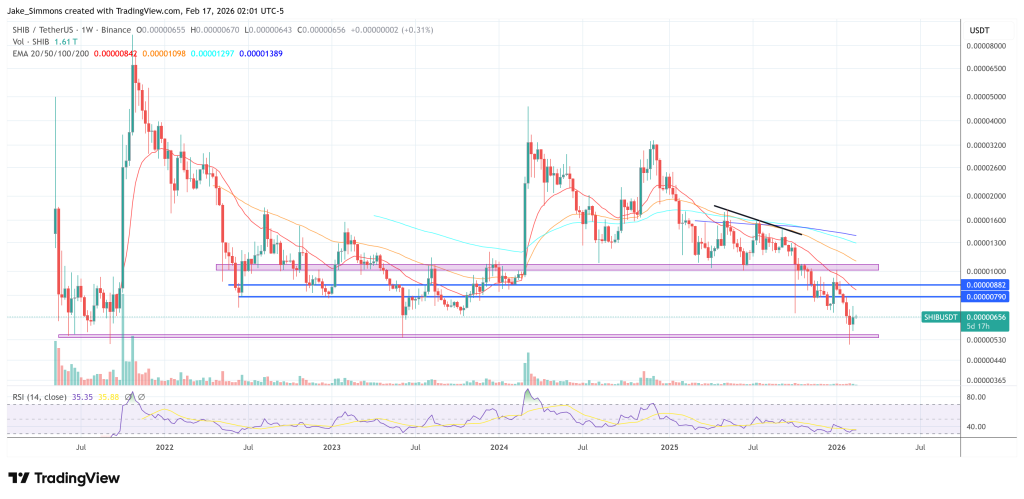
Shiba Inu trades near historical lows, 1-week chart | Source: SHIBUSDT on TradingView.com

Пов'язані матеріали

Unlocking $100 Million in Liquidity? Pump.fun's New Policy Tests the 5-Minute Pump Technique

Pump.fun, a popular meme coin launchpad, has introduced a new standard mechanism called BOOST. It aims to address a significant capital efficiency issue: when a newly launched token graduates from its initial bonding curve to a liquidity pool (LP), roughly 20% of its liquidity becomes permanently locked as "dead liquidity," estimated to waste over $100 million annually. Instead of locking these funds permanently, BOOST repurposes them. Upon a token's migration, approximately 20% of the settlement funds (e.g., 17.6 SOL or ~$2516 USDC) are used to buy back the token on the open market over a 5-minute period via a Time-Weighted Average Price (TWAP) mechanism. All purchased tokens are immediately burned. This creates a brief, systematic buy pressure immediately after migration, potentially generating a short-term price surge ("pump") while permanently reducing the token's circulating supply. The goal is to enhance the immediate post-launch trading experience, potentially increasing trader retention and sustainable protocol revenue, which funds ongoing token buybacks. However, concerns exist that this artificial 5-minute boost could lower the barrier for launching low-quality tokens and lead to steeper price crashes once the buy pressure stops, if followed by large sell-offs. The feature automatically applies to tokens migrating after July 21, 2024, but not to previously migrated tokens or those launched via the Mayhem AI Agent lab.

marsbit9 хв тому

Unlocking $100 Million in Liquidity? Pump.fun's New Policy Tests the 5-Minute Pump Technique

marsbit9 хв тому

Podcast Notes | Conversation with GSR Asset Management Head: To Determine if This Crypto Rally is Real, Just Watch the Lending Rates on Aave

Podcast Summary: Dialogue with GSR's Head of Asset Management: To Determine if This Crypto Rally is Real, Just Check Lending Rates on Aave Andy Baehr, Managing Director of Asset Management at GSR, discusses the current crypto market, characterizing it as stuck in a state of "ambivalence" with short-lived, unsustainable rallies. He outlines a simple framework: the market moves between "ambivalence" and "conviction" (sustained upward momentum). Currently, every rally resembles a single-stage rocket booster that quickly fizzles out. Baehr identifies three key signals to watch: 1) DeFi lending rates, 2) the potential passage of the CLARITY Act, and 3) the market forming a consensus on the "Fed hawkish peak." He emphasizes that the most immediate indicator for the sustainability of the recent CPI-triggered rally is the USDC borrowing rate on Aave, currently around 3.75%—close to U.S. Treasury yields. The absence of a credit spread indicates low leverage demand and a lack of market energy. He explains that a healthy, sustained rally requires layered buying pressure. Last year's rally progressed from an ETH short squeeze to crypto-native trader influx and finally to ETF inflows. Currently, this structure is missing. Other potential structural buyers like Digital Asset Treasury (DAT) companies are absent, and ETF flows have proven transient. Baehr notes that while small-cap crypto tokens outperformed large caps in Q2—a potential sign of capitation in major assets—capital is also flowing to more exciting opportunities like AI stocks and tech IPOs, leaving crypto sidelined. Regarding DeFi, he highlights that platforms like Aave provide a clear, real-time signal of leverage demand through their supply/demand-driven interest rates. A significant, sustained rate increase would signal genuine market conviction. He also observes the quiet emergence of fixed-income-like products and vaults in DeFi. On regulation, the probability of the CLARITY Act passing before the August 7th deadline has dropped linearly from 75% to below 40% on Polymarket. Baehr suggests its passage would be treated as a bullish surprise, a potent driver for price movement. However, political hurdles, including ethical clause debates and disclosures about the First Family's crypto profits, remain significant obstacles. Ultimately, the market awaits clarity on the Fed's terminal rate under Chair Warsh. Until the "Fed Solstice"—the point where the market collectively understands the peak of hawkish policy—sustained conviction will be difficult to achieve.

marsbit40 хв тому

Podcast Notes | Conversation with GSR Asset Management Head: To Determine if This Crypto Rally is Real, Just Watch the Lending Rates on Aave

marsbit40 хв тому

Торгівля

Спот
活动图片