Shiba Inu Lead Dev Issues Must-Read Year-End Letter: What You Must Know

bitcoinistОпубліковано о 2025-12-30Востаннє оновлено о 2025-12-30

Анотація

Shiba Inu lead developer Kaal Dhairya published a year-end letter describing the project's most difficult period, marked by a hack and leadership departures. He confirmed engagement with federal law enforcement and outlined technical recovery steps, including reactivating the Plasma Bridge with enhanced security. Dhairya introduced the SOU ("Shib Owes You") system, an on-chain NFT-based claims process on Ethereum to track and repay affected users. He stressed that ecosystem revenue must be directed toward repayments as an obligation, not an option. The letter calls for a shift from hype to focused rebuilding and financial accountability in the year ahead.

Shiba Inu lead developer Kaal Dhairya published a year-end letter on Dec. 29 describing what he called the most difficult period in the project’s history, outlining post-hack recovery steps, law-enforcement engagement, and a proposed on-chain claims system meant to track repayment to affected users.

Shiba Inu’s Team Year-End Letter

“This year — especially the last few months — has been the hardest period in Shiba Inu’s history,” Dhairya wrote. “The hack happened. The leadership that was supposed to be here and help us through this difficult time — isn’t. They left, without accountability, and without looking back. I stayed.”

Dhairya said he is not writing as Shiba Inu’s “official ‘leader,’” but argued the community deserves a direct update on what has been done, what is still unresolved, and what changes internally. He described the team working “around the clock — all-nighters, weekends, holidays,” and positioned the letter as an accountability-driven reset focused on repayment and core infrastructure.

Addressing claims that the team failed to file official complaints, Dhairya said a formal process is underway and pushed back on demands for public proof. “I have personally been interviewed by not one, not two, but three federal agents,” he wrote. “I passed on everything I have — all the information, all the OSINT, all the details we gathered during and after the incident. The official process is happening. It has been happening.”

He declined to share a complaint ID and said he would not continue “defending” the response to opportunistic critics, arguing some are “looking to sell their snake oil and keep extracting from you.”

Dhairya said “the technical recovery is largely complete,” detailing changes made after the hack. He wrote that the Plasma Bridge is back online with new safeguards, including “blacklisting, 7-day withdrawal delays, and hardened contracts,” and said more than 100 critical contracts have been moved to hardware custody. Hexens reviewed “every major change,” he added, and the checkpoint system is functioning again.

He also flagged a longer-term architecture change: “We’re also decoupling the bridge from the validators,” describing it as foundational work intended to enable decentralization of Shibarium. Even with that, he cautioned that malicious validators remain a risk and decentralizing the chain “won’t be easy.” Dhairya drew a hard distinction between restoring infrastructure and repaying users. “But technical recovery is not the same as making people whole,” he wrote.

SOU: ‘Shib Owes You’ Claims Via NFT

To address repayment, Dhairya introduced SOU (“Shib Owes You”), a system he stressed is “not live yet” and likely to attract scammers pretending otherwise. Under the proposal, every affected user receives an “SOU NFT” that records what the ecosystem owes them as an on-chain claim on Ethereum.

“This isn’t a promise in a database somewhere,” Dhairya wrote. “It’s cryptographic proof that you own a claim, recorded permanently on the Ethereum blockchain where no one can manipulate it or make it disappear.”

Each SOU tracks a principal amount that declines as payouts occur or donations are applied, with progress visible “in real time” and verifiable. Dhairya said SOUs can be “merged, split, or transferred,” including the option to sell a claim for liquidity on supported marketplaces. He added that the system’s components—“minting, payouts, donations, transfers”—have been audited by Hexens.

Dhairya argued the system only works if cash flow is routed into it, and said that should be treated as an obligation for ecosystem participants, particularly those controlling official distribution channels. “For SOU to function — for affected users to actually get made whole — revenue has to flow into the system,” he wrote. “That means everyone who benefits from the Shiba Inu ecosystem needs to contribute back. Not optionally. As an obligation.”

He said he will pause or sunset projects that are not generating revenue or reaching break-even, and prioritize initiatives that can fund repayment. “Revenue flows to SOU. SOU pays back affected users. If a project doesn’t fit that chain, it waits,” Dhairya wrote. He also previewed potentially contentious changes, including revisiting tokenomics and restructuring or merging systems to redirect value “back to the network and to the users who were affected.”

In closing, Dhairya said he has personally committed significant time and funds to keep the ecosystem running, but cannot do so indefinitely. “I cannot keep doing this forever,” he wrote, calling for others to step up if they believe Shib should be “a decentralized network” rather than “a meme” or “a pump.”

“The year ahead won’t be about hype,” Dhairya added. “It will be about repair, focus, and building something that can actually last.”

At press time, Shiba Inu traded at $0.00000721.
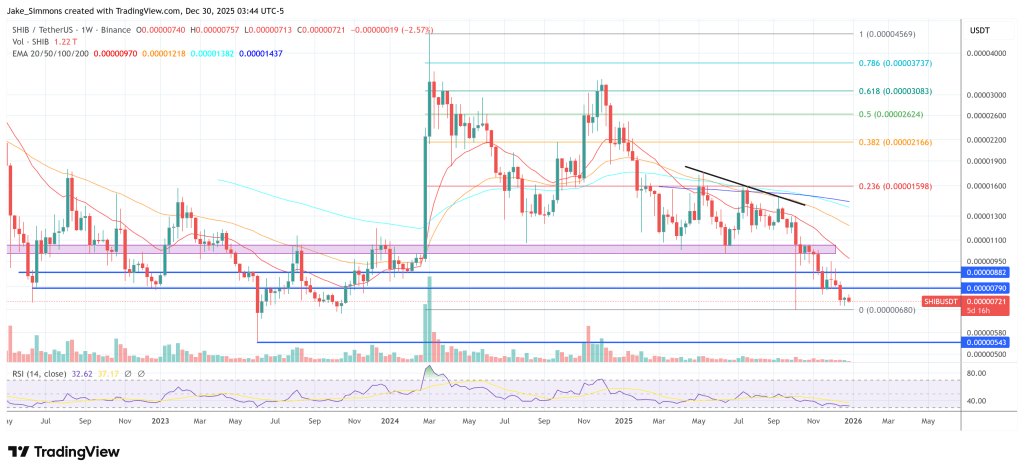
Shiba Inu remains in deep bearish territory, 1-week chart | Source: SHIBUSDT on TradingView.com

Пов'язані матеріали

Near Returns to the AI Stage: Transformation into a Public Chain Due to 'Payroll Difficulties,' Agent and Privacy Emerge as New Growth Narratives

NEAR Returns to AI Origins: From Payroll Struggles to Blockchain, Now Focusing on AI Agents and Privacy NEAR Protocol's journey began not with grand blockchain ambitions, but from a practical hurdle: its AI startup founders, including Transformer paper co-author Illia Polosukhin, couldn't efficiently pay international developers in 2017. This led them to pivot and build a high-performance, scalable blockchain. After years navigating various crypto narratives like sharding and cross-chain interoperability, NEAR is now leveraging its AI roots to re-enter the AI arena. A key driver is its "NEAR Intents" layer, which abstracts complex cross-chain transactions. Users simply state their goal (e.g., swap BTC for ETH), and a solver network finds the optimal route. This system has processed over $20B in cross-chain volume, generating significant fee revenue. A major growth area is private transactions via "Confidential Intents/Swaps," which hide trade details until settlement to protect against MEV and front-running. Remarkably, private swaps recently accounted for over 40% of NEAR's transaction volume, highlighting strong demand but also potential regulatory scrutiny. With its AI-founder pedigree, NEAR is positioning itself at the intersection of blockchain, AI agents, and privacy, aiming to become infrastructure for the emerging agent economy while navigating the challenges of its rapid adoption.

marsbit28 хв тому

Near Returns to the AI Stage: Transformation into a Public Chain Due to 'Payroll Difficulties,' Agent and Privacy Emerge as New Growth Narratives

marsbit28 хв тому

From Ethereum to AI's 'CROPS': What Exactly is This Set of 'Slow Variables' That Vitalik Repeatedly Emphasizes?

In recent discussions, Vitalik Buterin has frequently emphasized the concept of "CROPS," a framework defining core values for Ethereum's development. CROPS stands for Censorship Resistance, Capture Resistance, Open Source, Privacy, and Security. Initially outlined in the Ethereum Foundation's "EF Mandate," it represents a commitment to user sovereignty, ensuring that the network resists external control, remains open, protects privacy, and prioritizes security. The relevance of CROPS extends beyond Ethereum's foundational principles, becoming crucial in the context of AI integration. As AI agents begin handling wallet operations and automated transactions, the risk increases that users may cede control over their digital assets, privacy, and intentions to centralized AI service providers. A "CROPS AI" would therefore emphasize local execution where possible, privacy-preserving remote model calls (e.g., using zero-knowledge proofs), and transparent, verifiable processes to maintain user agency. Vitalik highlights a significant convergence between "CROPS Ethereum access layer" and "CROPS AI." Both address the same fundamental challenge: how users can access powerful services—be it blockchain data via RPCs or AI models—without exposing sensitive information or relinquishing ultimate control. This intersection points toward a future digital entry point that is more private, secure, and user-controlled. Ultimately, CROPS is not merely an abstract ideal but a practical guidepost. It steers development—from protocol resilience and wallet design to AI agent safety—towards a future where users retain self-sovereignty even as digital systems grow more complex and powerful. In an era of accelerating AI adoption, these "slow variables" of censorship resistance, openness, privacy, and security may define Ethereum's enduring value.

marsbit39 хв тому

From Ethereum to AI's 'CROPS': What Exactly is This Set of 'Slow Variables' That Vitalik Repeatedly Emphasizes?

marsbit39 хв тому

Silicon Valley 'Startup Guru' Steve Hoffman: Web3 + AI Could Be a Trap

Silicon Valley investor and "Godfather of Startups" Steve Hoffman warns that combining Web3 with AI is likely a trap, not a promising venture. In an interview, Hoffman argues that while AI is a foundational technology touching all industries, Web3 adds complexity, friction, and regulatory risk without solving mainstream consumer or business needs. He advises founders to focus on deep, specialized applications where startups can out-iterate giants, rather than on generic features easily replicated by large tech companies. Hoffman observes that Silicon Valley will lead foundational AI research, while China excels at rapid, large-scale application and commercialization, particularly in robotics. He stresses that AI-driven autonomous agents capable of collaborative, multi-step tasks are 2-4 years away, which will cause significant job displacement. The solution is not to slow AI but to redesign business models around human-AI collaboration and reform social systems like education and retraining. For startups, Hoffman recommends focusing on vertical, expertise-heavy domains to build defensibility. He sees major opportunities in AI fraud detection and cybersecurity. Key founder mindsets include systemic thinking over feature-focus, relentless customer centricity, building adaptive teams, and deeply understanding AI's capabilities and limits. Hoffman is also leading a non-profit initiative to establish university centers aimed at training future leaders in responsible, human-value-aligned AI innovation.

marsbit2 год тому

Silicon Valley 'Startup Guru' Steve Hoffman: Web3 + AI Could Be a Trap

marsbit2 год тому

Token Inefficient, Economy Tokenless

The article "Tokens Aren't Economical, Economics Aren't Tokenized" analyzes a pivotal shift in the AI industry from a technology-driven narrative to one dominated by capital efficiency. It highlights two concurrent trends: a severe capital shortage due to the exorbitant and recurring costs of compute (e.g., OpenAI's high burn rate) and a wave of corporate spin-offs where major tech companies are separating their AI units (like Kuaishou's Kling and Baidu's Kunlunxin). The core argument is that AI's "anti-internet" business model, where user growth increases costs rather than profits, has created a disconnect between high valuations and actual cash flow. Spin-offs address this by allowing AI assets to be valued independently. Within a parent company, they are seen as cost centers, but as standalone entities, they are priced based on their growth potential and scarcity in the primary market, leading to massive valuation premiums (e.g., Kling's estimated value tripling post-spin-off). The industry is at an inflection point, moving from "model worship" to "value realization." The competition is evolving from a pure compute (GPU) race to a broader focus on systemic efficiency and full-stack engineering (involving CPUs and orchestration) to achieve viable commercialization. The year 2026 is framed as a critical moment where the industry must definitively answer how to economically translate AI capability into tangible business value, reshaping the sector's future power structure.

marsbit2 год тому

Token Inefficient, Economy Tokenless

marsbit2 год тому

Торгівля

Спот
Ф'ючерси

Популярні статті

Як купити BILL

Ласкаво просимо до HTX.com! Ми зробили покупку Billions Network (BILL) простою та зручною. Дотримуйтесь нашої покрокової інструкції, щоб розпочати свою криптовалютну подорож.Крок 1: Створіть обліковий запис на HTXВикористовуйте свою електронну пошту або номер телефону, щоб зареєструвати обліковий запис на HTX безплатно. Пройдіть безпроблемну реєстрацію й отримайте доступ до всіх функцій.ЗареєструватисьКрок 2: Перейдіть до розділу Купити крипту і виберіть спосіб оплатиКредитна/дебетова картка: використовуйте вашу картку Visa або Mastercard, щоб миттєво купити Billions Network (BILL).Баланс: використовуйте кошти з балансу вашого рахунку HTX для безперешкодної торгівлі.Треті особи: ми додали популярні способи оплати, такі як Google Pay та Apple Pay, щоб підвищити зручність.P2P: Торгуйте безпосередньо з іншими користувачами на HTX.Позабіржова торгівля (OTC): ми пропонуємо індивідуальні послуги та конкурентні обмінні курси для трейдерів.Крок 3: Зберігайте свої Billions Network (BILL)Після придбання Billions Network (BILL) збережіть його у своєму обліковому записі на HTX. Крім того, ви можете відправити його в інше місце за допомогою блокчейн-переказу або використовувати його для торгівлі іншими криптовалютами.Крок 4: Торгівля Billions Network (BILL)Легко торгуйте Billions Network (BILL) на спотовому ринку HTX. Просто увійдіть до свого облікового запису, виберіть торгову пару, укладайте угоди та спостерігайте за ними в режимі реального часу. Ми пропонуємо зручний досвід як для початківців, так і для досвідчених трейдерів.

309 переглядів усьогоОпубліковано 2026.05.07Оновлено 2026.06.02

Як купити BILL

Що таке ATWO

I. Вступ до проектуArena Two - це децентралізована інтерактивна платформа, яка дозволяє фанатам грати активну, токенізовану роль у результатах подій в реальному часі. На відміну від традиційних моделей трансляції, які зменшують фанатів до пасивних глядачів, Arena Two використовує технологію блокчейн, щоб дозволити фанатам безпосередньо голосувати в реальному часі та впливати на результати на полі.II. Інформація про токенНазва токена: ATWO(Arena Two)III. Пов'язані посиланняВебсайт:https://arenatwo.com/Експлорери:https://basescan.org/token/0x499D35eBE6cEe9B2Ac35Fd003fcBbeeB9CFc7B32Twitter:https://x.com/arenatwoXПримітка: Вступ до проекту взято з матеріалів, опублікованих або наданих офіційною командою проекту, які є лише для довідки і не є інвестиційною порадою. HTX не несе відповідальності за будь-які прямі або непрямі збитки, що виникають внаслідок цього.

260 переглядів усьогоОпубліковано 2026.05.18Оновлено 2026.06.02

Що таке ATWO

Як купити ATWO

Ласкаво просимо до HTX.com! Ми зробили покупку Arena Two (ATWO) простою та зручною. Дотримуйтесь нашої покрокової інструкції, щоб розпочати свою криптовалютну подорож.Крок 1: Створіть обліковий запис на HTXВикористовуйте свою електронну пошту або номер телефону, щоб зареєструвати обліковий запис на HTX безплатно. Пройдіть безпроблемну реєстрацію й отримайте доступ до всіх функцій.ЗареєструватисьКрок 2: Перейдіть до розділу Купити крипту і виберіть спосіб оплатиКредитна/дебетова картка: використовуйте вашу картку Visa або Mastercard, щоб миттєво купити Arena Two (ATWO).Баланс: використовуйте кошти з балансу вашого рахунку HTX для безперешкодної торгівлі.Треті особи: ми додали популярні способи оплати, такі як Google Pay та Apple Pay, щоб підвищити зручність.P2P: Торгуйте безпосередньо з іншими користувачами на HTX.Позабіржова торгівля (OTC): ми пропонуємо індивідуальні послуги та конкурентні обмінні курси для трейдерів.Крок 3: Зберігайте свої Arena Two (ATWO)Після придбання Arena Two (ATWO) збережіть його у своєму обліковому записі на HTX. Крім того, ви можете відправити його в інше місце за допомогою блокчейн-переказу або використовувати його для торгівлі іншими криптовалютами.Крок 4: Торгівля Arena Two (ATWO)Легко торгуйте Arena Two (ATWO) на спотовому ринку HTX. Просто увійдіть до свого облікового запису, виберіть торгову пару, укладайте угоди та спостерігайте за ними в режимі реального часу. Ми пропонуємо зручний досвід як для початківців, так і для досвідчених трейдерів.

202 переглядів усьогоОпубліковано 2026.05.18Оновлено 2026.06.02

Як купити ATWO

Обговорення

Ласкаво просимо до спільноти HTX. Тут ви можете бути в курсі останніх подій розвитку платформи та отримати доступ до професійної ринкової інформації. Нижче представлені думки користувачів щодо ціни A (A).

活动图片














