SharpLink's Helm: Buy, Don't Sell, Let ETH Generate Income in the Crypto Winter

marsbitОпубліковано о 2026-07-29Востаннє оновлено о 2026-07-29

Анотація

SharpLink co-CEO Joseph Chalom, in an interview at the Injective Summit 2026, argues that market pessimism about Ethereum is detached from its strong fundamentals. He highlights that Ethereum dominates stablecoin trading volume (over 50%), tokenized real-world assets (nearly 60%), and DeFi. To counter negative sentiment stemming from the Ethereum Foundation's restructuring, SharpLink, alongside ConsenSys and Bitwise, is funding three newly independent teams from the Foundation: ETH Labs (scaling), Ethereum Institutional (marketing/business development), and EthSystems (privacy/compliance). These initiatives aim to accelerate institutional adoption. Chalom outlines SharpLink's strategy: raising billions to acquire and hold ETH productively through staking and DeFi partnerships without using leverage or debt, contrasting this with Bitcoin-focused treasury models that may require selling assets. He sees tokenization of assets and 24/7 trading as key future drivers, with regulatory clarity (e.g., the Clarity Act) acting as a catalyst. He believes institutions will eventually prefer tokenized, programmable assets for their constant tradability. SharpLink's roadmap focuses on being an "ecosystem steward," investing in Ethereum's growth to align with its shareholders' long-term interests.

Original byTony Edward

Compiled by | Odaily Planet Daily Qin Xiaofeng(@QinXiaofeng 888 )
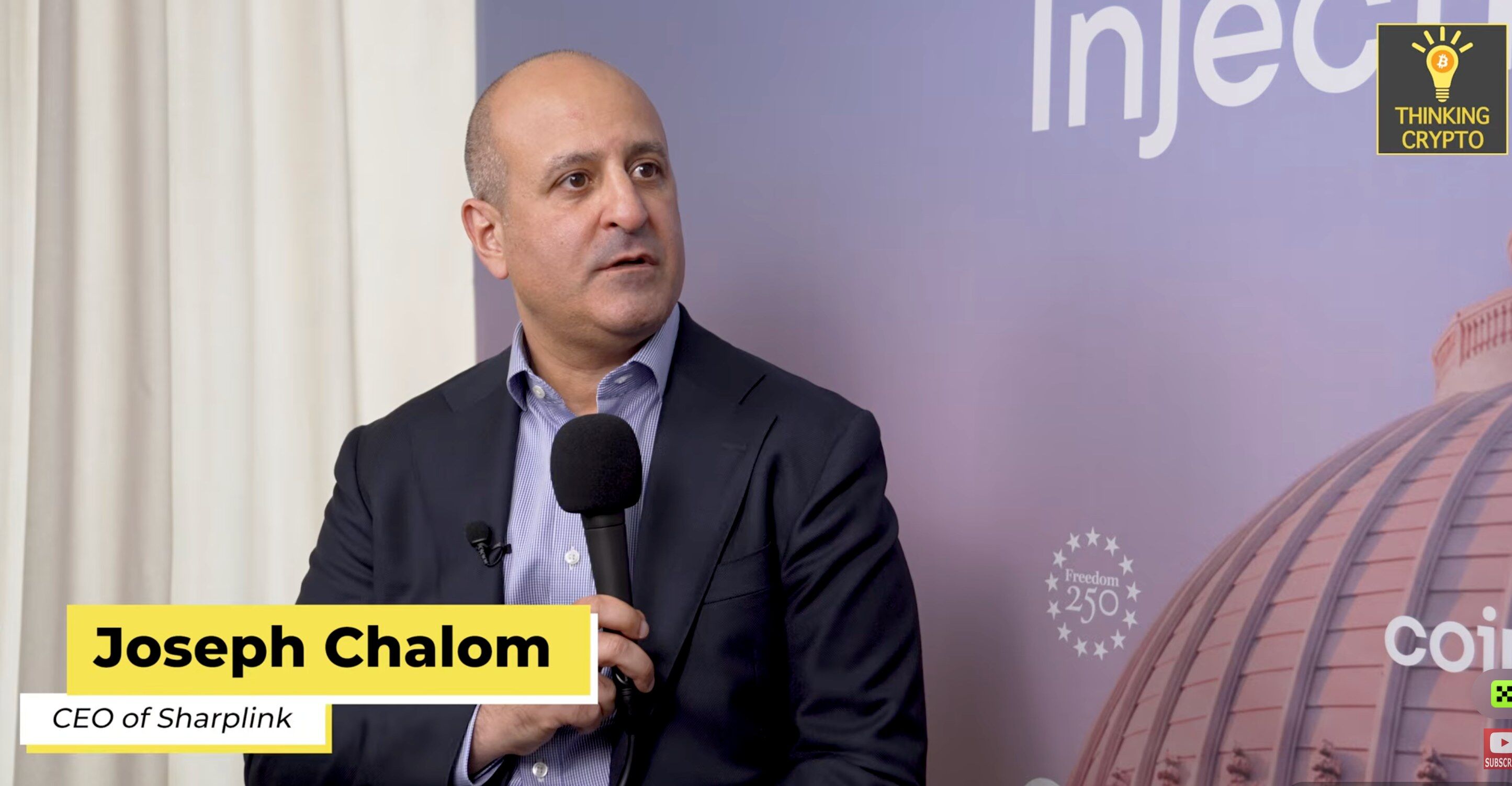
Editor's Note: At the recent Injective Summit 2026 in Washington D.C., SharpLink Co-CEO Joseph Chalom gave an exclusive interview.

He stated that while current market sentiment towards Ethereum is pessimistic, there is a divergence between reality and market sentiment. In reality, multiple data points within the Ethereum ecosystem indicate a bright future: stablecoin transaction volume exceeds 50%, tokenized RWA is close to 60%, and its DeFi dominance remains unchallenged. He said "Ethereum is winning, but the communication is failing." SharpLink has joined forces with giants like ConsenSys, investing substantial funds to support three core teams spun off from the Ethereum Foundation, focusing on institutional-grade scaling, privacy/compliance, and market outreach. More crucially, they employ zero leverage and take on no debt during the bear market, insisting on making ETH 'productive' to generate revenue, and predict that tokenization and 24/7 trading will ignite the next wave of institutional adoption.

This week, ETH once approached $2,000, and the ETH/BTC exchange rate also hit 0.03, marking its highest point in nearly 3 months, seemingly indicating that things are improving. Additionally, after roughly 8 months without large-scale new purchases, SharpLink bought another 10,000 ETH in June this year, with an average cost of around $1,611; after this purchase, their total ETH holdings reached 886,725 ETH.

The following is the original interview dialogue, Enjoy~

————————

Host (Tony Edward/Thinking Crypto): Everyone, we are recording at the Injective Policy Summit in Washington D.C., and with me today is Joseph Chalom, CEO of SharpLink. Joseph, great to see you.

Joseph Chalom: Great to be back with you. First, an introduction: we are a digital asset treasury management company. We have raised billions of dollars to purchase Ethereum (ETH) and make it highly efficient. Over the past month, the two most interesting things have been: first, we returned to the public markets for an equity financing, essentially buying back ETH and repurchasing some stock at a very good price. Second, together with Joe Lubin from ConsenSys and Tom Lee from Bitmine, we began supporting and investing in spin-out projects from the Ethereum ecosystem, which will be very positive for Ethereum's new narrative and new era.

Host: There's been a lot of negative sentiment around ETH recently, including some questioning of the Ethereum Foundation. Do you think this negative sentiment is just a symptom of the bear market?

Joseph Chalom: Actually, I think there's been a divergence between reality and market sentiment for about the past year and a half.

The reality is, let's start with the very positive side. The Ethereum ecosystem accounts for over 50% of all stablecoin transaction volume, nearly 60% of tokenized real-world assets, and the vast majority of DeFi is built on Ethereum. So if you look at the report card, they are winning. The sentiment is fairly negative largely because the industry is in a downturn and the Ethereum Foundation—though it has done a fantastic job over the past decade or so—made the decision to streamline and let more ecosystem participants support the roadmap. That communication created a lack of clarity and confidence in the ecosystem, even though it's actually winning.

So, some of us, as ecosystem stewards and large holders of ETH, stepped up and we are putting our money where our mouth is, and I'm happy to share some of the things we're doing as a collective industry.

Host: Go deeper. What specific initiatives?

Joseph Chalom: Let's start with the positive side. Ethereum is the longest-running blockchain besides Bitcoin, never gone down, most secure, most trusted, most liquid. It also has a multi-year, very aggressive scaling roadmap.

Now, their ethos and direction is about going back to basics. The Ethereum Foundation will focus on privacy and censorship resistance and some core tenets to keep Ethereum credibly neutral for the coming decades. But that means some of the most critical talent and functions within the Foundation are being spun out. In the past three weeks or so, three teams have spun out of the Ethereum Foundation, supported by Joe Lubin, myself, and Tom Lee from Bitmine. These are actually critically important for institutional adoption.

Let me tell you who they are. The first is ETH Labs, some of the strongest developers in the Ethereum ecosystem, building the scaling capability that institutions need. The second is Ethereum Institutional, the front-end marketing, business development arm of Ethereum, spun out of the Foundation with our support. And just earlier this week, the three of us also funded EthSystems, who are building the next-generation privacy and compliance capabilities on Ethereum, an absolute necessity for the largest institutions to transact and ensure their data privacy. While it sounds like three separate nodes in the ecosystem, these are the three most important things driving institutional adoption over the next year and beyond.

Host: That's interesting. I see a lot of institutions, when preparing for tokenization and diving into areas like DeFi, start with Ethereum first, and then they eventually expand to other chains.

Joseph Chalom: Absolutely. As I said earlier, Ethereum has the properties institutions need. I spent 20 years at BlackRock, I know that before you want to migrate financial rails that are 40, 50, 60 years old, you want to migrate to a system that is trusted, never goes down, secure, and most liquid. Most importantly, there's not enough talk about decentralization.

A truly decentralized blockchain means once you make a decision, the rules can't be changed. So, having a fully distributed, decentralized chain where no single person or single treasury controls it is massively important for institutions, because they are doing a once-in-a-generation infrastructure migration.

Host: Totally agree. So during the bear market, how does SharpLink create value for shareholders? Through staking DeFi protocols to generate passive income?

Joseph Chalom: Absolutely. In last summer's digital asset treasury management boom, about six or seven Ethereum digital asset treasury management companies, maybe five Solana treasury management companies launched. Only a handful of us were able to raise billions of dollars and get to scale quickly. You need scale when competing in this industry.

What we do is, first, take all that capital and buy ETH, and then from day one make it yield, because ETH is inherently a productive asset. You can stake it, get 2.5% to 3% yield. We've been doing that, and making it more efficient than that benchmark. We also participate in DeFi. We announced a partnership with another public company, Galaxy, forming a $125 million fund to deploy our ETH into new protocols, help them launch and get what's called TVL (Total Value Locked) or initial capital. So, we get the ETH to produce more than the native staking.

The last thing I'll say is, when you start a business and 3 months later you hit consolidation, winter, cycles, you really get to see who is operating a public company in an institutional way. We didn't take on debt, we didn't issue preferred shares, we didn't borrow against our ETH. We decided to be conservative during the winter. A few of us survived, holding billions of dollars worth of ETH. That's how we protect investors.

Frankly, going through a winter isn't fun, but treating investors with respect has been a motivating force for us. You know, after winter comes spring and summer. We are positioned incredibly well when the markets recover. And we're starting to see the recovery in ETH. Just since these recent announcements, ETH is up about 20% from the lows. The short term is definitely challenged, but the long-term adoption story has never been more optimistic.

Host: That's really great to hear. I love that you didn't take on debt because I think that's risky and goes a bit against the spirit of crypto.

Joseph Chalom: Yeah. You know, I have admiration for Michael Saylor; he really invented a new vehicle for asset exposure. You can own a public company and get exposure to Bitcoin.

The challenge in the Bitcoin space is that it's not inherently productive. The only way to get your Bitcoin to compound and generate yield is to financialize your stock, issue convertible notes, preferred shares. And then you can get into trouble and ultimately have to sell your reserve asset. That's been a challenge for the Bitcoin community, because digital asset treasury companies, including Michael Saylor's, have gone from being large net buyers of Bitcoin to now being sellers, which is very negative for short-term price action.

Host: Absolutely. Joseph, with your background at BlackRock and in TradFi, you have a wealth of experience. What's your outlook on institutional adoption of this technology? It seems like everyone on Wall Street is looking into tokenization, participating in stablecoins, DeFi.

Joseph Chalom: Yeah, I think the tokenization space, whether it's tokenizing the dollar into stablecoins, or tokenizing treasuries or real-world assets, has been a phenomenon for about 8 to 9 years.

It's actually been quite slow so far, due to a lack of regulatory clarity. I want to describe for everyone in very simple terms how these things work together and how they layer on top of each other.

You can think of stablecoins as the dollar or value layer of future finance, you can think of tokenized assets as the asset exposure layer, DeFi as the execution layer. If you have the money layer, the exposure layer, and the execution layer, you're off to the races. What you're starting to see is not just tokenization of new funds, but tokenization of existing multi-billion dollar funds and tokenization of stocks. To make it more complex, there's another layer, which is you have cash, assets, execution layer. Agentic will be the automation layer.

I think we're still in the bottom of the first inning. We're waiting for more regulatory clarity, but institutions have moved from learning to experimenting to now going into production, and it's now a race not to be left behind.

Host: Do you feel that once the Clarity Act passes, it will give institutions a catalyst or confidence to innovate and invest more?

Joseph Chalom: 100%. I think the Clarity Act is massively important in two ways. One, it clarifies that if you're a DeFi developer, you're a software provider, you are not liable for what happens on your software, but if you hold customer assets as a DeFi protocol, then you are regulated and responsible for everything that happens. So the future of DeFi is brighter because of the Clarity Act.

Secondly, I think it will also affect market sentiment and momentum. In crypto, even a little bit of tailwind can lead to massive moves.

Thirdly, if you're in a large institution and your leadership is interested in digital assets, having the government's 'well-managed' seal of approval gives you more leeway to do things faster that you would have done slowly. I think we're going to see a lot of momentum this summer. And I think we'll get to a point where tokenization will be the norm, not the exception.

Host: Do you think there will be any significant challenges when some companies tokenize, while traditional markets still exist? For example, you could have a tokenized version of Tesla stock, but there's still the traditional stock on the stock market. What differences do you see, what issues might arise?

Joseph Chalom: I think the biggest challenge is having separate liquidity pools. For tokenization to succeed, we need to make sure the digital version of a stock or a fund has comparable trading volume and liquidity to the traditional version. But any time there's technological advancement, you have analog and digital coexisting. Like slow trains and fast trains running on parallel tracks, eventually they all become fast.

But I think the more important inflection point is this: imagine a world where your government announces a war in the Middle East on a Friday night, assume you hold the analog version of a stock in your portfolio and you want to sell it. If you hold the digital version, you can trade 24/7 and express your view. You want to go long oil companies, you can. You want to sell consumer cyclicals, you can.

At some point, the fiduciary who decides whether to buy the analog version or the digital on-chain version will almost certainly choose to buy and hold the on-chain version because it's tradable 24/7, programmable, and instantly settled. So the fiduciary will reach a point and say to themselves: I can't hold the slow analog version because I can't express my view over the weekend. So there will be a tipping point at some point, I think it's still a few years away.

Host: That's a great point. As the market moves towards 24/7 trading, if you're still using the analog version, you're almost at a disadvantage. You have to move to the tokenized digital version.

Joseph Chalom: Yes. But you need liquidity to tip in favor of the more liquid version, because that's important too.

Host: I think that's why stock exchanges, large institutions, banks are all moving towards 24/7 markets, it makes a lot of sense.

Joseph Chalom: Yes. Nasdaq, NYSE are transitioning to 23-hour-a-day, 7-day-a-week or 24/7 trading. Just this week, DTCC (Depository Trust & Clearing Corporation) — the clearing and settlement house that processes about 400 quadrillion transactions a year — just launched on-chain collateral tokenization. So, I find that incredibly exciting. You see those announcements every day that have become so commonplace, whereas three or four years ago they would have moved markets. That's when you know the momentum is here.

Host: Absolutely. It feels like the asset class is maturing. We're entering a new phase of adoption. It's pretty incredible. Last one, can you share your roadmap?

Joseph Chalom: I think the most important thing SharpLink is doing right now, aside from accumulating ETH and making it yield (we've consistently been the most productive digital asset treasury company with our ETH), is stepping up to do something we never anticipated having to do, which is being an ecosystem steward. Not just talking about it, but putting capital into new capabilities, into the spin-outs from the Ethereum Foundation, and essentially helping Ethereum go to market.

I'm often asked: whose interest does this align with? The answer is, it aligns with our shareholders' interest, it's perfectly aligned. So, we're going to help Ethereum win, whether it's Layer 1 or Layer 2, and tell the story of why the ETH token will be the in-demand settlement and trust commodity, which actually aligns with our investors' interests. So, we're going to lean into that with our ecosystem partners, try to be a very good steward. What we won't do is participate in core protocol, that's fully decentralized. We won't participate in Ethereum governance, but we will participate in funding talent and funding go-to-market capabilities, which aligns with our investors' long-term interests.

(End)

Трендові криптовалюти

Пов'язані матеріали

Must-Watch Events Next Week|CLARITY Act Could Face Senate Vote; SpaceX, Circle to Report Earnings (8.3-8.9)

**Summary: Key Events and Developments to Watch (August 3-9)** The upcoming week is marked by significant financial disclosures, key legislative deadlines, and notable product updates. **Major Financial Events:** Several companies are scheduled to release their Q2 2026 earnings. American Bitcoin (ABTC) will report on August 3, followed by SpaceX and Hut 8 Mining Corp. on August 4, and Circle on August 5. Notably, a significant portion of SpaceX shares (up to 12% of total shares) will be unlocked on August 6 following their earnings release. **Key Legislative Deadline:** The U.S. Senate faces an August 7 deadline to secure 60 votes for the CLARITY Act, a bipartisan bill aiming to establish a federal regulatory framework for cryptocurrencies. The Senate may hold a full vote on the bill during the week. **Economic Data:** The U.S. July Non-Farm Payrolls report will be released on August 7, providing crucial labor market data. **Technology & Product Updates:** * **Shutdowns:** DeFi portfolio tracker Zapper and wallet app Ctrl Wallet will cease operations on August 3. * **Upgrades:** LayerZero will deprecate its v1 relayers on August 3. XRP Ledger's new version 3.3.0, featuring five new functions, is expected next week. * **AI:** Elon Musk announced that the advanced Grok 4.6 AI model is set for release around August 7. * **Bitcoin:** The BIP-110 forced signaling for a potential Bitcoin network change is scheduled to begin around August 8. **Other Notable Events:** Chinese robotics firm Unitree Tech has set its preliminary price inquiry for its IPO for August 5. South Korean exchange Upbit will delist AQT and AERGO tokens on August 3.

marsbit1 год тому

Must-Watch Events Next Week|CLARITY Act Could Face Senate Vote; SpaceX, Circle to Report Earnings (8.3-8.9)

marsbit1 год тому

Stocks Are Plummeting More Sharply Than Cryptocurrencies. Where Has the Money Gone?

Stock Markets Plunge Deeper Than Cryptocurrencies: Where Did the Money Go? In late July, Seoul's Kospi index triggered circuit breakers for two consecutive days, plummeting over 40% from its June high. The collapse was led by heavyweight stocks like SK Hynix, whose record profits still disappointed investors, and devastating leveraged ETFs, with one major product losing over 83% of its value. This signaled a global, forced deleveraging targeting the most crowded trades. Interestingly, while stocks exhibited extreme volatility akin to crypto markets, Bitcoin rose nearly 15% in July after a prior steep drop. Analysis shows the money fleeing equities did not flow into Bitcoin. Instead, Bitcoin had already absorbed its sell-off in May-June, when U.S. spot Bitcoin ETFs saw historic outflows. The true safe-haven beneficiary was gold, whose price rose over 20% year-on-year, highlighting a decoupling between Bitcoin and gold as "digital gold." The sell-off was a targeted unwinding of leveraged positions in tech and semiconductors, accelerated by broker-dealer risk management and shifts in the AI narrative, including new competition from Chinese memory chipmakers. The retreat path was clear: from high-valuation tech stocks to cash and U.S. Treasuries, then to gold. For Bitcoin to attract sustained institutional inflows, conditions like eased global liquidity pressure, a "soft-landing" Fed rate cut, and U.S. regulatory clarity via legislation like the stalled CLARITY Act are needed. Currently, Bitcoin is not a safe haven but an already-cleared asset. Its low correlation with tech stocks, however, makes it a potential diversification play for institutional portfolios once the storm passes. The money isn't here yet, but the positioning is underway.

marsbit1 год тому

Stocks Are Plummeting More Sharply Than Cryptocurrencies. Where Has the Money Gone?

marsbit1 год тому

In Conversation with Ray Dalio: We Are Currently in an AI Bubble, with 1% of My Portfolio in Bitcoin

Ray Dalio, founder of Bridgewater Associates, warns in an interview that the current AI boom shows classic bubble characteristics, which could lead to significant economic downturns as seen in past cycles like 1929 or 2000. He explains that speculative enthusiasm, fueled by debt and overvaluation, often precedes a crash when rising rates or taxation force asset sales, causing widespread losses and recession. Dalio also outlines his "Big Cycle" theory, describing an approximate 80-year pattern where widening wealth gaps, massive government deficits, and shifting geopolitical power (like China's rise) create internal conflict and global instability. He emphasizes that we are in a late-cycle, transitional phase where traditional powers like the US and UK face decline. For personal wealth protection, Dalio advises diversification beyond cash into assets like stocks, bonds, real estate, and particularly gold, which he prefers over Bitcoin. While he holds about 1% of his portfolio in Bitcoin as a non-printable hard asset, he views gold as more secure from technological or governmental threats. Regarding AI's impact, Dalio believes it will disproportionately benefit capital owners, worsening inequality by replacing both physical and cognitive labor. He suggests that human intuition and emotional intelligence, combined with AI, will be key for future workers. On taxation, Dalio argues that wealth taxes are impractical and risk triggering asset sell-offs, reducing productive investment. He points to the UK as a cautionary example of debt, low productivity, and political strife. Geopolitically, Dalio foresees a more regionalized world, with the US showing weakness in prolonged conflicts like with Iran, akin to past imperial declines. The ideal outcome, he suggests, is coexisting powerful blocs (e.g., Americas, China-Asia Pacific) without major war.

marsbit5 год тому

In Conversation with Ray Dalio: We Are Currently in an AI Bubble, with 1% of My Portfolio in Bitcoin

marsbit5 год тому

Торгівля

Спот

Популярні статті

Що таке $S$

Розуміння SPERO: Комплексний огляд Вступ до SPERO Оскільки ландшафт інновацій продовжує еволюціонувати, виникнення технологій web3 та криптовалютних проектів відіграє ключову роль у формуванні цифрового майбутнього. Один з проектів, який привернув увагу в цій динамічній сфері, — це SPERO, позначений як SPERO,$$s$. Ця стаття має на меті зібрати та представити детальну інформацію про SPERO, щоб допомогти ентузіастам та інвесторам зрозуміти його основи, цілі та інновації в рамках web3 та крипто-сектору. Що таке SPERO,$$s$? SPERO,$$s$ — це унікальний проект у криптопросторі, який прагне використати принципи децентралізації та технології блокчейн для створення екосистеми, що сприяє залученню, корисності та фінансовій інклюзії. Проект розроблений для полегшення взаємодії між користувачами новими способами, надаючи їм інноваційні фінансові рішення та послуги. У своїй основі SPERO,$$s$ прагне надати можливості індивідам, забезпечуючи інструменти та платформи, які покращують користувацький досвід у криптовалютному просторі. Це включає в себе можливість більш гнучких методів транзакцій, сприяння ініціативам, що підтримуються спільнотою, та створення шляхів для фінансових можливостей через децентралізовані додатки (dApps). Основна концепція SPERO,$$s$ обертається навколо інклюзивності, прагнучи зменшити розриви в традиційній фінансовій системі, використовуючи переваги технології блокчейн. Хто є творцем SPERO,$$s$? Особистість творця SPERO,$$s$ залишається дещо невідомою, оскільки є обмежені публічно доступні ресурси, що надають детальну інформацію про його засновників. Ця відсутність прозорості може бути наслідком зобов'язання проекту до децентралізації — етики, яку багато проектів web3 поділяють, ставлячи колективні внески вище за індивідуальне визнання. Зосереджуючи обговорення навколо спільноти та її колективних цілей, SPERO,$$s$ втілює суть наділення без виділення конкретних осіб. Таким чином, розуміння етики та місії SPERO є більш важливим, ніж ідентифікація єдиного творця. Хто є інвесторами SPERO,$$s$? SPERO,$$s$ підтримується різноманітними інвесторами, починаючи від венчурних капіталістів до ангельських інвесторів, які прагнуть сприяти інноваціям у крипто-секторі. Зосередження цих інвесторів зазвичай узгоджується з місією SPERO — пріоритет надається проектам, які обіцяють технологічний прогрес у суспільстві, фінансову інклюзію та децентралізоване управління. Ці інвесторські фонди зазвичай зацікавлені в проектах, які не лише пропонують інноваційні продукти, але й позитивно впливають на спільноту блокчейн та її екосистеми. Підтримка з боку цих інвесторів підкріплює SPERO,$$s$ як значного конкурента в швидко змінюваній сфері крипто-проектів. Як працює SPERO,$$s$? SPERO,$$s$ використовує багатогранну структуру, яка відрізняє його від традиційних криптовалютних проектів. Ось деякі ключові особливості, які підкреслюють його унікальність та інноваційність: Децентралізоване управління: SPERO,$$s$ інтегрує моделі децентралізованого управління, надаючи користувачам можливість активно брати участь у процесах прийняття рішень щодо майбутнього проекту. Цей підхід сприяє відчуттю власності та відповідальності серед членів спільноти. Корисність токена: SPERO,$$s$ використовує свій власний криптовалютний токен, розроблений для виконання різних функцій в екосистемі. Ці токени дозволяють здійснювати транзакції, отримувати винагороди та полегшувати послуги, що пропонуються на платформі, підвищуючи загальну залученість та корисність. Шарова архітектура: Технічна архітектура SPERO,$$s$ підтримує модульність та масштабованість, що дозволяє безперешкодно інтегрувати додаткові функції та додатки в міру розвитку проекту. Ця адаптивність є надзвичайно важливою для збереження актуальності в постійно змінюваному крипто-ландшафті. Залучення спільноти: Проект підкреслює ініціативи, що підтримуються спільнотою, використовуючи механізми, які стимулюють співпрацю та зворотний зв'язок. Підтримуючи сильну спільноту, SPERO,$$s$ може краще задовольняти потреби користувачів та адаптуватися до ринкових тенденцій. Фокус на інклюзію: Пропонуючи низькі комісії за транзакції та зручні інтерфейси, SPERO,$$s$ прагне залучити різноманітну базу користувачів, включаючи осіб, які раніше не брали участі в крипто-просторі. Це зобов'язання до інклюзії узгоджується з його загальною місією наділення через доступність. Хронологія SPERO,$$s$ Розуміння історії проекту надає важливі уявлення про його розвиток та етапи. Нижче наведено пропоновану хронологію, що відображає значні події в еволюції SPERO,$$s$: Етап концептуалізації та ідеації: Початкові ідеї, що стали основою SPERO,$$s$, були сформовані, тісно пов'язані з принципами децентралізації та фокусом на спільноті в індустрії блокчейн. Запуск білого паперу проекту: Після концептуального етапу був випущений комплексний білий папір, що детально описує бачення, цілі та технологічну інфраструктуру SPERO,$$s$, щоб залучити інтерес та зворотний зв'язок від спільноти. Створення спільноти та ранні залучення: Активні зусилля були спрямовані на створення спільноти ранніх прихильників та потенційних інвесторів, що полегшило обговорення цілей проекту та отримання підтримки. Подія генерації токенів: SPERO,$$s$ провів подію генерації токенів (TGE) для розподілу своїх рідних токенів серед ранніх прихильників та встановлення початкової ліквідності в екосистемі. Запуск початкового dApp: Перший децентралізований додаток (dApp), пов'язаний з SPERO,$$s$, став доступним, дозволяючи користувачам взаємодіяти з основними функціями платформи. Постійний розвиток та партнерства: Безперервні оновлення та вдосконалення пропозицій проекту, включаючи стратегічні партнерства з іншими учасниками блокчейн-простору, сформували SPERO,$$s$ у конкурентоспроможного та еволюціонуючого гравця на крипто-ринку. Висновок SPERO,$$s$ є свідченням потенціалу web3 та криптовалют для революціонізації фінансових систем та наділення індивідів. Завдяки зобов'язанню до децентралізованого управління, залучення спільноти та інноваційно спроектованих функцій, він прокладає шлях до більш інклюзивного фінансового ландшафту. Як і з будь-якими інвестиціями в швидко змінюваному крипто-просторі, потенційним інвесторам та користувачам рекомендується ретельно досліджувати та обдумано взаємодіяти з поточними подіями в SPERO,$$s$. Проект демонструє інноваційний дух крипто-індустрії, запрошуючи до подальшого дослідження його численних можливостей. Хоча подорож SPERO,$$s$ ще триває, його основні принципи можуть справді вплинути на майбутнє того, як ми взаємодіємо з технологією, фінансами та один з одним у взаємопов'язаних цифрових екосистемах.

221 переглядів усьогоОпубліковано 2024.12.17Оновлено 2024.12.17

Що таке $S$

Що таке AGENT S

Агент S: Майбутнє автономної взаємодії в Web3 Вступ У постійно змінюваному ландшафті Web3 та криптовалюти інновації постійно переосмислюють, як люди взаємодіють з цифровими платформами. Один з таких новаторських проектів, Агент S, обіцяє революціонізувати взаємодію людини з комп'ютером через свою відкриту агентну структуру. Прокладаючи шлях для автономних взаємодій, Агент S прагне спростити складні завдання, пропонуючи трансформаційні застосування в штучному інтелекті (ШІ). Це детальне дослідження заглиблюється в складності проекту, його унікальні особливості та наслідки для сфери криптовалюти. Що таке Агент S? Агент S є революційною відкритою агентною структурою, спеціально розробленою для вирішення трьох основних викликів в автоматизації комп'ютерних завдань: Набуття специфічних знань у галузі: Структура інтелектуально навчається з різних зовнішніх джерел знань та внутрішнього досвіду. Цей подвійний підхід дозволяє їй створити багатий репозиторій специфічних знань у галузі, покращуючи її продуктивність у виконанні завдань. Планування на довгих горизонтах завдань: Агент S використовує планування з підкріпленням досвіду, стратегічний підхід, який полегшує ефективний розподіл та виконання складних завдань. Ця функція значно підвищує її здатність ефективно та результативно управляти кількома підзавданнями. Обробка динамічних, неоднорідних інтерфейсів: Проект представляє Інтерфейс Агент-Комп'ютер (ACI), інноваційне рішення, яке покращує взаємодію між агентами та користувачами. Використовуючи багатомодальні великі мовні моделі (MLLMs), Агент S може безперешкодно орієнтуватися та маніпулювати різноманітними графічними інтерфейсами користувача. Завдяки цим новаторським функціям Агент S надає надійну структуру, яка вирішує складнощі, пов'язані з автоматизацією людської взаємодії з машинами, прокладаючи шлях для численних застосувань у ШІ та за його межами. Хто є творцем Агент S? Хоча концепція Агент S є фундаментально новаторською, конкретна інформація про його творця залишається невідомою. Творець наразі невідомий, що підкреслює або початкову стадію проекту, або стратегічний вибір зберегти засновників у таємниці. Незважаючи на анонімність, акцент залишається на можливостях та потенціалі структури. Хто є інвесторами Агент S? Оскільки Агент S є відносно новим у криптографічній екосистемі, детальна інформація про його інвесторів та фінансових спонсорів не задокументована. Відсутність публічно доступних відомостей про інвестиційні фонди або організації, що підтримують проект, викликає питання щодо його фінансової структури та дорожньої карти розвитку. Розуміння підтримки є критично важливим для оцінки стійкості проекту та потенційного впливу на ринок. Як працює Агент S? В основі Агент S лежить передова технологія, яка дозволяє йому ефективно функціонувати в різних умовах. Його операційна модель побудована навколо кількох ключових функцій: Взаємодія з комп'ютером, подібна до людської: Структура пропонує розширене планування ШІ, прагнучи зробити взаємодії з комп'ютерами більш інтуїтивними. Імітуючи людську поведінку при виконанні завдань, вона обіцяє підвищити досвід користувачів. Наративна пам'ять: Використовується для використання високорівневого досвіду, Агент S використовує наративну пам'ять для відстеження історій завдань, тим самим покращуючи свої процеси прийняття рішень. Епізодична пам'ять: Ця функція надає користувачам покрокові інструкції, дозволяючи структурі пропонувати контекстуальну підтримку в міру виконання завдань. Підтримка OpenACI: Завдяки можливості працювати локально, Агент S дозволяє користувачам зберігати контроль над своїми взаємодіями та робочими процесами, узгоджуючи з децентралізованою етикою Web3. Легка інтеграція з зовнішніми API: Його універсальність і сумісність з різними платформами ШІ забезпечують те, що Агент S може безперешкодно вписатися в існуючі технологічні екосистеми, роблячи його привабливим вибором для розробників та організацій. Ці функціональні можливості колективно сприяють унікальному положенню Агент S у крипто-просторі, оскільки він автоматизує складні, багатоступеневі завдання з мінімальним втручанням людини. У міру розвитку проекту його потенційні застосування в Web3 можуть переосмислити, як відбуваються цифрові взаємодії. Хронологія Агент S Розробка та етапи Агент S можуть бути узагальнені в хронології, яка підкреслює його значні події: 27 вересня 2024 року: Концепція Агент S була представлена в комплексній науковій статті під назвою “Відкрита агентна структура, яка використовує комп'ютери як людина”, що демонструє основи проекту. 10 жовтня 2024 року: Наукова стаття була опублікована на arXiv, пропонуючи детальне дослідження структури та її оцінки продуктивності на основі бенчмарку OSWorld. 12 жовтня 2024 року: Було випущено відеопрезентацію, що надає візуальне уявлення про можливості та особливості Агент S, ще більше залучаючи потенційних користувачів та інвесторів. Ці маркери в хронології не лише ілюструють прогрес Агент S, але й вказують на його прихильність до прозорості та залучення громади. Ключові моменти про Агент S У міру розвитку структури Агент S кілька ключових характеристик виділяються, підкреслюючи її новаторський характер та потенціал: Інноваційна структура: Розроблена для забезпечення інтуїтивного використання комп'ютерів, подібного до людської взаємодії, Агент S пропонує новий підхід до автоматизації завдань. Автономна взаємодія: Здатність автономно взаємодіяти з комп'ютерами через GUI означає стрибок до більш інтелектуальних та ефективних обчислювальних рішень. Автоматизація складних завдань: Завдяки своїй надійній методології він може автоматизувати складні, багатоступеневі завдання, роблячи процеси швидшими та менш схильними до помилок. Безперервне вдосконалення: Механізми навчання дозволяють Агенту S покращуватися на основі минулого досвіду, постійно підвищуючи свою продуктивність та ефективність. Універсальність: Його адаптивність до різних операційних середовищ, таких як OSWorld та WindowsAgentArena, забезпечує його здатність служити широкому спектру застосувань. Оскільки Агент S займає своє місце в ландшафті Web3 та криптовалюти, його потенціал покращити можливості взаємодії та автоматизувати процеси означає значний прогрес у технологіях ШІ. Завдяки своїй інноваційній структурі Агент S є прикладом майбутнього цифрових взаємодій, обіцяючи більш безперешкодний та ефективний досвід для користувачів у різних галузях. Висновок Агент S представляє собою сміливий крок вперед у поєднанні ШІ та Web3, з можливістю переосмислити, як ми взаємодіємо з технологією. Хоча проект все ще на ранніх стадіях, можливості для його застосування є величезними та переконливими. Завдяки своїй комплексній структурі, що вирішує критичні виклики, Агент S прагне вивести автономні взаємодії на передній план цифрового досвіду. У міру того, як ми заглиблюємося в сфери криптовалюти та децентралізації, проекти, подібні до Агент S, безсумнівно, відіграватимуть ключову роль у формуванні майбутнього технологій та співпраці людини з комп'ютером.

842 переглядів усьогоОпубліковано 2025.01.14Оновлено 2025.01.14

Що таке AGENT S

Як купити S

Ласкаво просимо до HTX.com! Ми зробили покупку Sonic (S) простою та зручною. Дотримуйтесь нашої покрокової інструкції, щоб розпочати свою криптовалютну подорож.Крок 1: Створіть обліковий запис на HTXВикористовуйте свою електронну пошту або номер телефону, щоб зареєструвати обліковий запис на HTX безплатно. Пройдіть безпроблемну реєстрацію й отримайте доступ до всіх функцій.ЗареєструватисьКрок 2: Перейдіть до розділу Купити крипту і виберіть спосіб оплатиКредитна/дебетова картка: використовуйте вашу картку Visa або Mastercard, щоб миттєво купити Sonic (S).Баланс: використовуйте кошти з балансу вашого рахунку HTX для безперешкодної торгівлі.Треті особи: ми додали популярні способи оплати, такі як Google Pay та Apple Pay, щоб підвищити зручність.P2P: Торгуйте безпосередньо з іншими користувачами на HTX.Позабіржова торгівля (OTC): ми пропонуємо індивідуальні послуги та конкурентні обмінні курси для трейдерів.Крок 3: Зберігайте свої Sonic (S)Після придбання Sonic (S) збережіть його у своєму обліковому записі на HTX. Крім того, ви можете відправити його в інше місце за допомогою блокчейн-переказу або використовувати його для торгівлі іншими криптовалютами.Крок 4: Торгівля Sonic (S)Легко торгуйте Sonic (S) на спотовому ринку HTX. Просто увійдіть до свого облікового запису, виберіть торгову пару, укладайте угоди та спостерігайте за ними в режимі реального часу. Ми пропонуємо зручний досвід як для початківців, так і для досвідчених трейдерів.

1.8k переглядів усьогоОпубліковано 2025.01.15Оновлено 2026.06.02

Як купити S

Обговорення

Ласкаво просимо до спільноти HTX. Тут ви можете бути в курсі останніх подій розвитку платформи та отримати доступ до професійної ринкової інформації. Нижче представлені думки користувачів щодо ціни S (S).

活动图片














