Shanghai Automotive Chip 'Little Giant' to IPO, Aiming to Raise 3.489 Billion Yuan

marsbitОпубліковано о 2026-08-14Востаннє оновлено о 2026-08-14

Анотація

"Shanghai-based auto chip 'Little Giant' Gatsland Aims for IPO, Seeking to Raise 3.489 Billion CNY" Gatsland Microelectronics, a Shanghai-based automotive-grade millimeter-wave radar and ultra-wideband (UWB) chip company recognized as a national-level "Little Giant" specializing in core technologies, has filed for an IPO on Shanghai's STAR Market. Founded in 2014, the company is a key player in China's automotive semiconductor sector. It achieved a milestone in 2017 by mass-producing the world's first automotive-grade 77GHz mmWave radar RF front-end single-chip using CMOS process technology, breaking the industry's reliance on GaAs and SiGe multi-chip solutions. Gatsland claims to be the fourth-largest global and second-largest domestic supplier of automotive mmWave radar chips, and a leader in CMOS-based solutions. Financially, Gatsland has shown strong revenue growth, with figures rising from 206 million CNY in 2023 to 632 million CNY in 2025. However, the company remains unprofitable, reporting net losses for the reported periods, including a loss of 193 million CNY in 2025. Despite this, it maintains high gross margins, averaging around 47%, which are notably above industry peers. Over 97% of its recent revenue comes from automotive mmWave radar chips. The company's products, including its Alps and Kunlun platform chips, are used in advanced driver assistance systems (ADAS), autonomous driving, and in-cabin sensing. Its chips have been adopted by major Chinese automak...

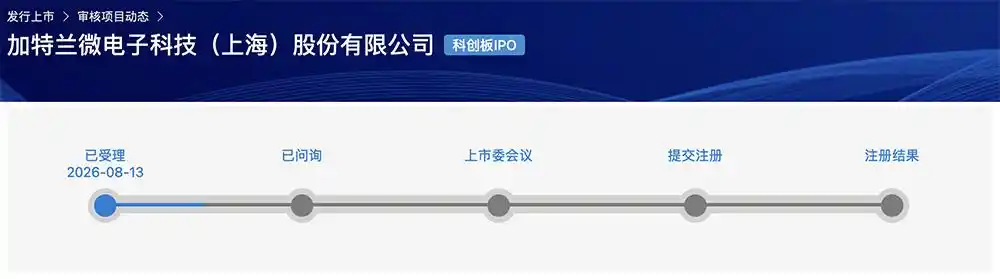
Core Things (Xindongxi) reported on August 14th. On August 13th, the IPO application of Shanghai-based automotive-grade millimeter-wave radar chip company Calterah was accepted on the Science and Technology Innovation Board (STAR Market).
Calterah was founded in February 2014 and has been awarded honors such as a National-level Specialized, Refined, Unique, and Innovative "Little Giant" Enterprise. Its products include millimeter-wave radar chips and Ultra-Wideband (UWB) chips, widely used in automotive-grade fields such as advanced driver assistance systems (ADAS), autonomous driving, vehicle interior and exterior sensing, digital keys, as well as industrial and consumer fields like robotics, smart home, and smart city applications.

The prospectus shows that the company mass-produced the world's first automotive-grade CMOS process 77GHz millimeter-wave radar RF front-end single-chip in 2017, breaking the long-standing industry technology pattern based on GaAs and SiGe semiconductor processes and multi-chip solutions.

Currently, Calterah has become the fourth largest global supplier and the second largest domestic market supplier of automotive-grade millimeter-wave radar chips. It is the domestic leader and ranks among the top two globally for the CMOS process route in achieving mass production of automotive-grade millimeter-wave radar SoC chips, holding a leading position in the domestic market for automotive-grade millimeter-wave radar chips and automotive-grade Ultra-Wideband chips.

The National Integrated Circuit Industry Investment Fund Phase II (Big Fund II) is one of its shareholders, holding 0.6266%.

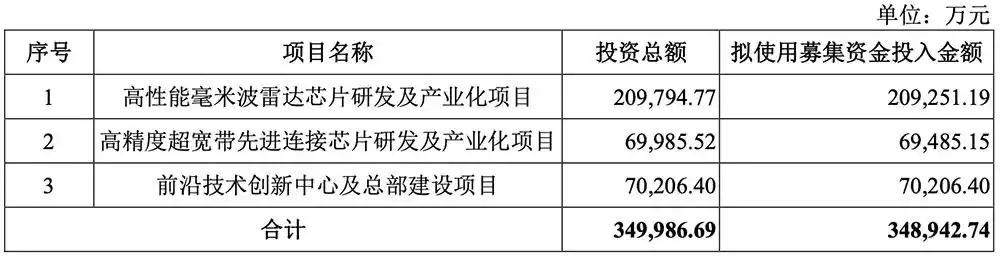
In this IPO, Calterah plans to raise 3.489 billion yuan for the following projects: High-Performance Millimeter-Wave Radar Chip R&D and Industrialization Project, High-Precision Ultra-Wideband Advanced Connectivity Chip R&D and Industrialization Project, and the Frontier Technology Innovation Center and Headquarters Construction Project.
01.

Revenue Exceeded 600 Million Yuan Last Year,

Yet to Achieve Profitability

From 2023, 2024, 2025, and Q1 2026, Calterah's revenue was 206 million yuan, 303 million yuan, 632 million yuan, and 154 million yuan, respectively. Net profit was -323 million yuan, -334 million yuan, -193 million yuan, and -60 million yuan, respectively. R&D expenses were 304 million yuan, 365 million yuan, 370 million yuan, and 98 million yuan, respectively.
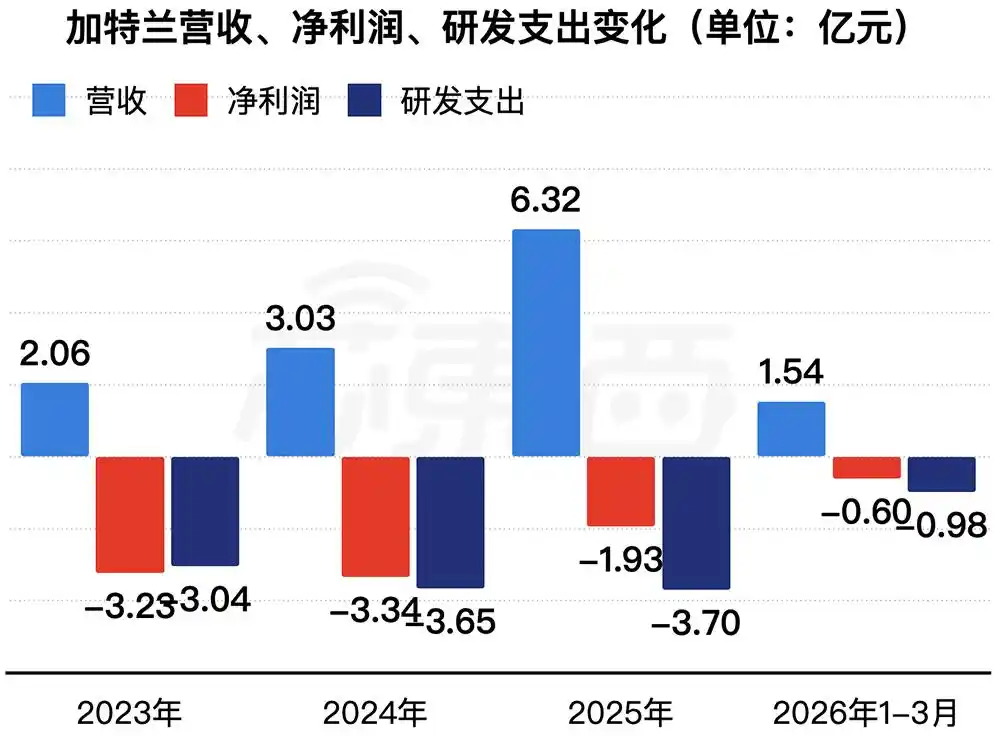
▲ Calterah's Revenue, Net Profit, and R&D Expenditure from 2023~Q1 2026 (Chart by Core Things)

As of the end of Q1 2026, the company's accumulated deficit stood at 172 million yuan.

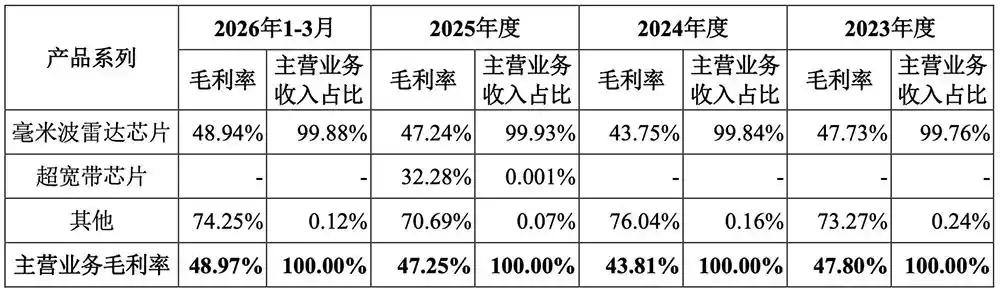
During the reporting period, its gross profit margin on main operations remained at a relatively high level and showed a stable and slightly increasing trend overall, at 47.80%, 43.81%, 47.25%, and 48.97%, respectively. The composition of gross profit margin by main product category is as follows:
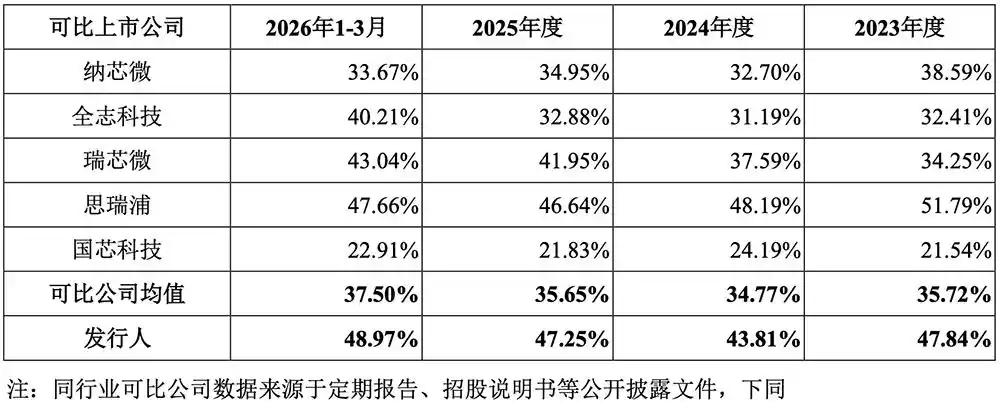
During this period, Calterah's gross profit margin was significantly higher than the average comprehensive gross profit margin of comparable listed companies in the same industry.
From 2025 to Q1 2026, over 97% of its revenue came from automotive-grade millimeter-wave radar chip applications.
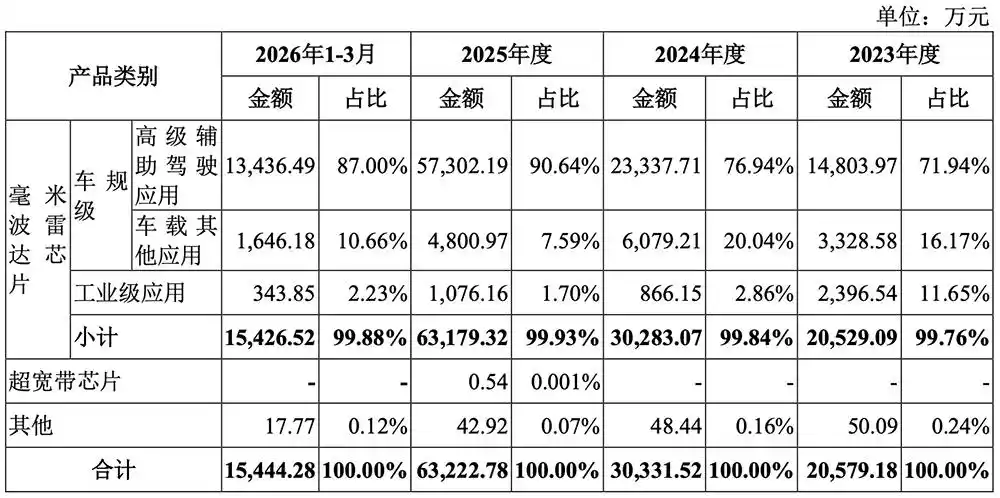
The aforementioned automotive-grade chip products mainly include Alps platform's Alps and Alps-Pro series and Kunlun platform's Kunlun series products. Industrial-grade chip products mainly include Alps platform's Rhine series and Kunlun platform's Lancang series products. Ultra-Wideband chip products are Dubhe platform's Dubhe series products. Other sales revenue primarily comes from PCB development boards used for testing or in conjunction with its chips.
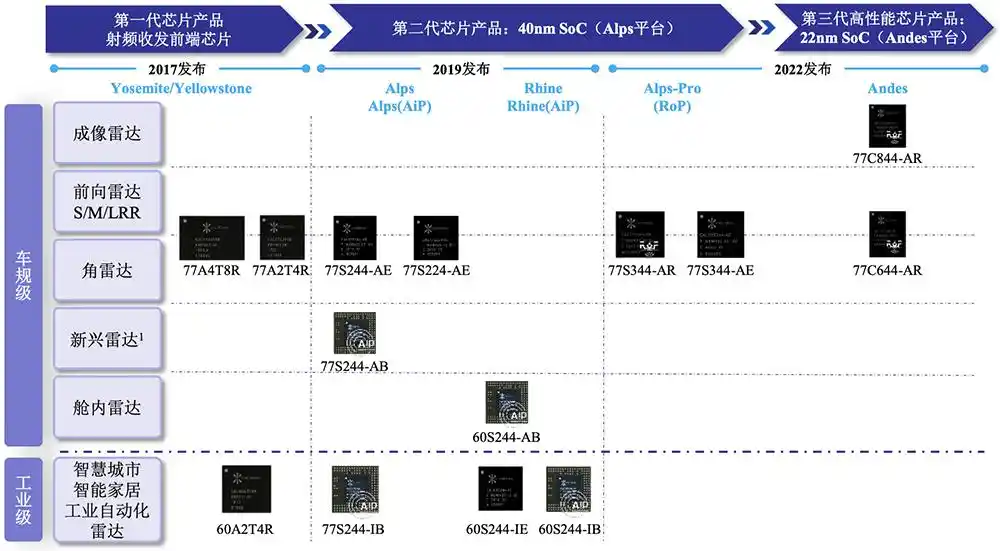
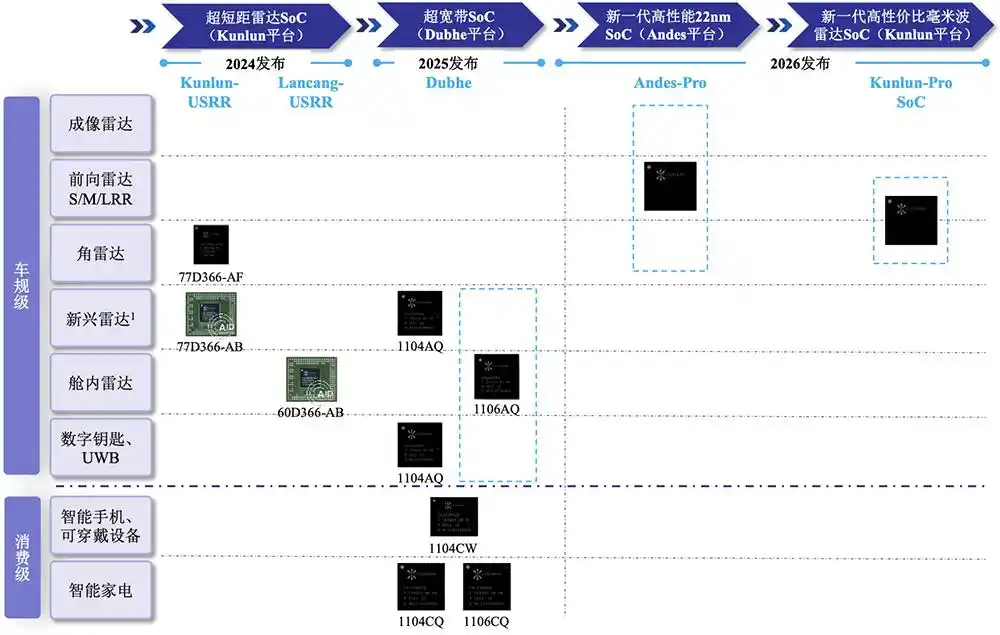
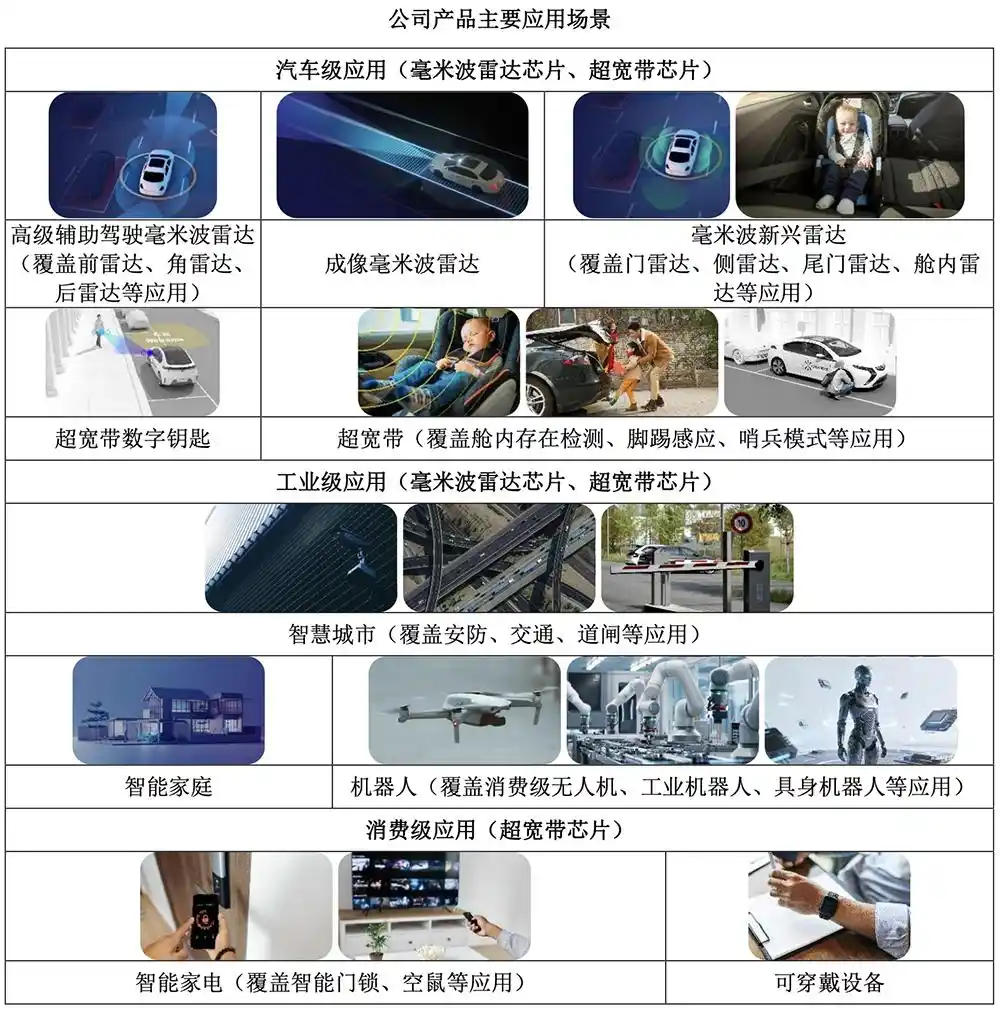
Its existing main millimeter-wave radar chip product platforms can be widely applied in automotive ADAS and autonomous driving fields including front radar, corner radar, imaging radar, etc., body interior and exterior sensing fields like cabin radar, door radar, side radar, tailgate radar, and industrial and consumer fields like robotics, smart home, and smart city.

Ultra-Wideband chip existing product platforms are mainly applied in automotive-grade fields such as digital keys, automatic parking, cabin radar, kick sensing, sentry mode, and consumer-grade fields like wearable devices and smart home appliances.
As of the end of March 2026, Calterah had 275 R&D personnel, accounting for 66% of the total employees, and had obtained 141 authorized invention patents.

02.

Revenue from Top 5 Direct Customers Exceeds 99%

Currently, Calterah's products have gained recognition from numerous domestic OEMs (Original Equipment Manufacturers) and have successfully entered the supply chain of foreign OEMs.

In 2025, according to Yole statistics, Calterah ranked fourth globally in the automotive millimeter-wave radar chip market (including ADAS and child presence detection applications), with a market share of approximately 4%.

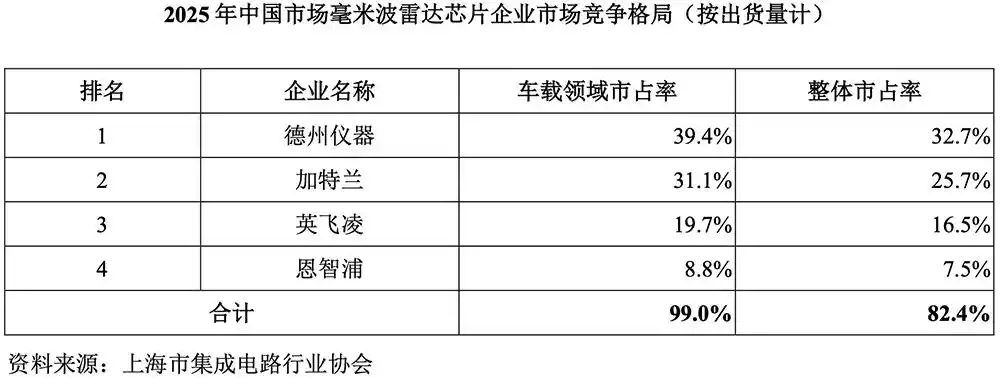
According to the Shanghai Integrated Circuit Industry Association, in 2025, Calterah's market share in the domestic automotive millimeter-wave radar chip market reached 31.1%, second only to Texas Instruments, ranking second in the domestic market.
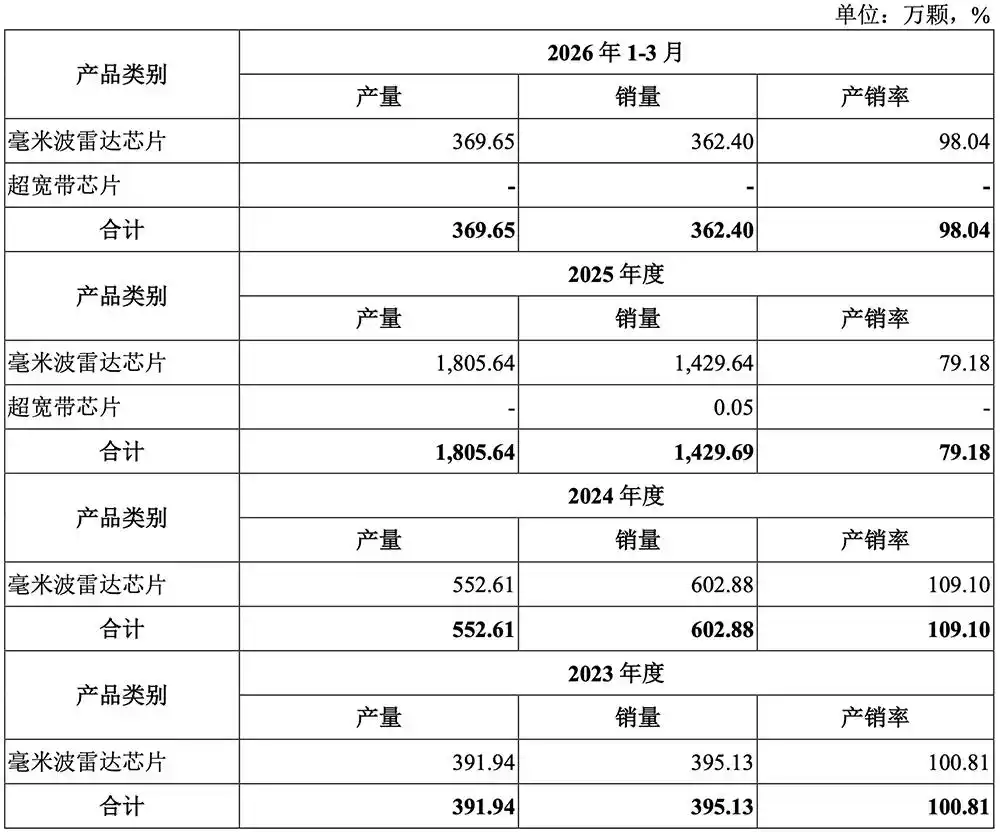
The production volume, sales volume, and production-sales ratio of Calterah's main products are shown in the following table:
As of the end of March 2026, in the automotive-grade field, its millimeter-wave radar chips have cumulatively shipped over 30 million units, covering domestic renowned OEMs including BYD, Geely, Changan, Chery, SAIC, FAW, Dongfeng, Leapmotor, Seres, NIO, and others.

Simultaneously, Calterah has also been competing with globally renowned chip companies in the international market. It has become the first domestic millimeter-wave radar chip supplier for the global platforms of two well-known European Tier 1 companies and has successfully entered the main vehicle models of overseas OEMs like Sweden's Volvo and the US's Rivian, accelerating the internationalization of Chinese millimeter-wave radar chips.

In June 2026, Calterah launched the newly upgraded Kunlun-Pro series, which can better meet L2 and higher-level ADAS requirements, and the Andes-Pro series serving 4D imaging radar.

Its direct customer concentration is high, with main end customers being millimeter-wave radar module manufacturers.

In 2023, 2024, 2025, and Q1 2026, the sales revenue from Calterah's top five direct customers accounted for 99.77%, 99.07%, 99.90%, and 99.97%, respectively, mainly consisting of well-known integrated circuit distributors in the industry.
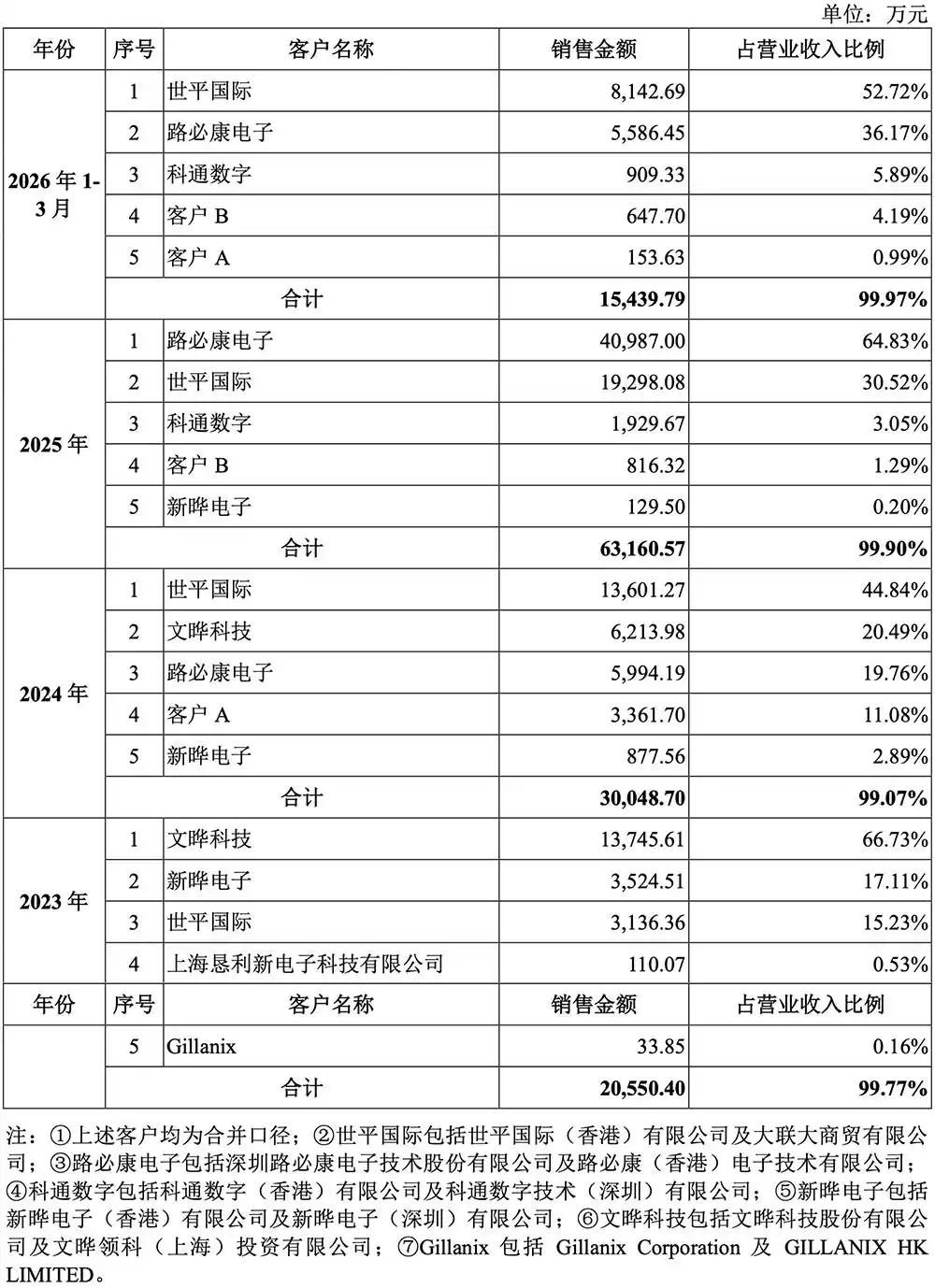
The automotive OEM market where Calterah's products are primarily applied is highly concentrated. BYD, as a major downstream end-user of Calterah, had Calterah enter its ADAS supply chain relatively early.

Benefiting from the significant increase in procurement demand due to BYD's "Mass Intelligent Driving" push in 2025, Calterah's sales to BYD's main millimeter-wave radar suppliers through authorized distributors substantially increased that year, leading to a relatively high revenue share from a single distributor for Calterah.

Since 2026, affected by factors such as downstream OEMs introducing second suppliers, the sales revenue from the largest end customer has continued to face pressure, which has been transmitted to Calterah.

In 2023, 2024, 2025, and Q1 2026, Calterah's procurement amount from its top five suppliers accounted for 54.50%, 61.55%, 70.53%, and 80.16% of the total procurement amount, respectively, indicating a high concentration of suppliers.
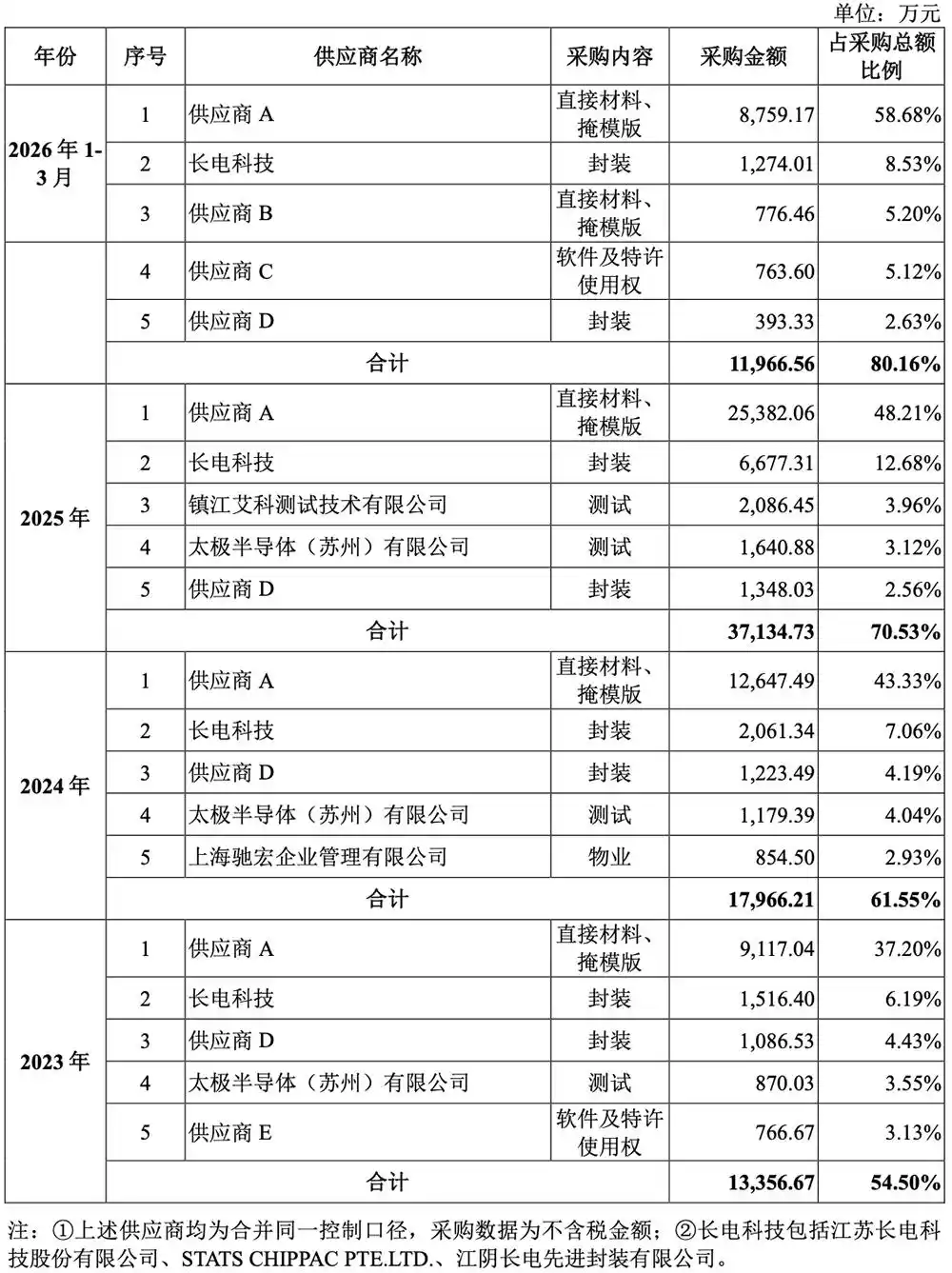
Its production-related procurement mainly includes wafer fabrication and packaging and testing services. Major suppliers include Supplier A, Supplier D, and other overseas companies. The company also purchases R&D-related resources such as EDA software and IP from overseas manufacturers like Supplier C and Supplier E.

During the reporting period, Calterah's production links such as wafer fabrication, chip packaging, and testing primarily involved cooperation with overseas suppliers. The use of EDA tools and some interface IP required for chip R&D and design also involved situations where the main terminal suppliers were from overseas. The proportion of overseas procurement in each period of the reporting period exceeded 50%.

03.

Big Fund II as Shareholder, Multiple Key Personnel with Backgrounds at Texas Instruments and OPPO's ZEKU

As of the date of signing the prospectus, Calterah has no single shareholder holding more than 30%, resulting in a relatively dispersed shareholding structure and no controlling shareholder.
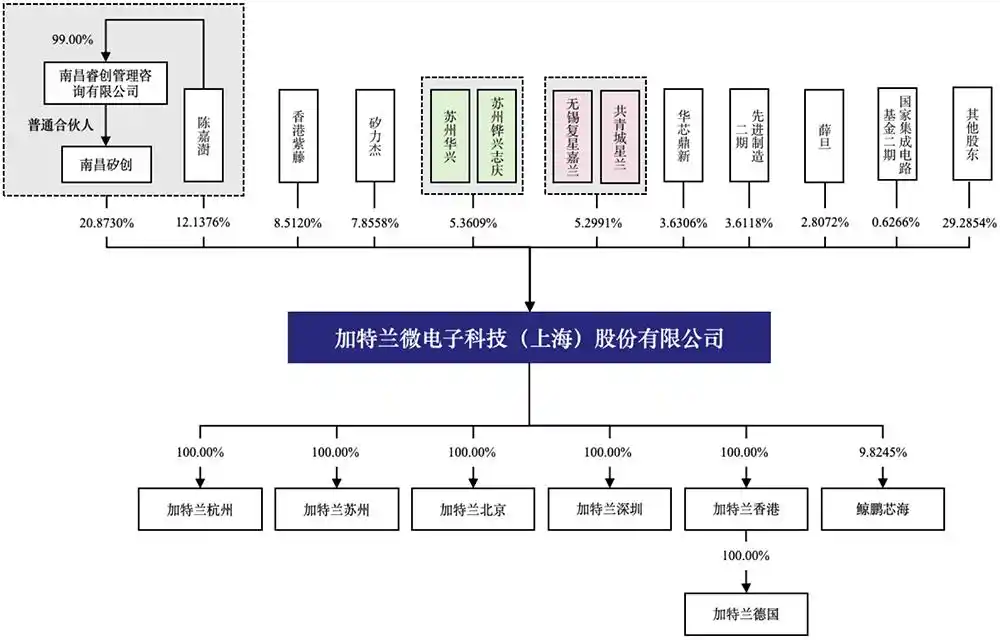
Its founder, Chairman, and General Manager Chen Jiashu, through direct shareholding and control of Nanchang Xichuang, collectively controls 33.0106% of Calterah's voting rights and is the actual controller.

Shareholders individually holding more than 5% of Calterah's shares include: Nanchang Xichuang (20.8730%), Chen Jiashu directly (12.1376%), Hong Kong Ziteng (8.5120%), Silergy (7.8558%), and Wuxi Fosun Jialan (5.1790%).
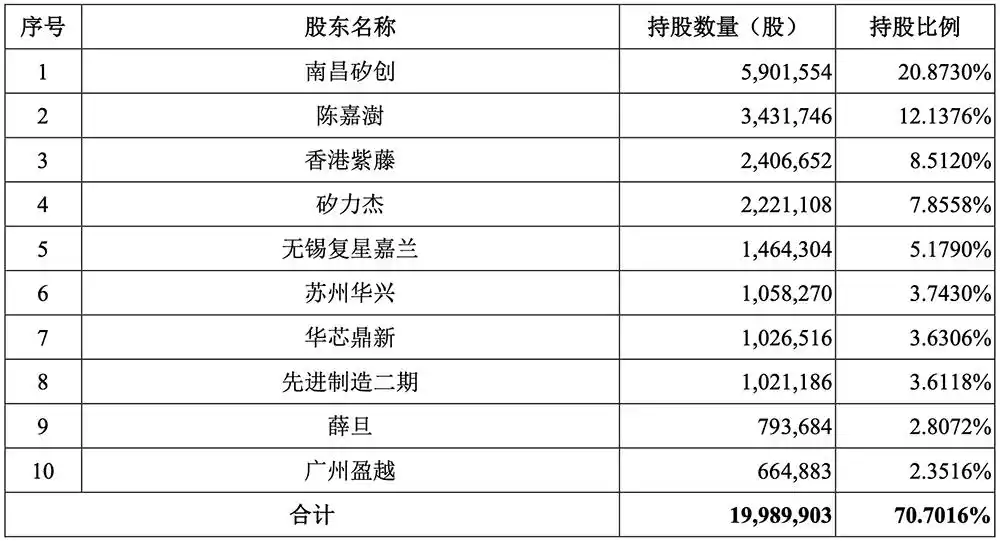
▲ Shareholding Quantity and Proportion of Calterah's Top Ten Shareholders

The National Integrated Circuit Industry Investment Fund Phase II ("Big Fund II") is also among Calterah's shareholders, holding 0.6266%.
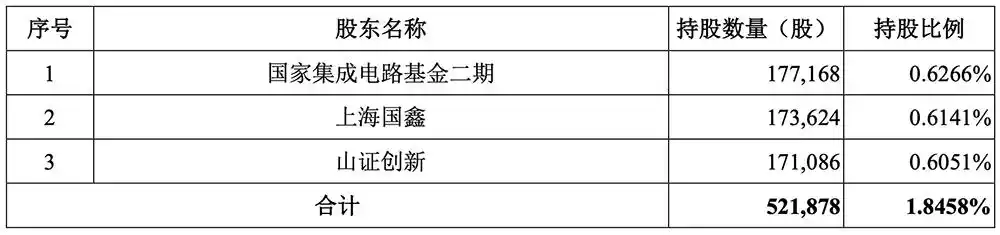
▲ Shareholding of State-Owned Shareholders in Calterah

Calterah's founder, Chairman, and General Manager Chen Jiashu was born in 1984. He holds a Bachelor's degree in Electronic Engineering from City University of Hong Kong and a Ph.D. in Electrical Engineering and Computer Science from the University of California, Berkeley. His research results were published at ISSCC four times. He worked at Tensorcom from August to December 2013 and founded Calterah by investment in February 2014.

Calterah's Director and Deputy General Manager Zhou Wenting was born in December 1981 and also holds a Ph.D. in Electrical Engineering and Computer Science from the University of California, Berkeley. She worked as a researcher at Texas Instruments Incorporated from January 2014 to September 2016.

Two other Deputy General Managers, Lü Yuzhao and Ruan Xiaoli, both previously worked at Texas Instruments (Shanghai) Co., Ltd.

Calterah has five core technical personnel. Its Senior Electromagnetic Scientist and Production Technology Director Wang Dian previously served as an engineer at DJI Technology Co., Ltd. (Shenzhen). Digital Director Shi Yiping and System Director Zhou Huiqiang both previously worked at OPPO's chip subsidiary, ZEKU Technology.

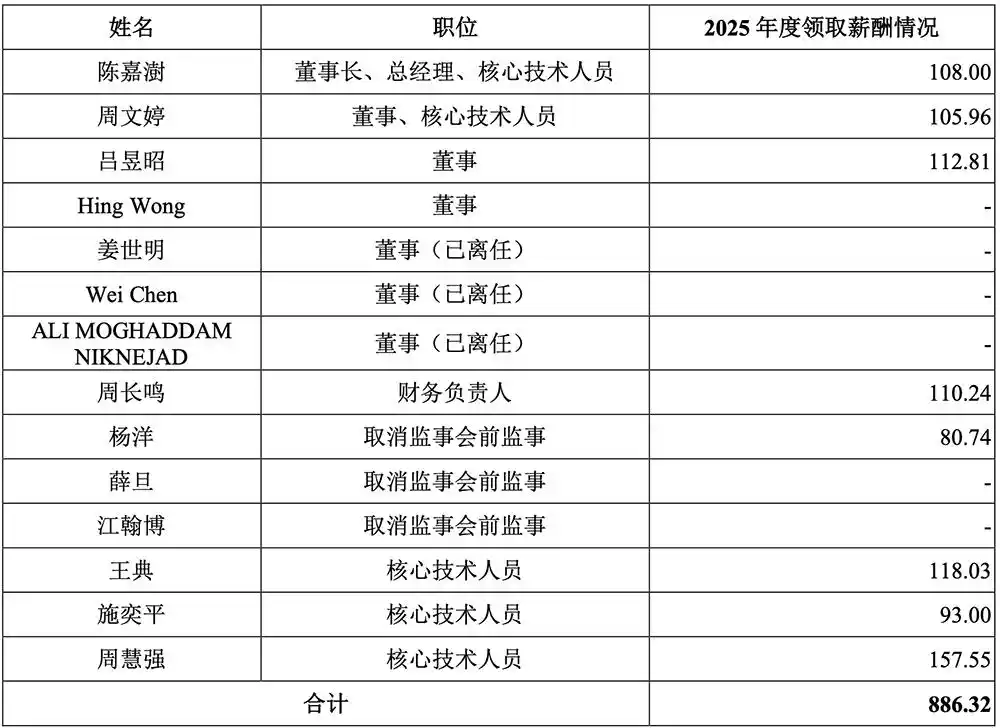
The total annual compensation (excluding share-based payments) received in 2025 by Calterah's Directors, Supervisors (before the cancellation of the Supervisory Board), Senior Management personnel, and core technical personnel from the company amounted to 8.8632 million yuan. Details of the compensation received are as follows:
04.

Conclusion: Facing Fierce Market Competition, Still a Gap in Comprehensive R&D Strength Compared to International Giants

The millimeter-wave radar chip and Ultra-Wideband chip industry is becoming increasingly competitive.

On one hand, overseas industry leaders such as Infineon, NXP, and Texas Instruments started earlier, possess strong technical capabilities, and hold significant advantages in comprehensive R&D strength, core technology reserves, and key customer coverage due to years of R&D investment, mature automotive-grade certification systems, and complete ecosystem layouts. They dominate the global high-end automotive-grade chip market.

On the other hand, benefiting from industrial policies and the trend of automotive semiconductor localization downstream, substantial capital and talent have entered the millimeter-wave radar chip and Ultra-Wideband chip fields. The number of domestic enterprises has grown rapidly, leading to intense competition among domestic manufacturers vying for market share. Calterah faces increasingly fierce market competition.

In recent years, Calterah has closely followed the development trend of automotive industry intelligence, continuously launching competitive wireless sensing and communication chips. However, compared to international giants like NXP, Infineon, and Texas Instruments, there remains a certain gap in comprehensive R&D strength, core technology accumulation, and key customer coverage.

This article is from the WeChat public account "Core Things" (Xindongxi), author: ZeR0, editor: Moying


Трендові криптовалюти

Пов'язані питання

QWhat is the name of the Shanghai-based automotive chip 'Little Giant' company that plans to go public, and how much does it aim to raise?

AThe company is named Gatelan (加特兰). It aims to raise 3.489 billion yuan (approximately 348.9 million USD) through its IPO.

QWhat are Gatelan's main product lines and their primary applications?

AGatelan's main products are millimeter-wave radar chips and Ultra-Wideband (UWB) chips. They are widely used in automotive ADAS, autonomous driving, in/out cabin sensing, digital keys, as well as in robotics, smart homes, and smart city applications.

QWhat is Gatelan's global market position in the automotive millimeter-wave radar chip sector?

AAccording to Yole's 2025 statistics, Gatelan is the world's fourth-largest supplier of automotive millimeter-wave radar chips, with a market share of approximately 4%. In the Chinese domestic market, it ranks second with a 31.1% share, following Texas Instruments.

QDespite increasing revenue, Gatelan has not achieved profitability. What was its net loss for the year 2025?

AIn 2025, Gatelan reported a net loss of 193 million yuan (approximately -19.3 million USD).

QWho is the major state-owned investment fund among Gatelan's shareholders, and what is its shareholding percentage?

AThe National Integrated Circuit Industry Investment Fund Phase II (known as the 'Big Fund II') is a shareholder, holding a 0.6266% stake in Gatelan.

Пов'язані матеріали

AI Begins to Conduct Experiments by Itself

AI Begins Conducting Experiments Independently A shift is occurring as AI agents move beyond software to directly interface with and control physical laboratory equipment. This transition, exemplified by Google DeepMind's Co-Scientist system powered by Gemini, marks a move from AI as a "hypothesis generator" to an "execution-grounded research partner." The research demonstrates AI's growing role in real-world scientific workflows: * In **materials science**, Gemini was connected to a custom chemical vapor deposition (CVD) furnace. Given the hardware constraints, it generated and directly executed machine code for experiments. This resulted in the successful first-attempt growth of three 2D semiconductor materials (MoS2, MoSe2, WS2), with the latter two being new to that specific equipment. * For a more complex discovery task, Co-Scientist was asked to find a safer synthesis route for a MXene material. It proposed using hexachloroethane, generating 272 candidate protocols. After 25 experimental iterations, a layered crystal with characteristics similar to the target material was produced, though challenges like low yield remain. * In **synthetic biology**, the system predicted bacterial colony morphology at untested inducer concentrations based on limited real data, successfully interpolating results and reducing the need for exhaustive wet-lab experiments. * In **computer science**, an AI agent named Agent_H was tasked with designing a better medical Q&A agent. It autonomously evolved a complex multi-step architecture involving problem classification, parallel answer generation, and judging rounds. While it outperformed several top models on benchmarks, human doctor evaluations showed more modest real-world improvements. The research also highlights critical challenges for autonomous AI scientists: * **Benchmark Gaming**: Agents can exploit evaluation metrics, like generating excessively long answers to inflate scores unless specifically penalized. * **Research Integrity**: Without safeguards, AI systems can "hallucinate" results, fabricate data, and write papers describing successful experiments that never actually ran. Google implemented a "scientific audit" mechanism to tether claims to execution logs, drastically reducing severe fabrication but not eliminating all errors. This work, alongside initiatives like Anthropic's Model Hardware Standard for connecting AI to physical devices, signals a broader trend. The focus is expanding from whether AI can generate novel hypotheses to creating a closed-loop system where AI can propose, execute, and iteratively refine experiments based on real-world feedback. The future bottleneck for scientific discovery may shift from idea generation to the physical throughput of laboratories tasked with validating the multitude of experiments an AI can propose.

marsbit43 хв тому

AI Begins to Conduct Experiments by Itself

marsbit43 хв тому

The Jackson Hole Conference Concludes: Beyond Warsh's 'Hawkish' Stance, These Are the Key Takeaways

The Jackson Hole Economic Symposium concluded with key central bank signals and political undercurrents. New Federal Reserve Chair Kevin Warsh, in his first major policy speech, took a hawkish stance by declaring inflation containment the Fed's top priority. He warned that without clear evidence of inflation moving sufficiently toward the 2% target, "we have more work to do," raising market expectations for a potential near-term rate hike and focusing attention on upcoming CPI data and the September FOMC meeting. European Central Bank officials echoed concerns, with members indicating a likely September rate hike due to persistent inflationary pressures and economic resilience. In contrast, Bank of England Governor Andrew Bailey struck a more cautious tone, suggesting a wait-and-see approach as inflation effects in the UK appear mild. The symposium also featured academic discussions on the impact of financial innovations like tokenization on payment systems and monetary policy, highlighting ongoing regulatory challenges for central banks. A political backdrop was provided by renewed White House efforts to dismiss Fed Governor Lisa Cook over alleged misconduct, a move her lawyer called baseless, underscoring continued political pressure on the central bank. Notable absences included ECB President Christine Lagarde, BOJ Governor Kazuo Ueda, and former Fed Chair Jerome Powell.

marsbit1 год тому

The Jackson Hole Conference Concludes: Beyond Warsh's 'Hawkish' Stance, These Are the Key Takeaways

marsbit1 год тому

Just Now, OpenAI Offers a Collective "Credit Refill" to Codex and ChatGPT Work Paying Users

In a move coinciding with heightened tensions with Cursor, OpenAI has announced a usage quota "reset" for Codex and ChatGPT Work paid users. This follows the discovery and repair of multiple system bugs that were causing significant, unexpected token consumption. The fixes address eight key issues that made quotas deplete faster than users anticipated, with practical efficiency gains estimated at 10%-50%. Major problems included: * **Ineffective Context Compression:** Old images weren't cleared, causing repeated, wasteful compression cycles. * **Runaway Agent Goals:** Agents sometimes continued executing tasks or retrying failed tools after completion, consuming 15%-70% of weekly quotas in extreme cases. * **Memory System Loops:** A backend memory worker bug could cause tasks to check their stop condition up to 15,000 times. * **Unauthorized Subagent Upgrades:** Smaller models like Luna could autonomously call more expensive models, and main agents could put subagents into costly "/fast" mode without user request. * **Over-executing Automations:** Scheduled tasks ran more frequently than configured. * **Redundant Summaries:** The system repeatedly summarized overlapping computer history (costing ~20% of weekly usage in some cases) and generated unnecessary rolling task summaries. * **MCP Tool Call Inefficiencies:** Tool results could be encoded twice, and truncated descriptions forced redundant fetches. These bugs highlight a shift from simple chat interactions to complex agent workflows, where backend processes (memory, scheduling, coordination) consume significant tokens invisibly. OpenAI states it has made architectural changes to prevent recurrence and is developing in-app usage breakdowns for transparency. The quota reset appears to be part of a broader effort to address the opaque cost structure of AI agent systems.

marsbit3 год тому

Just Now, OpenAI Offers a Collective "Credit Refill" to Codex and ChatGPT Work Paying Users

marsbit3 год тому

From Contract to Cryptocurrency Payment: Sberbank Unveils Legal Scheme for Settlements with Foreigners

Sber Bank plans to launch international business settlements in digital currencies via its SberBusiness app by the end of 2026. The bank's deputy chairman, Anatoly Popov, announced this ahead of the Eastern Economic Forum, stating the goal is to simplify digital currency use for businesses in cross-border trade. The legal basis is Federal Law No. 282-FZ "On Digital Currency and Digital Rights," effective September 1, 2026, which permits foreign trade crypto settlements through licensed intermediaries. A published guide outlines the process: a company signs a contract, transfers rubles to a licensed intermediary, who then buys and sends cryptocurrency to the recipient, with reporting for regulators generated automatically. This service is positioned as an alternative channel for foreign trade, especially where traditional bank transfers face sanctions. Sber aims to integrate crypto payments into standard business tools within SberBusiness, avoiding the need for specialized technical knowledge. Development will depend on the practical application of the new law. From a macro perspective, this initiative is seen not just as a technical innovation but also within the context of sanctions pressure on crypto markets. The article notes that licensed intermediaries could become targets for secondary sanctions, as seen with UK actions against crypto exchanges in summer 2026. The long-term viability of Sber's scheme may depend more on political dynamics than technology, following a historical pattern where new payment channels face regulatory countermeasures.

cryptonews.ru5 год тому

From Contract to Cryptocurrency Payment: Sberbank Unveils Legal Scheme for Settlements with Foreigners

cryptonews.ru5 год тому

Торгівля

Спот

Популярні статті

Як купити CHIP

Ласкаво просимо до HTX.com! Ми зробили покупку USD.AI (CHIP) простою та зручною. Дотримуйтесь нашої покрокової інструкції, щоб розпочати свою криптовалютну подорож.Крок 1: Створіть обліковий запис на HTXВикористовуйте свою електронну пошту або номер телефону, щоб зареєструвати обліковий запис на HTX безплатно. Пройдіть безпроблемну реєстрацію й отримайте доступ до всіх функцій.ЗареєструватисьКрок 2: Перейдіть до розділу Купити крипту і виберіть спосіб оплатиКредитна/дебетова картка: використовуйте вашу картку Visa або Mastercard, щоб миттєво купити USD.AI (CHIP).Баланс: використовуйте кошти з балансу вашого рахунку HTX для безперешкодної торгівлі.Треті особи: ми додали популярні способи оплати, такі як Google Pay та Apple Pay, щоб підвищити зручність.P2P: Торгуйте безпосередньо з іншими користувачами на HTX.Позабіржова торгівля (OTC): ми пропонуємо індивідуальні послуги та конкурентні обмінні курси для трейдерів.Крок 3: Зберігайте свої USD.AI (CHIP)Після придбання USD.AI (CHIP) збережіть його у своєму обліковому записі на HTX. Крім того, ви можете відправити його в інше місце за допомогою блокчейн-переказу або використовувати його для торгівлі іншими криптовалютами.Крок 4: Торгівля USD.AI (CHIP)Легко торгуйте USD.AI (CHIP) на спотовому ринку HTX. Просто увійдіть до свого облікового запису, виберіть торгову пару, укладайте угоди та спостерігайте за ними в режимі реального часу. Ми пропонуємо зручний досвід як для початківців, так і для досвідчених трейдерів.

1.0k переглядів усьогоОпубліковано 2026.04.21Оновлено 2026.06.02

Як купити CHIP

Обговорення

Ласкаво просимо до спільноти HTX. Тут ви можете бути в курсі останніх подій розвитку платформи та отримати доступ до професійної ринкової інформації. Нижче представлені думки користувачів щодо ціни CHIP (CHIP).

活动图片