Senator Lummis pushes for CLARITY Act, calls it ‘best thing to happen to DeFi community’

ambcryptoОпубліковано о 2026-04-02Востаннє оновлено о 2026-04-02

Анотація

Senator Cynthia Lummis advocates for the Digital Asset Market Clarity Act of 2025, calling it the "best thing to happen to the DeFi community." She argues the legislation would provide legal certainty and a "safe harbor" for developers, validators, and node operators, ensuring American innovation remains in the U.S. However, this optimism contrasts with Polymarket's prediction market, where the act's odds of passage are only 49%, reflecting broader market uncertainty. This skepticism may stem from ongoing disagreements between the White House and crypto entities like Coinbase. Concurrently, stablecoin infrastructure is evolving. The Better Money Company, backed by A16z crypto, is developing a "stablecoin clearinghouse" to simplify the use of multiple stablecoins across different blockchains. This development follows the passage of the GENIUS Act in 2025, which streamlined stablecoin regulations. Visa's on-chain analytics report a massive $72.3 trillion in stablecoin transaction volume over the past year, with USDC recently outpacing USDT in monthly transaction volume.

The hype around the Digital Asset Market Clarity Act of 2025 is increasing day by day. Senator Cynthia Lummis is the latest to lend some fresh optimism to the ongoing discussion around yield generations, with the Senator claiming that the CLARITY Act is the “best thing that could happen to the DeFi community.”

This is evidence of how even big officials can see the ongoing uncertainty surrounding regulations that are coming up in the way of actual growth of the crypto ecosystem. Hence, by pushing demand for the passage of the CLARITY Act, Lummis believes that this would finally give the crypto community “the legal certainty they deserve”.

Lummis also stressed on the seriousness of the situation as she explained how this proposed law is a one-pot solution to “developers, validators, and node operators.”

Once approved, this Act would provide “a safe harbor” and also “ensure American innovation stays right here on U.S soil.”

Polymarket odds are painting a negative picture

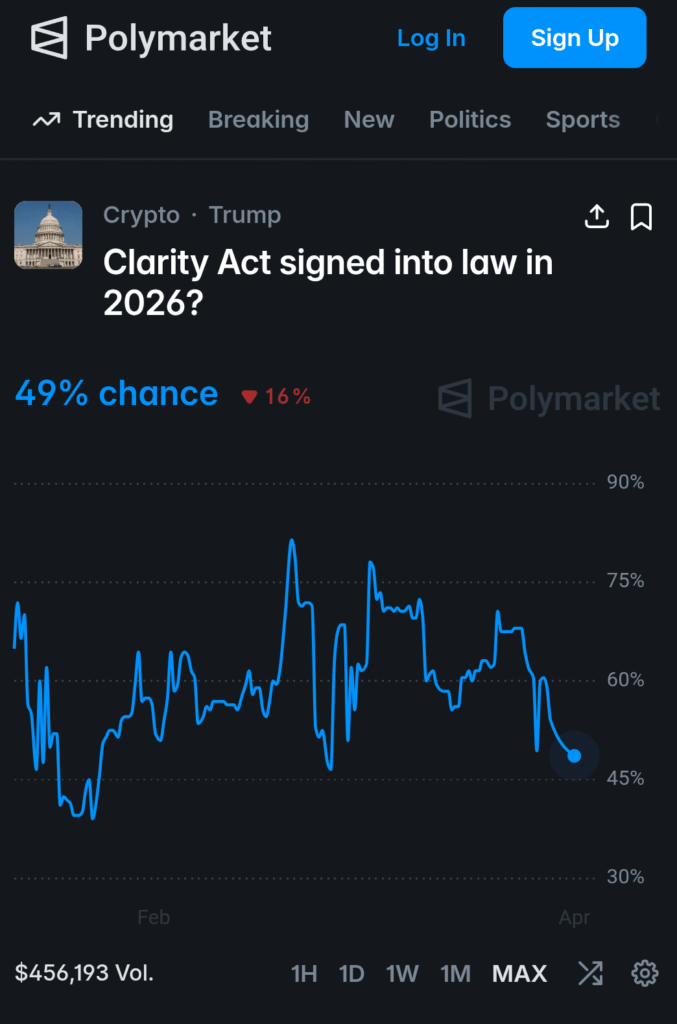
However, this optimism is in contrast to Polymarket odds. At the time of writing, they sat at 49%, even below the neutral level – A sign that the broader market is still unsure about the passage of the Act.
Source: Polymarket

This might be due to the series of disagreements between the White House and Coinbase.

On the contrary, others like the Better Money Company, a stablecoin infrastructure firm, are aiming to build “the next era of money”.

The current situation of the stablecoin market is such that different stablecoins exist across multiple blockchains, issuers, and platforms. And, they often require manual, costly conversions and sometimes even trading at slight value differences.

Finding the missing piece

Hence, to remove this roadblock, The Better Money Company is aiming to build “a stablecoin clearinghouse.” Under this plan, the firm will simplify how developers and businesses integrate stablecoins, enabling them to send, receive, and use multiple stablecoins as if they were one consistent form of money.

With A16z crypto investing in the startup, the plan is simply to develop the “critical missing connectivity layer” required to make the stablecoin ecosystem function effectively.

Other developments in and around stablecoins

All this is happening along the heels of the GENIUS Act that was passed in 2025, making stablecoin regulations seamless.

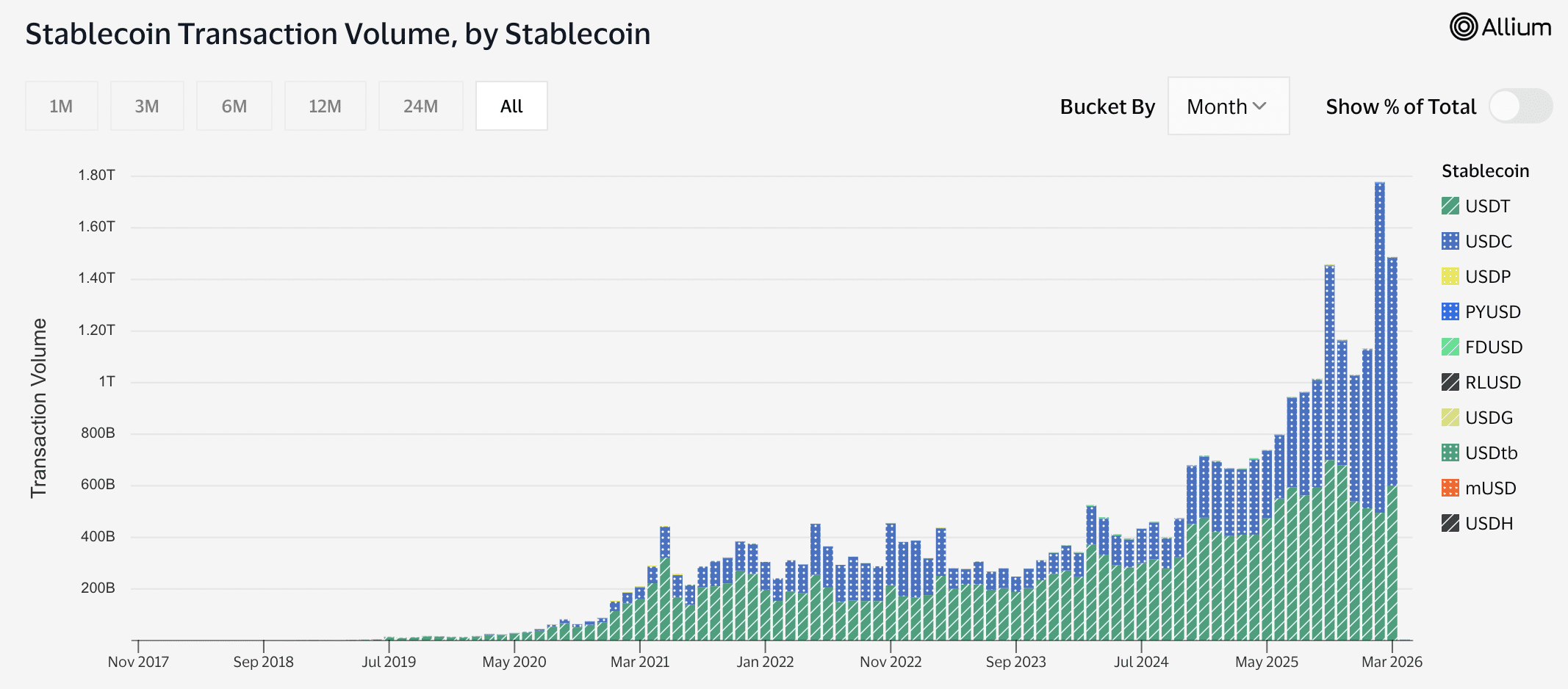
In the meantime, the total transaction volume of stablecoins hit a count of $72.3 trillion in the last 12 months, as per Visa’s on-chain analytics.
Source: Visa on-chain analytics

That’s not all either as data also revealed that USDC has been outpacing USDT lately. In fact, until last year, most months saw USDT ruling the transaction volume. However, things seem to have changed since 2026.


Final Summary

  • Despite growing optimism from the likes of Senator Cynthia Lummis, Polymarket odds remain below par.
  • Firms like Better Money Company now stepping in with new stablecoin plans.

Трендові криптовалюти

Пов'язані питання

QWhat is the CLARITY Act and why does Senator Lummis support it?

AThe CLARITY Act refers to the Digital Asset Market Clarity Act of 2025. Senator Lummis supports it because she believes it will provide the DeFi community with 'the legal certainty they deserve,' act as a one-pot solution for developers, validators, and node operators, provide a 'safe harbor,' and ensure American innovation stays in the U.S.

QAccording to the article, what do the current Polymarket odds suggest about the Act's passage?

AThe current Polymarket odds, sitting at 49% (below the neutral level), suggest that the broader market is still unsure about the passage of the CLARITY Act.

QWhat problem is The Better Money Company aiming to solve with its 'stablecoin clearinghouse'?

AThe Better Money Company aims to solve the problem of different stablecoins existing across multiple blockchains, issuers, and platforms, which often require manual, costly conversions and can trade at slight value differences. Their clearinghouse would simplify integration, allowing users to send, receive, and use multiple stablecoins as one consistent form of money.

QWhat significant development in stablecoin regulation preceded the events in this article?

AThe GENIUS Act, which was passed in 2025 and made stablecoin regulations seamless, preceded the events discussed in the article.

QWhat does the data from Visa's on-chain analytics reveal about stablecoin transaction volume and the performance of USDC vs. USDT?

AVisa's on-chain analytics revealed that the total transaction volume of stablecoins was $72.3 trillion in the last 12 months. The data also showed that USDC has been outpacing USDT lately, a change from previous years where USDT typically ruled the transaction volume.

Пов'язані матеріали

A 'Overlooked' Market Event: Joint US-Japan-South Korea Intervention, Rare US Treasury Involvement, and Bessent's Quiet 'Market Rescue'?

Summary: The United States, Japan, and South Korea executed their largest coordinated foreign exchange intervention in nearly 30 years. The action targeted depreciation pressure on the Japanese yen and South Korean won. This move is seen as a significant effort by the US to stabilize the financial markets of its key allies and prevent the spillover of risks. Key details: * Japan reportedly intervened on July 30 using approximately 8.45 trillion yen (about $52.8 billion). South Korean authorities also intervened that day, selling dollars to support the won. * Notably, the US Treasury Department intervened directly in yen markets for the first time in roughly 30 years. The New York Fed, reportedly acting on behalf of the Treasury, sold euros to buy yen via Goldman Sachs and Morgan Stanley on July 31. Analysts view the use of the euro-yen pair as a way to alleviate yen pressure without adding selling pressure to the US dollar. * Prior to the action, the New York Fed conducted "rate checks" on both USD/JPY and EUR/JPY, a newer signaling tool that falls between verbal and physical intervention. The intervention is interpreted as going beyond traditional currency stabilization. Analysts, such as Michael Hartnett of Bank of America, suggest it resembles a "Price Keeping Operation" for the AI era. The core US objectives are perceived to be: 1. Preventing rapid yen depreciation from triggering a sharp rise in Japanese government bond yields. 2. Containing financial stress from spreading across Asian markets like South Korea and Japan. 3. Reducing the risk of disorderly capital flows impacting the US bond market. This coordinated action underscores the importance of Japan and South Korea as critical partners in the US semiconductor and AI supply chain. Stabilizing their financial markets is seen as vital to mitigating risks to the broader tech industry and the US market itself. The intervention coincides with market pressures, including the KOSDAQ index hitting a low since October 2022. While seen as a move to control volatility, some analysts caution it may not fundamentally reverse existing market trends.

marsbit4 хв тому

A 'Overlooked' Market Event: Joint US-Japan-South Korea Intervention, Rare US Treasury Involvement, and Bessent's Quiet 'Market Rescue'?

marsbit4 хв тому

Will the Federal Reserve Definitely Raise Interest Rates in September? How Will Cryptocurrencies and US Stocks Bear the Pressure?

In early August 2024, market expectations for a September Federal Reserve rate hike surged dramatically, from below 50% to over 80%, driven by renewed inflation concerns. This shift followed a contentious July FOMC meeting where a 9-3 vote to hold rates revealed a growing hawkish faction advocating for an immediate hike, citing prolonged above-target inflation. The key catalyst is escalating conflict near the Strait of Hormuz, which has pushed oil prices up approximately 20% in July, threatening to reignite inflation. The next critical data point is the July CPI report on August 12th; a hot reading could solidify hike expectations. For crypto assets, particularly Bitcoin, this represents near-term pressure. Bitcoin continues to exhibit high-beta, risk-on characteristics, making it sensitive to tightening liquidity and higher opportunity costs. However, historical precedent suggests that if a hike is perceived as the cycle's end rather than its start, the negative impact may be brief, with markets quickly pivoting to anticipate future rate cuts. U.S. stocks, especially crypto-linked equities like Coinbase and high-valuation tech stocks, face amplified volatility. Higher rates increase discount rates in valuation models, pressuring growth stocks. This coincides with a pivotal tech earnings season where investor focus has shifted from massive AI capital expenditures to demonstrable revenue and cash flow generation. Companies with negative cash flows and weak growth narratives could see severe pressure if a September hike materializes, as financing costs would rise. Key indicators to watch include oil prices, upcoming inflation data, and Fed commentary at events like the Jackson Hole symposium.

Odaily星球日报4 хв тому

Will the Federal Reserve Definitely Raise Interest Rates in September? How Will Cryptocurrencies and US Stocks Bear the Pressure?

Odaily星球日报4 хв тому

From South Korea to the United States: Blue-Collar Jobs Are Becoming Increasingly Popular, Thanks to AI

AI is reshaping the labor market's value proposition. The traditional four-year college degree is losing its appeal as a guaranteed career path, while skilled blue-collar trades like electricians, welders, and plumbers are experiencing historic demand and wage premiums. This shift is driven by dual pressures: AI's displacement of certain white-collar roles and a booming need for physical infrastructure and data center construction. Data confirms the trend. In the U.S., vocational school revenue surged, and a significant portion of recent layoffs are AI-related. Surveys show a majority of Gen Z adults plan to pursue blue-collar work, citing better job security against AI automation. Vocational education interest has exploded recently. Experts cite a psychological shift as younger generations seek tangible, AI-resistant careers and avoid high student debt. In many cases, salaries for skilled trades now match or exceed those requiring a bachelor's degree. In South Korea, semiconductor vocational high schools boast near-total employment, with graduates securing high-paying roles at companies like Samsung. The shortage is structural, exacerbated by a retiring baby boomer workforce and massive infrastructure projects. Companies like JPMorgan Chase, Meta, and Lowe's are investing heavily in training programs. However, overcoming historical stigma and a "perception gap" around trade careers remains a key challenge to closing the talent gap.

marsbit1 год тому

From South Korea to the United States: Blue-Collar Jobs Are Becoming Increasingly Popular, Thanks to AI

marsbit1 год тому

Торгівля

Спот

Популярні статті

Як купити HYPE

Ласкаво просимо до HTX.com! Ми зробили покупку Hyperliquid (HYPE) простою та зручною. Дотримуйтесь нашої покрокової інструкції, щоб розпочати свою криптовалютну подорож.Крок 1: Створіть обліковий запис на HTXВикористовуйте свою електронну пошту або номер телефону, щоб зареєструвати обліковий запис на HTX безплатно. Пройдіть безпроблемну реєстрацію й отримайте доступ до всіх функцій.ЗареєструватисьКрок 2: Перейдіть до розділу Купити крипту і виберіть спосіб оплатиКредитна/дебетова картка: використовуйте вашу картку Visa або Mastercard, щоб миттєво купити Hyperliquid (HYPE).Баланс: використовуйте кошти з балансу вашого рахунку HTX для безперешкодної торгівлі.Треті особи: ми додали популярні способи оплати, такі як Google Pay та Apple Pay, щоб підвищити зручність.P2P: Торгуйте безпосередньо з іншими користувачами на HTX.Позабіржова торгівля (OTC): ми пропонуємо індивідуальні послуги та конкурентні обмінні курси для трейдерів.Крок 3: Зберігайте свої Hyperliquid (HYPE)Після придбання Hyperliquid (HYPE) збережіть його у своєму обліковому записі на HTX. Крім того, ви можете відправити його в інше місце за допомогою блокчейн-переказу або використовувати його для торгівлі іншими криптовалютами.Крок 4: Торгівля Hyperliquid (HYPE)Легко торгуйте Hyperliquid (HYPE) на спотовому ринку HTX. Просто увійдіть до свого облікового запису, виберіть торгову пару, укладайте угоди та спостерігайте за ними в режимі реального часу. Ми пропонуємо зручний досвід як для початківців, так і для досвідчених трейдерів.

397 переглядів усьогоОпубліковано 2024.12.11Оновлено 2026.06.02

Як купити HYPE

Обговорення

Ласкаво просимо до спільноти HTX. Тут ви можете бути в курсі останніх подій розвитку платформи та отримати доступ до професійної ринкової інформації. Нижче представлені думки користувачів щодо ціни HYPE (HYPE).

活动图片