Senate Judiciary flags DeFi oversight ‘gaps’ in U.S. crypto bill

ambcryptoОпубліковано о 2026-01-17Востаннє оновлено о 2026-01-17

Анотація

The Senate Judiciary Committee, led by Chuck Grassley and Dick Durbin, has raised concerns about the CLARITY Act, a broader crypto market structure bill. They warn that exemptions in the bill could allow DeFi software developers to avoid financial licensing requirements for money-transmitting businesses, potentially weakening federal criminal code enforcement tools used by the Department of Justice. The Judiciary Committee argues it was not consulted on these changes and urged the Senate Banking Committee to reject the exemptions, citing risks such as enabling money laundering. In response, the Banking Committee defended the protections for developers, stating the provisions fall under its jurisdiction and aim to prevent unfair prosecution of those without control over funds or transactions. The bill faces further uncertainty after Coinbase withdrew support, and the White House reportedly warned the exchange to return to negotiations or risk losing backing. The future of the legislation remains unclear.

The broader crypto market structure, the CLARITY Act, has hit another snag, this time from the Senate Judiciary Committee.

The Committee’s Chair, Chuck Grassley (R-Iowa), and ranking member, Dick Durbin (D-Illinois), raised an alarm about a section of the bill.

They pointed out that it would exempt some DeFi software developers from financial licensing requirements for money-transmitting businesses (MTBs).

In a letter to Senate Banking Committee Chair Tim Scott and Ranking Member Elizabeth Warren (D‐Massachusetts), Senators Grassley and Durbin emphasized that they had not been consulted. They argued that the mandate nonetheless falls within their jurisdiction.

The Senate Judiciary Committee went further, warning that the bill’s exemptions “weaken” the federal criminal code. They stressed that this code is a critical enforcement tool for the Department of Justice in combating serious crime.

“By providing a sweeping exemption to non-controlling developers or providers from critical portions of Titles 18 and 31.”

The letter further stated,

“The Senate Judiciary Committee, which has jurisdiction over Title 18, was not consulted or given the opportunity to meaningfully review the proposed changes in advance.”

The senators warned that the proposed exemptions could allow founders, such as Roman Storm of the crypto mixer Tornado Cash, to walk free, even after facilitating the laundering of large‐scale criminal proceeds.

As a consequence, the Judiciary Committee urged its banking colleagues to reject these exemptions. They emphasized the need to close potential DeFi oversight “gaps” in the bill to ensure accountability.

Senate Banking defends developer protections

For perspective, Storm was convicted of conspiracy to operate an unlicensed MTBs despite not having custody of funds or discretionary control over transactions.

This section of the bill, known as the Blockchain Regulatory Certainty Act (BRCA), was added to the broader crypto legislation.

Its purpose is to protect software developers from what lawmakers describe as “unfair” prosecution. Specifically, it seeks to shield them from liability under the Bank Secrecy Act and criminal law.

Even pro-crypto Cynthia Lummis backed these exemptions, provided the platforms don’t control the funds or transactions.
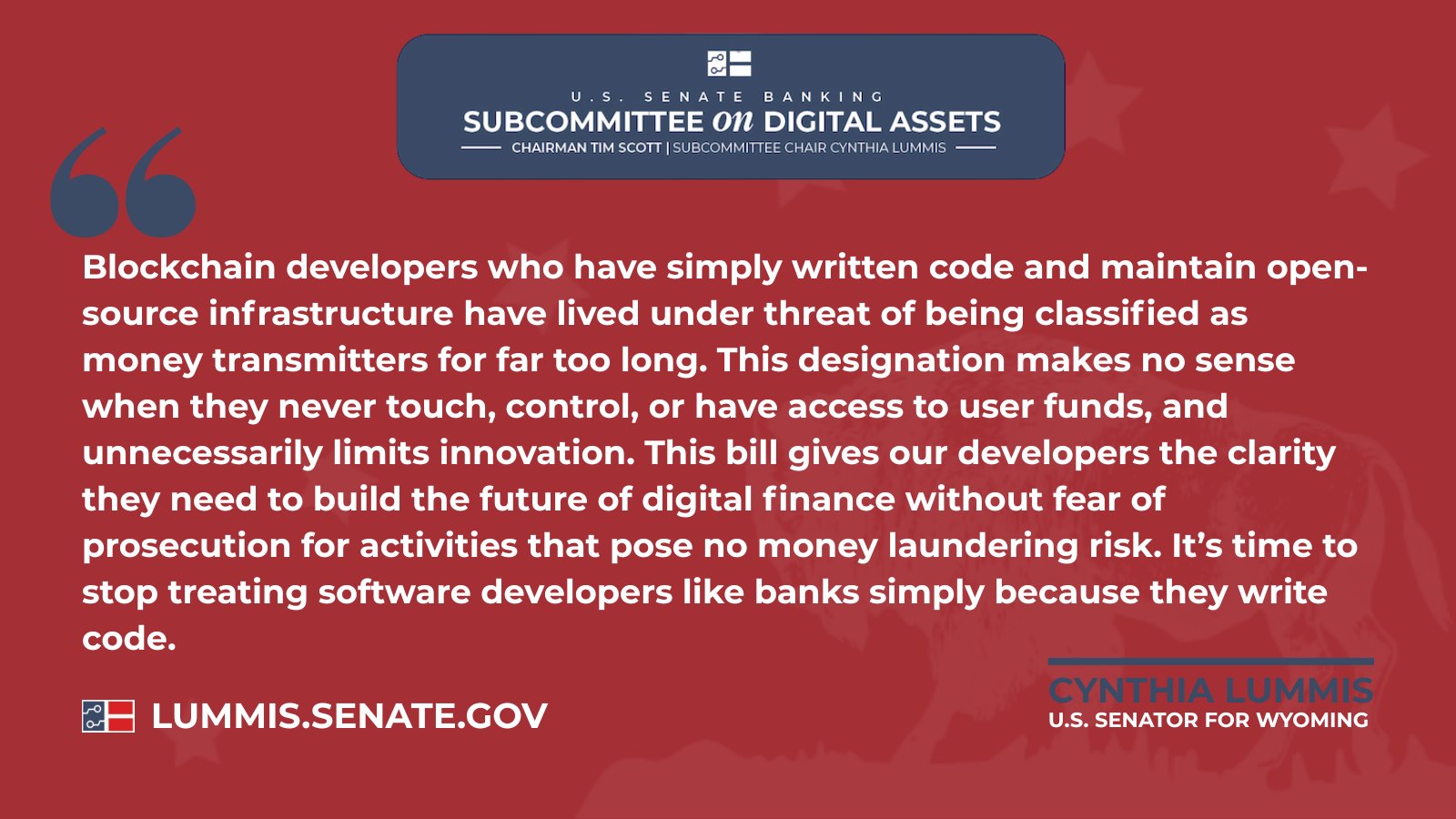
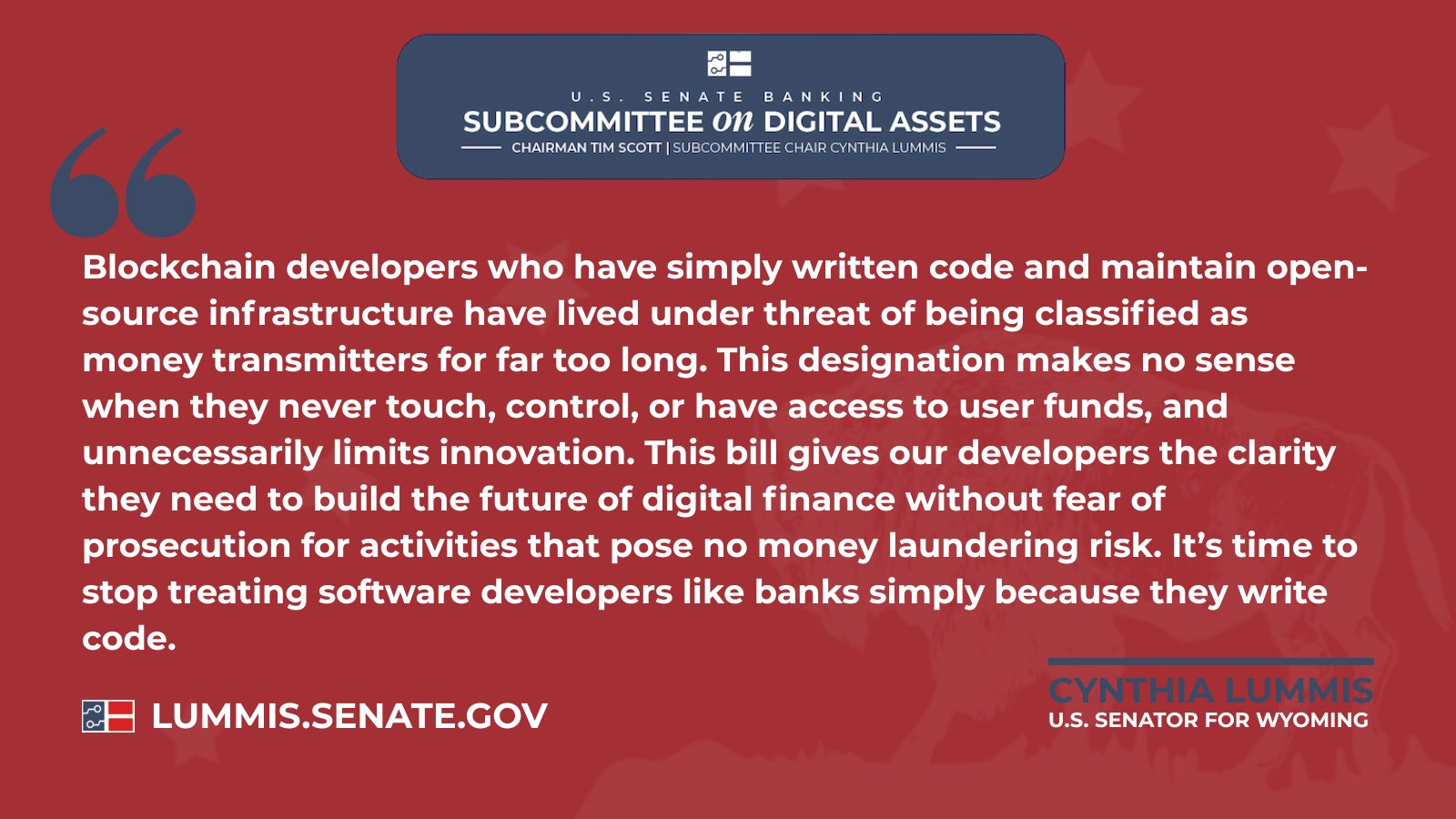
Source: X/Cynthia Lummis

In a response to Senate Judiciary claims, Tim Scott’s spokesperson, Jeff Naft, told Politico that BRCA falls within the Banking Committee and added,

“The Chairman (Scott) remains committed to protecting software developers while ensuring that law enforcement has the necessary tools to prosecute actual illegal money transmission operations.”

Uncertainty rocks crypto bill

The bill’s progress hit a roadblock after Coinbase withdrew support, citing ‘too many issues’ including a ban on stablecoin rewards.

Coinbase’s CEO Brian Armstrong’s “no bill, better than bad bill” stance has left the industry divided, intensifying uncertainty on the bill’s way forward.

That said, White House was reportedly unhappy with Coinbase’s move, calling it a ‘rug-pull’ against the entire industry.

According to reporter Eleanor Terrett, citing an insider, the White House will also pull support if Coinbase does come back to negotiations, adding that,

“This is President Trump’s bill at the end of the day, not Brian Armstrong’s”

It remains to be seen whether the bill will regain momentum in the coming days.


Final Thoughts

  • Senate Judiciary pressed for rejection of DeFi software developer exemptions to strengthen DoJ oversight in the space.
  • The White House reportedly warned Coinbase to return to negotiations or risk losing support.

Пов'язані питання

QWhat specific concern did the Senate Judiciary Committee raise about the CLARITY Act?

AThe Senate Judiciary Committee raised concerns that the bill would exempt some DeFi software developers from financial licensing requirements for money-transmitting businesses, which they argue would 'weaken' the federal criminal code and create oversight gaps.

QWhich specific legal titles did the Judiciary Committee argue were being weakened by the proposed exemptions?

AThe Judiciary Committee argued that the exemptions would weaken critical portions of Titles 18 and 31 of the U.S. Code, which fall under their jurisdiction.

QWhat is the purpose of the Blockchain Regulatory Certainty Act (BRCA) section added to the broader crypto bill?

AThe Blockchain Regulatory Certainty Act (BRCA) aims to protect software developers from what lawmakers describe as 'unfair' prosecution by shielding them from liability under the Bank Secrecy Act and criminal law, provided they don't control funds or transactions.

QWhy did Coinbase withdraw its support for the crypto bill?

ACoinbase withdrew its support for the bill citing 'too many issues,' including a proposed ban on stablecoin rewards.

QWhat was the White House's reported reaction to Coinbase's withdrawal from the bill negotiations?

AThe White House was reportedly unhappy with Coinbase's move, calling it a 'rug-pull' against the entire industry, and warned that they would also pull support if Coinbase did not return to negotiations.

Пов'язані матеріали

Why Bitcoin Holds Above $64,000 After Fed's Hard Pause

**Bitcoin Stabilizes Near $64,000 Following Hawkish Fed Pause** The cryptocurrency market, led by Bitcoin, remained stable around $64,000 despite a volatile reaction to the latest U.S. Federal Reserve meeting. The Fed paused interest rates but signaled a hawkish stance, with three committee members voting for an increase—the highest dissent since 2016. This limits risk appetite but hasn't triggered panic selling. Key market highlights include Bitcoin ETFs seeing a net inflow of $32.1 million, breaking a streak of outflows, while Ethereum ETFs experienced outflows of $18.65 million. Liquidations affected about 90,000 traders. Technically, Bitcoin finds support around $63,000-$63,500, with major resistance near $66,000. While its price is about 49% below its all-time high, institutional demand via ETFs and the absence of mass capitulation support a potential recovery scenario in the second half of the year. Major altcoins showed mixed movements, with Solana attracting capital while Ethereum faced selling pressure despite strong on-chain metrics like a growing staking queue. Regulatory news took a pause as the U.S. Senate delayed the CLARITY Act vote until at least autumn. For the final trading day of July, U.S. inflation and consumer spending data will be crucial. Bitcoin's key levels to watch are $63,000 support and $66,000 resistance. Sustained ETF inflows and Bitcoin holding above $63,000 are seen as positive signs for a potential market recovery later in the year.

cryptonews.ru16 хв тому

Why Bitcoin Holds Above $64,000 After Fed's Hard Pause

cryptonews.ru16 хв тому

Participants in XRP Fraud Scheme That Stole $9 Million from 71 Investors Arrested

South Korean police have arrested three individuals accused of operating a fraudulent investment platform that stole approximately 3.4 million XRP (worth about $9 million) from 71 investors between October 16 and 23. The suspects promoted the site Fxrpntwork.com through blogs, online articles, and YouTube videos, promising guaranteed principal and monthly returns of 1.5% to 1.8%. Investors were instructed to transfer XRP from Korean exchanges to overseas platforms and then to wallets controlled by the group before the site was shut down. The scammers copied the branding of legitimate projects Flare Network and FXRP to appear credible. Authorities warn that such impersonation frauds, which use familiar branding and urgent promises of guaranteed profits, are a common red flag. Legitimate companies do not solicit cryptocurrency transfers through unsolicited promotions. Seoul police have issued an Interpol Red Notice for a fourth suspect abroad and are investigating others involved in creating and promoting the fraudulent website. While investigators froze 17.3 billion won in assets, approximately 10 billion won was moved during the probe, with wallet analysis revealing transfers totaling 27.3 billion won, suggesting there may be additional unidentified victims and accomplices. The case underscores the organized, cross-border nature of crypto investment fraud.

cryptonews.ru19 хв тому

Participants in XRP Fraud Scheme That Stole $9 Million from 71 Investors Arrested

cryptonews.ru19 хв тому

Торгівля

Спот
活动图片





