Semiconductors up 78% annually, software down 12% annually: The 'Liquidity Siphon' is playing out within tech stocks

marsbitОпубліковано о 2026-05-26Востаннє оновлено о 2026-05-26

Анотація

Semiconductor ETFs like SOXX have surged 78.5% year-to-date, while software ETFs like IGV have dropped 12.5%, creating a record performance gap exceeding 90 percentage points. This reflects a major "liquidity suction" within tech stocks, with capital flooding into semiconductors as software faces selling pressure. Driving the semiconductor boom are staggering capital expenditure plans from hyperscalers like Microsoft, Alphabet, Amazon, and Meta, whose combined 2026 capex is projected near $700 billion. This fuels demand for chips, with companies like SanDisk (up 426%), Intel (up 222%), and Micron (up 154%) leading the S&P 500. In contrast, major software firms like Microsoft, Adobe, and Salesforce are all down over 17% year-to-date. The software sector faces a dual challenge: capital is being redirected to semiconductors, and the rise of AI agents like Claude Code threatens traditional SaaS business models, triggering a narrative of AI displacement. Key unanswered questions remain: How long can hyperscalers sustain their massive capex, given potential free cash flow pressures? And will capital eventually rotate back into the deeply oversold software sector? While some analysts warn of a potential semiconductor bubble akin to the dot-com era, the sector's powerful momentum continues, making market timing exceptionally difficult.

Author: Claude, Deep Tide TechFlow

Deep Tide Introduction: The Semiconductor ETF (SOXX) has surged 78.5% year-to-date, while the Software ETF (IGV) has fallen 12.5% over the same period, creating a performance gap of over 90 percentage points, a historically extreme level.

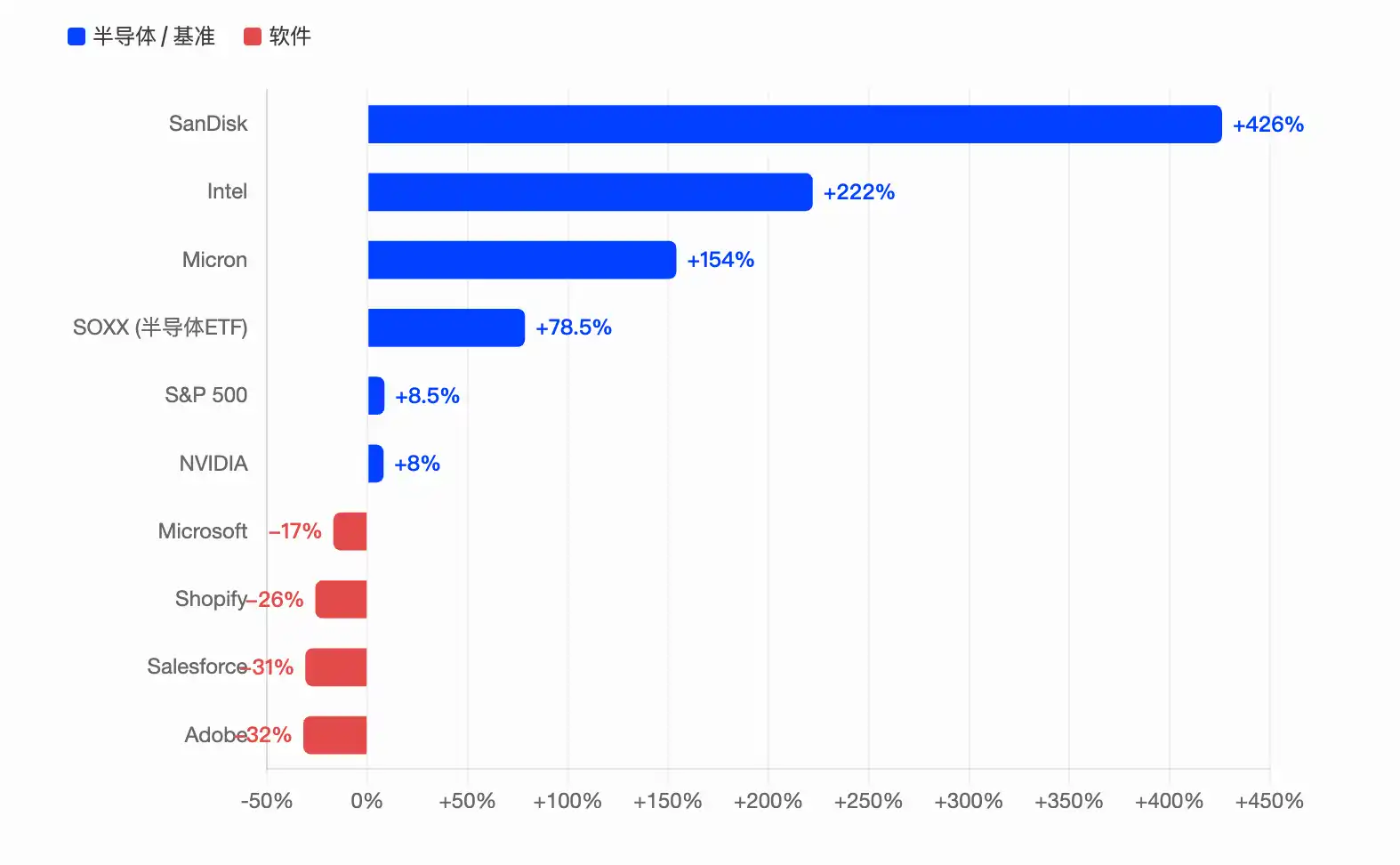
SanDisk leads the S&P 500 with a 426% annual gain, Intel has tripled, Micron is up 154%, while Microsoft, Adobe, and Salesforce have all dropped more than 17% year-to-date. The four hyperscale compute companies' combined capital expenditures for 2026 are nearing $700 billion. Capital is pouring into the chip supply chain like a black hole, while the software sector faces a double squeeze from AI displacement narratives and fund outflows.

Recently, a hot post on the Reddit investment forum overseas stated that semiconductor stocks are "basically a black hole sucking everything else in," which resonated widely.

Data confirms this intuition. As of the May 22nd close, the iShares Semiconductor ETF (SOXX) has returned 78.5% year-to-date, while the iShares Expanded Tech-Software ETF (IGV) has returned -12.5%. Two ETFs belonging to the same broad technology category show a year-to-date performance gap exceeding 90 percentage points.

According to Tickeron statistics, all software stocks in the S&P 500 are currently trading below their 200-day moving averages, while about 89% of semiconductor stocks remain above their 200-day moving averages. Both sectors fell in sync to the zero line during the 2022 bear market, after which their trajectories completely diverged. This split was not gradual but explosive.
SanDisk up 426% leads S&P 500, Intel's triple gain crushes AMD

The numbers are even more dramatic at the individual stock level.

According to Benzinga Pro data, SanDisk (SNDK) has risen about 426% year-to-date, making it the best-performing stock in the S&P 500 in 2026, following a 559% surge in 2025. This storage chip company, spun off from Western Digital, has seen NAND flash prices rise over 200% year-over-year driven by AI, with March quarter revenue growing 250% to $5.95 billion and non-GAAP gross margins reaching a high 78.4%.

According to 24/7 Wall Street, Intel (INTC) has risen about 222% year-to-date to $225, doubling AMD's gain. Intel's rebound comes from an extremely low base, coupled with progress on its 18A process node, rumors of Apple foundry orders, and yield improvement data disclosed by CEO Patrick Gelsinger in a CNBC interview. Short sellers have been severely squeezed; according to S3 Partners data, since the March 30th low point, Intel's market cap has increased over $440 billion, resulting in paper losses exceeding $12 billion for short sellers.

Micron (MU) has risen about 154% year-to-date, with a cumulative gain of 661% over the past 12 months. Earnings support this move; for the fiscal 2026 second quarter, revenue was $23.9 billion, up 196% year-over-year, with adjusted earnings per share of $12.20, far exceeding market expectations of $9.21. DRAM accounted for 79% of total revenue, with High Bandwidth Memory (HBM) being a key driver. SK Hynix Chairman Chey Tae-won even predicted that the memory chip shortage could last until 2030.

In contrast, NVIDIA (NVDA), the true "money printer" of AI compute, has risen about 8% to $15 year-to-date, performing far worse than the aforementioned second-tier semiconductor companies. According to The Motley Fool, NVIDIA's current forward P/E ratio is about 21.5x, almost on par with the S&P 500's 20.3x. This means the market is no longer paying a growth premium for NVIDIA; capital is instead flowing towards chip companies with lower valuations and greater potential upside.
$700 Billion in Capex: The Hyperscale Compute Companies' 'Arms Race'

Behind the semiconductor surge is real money.

According to data compiled by the Financial Times and multiple institutions, the combined capital expenditures for 2026 by the four hyperscale compute companies—Microsoft, Alphabet (Google's parent), Amazon, and Meta—are projected to be between $650 billion and $725 billion, nearly doubling from about $410 billion in 2025. This represents the largest concentrated infrastructure investment cycle in tech history.

According to Tom's Hardware, Jefferies analyst Brent Thill stated bluntly: "The AI economy is healthy. The bear thesis is garbage."

Specifically: Amazon leads with a single-quarter capex of $44.2 billion, with AWS growing 28%; Alphabet's Q1 capex was $35.67 billion, doubling year-over-year, with Google Cloud backlog jumping above $460 billion; Microsoft's calendar 2026 capex is projected at $190 billion, with about $25 billion attributed to price increases in memory chips and components; Meta raised its full-year capex guidance to $125-$145 billion.

According to statistics from Om Malik's blog, three of the hyperscale compute companies recorded significant non-cash investment gains in their Q1 earnings: Alphabet recorded $36.8 billion (primarily from Anthropic equity appreciation), Amazon recorded $16.8 billion, and Microsoft recorded $5.9 billion (from OpenAI). While capital expenditures are burning cash fiercely, the AI investment targets themselves are also appreciating.

Software Stocks Slaughtered by AI Displacement Narrative, IGV Posts Worst Drop Since 2008

The other side of the coin is the brutal collapse of software stocks.

According to The Motley Fool, after Anthropic released Claude Code in early 2026, the software sector experienced a sharp decline—the market's logic was not to reward AI innovation but to punish those SaaS companies potentially displaced by AI. IGV recorded its largest drop since 2008 at one point.

As of late May, Microsoft is down about 17% year-to-date, Adobe down about 32%, Salesforce down about 31%, and Shopify down about 26%. The S&P 500 Software & Services Index is about 21% below its 200-day moving average, the largest such deviation since June 2022. According to Goldman Sachs and other institutional data, short positions in mid-to-large software companies have surged sharply over the past three months, with cybersecurity and SaaS companies being the most heavily targeted areas for shorts.

Two layers of logic underlie this divergence. The first is direct capital siphoning: market liquidity is finite. When $700 billion in capex pushes chip stocks into parabolic moves, capital must be withdrawn from somewhere. As the author of that Reddit post said: "Fundamentally decent software companies just sit there or bleed slowly, while the semiconductor index goes vertical."

The second is a revaluation of the narrative. The rapid evolution of AI agents is prompting the market to re-evaluate the moats of SaaS business models: when AI can automate programming, form-filling, and customer service, how long can subscription models based on per-seat fees last? The Motley Fool points out that software companies likely to survive will need features like real data, proprietary workflows, and deep customer integration that are difficult for AI to replicate.

Cycle Peak or Structural Shift? Two Key Questions Remain Unanswered

That Reddit user ended the post with two questions, representing investors' ultimate doubts about whether the semiconductor rally can persist.

However, these two questions remain unanswered.

First: How long can the hyperscale compute companies' capital expenditures be sustained?

According to CNBC, Pivotal Research projects Alphabet's 2026 free cash flow will plunge nearly 90% from $73.3 billion in 2025 to $8.2 billion. Of Microsoft's $190 billion annual capex, $25 billion is consumed just by price increases in memory chips and components. These companies are betting future profits on AI revenue that has not yet fully materialized.

Second: Is software the next rotation target?

According to Bank of America's Chief Investment Officer Hartnett's previous judgment in the Flow Show report, software is one of the best contrarian long positions for Q2 2026, given the extreme deviation of the sector relative to its 50-day and 200-day moving averages.

However, this does not mean the semiconductor rally is over. The Philadelphia Semiconductor Index (SOX) recorded a historic streak of 18 consecutive daily gains on April 25th, rising about 45% during that period. According to Intellectia analysis, some veteran analysts are beginning to compare the current move to the 1999-2000 internet bubble, warning of a potential 25% to 30% correction. But SOX has been up in 22 of the past 23 trading days, setting 15 intraday record highs; this momentum is itself a signal.

As that Reddit user said: "I don't want to call a top because I've been slapped in the face too many times before. But the extreme concentration of gains in a single sector is starting to smell like the late stages of a cycle."


Пов'язані питання

QWhat is the central theme of the article regarding the performance of tech stocks in 2026?

AThe central theme is a 'liquidity siphon' or 'black hole' effect within tech stocks, where capital is being aggressively pulled from software stocks and funneled into the semiconductor sector, creating a historic performance gap.

QWhich two ETFs are highlighted to demonstrate the extreme divergence between the semiconductor and software sectors?

AThe iShares Semiconductor ETF (SOXX) and the iShares Expanded Tech-Software ETF (IGV) are highlighted. SOXX was up 78.5% year-to-date, while IGV was down 12.5%, a gap exceeding 90 percentage points.

QWhat is driving the massive capital expenditure from the 'hyperscale' companies, and what is the estimated total for 2026?

AThe massive capital expenditure is driven by the AI infrastructure 'arms race'. The combined capex of Microsoft, Alphabet (Google), Amazon, and Meta is estimated to be between $650 billion and $725 billion for 2026, nearly double the 2025 figure.

QWhat are the two main reasons given for the severe underperformance of software stocks?

AThe two main reasons are: 1) Direct liquidity siphoning, where funds flow from software into the surging semiconductor sector. 2) A valuation narrative shift, where AI's capabilities (like automated coding) threaten the traditional SaaS subscription business model, raising questions about its long-term viability.

QWhat two critical unresolved questions about the market trend does the article present at the end?

AThe two unresolved questions are: 1) How long can the hyperscale companies sustain their enormous capital expenditures? 2) Is software poised to become the next sector for a rotational rally, or is the semiconductor momentum still strong?

Пов'язані матеріали

Another Corporate Bitcoin Treasury Strategy Ends: From High-Profile Entry to Liquidation at a Massive Loss in 11 Months

French semiconductor company Sequans Communications has sold off its bitcoin holdings and terminated its corporate bitcoin treasury strategy less than a year after launching it, sustaining heavy losses. Facing delisting from the New York Stock Exchange in mid-2025 due to low market capitalization, Sequans announced a plan to hold over 3,000 bitcoin as a long-term reserve asset. The strategy was executed with Swan Bitcoin and backed by a $384 million private financing round. At its peak in October 2025, the company held 3,234 bitcoin with an average cost of approximately $116,643 per coin. However, the plan quickly unraveled. With bitcoin's price falling, Sequans sold 970 bitcoin in late 2025 to repay debt, contradicting the core "hold" philosophy of such corporate strategies. The company has now sold more bitcoin to fully repay its convertible notes and announced the termination of its bitcoin reserve strategy. It plans to liquidate its remaining 658 bitcoin. The venture resulted in significant financial damage. The company reported an unrealized loss of $67.4 million on its bitcoin holdings in 2025, contributing to a total net loss of $109.3 million for the year. Sequans' stock (SQNS) has plummeted over 80% since the strategy's launch and is down 77% year-to-date. CEO Georges Karam, who previously championed bitcoin's long-term value, now states the company will refocus entirely on its core IoT semiconductor business. The failed experiment highlights the risks for companies adopting volatile digital assets as treasury reserves.

marsbit35 хв тому

Another Corporate Bitcoin Treasury Strategy Ends: From High-Profile Entry to Liquidation at a Massive Loss in 11 Months

marsbit35 хв тому

BIS Latest Research: The Future of Stablecoins and the Global Monetary Landscape

BIS Working Paper No. 170, released in May 2026, analyzes the impact of stablecoins on the global monetary system. The market has grown exponentially since 2014, with over 300 active stablecoins exceeding $300 billion in market capitalization. It is highly concentrated, dominated by USD-linked stablecoins (98% by market cap, mainly USDT and USDC), which function as new forms of private offshore dollar claims on blockchain. Currently, stablecoin use remains largely within crypto ecosystems for trading and DeFi collateral. Real-economy adoption, such as in cross-border payments, is nascent but growing in emerging markets and developing economies (EMDEs) facing high inflation and volatile currencies, where they facilitate capital flight and "digital dollarization." The paper assesses impacts using the Cohen-Kennen framework. For private-sector functions, stablecoins most directly affect value storage (as a dollar-denominated safe haven in EMDEs) and the medium of exchange (enhancing cross-border payment efficiency, further entrenching dollar use). Impacts on the unit of account and official-sector functions are currently limited but could indirectly constrain monetary policy autonomy and capital controls. The report outlines three potential future scenarios: 1) **Niche adoption**, where stablecoins remain crypto-centric with minimal systemic impact; 2) **Digital dollarization**, a high-risk scenario where USD stablecoins become de facto standards in EMDEs, eroding monetary sovereignty; and 3) **Local currency stablecoin integration**, an ideal but challenging scenario where regulated domestic stablecoins linked to CBDCs enhance efficiency without foreign currency substitution. Key policy recommendations emphasize global coordination: establishing uniform regulatory standards (e.g., for reserves and disclosure), strengthening cross-border supervisory cooperation, enhancing domestic defenses in EMDEs (via macroeconomic stability, improved payment systems, and CBDCs), and combating illicit activities. The paper concludes that stablecoins are a structural force reinforcing dollar dominance in the near term, posing significant risks to EMDEs' financial stability and policy autonomy. Their long-term trajectory depends on regulatory responses, adoption patterns, and the co-evolution with public digital currencies.

marsbit43 хв тому

BIS Latest Research: The Future of Stablecoins and the Global Monetary Landscape

marsbit43 хв тому

BIS Latest Research: Stablecoins and the Future of the Global Monetary Landscape

The Bank for International Settlements (BIS) Working Paper No. 170 analyzes the rise of stablecoins and their impact on the global monetary system. Stablecoins, privately issued digital tokens pegged to fiat currencies, have grown exponentially since 2014, with a market dominated by USD-pegged variants like USDT and USDC. Their core function remains within the crypto ecosystem, though use in cross-border payments and as a store of value in high-inflation emerging markets is increasing. The report identifies stablecoins as a new form of offshore dollar claims, extending dollar liquidity via blockchain. Their stability depends entirely on reserve quality and market arbitrage, lacking traditional banking safeguards. In the short term, stablecoins reinforce the US dollar's dominance, posing risks to monetary sovereignty in emerging market and developing economies (EMDEs) by facilitating "digital dollarization," which can undermine local currency deposits, capital controls, and monetary policy effectiveness. The BIS outlines three potential future scenarios: 1) Niche adoption within crypto (baseline), 2) Widespread "digital dollarization" in EMDEs (high-risk), and 3) Integration of domestic currency stablecoins (ideal but challenging). Effective global regulatory coordination is crucial to manage risks like reserve transparency, cross-border spillovers, and illicit activities. The report concludes that stablecoins represent a structural force reshaping international monetary hierarchies, presenting both opportunities for payment efficiency and significant risks to financial stability and autonomy, necessitating robust policy responses.

链捕手49 хв тому

BIS Latest Research: Stablecoins and the Future of the Global Monetary Landscape

链捕手49 хв тому

Solo Company Craze: Some Earn Millions Annually, Others See Incomes Shrink by 90%

The Rise of the "One-Person Company" (OPC): AI Fuels a Solo Entrepreneurship Wave The concept of the "One-Person Company" (OPC)—where an individual leverages AI tools to start and run a business—is gaining significant traction, hailed by some as ushering in a "golden age" for solo entrepreneurship. While success stories abound, the reality is a mixed picture of high earnings and significant struggles. The article profiles several OPC founders across different industries: * A game developer created 6 bullet-chat (danmaku) games in a year using an AI-powered workflow, earning approximately 1 million RMB. AI handled around 70% of art and 99% of coding tasks, slashing development cycles from months to about 15 days per game. * A materials researcher in Japan, using AI for tasks from translation to legal advice, earns roughly triple the salary of a local white-collar worker. * A biotech entrepreneur uses AI Agents to automate 80% of repetitive work like data analysis, doubling their previous income while gaining time freedom. * Conversely, a former tech executive turned cross-border e-commerce founder in Latin America reports a 90% drop in income compared to their previous corporate job, cautioning against blindly following the trend. Key insights from these cases include: AI dramatically lowers barriers to entry and operational costs, but does not guarantee success. It excels at automating repetitive tasks but cannot replace core human skills like creativity, project management, judgment, and client acquisition. Industry experience and existing client/resources remain critical advantages. The model suits self-starters with specific expertise but poses challenges in areas like sales, compliance, and scaling. Ultimately, while AI empowers solo ventures, entrepreneurship's inherent risks and demands persist.

marsbit55 хв тому

Solo Company Craze: Some Earn Millions Annually, Others See Incomes Shrink by 90%

marsbit55 хв тому

Торгівля

Спот
Ф'ючерси
活动图片




