SEC Moves To Bar FTX Execs And Ex-Alameda Research CEO From Public Company Roles

bitcoinistОпубліковано о 2025-12-20Востаннє оновлено о 2025-12-20

Анотація

The US Securities and Exchange Commission (SEC) has filed proposed final consent orders against former Alameda Research CEO Caroline Ellison and ex-FTX executives Gary Wang and Nishad Singh. The regulator alleges they participated in a multi-year scheme where FTX raised over $1.8 billion by misleading investors about the safety of the platform and the relationship with Alameda. The SEC claims Alameda was given special privileges, including an unlimited line of credit funded by FTX customer deposits, which were misused for trading, investments, and executive loans. Without admitting guilt, the three agreed to permanent antifraud violations bans. Ellison accepted a 10-year officer-director bar, while Wang and Singh agreed to 8-year bans.

The US Securities and Exchange Commission (SEC) has released new sanctions against Caroline Ellison, the former CEO of Alameda Research, along with Gary Wang and Nishad Singh, former executives of the now-defunct cryptocurrency exchange FTX, as part of a larger case surrounding FTX’s misconduct.

SEC Targets Key FTX Figures In Fraud Case

On Friday, the regulator announced that it has filed proposed final consent judgments in the US District Court for the Southern District of New York concerning Ellison, Wang, and Singh.

The complaints against Ellison and Wang were initially filed in December 2022, while the allegations against Singh were issued in February 2023.

The SEC’s filings claim that from May 2019 to November 2022, Sam Bankman-Fried and FTX raised over $1.8 billion from investors by misleading them into believing that the exchange was a secure trading platform for cryptocurrency.

They purportedly claimed to employ sophisticated risk mitigation measures designed to safeguard customer assets and insisted that Alameda Research, a crypto asset hedge fund owned by Bankman-Fried and Wang, was merely another customer without any special advantages.

In stark contrast to these representations, the SEC alleges that Ellison, Wang, and Singh knowingly engaged in actions that exempted Alameda from these risk mitigation protocols.

Ellison Agrees To 10-Year Ban

The regulator also claimed that Alameda was granted a virtually unlimited line of credit funded by FTX customer deposits. Allegations further assert that Wang and Singh developed the software code that facilitated the redirection of customer funds from FTX to Alameda, while Ellison reportedly misused these funds in her trading activities.

Additionally, the complaints detail how Sam Bankman-Fried, with the knowledge and consent of Ellison, Wang, and Singh, directed “hundreds of millions of dollars” of customer funds to Alameda.

The complaint asserts that these funds were used for further venture investments and personal loans to Bankman-Fried and other executives, including Wang and Singh.

In light of these serious allegations, Ellison, Wang, and Singh have agreed to final judgments, pending court approval, without admitting to the SEC’s claims.

They consented to be permanently barred from violating the antifraud provisions outlined in Section 10(b) of the Securities Exchange Act of 1934, as well as Rule 10b-5 and Section 17(a) of the Securities Act of 1933.

Ellison, who had a romantic relationship with FTX’s former CEO, specifically agreed to a 10-year ban from serving as an officer or director of any public company, while Wang and Singh accepted an 8-year ban.

The daily chart shows FTT’s uptick seen on Friday. Source: FTTUSDT on TradingView.com

At the time of writing, FTX’s native token, FTT, is trading at $0.5086, having recorded a notable 6% surge following the SEC’s statement on the matter. However, the cryptocurrency remains far below the highs it reached just before the exchange’s collapse, sitting at 99.3% of its record high.

Featured image from DALL-E, chart from TradingView.com

Пов'язані питання

QWho are the key individuals targeted by the SEC in the latest action regarding FTX?

AThe SEC has targeted Caroline Ellison, the former CEO of Alameda Research, and Gary Wang and Nishad Singh, former executives of FTX.

QWhat was the primary allegation the SEC made against Sam Bankman-Fried and FTX regarding investor funds?

AThe SEC alleged that Sam Bankman-Fried and FTX raised over $1.8 billion from investors by misleading them into believing FTX was a secure crypto trading platform with sophisticated risk mitigation measures to protect customer assets.

QWhat specific role did the SEC allege that Gary Wang and Nishad Singh played in the misconduct?

AThe SEC alleged that Gary Wang and Nishad Singh developed the software code that allowed customer funds to be diverted from FTX to Alameda Research.

QWhat are the consequences of the proposed final judgments for Ellison, Wang, and Singh?

AThey have consented to be permanently barred from violating antifraud provisions of securities laws. Caroline Ellison agreed to a 10-year ban from serving as an officer or director of any public company, while Gary Wang and Nishad Singh accepted an 8-year ban.

QHow did FTX's native token, FTT, react to the SEC's announcement?

AFTT's price surged by 6% following the SEC's statement, trading at $0.5086 at the time of writing, though it remains 99.3% below its all-time high.

Пов'язані матеріали

Company Managing $2.8 Billion in Bitcoin Makes Optimistic Statement About BTC!

Dylan LeClair, CFO of MetaPlanet, commented on the recent sharp sell-offs in crypto markets and growing criticism towards Bitcoin-holding companies. He compared the current pessimism to the 2022 crash, suggesting price corrections and liquidations have set the stage for Bitcoin's next growth phase. LeClair acknowledged that the recent BTC price drop created negative perceptions of corporate balance sheet holdings but called this a cyclical phenomenon. He referenced similar criticism faced by MicroStrategy in 2021/22, noting that while such companies can underperform BTC during downturns due to leveraged structures, the long-term trend reverses. He argued that for Bitcoin to reach a multi-trillion-dollar asset class, integration with traditional capital markets is essential, and retail "cold storage" alone is insufficient. Addressing criticism from some Bitcoin purists, LeClair defended the use of equities and debt instruments as necessary bridges to attract institutional capital with varying risk tolerances. LeClair suggested the market may have bottomed, citing institutional funds rotating from Bitcoin-related assets into AI stocks at the end of Q2, creating artificial selling pressure. He downplayed exaggerated fears like quantum computing threats, predicting that once sellers are exhausted, Bitcoin will surge sharply without significant news catalysts.

cryptonews.ru2 год тому

Company Managing $2.8 Billion in Bitcoin Makes Optimistic Statement About BTC!

cryptonews.ru2 год тому

Capital is Moving from Cryptocurrency Speculation to Tokenized RWA Assets

In 2026, tokenized real-world assets (RWA) became one of the fastest-growing areas in crypto. Investors, weary of market volatility, are shifting capital from speculative crypto trading towards assets offering stable yield. These include tokenized government bonds (e.g., T-bills), private credit, real estate income, commodities, and money market funds. Data shows a clear preference for transparent, regulated products. Deposits into RWA protocols more than tripled year-on-year, reaching $7.4 billion in Q2, while spot trading activity surged 220%. The total on-chain value of tokenized RWAs exceeded $30 billion in 2026, more than doubling from the previous year, and approached $38 billion by August. RWA acts as a bridge between traditional finance and blockchain, not a replacement. It allows banks and asset managers to launch regulated products on public blockchains, while DeFi users gain access to previously unavailable real-world assets. Blockchain provides 24/7 settlements, transparency, programmability, and lower fees, while traditional finance contributes capital, regulation, and proven products. Tokenized private credit remains the largest RWA category (over $7 billion on-chain), benefiting from blockchain's cost reduction and transparency. Treasury bills are the fastest-growing institutional segment, driven by higher interest rates. Tokenized commodities, especially gold, are expanding, combining asset safety with blockchain trading ease. Real estate, though smaller, is also growing steadily. Tokenization is increasingly viewed as core financial infrastructure.

cryptonews.ru3 год тому

Capital is Moving from Cryptocurrency Speculation to Tokenized RWA Assets

cryptonews.ru3 год тому

Lone Bitcoin Miner Defies All Odds, Hits $200,000 Jackpot with Block Reward

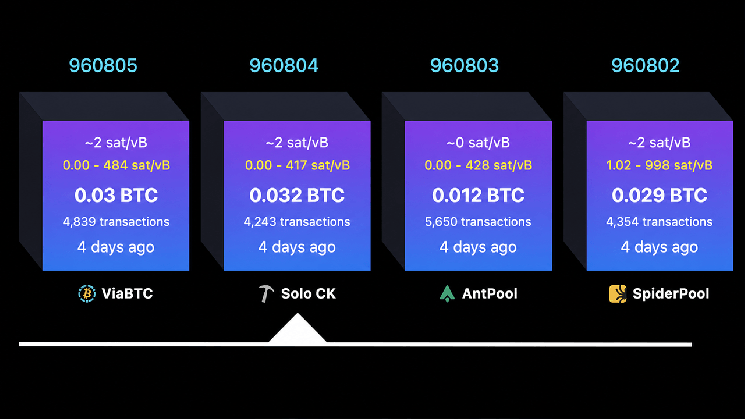
A solo Bitcoin miner, contrary to all predictions, won a $200,000 jackpot as a block reward. The payment went to an address linked to CKPool, a solo-mining service. This was the 317th solo block found by the pool. The reward consisted of the 3.125 BTC fixed subsidy and about 0.032 BTC in transaction fees from 4,243 transactions. CKPool operator Dr -ck (Con Kolivas) confirmed the win, noting the miner's hashrate was "extremely volatile, presumably rented," peaking at 100 PH/s. This represented about 0.011% of Bitcoin's total network hashrate. At that level, a miner could statistically expect to find a block roughly every 64 days, far more likely than for a typical small home setup. Solo mining differs from pool mining, where rewards are shared based on contributed work. In solo mining, a miner gets nothing unless they personally find a block, but then receives the entire reward. CKPool charges a ~2% fee on blocks found. Dr -ck noted the hashrate pattern suggested rented computing power, a practice making solo wins more accessible. He also highlighted this was the first mainnet block mined after integrating Stratum V2 code into ckpool, though the block itself was found using the older Stratum V1 protocol. Against a backdrop of mining concentration in large industrial pools, such solo finds remain rare but demonstrate that anyone with sufficient hashrate can claim a full reward without corporate or government permission. The block subsidy will remain 3.125 BTC until the next halving around April 2028. The miner's identity remains unknown, as is typical. Bitcoin's mining difficulty is due for an adjustment, and network hashrate has declined from late 2025 peaks, partly due to competition for power and hardware from AI data centers.

cryptonews.ru3 год тому

Lone Bitcoin Miner Defies All Odds, Hits $200,000 Jackpot with Block Reward

cryptonews.ru3 год тому

Blackrock Leads with $305 Million Inflow into Bitcoin and Ether ETFs

Money continued to flow rapidly into the largest cryptocurrency ETFs. Bitcoin and Ethereum ETFs collectively attracted over $305 million in inflows, with BlackRock again leading the charge, marking the third consecutive session of strong institutional demand. The broader market picture was mixed. Hyperliquid ($HYPE) ETFs finally saw renewed buying interest, while XRP ($XRP) ETFs faced outflows, and Solana-based products remained stagnant. In a strong session, Bitcoin ETFs recorded a net inflow of $244.42 million across five funds. BlackRock's IBIT dominated with $196.83 million, followed by ARK 21Shares' ARKB at $37.63 million and Fidelity's FBTC at $11.28 million. Vaneck's HODL was the sole fund to see an outflow (-$14.67 million), barely impacting the category's overall positive trend. Total trading volume reached $1.58 billion. Ethereum ETFs also continued their positive run, attracting $60.86 million. BlackRock's ETHA led with $50.34 million. The staking-oriented ETHB and Fidelity's FETH followed. No Ethereum ETF saw outflows. Among smaller tokens, Hyperliquid ETFs saw a minor but notable inflow of ~$966,690, potentially signaling easing selling pressure. Conversely, XRP ETFs experienced a $3.58 million outflow. Solana ETFs saw no net activity. The session solidified Bitcoin and Ethereum as the focal point for institutional capital, with BlackRock as the dominant source of demand, while activity in altcoin ETFs remained volatile.

cryptonews.ru3 год тому

Blackrock Leads with $305 Million Inflow into Bitcoin and Ether ETFs

cryptonews.ru3 год тому

Торгівля

Спот
活动图片