Screwed by Polymarket, This Time the Bug Was a 'Time Warp'

marsbitОпубліковано о 2026-03-09Востаннє оновлено о 2026-03-09

Анотація

Polymarket, a prediction market platform, encountered a technical issue related to the transition from Eastern Standard Time (EST) to Eastern Daylight Time (EDT) on March 8. The switch, which involves moving the clock forward by one hour, caused a disruption in the platform’s hourly cryptocurrency price prediction markets for assets like BTC, ETH, SOL, and XRP. Due to the time change, the 2:00 AM hour effectively did not exist, leading Polymarket’s system to display an illogical time range of "March 8, 1-1 AM ET" for these events, instead of the expected one-hour duration. This anomaly affected both the front-end display and API data, causing confusion among users. One automated trading user reported significant losses exceeding $100,000, as their system relied on accurate end-time data to execute trades. The incident highlights a design flaw in using local time (ET) without accounting for daylight saving transitions, unlike mainstream financial systems that typically use UTC time to avoid such inconsistencies. Users have called for Polymarket to switch to UTC and compensate affected traders. The platform has not yet issued an official response.

Original | Odaily Planet Daily (@OdailyChina)

Author | Azuma (@azuma_eth)

In conventional understanding, time is linear, but the crypto world has its "exceptions".

Yesterday, Eastern Time (ET) completed the switch from standard time to daylight saving time as per convention (generally on the second Sunday of March at 2:00 AM), moving the clock forward by one hour, jumping directly from 2:00 AM on March 8 to 3:00 AM. The time didn't vanish into thin air; it's just that the Eastern Time zone switches between Eastern Standard Time (EST) and Eastern Daylight Time (EDT) based on custom, aiming to artificially adjust the time scale to make fuller use of daylight hours (and save electricity in the process).

For daily life, this switch doesn't cause much impact, but on the prediction market Polymarket, yesterday's time zone switch directly sparked an unexpected controversy.

Polymarket Runs Into Timing Controversy

The controversy occurred around the "Crypto Up or Down" prediction events on Polymarket.

Polymarket offers cryptocurrency price movement prediction events with timeframes of year, month, week, day, 4 hours, 1 hour, 15 minutes, and 5 minutes, supporting major tokens like BTC, ETH, SOL, and XRP. These events are automatically created and settled based on Eastern Time and have become a significant source of trading volume on Polymarket.

At 1:00 AM on March 8 (still Eastern Standard Time at that moment), Polymarket launched new 1-hour up/down prediction events for BTC, ETH, SOL, and XRP. Links to the relevant events are below.

  • BTC (Final Result: Up): https://polymarket.com/event/bitcoin-up-or-down-march-8-1am-et
  • ETH (Final Result: Down): https://polymarket.com/event/ethereum-up-or-down-march-8-1am-et
  • SOL (Final Result: Down): https://polymarket.com/event/solana-up-or-down-march-8-1am-et
  • XRP (Final Result: Down): https://polymarket.com/event/xrp-up-or-down-march-8-1am-et

According to the event settlement rules — comparing the opening and closing prices of the 1-hour candle on Binance's USDT trading pairs starting from the event's beginning — the above four events have all been settled.

However, because the end time of this batch of events coincided with the daylight saving time switch, the moment Eastern Time reached 2:00 AM, it immediately jumped to 3:00 AM (meaning the period from 2:00 AM to 3:00 AM was skipped), causing some timing confusion for this batch of events on the Polymarket platform itself.


As shown on Polymarket's frontend interface, perhaps because 2:00 AM did not exist in yesterday's Eastern Time reckoning, the time period currently displayed for this batch of events is "March 8, 1-1 AM ET" (i.e., March 8, 1:00 AM - 1:00 AM). Under normal timing conditions, such events should display a 1-hour time period (for example, the previous day's similar event was "March 7, 1-2 AM ET", i.e., 1:00 AM - 2:00 AM). If accounting for the daylight saving time switch, a more reasonable time period for this batch would be "March 8, 1-3 AM ET" (i.e., 1:00 AM - 3:00 AM, still effectively 1 hour).

So no matter how you look at it, the currently displayed "March 8, 1-1 AM ET" is very strange.

Chinese user "Xiao Z" (@richrichardoz) posted on X regarding this, stating that besides the frontend, Polymarket's API also returned the "1-1 AM ET" time period, causing automated programs relying on the API data to "all crash", estimating losses exceeding $100,000 as a result.

"Xiao Z" further explained that the start time and end time being exactly the same is a market state that is logically impossible. Many automated trading systems rely on the end time to determine the trading window; this error directly caused their program to lose a large sum of money. Therefore, they suggested Polymarket change the time standard for relevant events to UTC time and compensate users affected by the data issue.
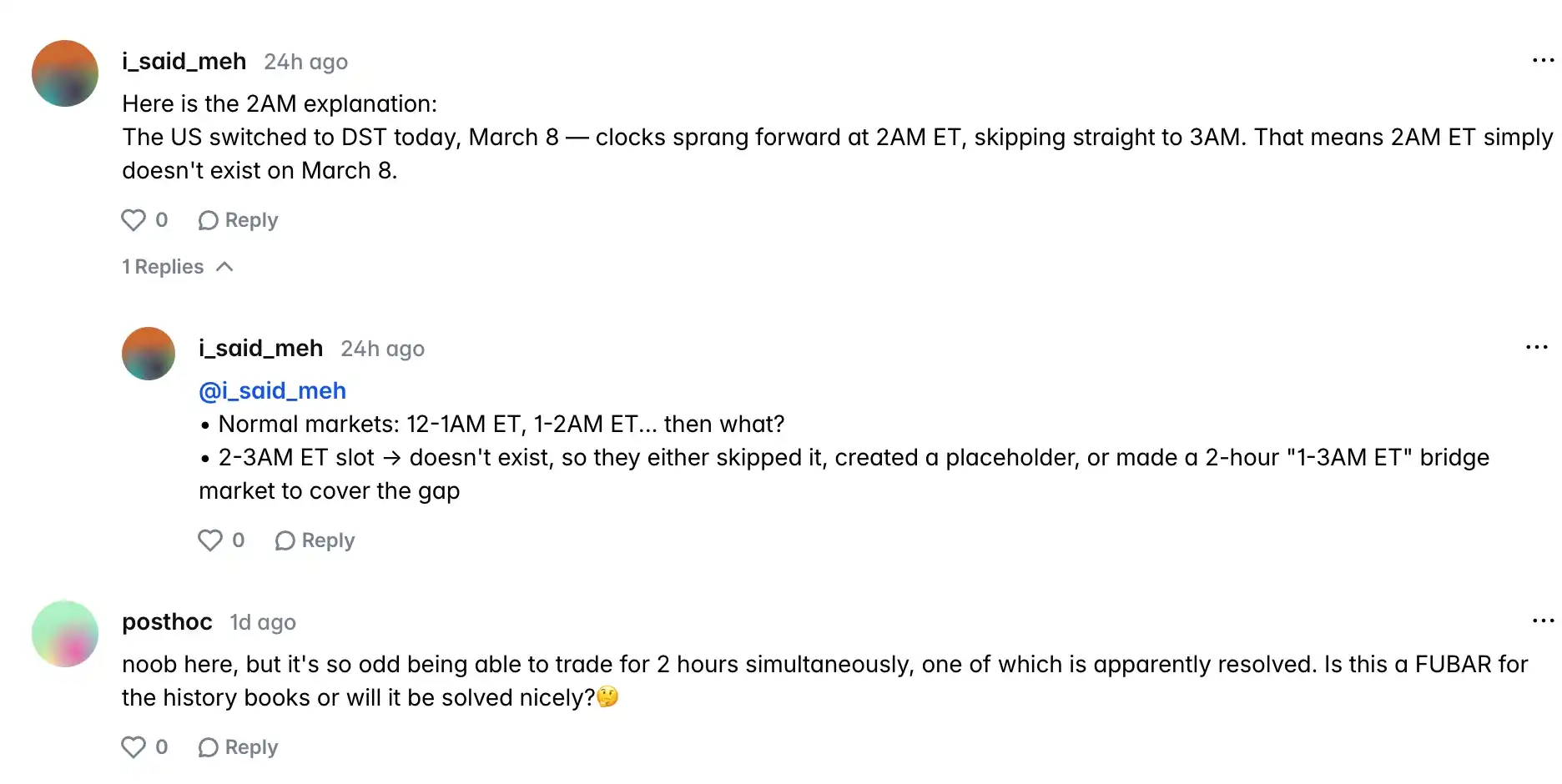
Besides this user, many other users have also commented under the relevant events expressing confusion, but as of writing, Polymarket has not responded through official channels.

Time Standards in Traditional Financial Markets

Looking back at this controversy, while the scale of impact isn't huge, it exposed a fundamental design flaw in Polymarket's "Crypto Up or Down" market events.

Influenced by historical customs, economic status, and industry practices, Eastern Time is still widely used across various industries. However, this is not particularly friendly to financial systems because Eastern Time switches between daylight saving time and standard time every year — artificially moving the clock forward or backward by one hour at specific times, creating "jumps" and "overlaps" in time respectively.

In modern financial systems, UTC time has long become the de facto universal standard. In the vast majority of financial infrastructure, internal systems typically use UTC timestamps as the sole standard time. Local times like Eastern Time are still used, but in system logic, they often only exist in the presentation layer面向用户. This design is precisely to avoid the uncertainty of time systems, ensuring that time remains monotonic, unique, and globally consistent in financial transactions, settlement, and automated systems.

The key矛盾 (contradiction) in this Polymarket controversy lies in the fact that the relevant events used Eastern Time as the timing standard but failed to fully consider the potential variable of the daylight saving time switch, ultimately causing confusion in the frontend and API data. Among the current user base of prediction markets, more and more participants are trading via APIs and automated programs. Some issues that originally only affected frontend display can easily be amplified into real financial losses in automated systems.

Judging by the outcome, this controversy might not be considered a serious incident, and theoretically it can only happen at most twice a year, but what it reveals is a more serious design problem — as prediction markets gradually move towards becoming financial infrastructure, they must also adhere to the engineering standards used by financial infrastructure.


Пов'язані питання

QWhat was the main issue that occurred on Polymarket due to the daylight saving time switch?

AThe main issue was a timing confusion caused by the switch from EST to EDT, where the clock jumped from 2:00 to 3:00, causing the 1-hour prediction events to display an illogical '1-1 AM ET' time period in both the frontend and API, disrupting automated trading systems.

QWhich cryptocurrencies were affected by the timing error in Polymarket's prediction events?

AThe affected prediction events were for BTC, ETH, SOL, and XRP, specifically the 1-hour up or down markets that started at 1:00 AM ET on March 8.

QHow did the timing error impact users, particularly automated trading systems?

AThe error caused automated trading programs to malfunction because the API returned an identical start and end time ('1-1 AM ET'), which is logically impossible. This led to significant losses, with one user estimating over $100,000 in losses due to the disrupted trading windows.

QWhat time standard do traditional financial markets typically use to avoid issues like daylight saving time changes?

ATraditional financial markets predominantly use UTC (Coordinated Universal Time) as the internal standard for timestamps to ensure consistency, avoid ambiguities from local time changes, and maintain global synchronization in trading and settlement systems.

QWhat suggestion did users make to Polymarket to prevent similar issues in the future?

AUsers suggested that Polymarket should change the time standard for its events to UTC instead of Eastern Time (ET) to eliminate confusion from daylight saving transitions, and also compensate users who suffered losses due to the data error.

Пов'язані матеріали

Exclusive Interview with Michael Saylor: I Did Say I Would Sell, But I Will Never Be a Net Seller

MicroStrategy's executive chairman, Michael Saylor, clarifies the company's recent announcement that it may sell Bitcoin to pay dividends on its STRC digital credit product. He emphasizes this does not make MicroStrategy a net seller of Bitcoin. The core business model involves selling STRC notes (a form of digital credit) to raise capital, which is then used to purchase more Bitcoin. Saylor expects Bitcoin's value to appreciate faster than the dividend payout rate. Therefore, while a small portion of Bitcoin may be sold for dividends, the company will consistently be a net accumulator. For example, in April, the company raised $3.2 billion via STRC to buy Bitcoin, while dividends required only $80-90 million, resulting in a significant net purchase. Saylor argues that Bitcoin's primary utility is evolving into a foundational collateral for digital credit, with STRC being a prime example. He notes that STRC now constitutes a majority of the U.S. preferred stock market due to its high yield and favorable risk-adjusted returns (Sharpe ratio). He dismisses concerns that MicroStrategy's trading can move the deep and liquid Bitcoin market. Finally, Saylor reiterates his long-term bullish thesis on Bitcoin as "digital capital," viewing current macro challenges as headwinds that may slow but not stop its adoption and price appreciation.

Odaily星球日报7 хв тому

Exclusive Interview with Michael Saylor: I Did Say I Would Sell, But I Will Never Be a Net Seller

Odaily星球日报7 хв тому

Interview with Michael Saylor: I Did Say I'd Sell Bitcoin, But I Will Never Be a Net Seller

**Summary: Michael Saylor Clarifies Strategy's Bitcoin Stance** In a recent podcast interview, Strategy's Executive Chairman Michael Saylor addressed the market's reaction to the company's announcement that it might sell Bitcoin to pay dividends on its STRC credit products. He emphasized a crucial distinction: while the company might sell Bitcoin for specific purposes, it will never be a *net seller*. Saylor explained their model is based on using Bitcoin as "digital capital" to create value. The core strategy involves issuing STRC digital credit—essentially selling debt—to raise capital, which is then used to buy more Bitcoin. He estimates Bitcoin appreciates at roughly 40% annually. A small portion of these capital gains (e.g., ~2.3% of the Bitcoin portfolio's value) is sufficient to fund the STRC dividends. Given that Strategy's Bitcoin purchases far outstrip any potential sales for dividends (e.g., buying $3.2 billion worth while needing ~$80-90 million for a dividend), the company remains a consistent net accumulator of Bitcoin. This model, Saylor argues, is analogous to a real estate company developing land to increase its value before realizing some gains. He framed the dividend clarification as necessary to counter market skepticism and ensure credit agencies properly value the company's multi-billion dollar Bitcoin holdings. Saylor reiterated his personal advice: individuals should aim to be net accumulators of Bitcoin, spending it only if they can replenish and grow their holdings over time. Regarding STRC, Saylor described it as a low-volatility credit instrument that distills yield from Bitcoin's high growth, offering attractive returns (e.g., ~11-12% yield) for risk-averse investors. He noted that Strategy's STRC issuance now constitutes about 60% of the U.S. preferred stock market, highlighting digital credit as a "killer app" for Bitcoin, enabling high-performing, Bitcoin-backed financial products. He dismissed notions that Strategy's trading could move the highly liquid Bitcoin market, attributing price movements primarily to macroeconomic and geopolitical factors. Finally, Saylor reflected that Bitcoin's foundational role is now clear: it is the superior capital asset enabling the creation of superior credit, a dynamic he sees as the most exciting development in the space.

marsbit14 хв тому

Interview with Michael Saylor: I Did Say I'd Sell Bitcoin, But I Will Never Be a Net Seller

marsbit14 хв тому

380,000 Apps Exposed, 2,000+ Apps Leaked Secrets: AI Programming Turns 'Intranet' into Public Internet

Israeli cybersecurity firm RedAccess uncovered a severe data exposure trend linked to "vibe coding" or AI-powered software development tools. Their research found approximately 38,000 publicly accessible web applications built with platforms like Lovable, Base44, Netlify, and Replit. Of these, an estimated 2,000 apps exposed sensitive corporate and personal data, including medical records, financial information, internal strategic documents, and customer chat logs. In some cases, access even granted administrative privileges. The core issue stems from default privacy settings that make applications public by default, combined with a lack of built-in security controls (like authentication) in the AI-generated code. This allows employees without security expertise—"citizen developers"—to easily create and deploy applications that bypass standard corporate security reviews. The exposed apps, often indexed by search engines, are trivially discoverable. While some platform providers (Replit, Lovable, Wix/Base44) argue that security configuration is the user's responsibility and question the validity of some findings, security researchers confirm the widespread reality of such exposures. This pattern, also noted in prior studies, highlights a critical security gap as AI democratizes app creation, potentially leading to massive, unintentional data leaks.

marsbit1 год тому

380,000 Apps Exposed, 2,000+ Apps Leaked Secrets: AI Programming Turns 'Intranet' into Public Internet

marsbit1 год тому

Attracting Global Capital, Asia's New 'Super Cycle' Is Unfolding

Investors are turning to Asia as the next frontier for global equity growth, with a new "super cycle" unfolding across the region. Driven by the AI revolution, Asian markets, particularly South Korea, have seen significant rallies. According to Morgan Stanley analysis, the underlying drivers of Asia's industrial cycle are shifting from traditional sectors like real estate and manufacturing to massive investments in AI infrastructure, energy security and transition, and supply chain resilience. Fixed asset investment in Asia is projected to grow from around $11 trillion in 2025 to $16 trillion by 2030, with a 7% annual growth rate from 2026-2030. The AI wave is a primary catalyst, driving immense capital expenditure for chips, servers, data centers, and power systems. Asia is central to this hardware supply chain. In China, AI investment is focused on building a full-system domestic capability, with the local AI chip market potentially reaching $86 billion by 2030. Beyond AI, China's export story is expanding from EVs and batteries to robotics. The country already captures about half of new global industrial robot demand and over 90% of humanoid robot shipments. This growth phase mirrors the early stages of China's EV export boom. Simultaneously, energy security investments, spurred by AI's massive power needs, are rising, with China benefiting from its leadership in solar, batteries, and EVs. Regional defense spending is also increasing structurally, supporting demand for advanced manufacturing. The main beneficiaries are China, South Korea, and Japan, positioned in core supply chain areas. However, risks remain, including potential overcapacity, profit margin pressures from competition, persistent technological restrictions, geopolitical friction, and workforce displacement due to AI-driven automation. Market volatility is also expected to increase as investor expectations diverge on the realization of these capital investment and export themes.

marsbit1 год тому

Attracting Global Capital, Asia's New 'Super Cycle' Is Unfolding

marsbit1 год тому

Торгівля

Спот
Ф'ючерси
活动图片






