Scaramucci predicts ‘exponential opportunity’ for crypto at LONGITUDE

cointelegraphОпубліковано о 2025-12-12Востаннє оновлено о 2025-12-12

Анотація

At the LONGITUDE event, Anthony Scaramucci and other industry leaders expressed strong optimism for cryptocurrency in 2026, citing institutional investment and clearer regulations as key drivers. Scaramucci emphasized the potential for blockchain to reduce the $4 trillion spent globally on transaction verification in TradFi, with protocols like Ethereum and Solana offering major efficiency gains. Kristin Smith highlighted regulatory progress in the U.S. and globally, though she noted that trading regulations remain a barrier. Eli Ben-Sasson discussed the rising demand for privacy protocols like Zcash, noting that enterprises seek tailored privacy solutions. Security was also a focus, with Phemex CEO Federico Variola and Ledger's Ian Rodgers addressing risks from social engineering attacks, exemplified by the $1.6B Bybit hack. The event underscored a collective push toward safer, more regulated, and efficient crypto adoption.

Institutional investment and clear-cut regulations are laying the foundation for a strong start to 2026 for the wider cryptocurrency industry.

Industry titans including Anthony Scaramucci, Kristin Smith, Eli Ben-Sasson, Ian Rodgers, Reeve Collins and Joseph Chalom delivered optimistic outlooks for the new year after a year of positive change, particularly in the United States.

Cointelegraph’s latest LONGITUDE event, powered by Phemex, featured alpha-rich panels focused on Solana’s growth, surging interest in privacy protocols and lessons learned from security incidents in 2025.
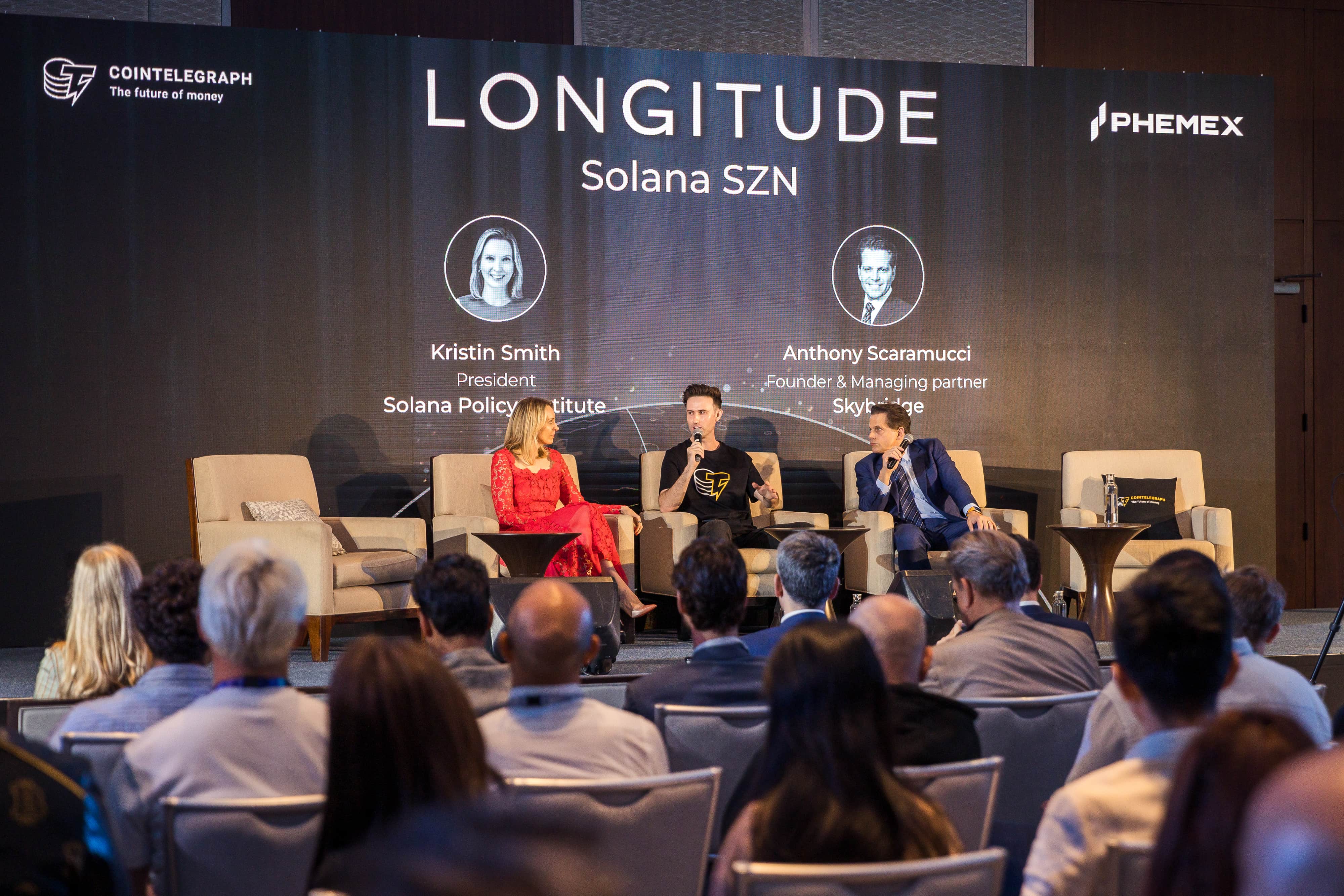
From left, Solana Policy Institute president Kristin Smith, Cointelegraph journalist Ciaran Lyons and SkyBridge founder Anthony Scaramucci.

“There’s been a tremendous amount of progress in 2025, an unprecedented amount,” Smith said. The president of the Solana Policy Institute has been intimately involved in crypto-focused discussions in Washington over the past 18 months.

“I think now that the US is catching up, you’re seeing policymakers around the globe figuring out what they need to do to stay competitive and keep crypto within their borders, which is different than trying to keep crypto outside of their borders.”

Scaramucci said educating policymakers remains a key hurdle to helping the traditional financial system adopt innovative protocols running on blockchain rails.

“Kristin has got to go into those rooms, and she’s got to explain to these people why this regulation needs to get passed so that we can retool the financial system and make the system less expensive and more seamless,” Scaramucci said.

The founder of SkyBridge Capital added that existing TradFi systems currently spend over $4 trillion on transaction verification globally. Shifting to protocols like Ethereum and Solana, which currently rank highest for RWA tokenization and onchain activity, could offer unrivalled efficiency and cost savings.

“That’s credit card fees, wire fees, a whole host of different things. If we were able to adopt Solana and use it in the process of tokenizing assets, you could save probably 75% of that, and that could be transformative for the global economy.”

Again, the major hurdle in recent years has been lagging regulations that have scuppered innovation and the ability for institutions to actively explore using blockchain protocols.

“We can do that today. It’s actually fairly easy to issue a share or a bond on a blockchain. The problem is the regulations don’t make sense when it comes to trading those assets. And so that’s a piece that we’re working on,” Smith said.

Related: Scaramucci family invested over $100M in Trump’s Bitcoin mining firm: Report

Scaramucci delivered a bullish parting message, highlighting the intent of America’s biggest financial institutions, BlackRock, Blackstone and JPMorgan, moving to tokenize assets on blockchain protocols.

“Don’t sit here myopically in 2025 and see this short-sighted opportunity. See the exponential technological opportunity that’s coming.”

Privacy in vogue

StarkWare founder Eli Ben-Sasson, who also co-founded the Zcash protocol, engaged in a thought-provoking fireside chat unpacking why privacy protocols have been in vogue in the latter half of 2025.

“I spent several decades of my life thinking about privacy, both the math and then the productization. Privacy is a spectrum.”

Ben-Sasson weighed in on the massive interest in Zcash (ZEC) in 2025. The privacy-focused cryptocurrency has been around since 2016, but saw a massive surge in value and interest off the back of support from various big names in the industry.

“At one extreme, you have the stuff we did at Zcash, which is resistance money level of privacy. If you need to jump on a plane and the government is pursuing you and you need to be fully you know, off the radar, then you have that,” Ben-Sasson said.
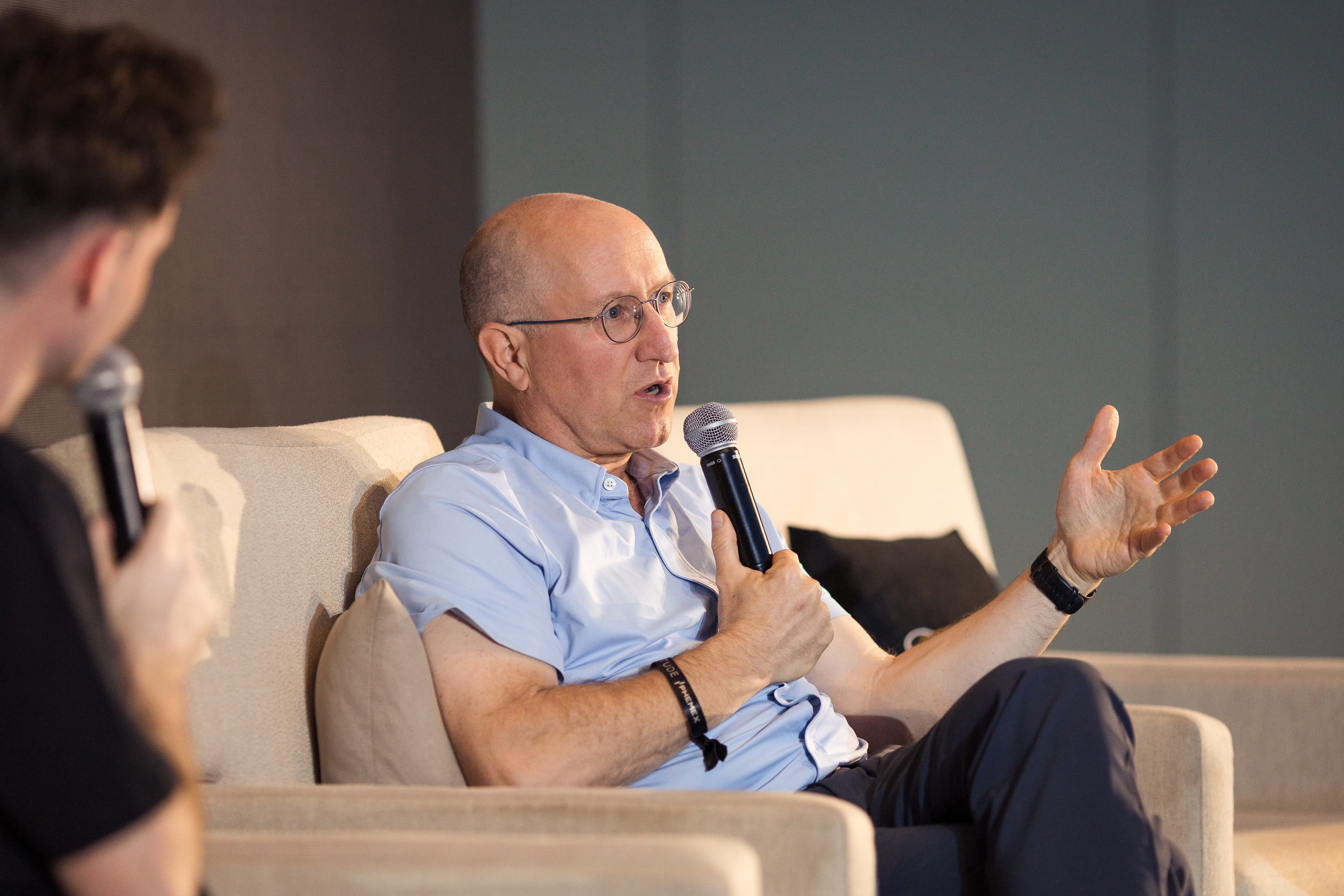
StarkWare co-founder Eli Ben-Sasson.

However, Ben-Sasson said the cost of that luxury is in the user experience. Wallets, programmability and user experience are harder to provide with that level of privacy. The less technical end of the spectrum affords a use case that is in high demand.

Related: Can Zcash’s rise revive the Bitcoin OP_CAT discussion?

“Enterprises come in, and they are going to want a different kind of privacy and also a different kind of privacy from the kind that we did on Zcash. They’re going to want privacy where they, as enterprises, and their customers are shielded away from other customers and from their competitors,” he said.

Security wake-up call

Security was another major talking point at LONGITUDE VII, given the spate of high-profile hacks and security incidents in 2025.
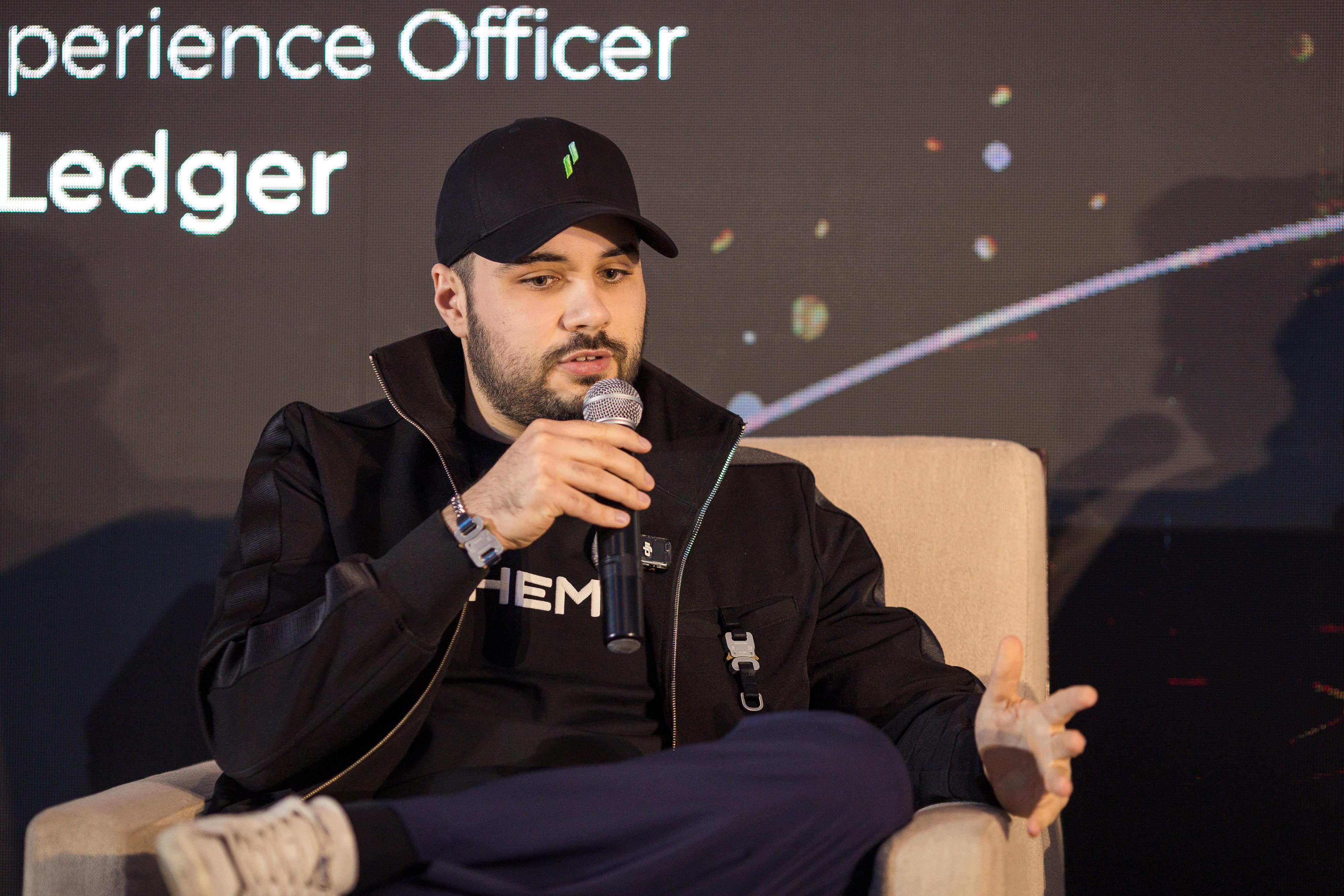
Phemex CEO Federico Variola. Source: Cointelegraph

The theft of $1.6 billion of Ether (ETH) from Bybit in March was a wake-up call for the industry. As Phemex CEO Federico Variola explained, social engineering and unverified access continue to be a major threat to everyday crypto users.

“I think combining the social layer of being a crypto participant with the financial layer, those kind of devices should be never interacting with each other.”

“It’s difficult in crypto because sometimes you need to participate in an airdrop, or like you want your Twitter account to be linked to the MegaETH ICO, for example. Nevertheless, you should be aware that you’re always exposing yourself to significant risk,” Variola said.

Related: Bybit hack: ‘Reckoning’ that led SafeWallet to rearchitect its systems

Ledger’s chief experience officer Ian Rodgers said that the onus is on service providers and infrastructure builders to think critically about the risks their platforms and users face.

“There are there is no way to make a risk go to zero. But it is the responsibility to minimize the risk as much as possible, to think about what is the worst thing that could possibly happen, what could go wrong here,” Rodgers said.

Cointelegraph’s exclusively LONGITUDE events will be back on the calendar in 2026, with editions planned for New York, Paris, Dubai, Hong Kong, Singapore, and Abu Dhabi.


Пов'язані питання

QWhat does Anthony Scaramucci predict for the cryptocurrency industry in 2026?

AAnthony Scaramucci predicts 'exponential opportunity' for crypto, driven by institutional investment and clear regulations, with major financial institutions like BlackRock and JPMorgan moving to tokenize assets on blockchain protocols.

QAccording to Kristin Smith, what is the current regulatory challenge for trading tokenized assets?

AKristin Smith states that while it is easy to issue shares or bonds on a blockchain, the regulations don't make sense for trading those assets, which is a key area being worked on.

QWhy has there been increased interest in privacy protocols like Zcash in 2025?

AEli Ben-Sasson explains that privacy protocols are in vogue due to high demand for different levels of privacy, from resistance-money level privacy for individuals to enterprise-focused privacy shielding customers and competitors.

QWhat was the significance of the $1.6 billion Bybit hack in March 2025?

AThe $1.6 billion Ether theft from Bybit was a wake-up call for the industry, highlighting the major threats of social engineering and unverified access to crypto users.

QHow does Anthony Scaramucci suggest blockchain protocols like Solana could transform the global economy?

AScaramucci suggests that adopting Solana for tokenizing assets could save up to 75% of the over $4 trillion spent globally on transaction verification in TradFi systems, leading to transformative efficiency and cost savings.

Пов'язані матеріали

Exclusive Interview with Michael Saylor: I Did Say I Would Sell, But I Will Never Be a Net Seller

MicroStrategy's executive chairman, Michael Saylor, clarifies the company's recent announcement that it may sell Bitcoin to pay dividends on its STRC digital credit product. He emphasizes this does not make MicroStrategy a net seller of Bitcoin. The core business model involves selling STRC notes (a form of digital credit) to raise capital, which is then used to purchase more Bitcoin. Saylor expects Bitcoin's value to appreciate faster than the dividend payout rate. Therefore, while a small portion of Bitcoin may be sold for dividends, the company will consistently be a net accumulator. For example, in April, the company raised $3.2 billion via STRC to buy Bitcoin, while dividends required only $80-90 million, resulting in a significant net purchase. Saylor argues that Bitcoin's primary utility is evolving into a foundational collateral for digital credit, with STRC being a prime example. He notes that STRC now constitutes a majority of the U.S. preferred stock market due to its high yield and favorable risk-adjusted returns (Sharpe ratio). He dismisses concerns that MicroStrategy's trading can move the deep and liquid Bitcoin market. Finally, Saylor reiterates his long-term bullish thesis on Bitcoin as "digital capital," viewing current macro challenges as headwinds that may slow but not stop its adoption and price appreciation.

Odaily星球日报6 хв тому

Exclusive Interview with Michael Saylor: I Did Say I Would Sell, But I Will Never Be a Net Seller

Odaily星球日报6 хв тому

Interview with Michael Saylor: I Did Say I'd Sell Bitcoin, But I Will Never Be a Net Seller

**Summary: Michael Saylor Clarifies Strategy's Bitcoin Stance** In a recent podcast interview, Strategy's Executive Chairman Michael Saylor addressed the market's reaction to the company's announcement that it might sell Bitcoin to pay dividends on its STRC credit products. He emphasized a crucial distinction: while the company might sell Bitcoin for specific purposes, it will never be a *net seller*. Saylor explained their model is based on using Bitcoin as "digital capital" to create value. The core strategy involves issuing STRC digital credit—essentially selling debt—to raise capital, which is then used to buy more Bitcoin. He estimates Bitcoin appreciates at roughly 40% annually. A small portion of these capital gains (e.g., ~2.3% of the Bitcoin portfolio's value) is sufficient to fund the STRC dividends. Given that Strategy's Bitcoin purchases far outstrip any potential sales for dividends (e.g., buying $3.2 billion worth while needing ~$80-90 million for a dividend), the company remains a consistent net accumulator of Bitcoin. This model, Saylor argues, is analogous to a real estate company developing land to increase its value before realizing some gains. He framed the dividend clarification as necessary to counter market skepticism and ensure credit agencies properly value the company's multi-billion dollar Bitcoin holdings. Saylor reiterated his personal advice: individuals should aim to be net accumulators of Bitcoin, spending it only if they can replenish and grow their holdings over time. Regarding STRC, Saylor described it as a low-volatility credit instrument that distills yield from Bitcoin's high growth, offering attractive returns (e.g., ~11-12% yield) for risk-averse investors. He noted that Strategy's STRC issuance now constitutes about 60% of the U.S. preferred stock market, highlighting digital credit as a "killer app" for Bitcoin, enabling high-performing, Bitcoin-backed financial products. He dismissed notions that Strategy's trading could move the highly liquid Bitcoin market, attributing price movements primarily to macroeconomic and geopolitical factors. Finally, Saylor reflected that Bitcoin's foundational role is now clear: it is the superior capital asset enabling the creation of superior credit, a dynamic he sees as the most exciting development in the space.

marsbit12 хв тому

Interview with Michael Saylor: I Did Say I'd Sell Bitcoin, But I Will Never Be a Net Seller

marsbit12 хв тому

380,000 Apps Exposed, 2,000+ Apps Leaked Secrets: AI Programming Turns 'Intranet' into Public Internet

Israeli cybersecurity firm RedAccess uncovered a severe data exposure trend linked to "vibe coding" or AI-powered software development tools. Their research found approximately 38,000 publicly accessible web applications built with platforms like Lovable, Base44, Netlify, and Replit. Of these, an estimated 2,000 apps exposed sensitive corporate and personal data, including medical records, financial information, internal strategic documents, and customer chat logs. In some cases, access even granted administrative privileges. The core issue stems from default privacy settings that make applications public by default, combined with a lack of built-in security controls (like authentication) in the AI-generated code. This allows employees without security expertise—"citizen developers"—to easily create and deploy applications that bypass standard corporate security reviews. The exposed apps, often indexed by search engines, are trivially discoverable. While some platform providers (Replit, Lovable, Wix/Base44) argue that security configuration is the user's responsibility and question the validity of some findings, security researchers confirm the widespread reality of such exposures. This pattern, also noted in prior studies, highlights a critical security gap as AI democratizes app creation, potentially leading to massive, unintentional data leaks.

marsbit1 год тому

380,000 Apps Exposed, 2,000+ Apps Leaked Secrets: AI Programming Turns 'Intranet' into Public Internet

marsbit1 год тому

Attracting Global Capital, Asia's New 'Super Cycle' Is Unfolding

Investors are turning to Asia as the next frontier for global equity growth, with a new "super cycle" unfolding across the region. Driven by the AI revolution, Asian markets, particularly South Korea, have seen significant rallies. According to Morgan Stanley analysis, the underlying drivers of Asia's industrial cycle are shifting from traditional sectors like real estate and manufacturing to massive investments in AI infrastructure, energy security and transition, and supply chain resilience. Fixed asset investment in Asia is projected to grow from around $11 trillion in 2025 to $16 trillion by 2030, with a 7% annual growth rate from 2026-2030. The AI wave is a primary catalyst, driving immense capital expenditure for chips, servers, data centers, and power systems. Asia is central to this hardware supply chain. In China, AI investment is focused on building a full-system domestic capability, with the local AI chip market potentially reaching $86 billion by 2030. Beyond AI, China's export story is expanding from EVs and batteries to robotics. The country already captures about half of new global industrial robot demand and over 90% of humanoid robot shipments. This growth phase mirrors the early stages of China's EV export boom. Simultaneously, energy security investments, spurred by AI's massive power needs, are rising, with China benefiting from its leadership in solar, batteries, and EVs. Regional defense spending is also increasing structurally, supporting demand for advanced manufacturing. The main beneficiaries are China, South Korea, and Japan, positioned in core supply chain areas. However, risks remain, including potential overcapacity, profit margin pressures from competition, persistent technological restrictions, geopolitical friction, and workforce displacement due to AI-driven automation. Market volatility is also expected to increase as investor expectations diverge on the realization of these capital investment and export themes.

marsbit1 год тому

Attracting Global Capital, Asia's New 'Super Cycle' Is Unfolding

marsbit1 год тому

Торгівля

Спот
Ф'ючерси
活动图片




