Saylor Softens Stance, STRC Weakens, Is BTC Facing a Do-or-Die Battle?

marsbitОпубліковано о 2026-05-09Востаннє оновлено о 2026-05-09

Анотація

**Summary: Bitcoin (BTC) at a Critical Juncture? Saylor's Hint and STRC Softness Spark Concerns** This article examines two recent developments that could pressure Bitcoin's price: Saylor's hinted willingness to sell some of MicroStrategy's (MSTR) BTC holdings and a significant slowdown in the issuance of its Structured Token Receipt Capital (STRC) product. Previously, STR C was viewed as a powerful new source of ongoing demand for Bitcoin, as the funds raised were used to buy more BTC with leverage. However, MicroStrategy CEO Michael Saylor's recent acknowledgment that the company *might* sell BTC to pay dividends undermines the "never sell" narrative that underpins MSTR's valuation premium and the entire STRC-driven demand thesis. While mathematically sustainable if BTC appreciates, forced selling during a market downturn would severely damage the company's balance sheet and reverse much of its recent buying. Simultaneously, the STRC "flywheel" appears to be stalling. Unlike in previous cycles, the STRC price has failed to return to its $100 par value ahead of the May dividend date, indicating zero new BTC purchases via this channel for the current period. The author attributes this "softness" to a saturated market of arbitrage traders after huge inflows in March and April, whose selling pressure kept prices down, as well as higher opportunity costs in a surging stock market. The combination risks starting a "reverse flywheel": No STRC issuance means no new BTC buying, ...

In the previous article, we introduced how Strategy brought new marginal buying pressure to Bitcoin through STRC.

However, two incidents occurring in the new ex-dividend cycle have made some traders uneasy about the "new paradigm of supply and demand dynamics" that STRC brings to Bitcoin.

Saylor Softens Stance

After market hours on May 5th, during the Q1 2026 earnings call for MicroStrategy, Saylor publicly acknowledged for the first time that the company might sell a portion of its Bitcoin to pay dividends.

Saylor's statement can be interpreted in three ways.

The first interpretation is that Saylor is trying to let the market know and digest this possibility in advance to avoid a violent reaction if it actually happens. This is a "public relations" move to provide a price buffer for BTC.

The second interpretation is straightforward: Saylor's promise to "never sell Bitcoin" is the cornerstone supporting MSTR's premium and the entire Bitcoin treasury narrative. Once Saylor himself opens a crack, the market will reassess the stability of the entire system.

The third interpretation: MicroStrategy's previous financing relied mainly on two tools: issuing MSTR common stock and issuing convertible bonds. Preferred stock has only become the main tool in the past year, but the issuance ceiling is still limited by the secondary market's absorption capacity. The only remaining tools that don't create future obligations and are large enough in scale are ATM (at-the-market) offerings of MSTR common stock. The problem is that MSTR's mNAV must be above 1.22x for new common stock issuance not to dilute the BTC per share. Currently, MSTR's mNAV is not far from this threshold. Saylor uses the relatively gentle method of "possibly selling Bitcoin" to attract market attention, making the relative cost of continuing to issue MSTR common stock seem more acceptable.

Looking at the balance sheet, MicroStrategy's current annual dividend and interest payments total about $1.5 billion, with monthly payments around $125 million. STRC accounts for about $978 million of this, or 65%. As of Q1 this year, the company had approximately $2.25 billion in USD reserves, which, according to management, can cover 18 months of dividend payments.

If STRC issuance stalls and the cash reserves are depleted, the only remaining option would be to sell BTC to cover dividend payments. At a BTC price of $80k and annual interest and dividend payments of $1.5 billion, Strategy would need to sell about 18,519 BTC per year, equivalent to 2.3% of its total holdings.

As long as BTC appreciates by at least 2.3% annually, this selling pressure can be absorbed by the increase in portfolio value. Over a multi-year horizon, BTC's compound annual return is often in the double or even triple digits, making 2.3% almost a non-constraint.

However, BTC has also experienced single-year drawdowns of -77% in 2018 and -65% in 2022. If Strategy sells 2.3% of its BTC holdings during a bottom, the company's balance sheet would deteriorate severely.

MicroStrategy has net purchased about 77,000 BTC through STRC so far in 2026. If a sell scenario is triggered and BTC falls back near Strategy's average cost of $75,537, selling 2.3% of the total holdings would be equivalent to 25% of the year-to-date purchase volume.

In other words, Saylor's selling in one year could offset four months of buying.

STRC "Weakens"
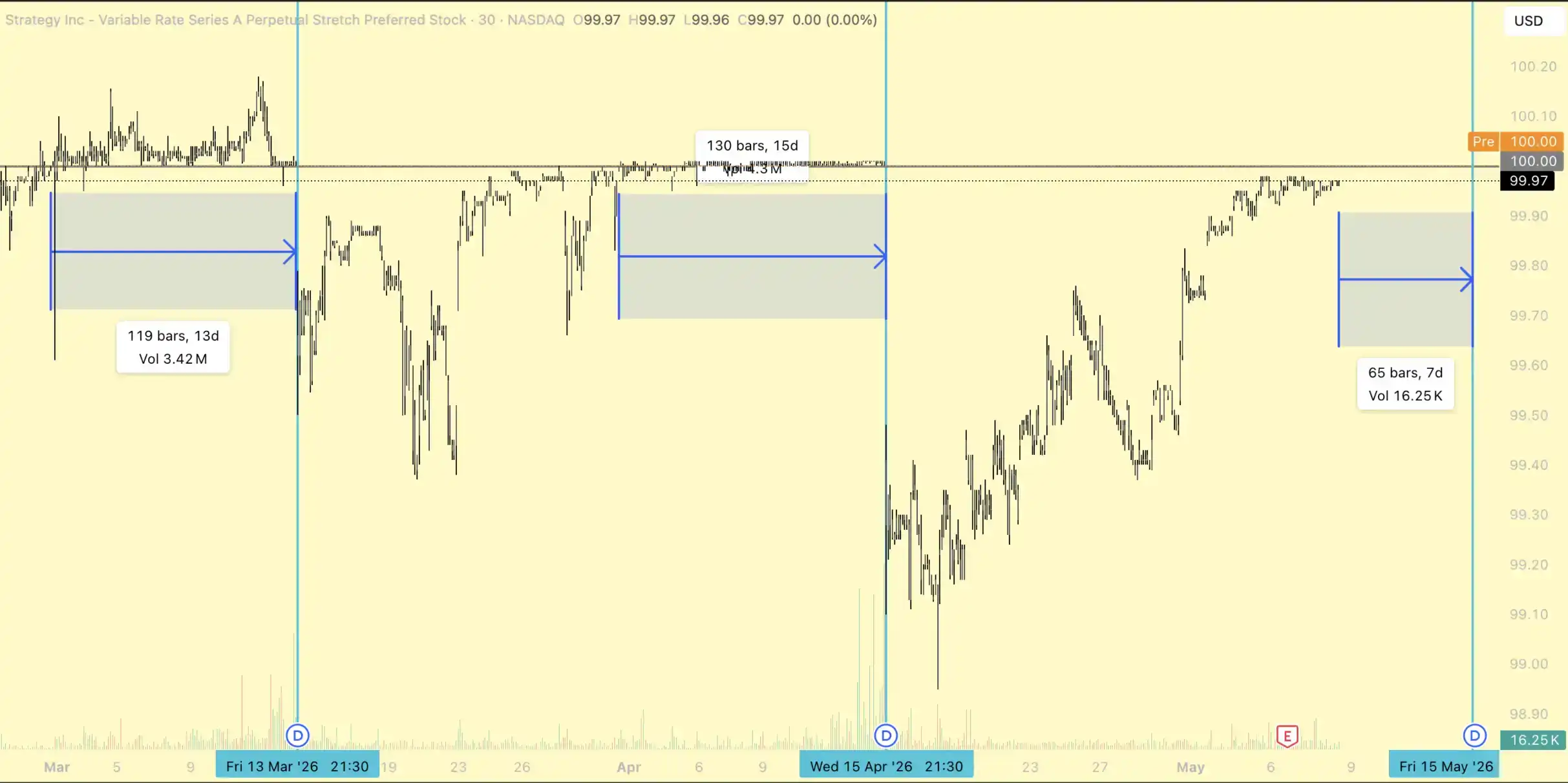
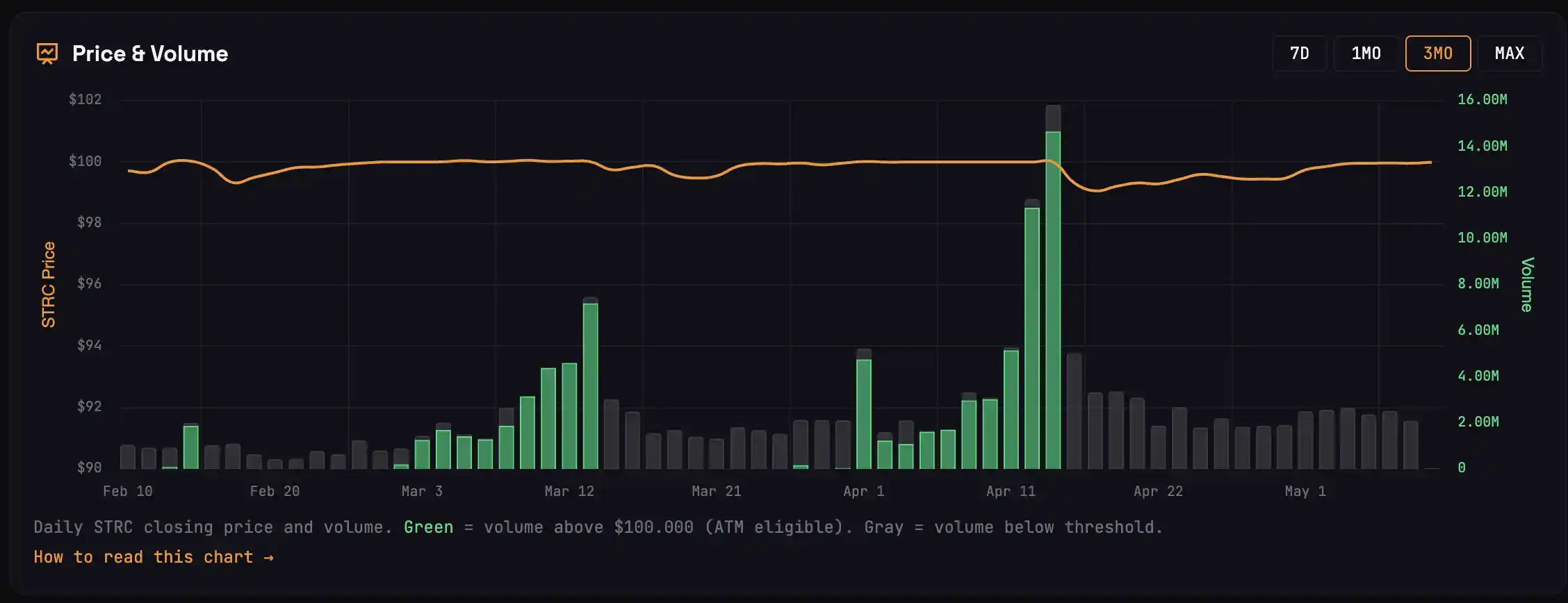
In the March ex-dividend cycle, STRC traded above $100 for 13 days before the ex-date, with cumulative volume of 3.42M shares, corresponding to about 22,000 BTC purchased. In the April cycle, STRC generated buying pressure for about 47,000 BTC.

Now, with only 5 trading days left before the May 15th ex-date, STRC has not returned to its $100 par value in the May cycle, meaning the corresponding BTC buying is 0.

To understand why this cycle is suddenly different, we can categorize STRC buyers into four types:

· The first type consists of arbitrageurs who rush in a few days before the ex-date. They buy STRC before the ex-date, collect the dividend on the ex-date, and then sell. The peak volume on the ex-date mainly comes from these funds, and their sell orders are the main driver of STRC's price decline after the ex-date.

· The second type consists of arbitrageurs who enter only after the ex-date. STRC typically falls to the $99.20 to $99.50 range after the ex-date. They buy and place sell orders around $99.95 to $99.99, waiting for STRC to return to par value. These funds don't need STRC to actually reach $100 to profit; their sell walls are the fundamental reason STRC lingers below par value.

· The third type consists of medium-to-long-term holders who treat STRC as a wealth management product. They don't actively arbitrage but may redeem small amounts when they need funds. These occasional sell orders join those of the second type, placing limit orders near the $100 par value.

· The fourth type consists of true long-term holders who do not sell. They have almost no impact on the price dynamics of each ex-dividend cycle.

If the source of funds leading to STRC issuance is arbitrageurs, the overall market behavior will lean towards "selling near the $100 par value."

This is what happened last month.

In March and April, Strategy raised nearly $5 billion through STRC. An inflow of this magnitude could only be contributed by arbitrageurs, as long-term holders wouldn't suddenly increase by that much.

This also led to stronger arbitrageur selling pressure in April than ever before.

Strong selling pressure means STRC fell deeper after the April ex-date and took longer to return to $100 than in previous cycles. A significant portion of the first type of funds didn't manage to exit in time and got stuck at lower prices. These funds, having taken a loss, might not participate in the May arbitrage.

Furthermore, the external environment is changing.

The S&P 500 continues to hit new highs, altering the opportunity cost for fixed-income funds to buy STRC. After all, many sectors in the U.S. stock market can see single-day gains exceeding STRC's annual yield (11.5%).

Strategy's management has foreseen this issue and submitted an amendment on April 17th to make STRC pay dividends twice a month. Semi-monthly dividends could reduce the decline on each ex-date and spread out the arbitrage profits. However, this amendment won't take effect until July 15th; next week's ex-date will still follow the monthly rule.

Reverse Flywheel

The previous article discussed Strategy's flywheel: Money buying STRC is levered threefold to flow into BTC; BTC's rise improves STRC's collateral quality; more funds flow into STRC. Each link pushes the next higher.

What if the flywheel spins in reverse?

STRC fails to return to par, Strategy's at-par issuance (ATM) window closes, no new cash buys BTC, BTC loses marginal buying pressure, price comes under pressure, STRC's collateral base weakens, fixed-income investors demand higher credit spreads. Widening spreads either force MicroStrategy to raise the dividend rate (increasing interest burden) or investors continue selling STRC, making it harder for the price to return to the $100 par value.
Each link pushes the next lower.

Saylor's statement about "possibly selling some BTC" is essentially pre-pricing the end of this reverse cycle.

In concrete numbers: In April, Strategy's net BTC buying via STRC was about $4.1 billion. If STRC issuance in May falls back to the range of $1 billion, and simultaneously BTC appreciation doesn't reach the 2.3% threshold, triggering Strategy's sell-BTC-for-dividends plan, the monthly net contribution could plummet from $4.1 billion to just a few hundred million dollars, a contraction of over 90%.

The market's argument over the past few months that "STRC buying" provides bottom support for BTC would be disproven, and BTC's price would face a sharp correction.

It must be acknowledged this is only one possible path. If STRC smoothly returns to $100 next week and the issuance scale is substantial, all the aforementioned concerns will be postponed.

Optimistic Signals

During the pre-market session on May 8th, STRC saw its first issuance in this ex-dividend cycle, corresponding to 0.4 BTC purchased.
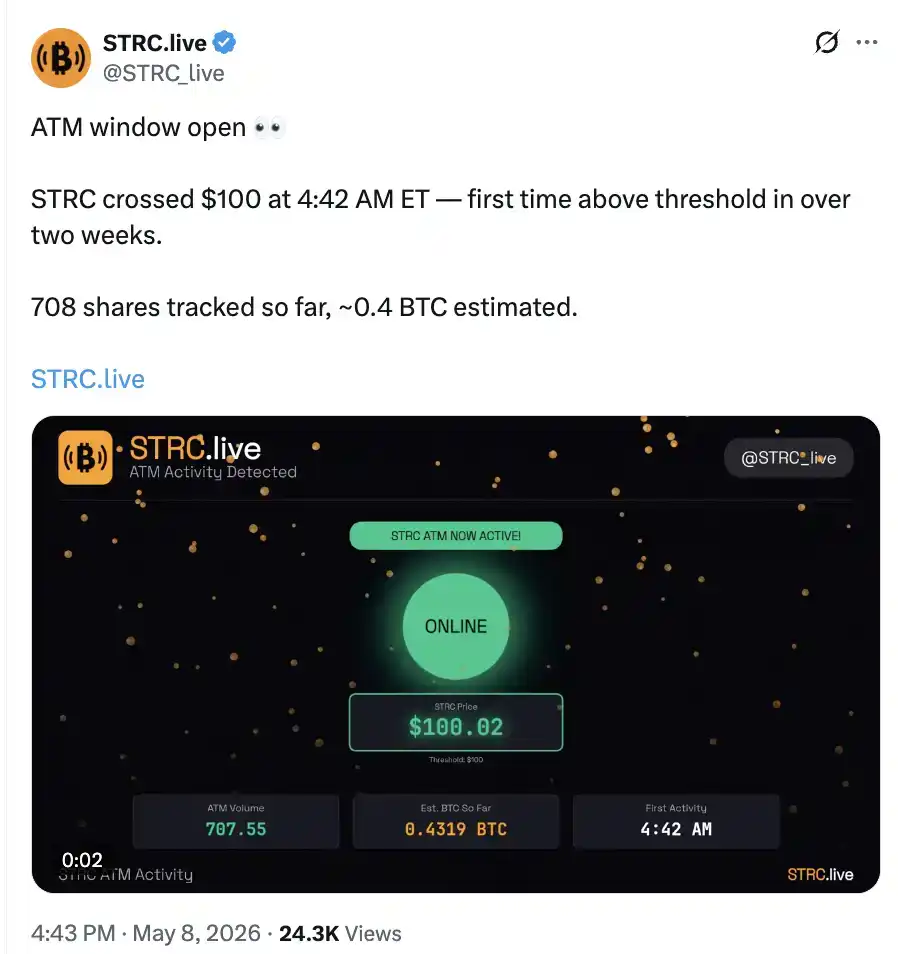
The absolute scale is negligible, but the significance lies in the shift from zero to one.
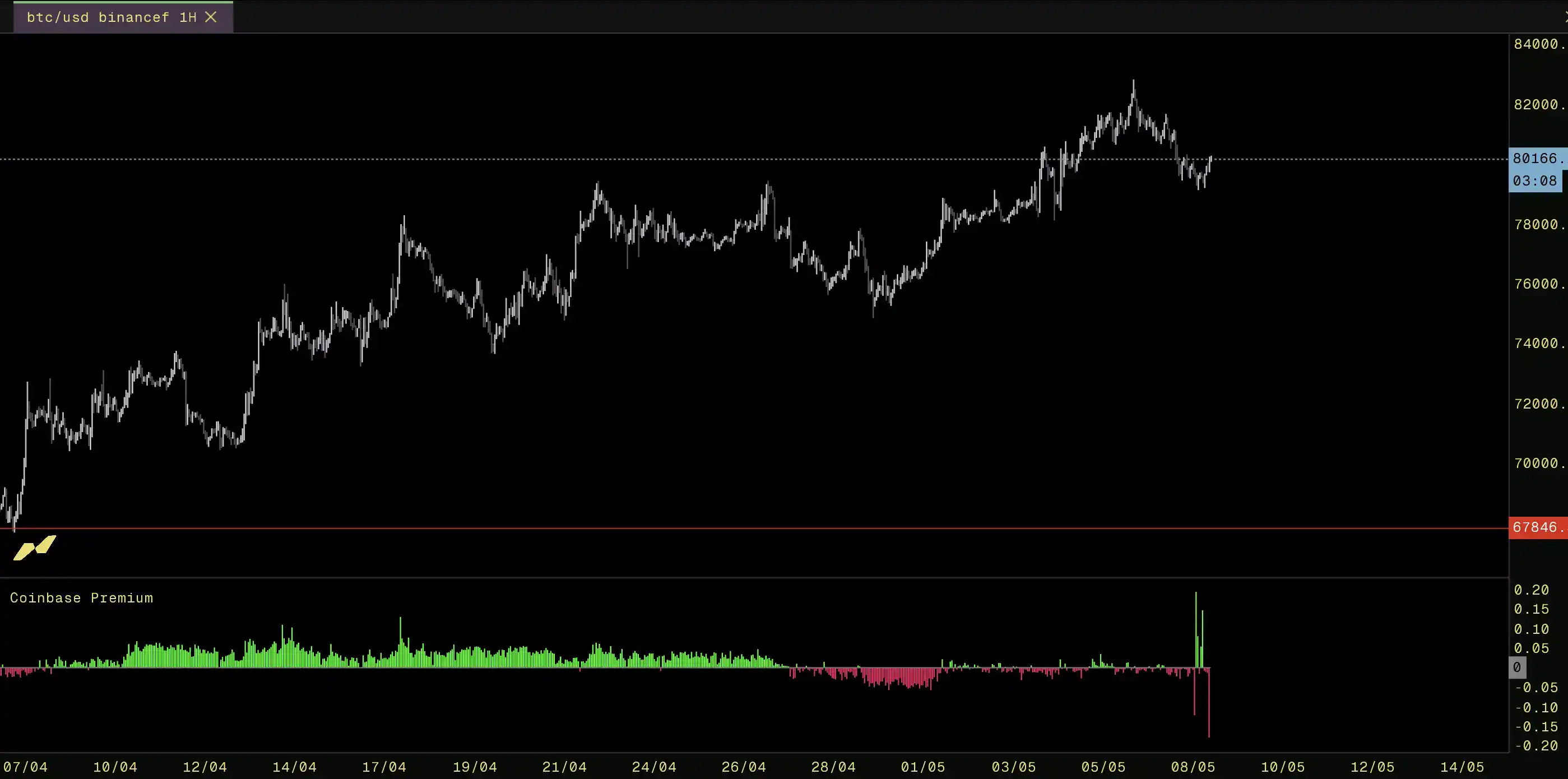
Simultaneously, the Coinbase premium briefly turned positive and returned to April's levels.

Whether BTC, which appears to be losing upward momentum, will fall back to February's range or attack $90,000, STRC's performance next week will play a key role.


Пов'язані питання

QAccording to the article, what are the three possible interpretations of Michael Saylor's statement about MicroStrategy potentially selling some Bitcoin?

A1. It is a 'public relations' move to let the market know and digest the possibility in advance to cushion the impact if it actually happens. 2. It signifies a crack in the foundation of the 'never selling' pledge that supports the MSTR premium and the entire corporate Bitcoin treasury narrative, leading the market to reassess the system's stability. 3. It is a strategy to make issuing more MSTR common stock (via an ATM offering) seem more acceptable by drawing attention with the 'potential sale' narrative, as issuing new shares above a certain mNAV threshold becomes more difficult.

QWhat are the four categories of STRC buyers identified in the article, and how did their behavior change in the May dividend cycle?

A1. Arbitrageurs buying just before the ex-dividend date to capture the dividend. 2. Arbitrageurs buying after the ex-dividend date when the price dips, aiming to profit as it returns to par value. 3. Medium-to-long-term holders treating STRC as a financial product. 4. Long-term, non-selling holders. In the May cycle, STRC's price failed to return to its $100 par value before the ex-dividend date. This was likely because arbitrageurs from the previous (April) cycle, who suffered losses due to a deeper price drop and slower recovery, did not return. Additionally, a strong stock market increased the opportunity cost for fixed-income funds to buy STRC.

QWhat is the 'reverse flywheel' effect described in the article, and what are its potential consequences for Bitcoin?

AThe 'reverse flywheel' is the opposite of the positive cycle where STRC inflows fuel BTC buying. It starts if STRC cannot return to its $100 par value, closing MicroStrategy's ATM issuance window. This cuts off new cash for buying BTC, removing a key marginal buyer and putting downward pressure on BTC's price. A weaker BTC price worsens STRC's collateral quality, leading fixed-income investors to demand higher credit spreads. Higher spreads force MicroStrategy to either raise STRC's dividend rate (increasing costs) or face continued selling, making it even harder for STRC to reach $100. Each stage pushes the next one lower, potentially leading to a severe correction in BTC's price if the STRC-driven buying support is disproven.

QWhat critical financial threshold is mentioned regarding MicroStrategy's potential need to sell Bitcoin to cover obligations, and under what conditions is it manageable?

AThe article states that if MicroStrategy needed to sell BTC to cover annual interest and dividend payments of approximately $1.5 billion, it would need to sell about 18,519 BTC per year (at an $80k price), equivalent to 2.3% of its total holdings. This selling pressure is manageable if BTC's price appreciates by at least 2.3% annually. Over multiple years, given BTC's historical double or triple-digit compound annual returns, this 2.3% is hardly a constraint. However, it becomes a serious problem if BTC experiences a major drawdown (like -77% in 2018 or -65% in 2022) while the company is forced to sell, severely damaging its balance sheet.

QWhat was the 'optimistic signal' observed on May 8th regarding STRC and Bitcoin, and why is the coming week crucial?

AOn May 8th, during pre-market trading, STRC saw its first issuance in that dividend cycle, corresponding to a 0.4 BTC purchase. While the amount was negligible, its significance was the shift 'from zero to one,' indicating some renewed buying interest. Concurrently, the Coinbase premium briefly turned positive and returned to April's levels. The coming week is crucial because STRC's performance around its May 15th ex-dividend date will be key in determining whether BTC, which appears to be losing upward momentum, will fall back to its February trading range or resume an attack towards $90,000.

Пов'язані матеріали

Near Returns to the AI Stage: Transformation into a Public Chain Due to 'Payroll Difficulties,' Agent and Privacy Emerge as New Growth Narratives

NEAR Returns to AI Origins: From Payroll Struggles to Blockchain, Now Focusing on AI Agents and Privacy NEAR Protocol's journey began not with grand blockchain ambitions, but from a practical hurdle: its AI startup founders, including Transformer paper co-author Illia Polosukhin, couldn't efficiently pay international developers in 2017. This led them to pivot and build a high-performance, scalable blockchain. After years navigating various crypto narratives like sharding and cross-chain interoperability, NEAR is now leveraging its AI roots to re-enter the AI arena. A key driver is its "NEAR Intents" layer, which abstracts complex cross-chain transactions. Users simply state their goal (e.g., swap BTC for ETH), and a solver network finds the optimal route. This system has processed over $20B in cross-chain volume, generating significant fee revenue. A major growth area is private transactions via "Confidential Intents/Swaps," which hide trade details until settlement to protect against MEV and front-running. Remarkably, private swaps recently accounted for over 40% of NEAR's transaction volume, highlighting strong demand but also potential regulatory scrutiny. With its AI-founder pedigree, NEAR is positioning itself at the intersection of blockchain, AI agents, and privacy, aiming to become infrastructure for the emerging agent economy while navigating the challenges of its rapid adoption.

marsbit1 год тому

Near Returns to the AI Stage: Transformation into a Public Chain Due to 'Payroll Difficulties,' Agent and Privacy Emerge as New Growth Narratives

marsbit1 год тому

From Ethereum to AI's 'CROPS': What Exactly is This Set of 'Slow Variables' That Vitalik Repeatedly Emphasizes?

In recent discussions, Vitalik Buterin has frequently emphasized the concept of "CROPS," a framework defining core values for Ethereum's development. CROPS stands for Censorship Resistance, Capture Resistance, Open Source, Privacy, and Security. Initially outlined in the Ethereum Foundation's "EF Mandate," it represents a commitment to user sovereignty, ensuring that the network resists external control, remains open, protects privacy, and prioritizes security. The relevance of CROPS extends beyond Ethereum's foundational principles, becoming crucial in the context of AI integration. As AI agents begin handling wallet operations and automated transactions, the risk increases that users may cede control over their digital assets, privacy, and intentions to centralized AI service providers. A "CROPS AI" would therefore emphasize local execution where possible, privacy-preserving remote model calls (e.g., using zero-knowledge proofs), and transparent, verifiable processes to maintain user agency. Vitalik highlights a significant convergence between "CROPS Ethereum access layer" and "CROPS AI." Both address the same fundamental challenge: how users can access powerful services—be it blockchain data via RPCs or AI models—without exposing sensitive information or relinquishing ultimate control. This intersection points toward a future digital entry point that is more private, secure, and user-controlled. Ultimately, CROPS is not merely an abstract ideal but a practical guidepost. It steers development—from protocol resilience and wallet design to AI agent safety—towards a future where users retain self-sovereignty even as digital systems grow more complex and powerful. In an era of accelerating AI adoption, these "slow variables" of censorship resistance, openness, privacy, and security may define Ethereum's enduring value.

marsbit1 год тому

From Ethereum to AI's 'CROPS': What Exactly is This Set of 'Slow Variables' That Vitalik Repeatedly Emphasizes?

marsbit1 год тому

Silicon Valley 'Startup Guru' Steve Hoffman: Web3 + AI Could Be a Trap

Silicon Valley investor and "Godfather of Startups" Steve Hoffman warns that combining Web3 with AI is likely a trap, not a promising venture. In an interview, Hoffman argues that while AI is a foundational technology touching all industries, Web3 adds complexity, friction, and regulatory risk without solving mainstream consumer or business needs. He advises founders to focus on deep, specialized applications where startups can out-iterate giants, rather than on generic features easily replicated by large tech companies. Hoffman observes that Silicon Valley will lead foundational AI research, while China excels at rapid, large-scale application and commercialization, particularly in robotics. He stresses that AI-driven autonomous agents capable of collaborative, multi-step tasks are 2-4 years away, which will cause significant job displacement. The solution is not to slow AI but to redesign business models around human-AI collaboration and reform social systems like education and retraining. For startups, Hoffman recommends focusing on vertical, expertise-heavy domains to build defensibility. He sees major opportunities in AI fraud detection and cybersecurity. Key founder mindsets include systemic thinking over feature-focus, relentless customer centricity, building adaptive teams, and deeply understanding AI's capabilities and limits. Hoffman is also leading a non-profit initiative to establish university centers aimed at training future leaders in responsible, human-value-aligned AI innovation.

marsbit3 год тому

Silicon Valley 'Startup Guru' Steve Hoffman: Web3 + AI Could Be a Trap

marsbit3 год тому

Token Inefficient, Economy Tokenless

The article "Tokens Aren't Economical, Economics Aren't Tokenized" analyzes a pivotal shift in the AI industry from a technology-driven narrative to one dominated by capital efficiency. It highlights two concurrent trends: a severe capital shortage due to the exorbitant and recurring costs of compute (e.g., OpenAI's high burn rate) and a wave of corporate spin-offs where major tech companies are separating their AI units (like Kuaishou's Kling and Baidu's Kunlunxin). The core argument is that AI's "anti-internet" business model, where user growth increases costs rather than profits, has created a disconnect between high valuations and actual cash flow. Spin-offs address this by allowing AI assets to be valued independently. Within a parent company, they are seen as cost centers, but as standalone entities, they are priced based on their growth potential and scarcity in the primary market, leading to massive valuation premiums (e.g., Kling's estimated value tripling post-spin-off). The industry is at an inflection point, moving from "model worship" to "value realization." The competition is evolving from a pure compute (GPU) race to a broader focus on systemic efficiency and full-stack engineering (involving CPUs and orchestration) to achieve viable commercialization. The year 2026 is framed as a critical moment where the industry must definitively answer how to economically translate AI capability into tangible business value, reshaping the sector's future power structure.

marsbit3 год тому

Token Inefficient, Economy Tokenless

marsbit3 год тому

Торгівля

Спот
Ф'ючерси
活动图片




