Fernandina Beach, USA/Florida, December 15th, 2025, Chainwire
SaucerSwap Labs, the team behind Hedera’s leading decentralized exchange, today unveiled a fully redesigned platform and refreshed brand identity. The update delivers modernized navigation, integrated analytics, and a new visual design system while preserving the audited smart contracts and non-custodial architecture that users rely on.
“Whether you’re discovering Hedera DeFi for the first time or you’re a professional trader, everything has been rebuilt to feel fast, trusted, and intuitive,” said Peter Campbell, CEO and Co-founder of SaucerSwap Labs. “This is a serious workstation for capital.”
A New Era for Hedera’s Liquidity Protocol
Since launching in 2022, SaucerSwap has grown from an early-stage automated market maker into Hedera’s dominant DeFi protocol, routing the majority of on-chain liquidity and processing tens of millions of swaps. The redesigned platform brings the user experience in line with that scale, introducing clearer information architecture and analytics built directly into every workflow.
The launch also introduces a refreshed visual identity for SaucerSwap, including an updated logo, new color palette, and a modern design system that reflects the protocol’s evolution from startup to infrastructure.
Navigation Built Around Real Workflows
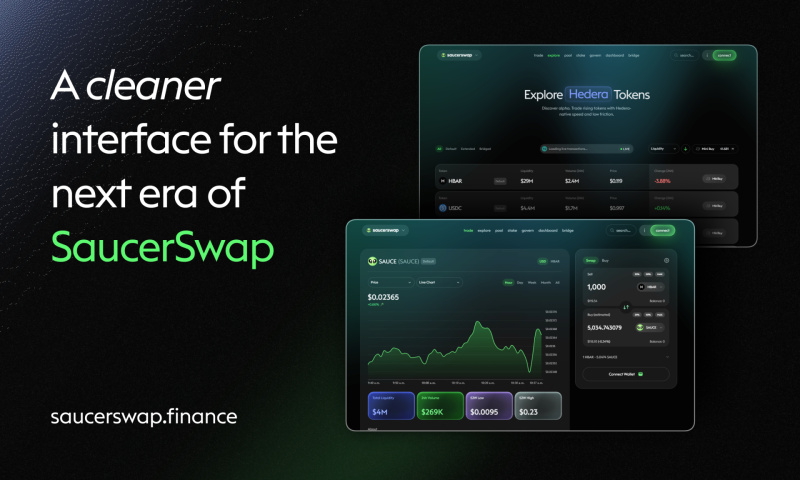
The platform is now organized into clear, action-driven sections. Trading, token discovery, liquidity provisioning, staking, governance, and portfolio monitoring each have dedicated views. Users can move from a token swap to providing liquidity, staking SAUCE, or voting on a governance proposal in seconds.
A bridge modal connects Hedera to external networks including Base and BNB Chain, making it easier to move capital in and out of the ecosystem.
The redesign standardizes how information is displayed across the platform: pair and pool charts, liquidity depth, fee APYs, LP position analytics, historical performance, and protocol health metrics all follow consistent visual patterns. These components are designed to scale with SaucerSwap’s roadmap, including the planned V3 protocol upgrade, perpetuals, limit orders, dollar cost averaging, and ETF-style products.
“The interface was designed so that complex features feel simple,” said Markus Bergvinson, Chief Strategy Officer at SaucerSwap Labs. “Whether it’s swaps today or advanced derivatives tomorrow, it all lives inside one consistent experience.”
Built for Every Type of User
The platform is tuned for different audiences. Retail users and newcomers get clear copy and guided flows that feel similar to modern banking apps. Advanced users and liquidity providers gain faster access to deeper analytics and more powerful LP tools. Builders and token projects can rely on the interface for token launches and liquidity programs. Professional partners can bridge assets from other networks and interact with a protocol that matches their expectations for security and longevity.
Protocol Unchanged, Experience Upgraded
The redesign does not change SaucerSwap’s audited smart contracts, non-custodial architecture, on-chain governance via SAUCE and xSAUCE, or any existing LP positions, stakes, or rewards. Everything users have built on SaucerSwap remains intact.
This launch marks the beginning of SaucerSwap’s next chapter: new design, new brand, and new capabilities, with the same mission of being the most efficient, accessible, and secure liquidity protocol on Hedera.
About SaucerSwap
SaucerSwap is Hedera’s leading decentralized exchange and liquidity protocol, enabling fast, low-cost token swaps with integrated analytics. Governed by the SaucerSwap DAO through SAUCE and xSAUCE, the protocol powers Hedera-native and cross-chain liquidity for retail users, builders, and institutional partners.
For more information, users can visit the SaucerSwap Docs and explore the new SaucerSwap platform.
Contact
CEO
Peter Campbell
SaucerSwap Labs LLC
outreach@saucerswap.finance





