Satoshi Nakamoto statue lands on NYSE in sign of changing times

cointelegraphОпубліковано о 2025-12-11Востаннє оновлено о 2025-12-11

Анотація

The New York Stock Exchange (NYSE) has installed a statue of Satoshi Nakamoto, Bitcoin’s pseudonymous creator, marking a symbolic shift in the acceptance of cryptocurrency within traditional finance. The statue, designed by artist Valentina Picozzi, was placed by Bitcoin firm Twenty One Capital. This event coincides with the anniversary of the Bitcoin mailing list launched in 2008. The installation reflects Bitcoin’s journey from a niche concept to a mainstream asset, now held by major institutions, companies, and ETFs. Picozzi has placed six of a planned 21 statues worldwide, each representing Nakamoto’s elusive legacy and the decentralized ideals of Bitcoin.

The New York Stock Exchange (NYSE) has just become the sixth home for Valentina Picozzi’s “disappearing” Satoshi Nakamoto statue — a massive contrast to just a few years ago, when crypto was seen as taboo on Wall Street.

The NYSE is considered a center of traditional financial institutions, and the inclusion of a Nakamoto statue marks it as “shared ground between emerging systems and established institutions,” the stock exchange said in an X post on Wednesday.

The statue was installed by Bitcoin company Twenty One Capital, which launched for trading this week; however, the design is the brainchild of artist Valentina Picozzi, who said on X, under her Satoshigallery handle, that her latest creation coming to such a prominent location is “Mind-blowing.”
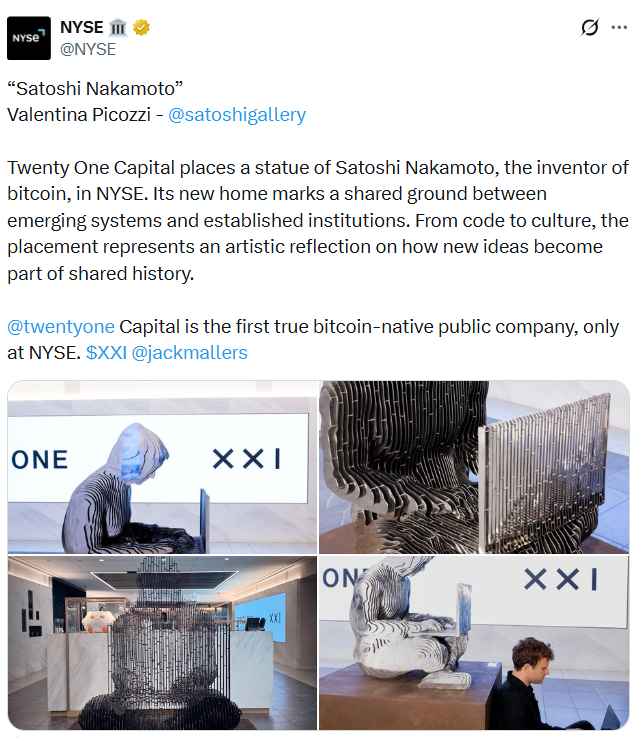
Source: New York Stock Exchange

“This is such an achievement, even in our wildest dream we wouldn’t think about placing the statue of Satoshi Nakamoto in this location! The 6th/21 statues of Satoshi Nakamoto found its home in the NYSE,” she added.

It also happens to coincide with the anniversary of the Bitcoin mailing list, which Nakamoto launched on Dec. 10, 2008.

Bitcoin's journey from thought experiment to mainstream asset

Satoshi Nakamoto mined the genesis block on Jan. 3, 2009, minting the first 50 Bitcoin in history and planting the seeds for the crypto industry we see today.

Over a year later, on May 22, 2010, programmer Laszlo Hanyecz made the first documented purchase of goods using Bitcoin, paying 10,000 Bitcoin for two Papa John’s pizzas.

In the intervening years, Bitcoin and cryptocurrency faced many challenges, as institutions and banks shunned them, and governments allegedly attempted to suppress them through efforts such as Operation Chokepoint 2.0.

However, it has since turned a corner, as skeptics, such as BlackRock CEO Larry Fink, have changed their minds about the technology, and institutions and Wall Street have scrambled to invest through vehicles like exchange-traded funds and directly by holding Bitcoin in their treasuries.

Public and private companies, countries and ETFs now collectively hold more than 3.7 million Bitcoin, according to Bitbo, worth more than $336 billion.

More Satoshi statues incoming

Picozzi has five other Nakamoto statues around the world, located in Switzerland, El Salvador, Japan, Vietnam, and Miami, a city in the US State of Florida.

Related: Disappearing Satoshi statue in Lugano took 21 months to create, says artist

Picozzi, under her Satoshigallery handle, said she is committed to placing 21 around the world, a possible reference to the theoretical 21 million Bitcoin maximum supply.

Speaking to Cointelegraph last year, she said Nakamoto is one of the most intriguing and fascinating figures of this era, and the statues stand as a tribute to the person behind Bitcoin.

“The statue itself wants to give to the viewer this feeling of disappearance, and the sense that the inventor stays between the lines — as of today, Satoshi exists in the lines of the Bitcoin code, allowing humanity to have the first decentralized payment system,” she said.

“It represents a hacker in his stereotyped pose, sitting with the laptop on his legs, and is a tribute to all the developers and programmers around the world that helped build the Bitcoin ecosystem, fighting for transparency and freedom.”

Magazine: 6 reasons Jack Dorsey is definitely Satoshi... and 5 reasons he’s not

Трендові криптовалюти

Пов'язані матеріали

In Just 11 Days, Claude Rewrote Millions of Lines of Code, an Epic AI Engineering Feat Sparks Fury

In just 11 days, Bun's founder Jarred Sumner used Anthropic's Claude AI models to rewrite its million lines of code from Zig to Rust. This move sparked significant controversy, particularly from Zig's creator, Andrew Kelley, who publicly criticized Sumner's engineering practices and the decision to use AI for such a massive rewrite. Bun, a high-performance JavaScript/TypeScript runtime and rival to Node.js, was originally written in Zig. After Anthropic acquired Bun, the team encountered persistent stability and memory safety bugs in the Zig codebase. These issues, combined with Zig's strict policy against LLM-generated code, led to the decision to rewrite in Rust. The rewrite was executed using Claude AI tools at an estimated API cost of $165,000, dramatically reducing the expected time and financial cost. Andrew Kelley's response was scathing. He blamed the original bugs on poor engineering habits, calling Bun's Zig code a collection of "hacks on top of hacks." He expressed relief that Bun was no longer associated with Zig, fearing it would misrepresent the language and attract low-quality, AI-generated contributions. The tech community is divided; some view Kelley's critique as unprofessional, while others see it as a defense of engineering integrity. A major concern about the AI-driven rewrite is the resulting code quality. The translation from Zig left approximately 27,000 lines of unsafe Rust code, raising fears about long-term maintainability and technical debt. The debate centers on whether this project is a milestone in AI-assisted development or a future maintenance nightmare.

marsbit40 хв тому

In Just 11 Days, Claude Rewrote Millions of Lines of Code, an Epic AI Engineering Feat Sparks Fury

marsbit40 хв тому

From Auto Finance to Bitcoin to AI Engines: An Analysis of Cango's 'What Not to Do' Strategy

From Auto Finance to Bitcoin and Now AI: Cango's "What Not to Do" Strategy Cango, a Chinese auto finance platform that went public on the NYSE in 2018, is undergoing its third major transformation. After selling its entire auto business in 2024, it pivoted to become a large-scale Bitcoin miner, acquiring 50 exahash of mining rigs from Bitmain. However, its true goal was never Bitcoin, but owning and controlling energy infrastructure. Now, Cango is pivoting again. While most listed Bitcoin miners are leasing power to giant hyperscalers for AI training clusters, Cango is taking the opposite path. It has launched an AI inference subsidiary called EcoHash, focusing not on training but on distributed inference. The company's strategy hinges on the insight that over 70% of mining industry power is controlled by small, independent sites (10-50 MW), which are too small for hyperscalers but ideal for low-latency AI inference. Cango aims to partner with these small operators, providing the AI technology, customers, and financing through its EcoLink software layer, which can distribute workloads across sites for reliability. Cango maintains a hybrid model, running roughly 31.7 EH/s of Bitcoin mining for cash flow while aggressively cleaning its balance sheet—slashing long-term debt by 94.5% to $30.6 million and raising $75 million for its AI venture. Its first AI deployment will be at a 50 MW site in Georgia. The strategy faces skepticism, given the high costs of converting mining sites and the potential for an AI bubble. However, Cango's leadership believes discipline around "what not to do"—avoiding direct competition with hyperscalers in training—positions it to capture the long-tail demand for distributed AI inference power.

Foresight News57 хв тому

From Auto Finance to Bitcoin to AI Engines: An Analysis of Cango's 'What Not to Do' Strategy

Foresight News57 хв тому

Strategy's Bitcoin Sales Cap Far Exceeds $1.25 Billion: A Detail the Market Overlooked

The article discusses how MicroStrategy's potential Bitcoin sales go far beyond the announced $1.25 billion "reserve-building capacity." It clarifies a key distinction in the company's "BTC Monetization Program": selling Bitcoin to *build* a new dollar reserve (the $1.25B cap) versus selling to *replenish* the existing USD Reserve after it's used for expenses like preferred share dividends. The recent $216M BTC sale for dividend payments was a "replenishment," leaving the headline $1.25B building quota untouched. The plan actually outlines three potential funding pools from BTC sales: 1) Building the reserve ($1.25B cap), 2) Covering preferred share/ debt costs (no specified cap), and 3) Funding buyback programs (up to $20B). This means the structured sales potential exceeds $30 billion, not including uncapped replenishment sales. The piece argues this marks MicroStrategy's shift from a passive "buy-and-hold" Bitcoin proxy to an actively managed entity using BTC as a balance-sheet tool to manage its complex capital structure (common stock, preferred shares, debt, reserve). This creates new dynamics and potential conflicts, as actions benefiting one part (e.g., selling BTC to pay dividends) may pressure another (e.g., undermining the "never sell" narrative). Investors must now parse the company's specific terminology ("build" vs. "replenish") to understand the true scope of future BTC sales, which is significantly larger than the market initially perceived.

marsbit1 год тому

Strategy's Bitcoin Sales Cap Far Exceeds $1.25 Billion: A Detail the Market Overlooked

marsbit1 год тому

Goldman Sachs Report Deconstructs the Competitive Landscape of China's AI Large Models: Who Will Be the Long-Term Winner?

Goldman Sachs analyzes China's AI large language model (LLM) landscape, identifying key players and a strategic shift towards efficiency and global expansion. The report highlights that Chinese open-source/open-weight models are closing the performance gap with top global proprietary models at significantly lower cost, driven by architectural innovations like MoE. This enables a "two-tier" market: a high-end segment (e.g., GLM5.2, Qwen3.7 Max) with pricing at ~$1 per million tokens, and a low-end, price-sensitive global segment. Open-source strategies aid adoption but limit monetization, as deployments via third-party platforms (e.g., AWS Bedrock, Alibaba Cloud) may not generate direct revenue for model creators. The industry is thus moving towards "open-weight + community license" models with revenue-sharing to improve unit economics. Internationally, the focus is shifting from "token maximization" to ROI-driven enterprise adoption, particularly in non-U.S. markets. Major cloud platforms are integrating Chinese models (e.g., DeepSeek, MiniMax). Using a competitive framework based on pricing power, cost advantage, and financial strength, Goldman Sachs identifies **Zhipu AI** and **DeepSeek** as leaders in foundational text models, and **ByteDance** (with Seedance) leading in multimodal/video generation. **MiniMax** and **Kuaishou** are also rated favorably. The firm forecasts China's AI model API/subscription revenue growing from ~RMB 35bn (2026E) to RMB 879bn by 2030.

marsbit1 год тому

Goldman Sachs Report Deconstructs the Competitive Landscape of China's AI Large Models: Who Will Be the Long-Term Winner?

marsbit1 год тому

Торгівля

Спот

Популярні статті

Як купити HOME

Ласкаво просимо до HTX.com! Ми зробили покупку Defi.app (HOME) простою та зручною. Дотримуйтесь нашої покрокової інструкції, щоб розпочати свою криптовалютну подорож.Крок 1: Створіть обліковий запис на HTXВикористовуйте свою електронну пошту або номер телефону, щоб зареєструвати обліковий запис на HTX безплатно. Пройдіть безпроблемну реєстрацію й отримайте доступ до всіх функцій.ЗареєструватисьКрок 2: Перейдіть до розділу Купити крипту і виберіть спосіб оплатиКредитна/дебетова картка: використовуйте вашу картку Visa або Mastercard, щоб миттєво купити Defi.app (HOME).Баланс: використовуйте кошти з балансу вашого рахунку HTX для безперешкодної торгівлі.Треті особи: ми додали популярні способи оплати, такі як Google Pay та Apple Pay, щоб підвищити зручність.P2P: Торгуйте безпосередньо з іншими користувачами на HTX.Позабіржова торгівля (OTC): ми пропонуємо індивідуальні послуги та конкурентні обмінні курси для трейдерів.Крок 3: Зберігайте свої Defi.app (HOME)Після придбання Defi.app (HOME) збережіть його у своєму обліковому записі на HTX. Крім того, ви можете відправити його в інше місце за допомогою блокчейн-переказу або використовувати його для торгівлі іншими криптовалютами.Крок 4: Торгівля Defi.app (HOME)Легко торгуйте Defi.app (HOME) на спотовому ринку HTX. Просто увійдіть до свого облікового запису, виберіть торгову пару, укладайте угоди та спостерігайте за ними в режимі реального часу. Ми пропонуємо зручний досвід як для початківців, так і для досвідчених трейдерів.

256 переглядів усьогоОпубліковано 2025.06.10Оновлено 2026.06.02

Як купити HOME

Обговорення

Ласкаво просимо до спільноти HTX. Тут ви можете бути в курсі останніх подій розвитку платформи та отримати доступ до професійної ринкової інформації. Нижче представлені думки користувачів щодо ціни HOME (HOME).

活动图片