Samsung Securities Bets on Upbit: South Korean Financial Capital Fully Embraces Crypto

marsbitОпубліковано о 2026-05-29Востаннє оновлено о 2026-05-29

Анотація

On May 28th, Samsung Securities announced its investment of approximately 306.3 billion KRW (about $203 million) to acquire a 2% stake in Dunamu, the operator of Upbit, South Korea's largest cryptocurrency exchange. This move signifies a strategic shift as South Korea's traditional financial capital begins to formally embrace the crypto industry, potentially heralding a deeper integration between the two sectors. South Korea has long been a vibrant crypto market, with Upbit dominating local trading volumes. However, a regulatory policy known as "separation of finance and virtual assets" had previously limited traditional financial institutions' direct involvement. Recent signals from regulators about potentially relaxing these rules have opened the door for deeper engagement. Samsung Securities' investment is seen as a strategic move to secure a foothold in the next generation of digital finance ahead of this expected liberalization. The investment reflects a broader anxiety among traditional Korean financial institutions about evolving financial landscapes. As financial activities increasingly migrate on-chain and younger users gravitate towards crypto and digital assets, platforms like Upbit are evolving from simple trading venues into core nodes for future financial networks—encompassing roles like new-age brokerages, asset issuance platforms, and payment gateways. By investing in Dunamu, Samsung Securities is not only gaining exposure to a profitable entity but also sec...

Author: Winnie, CryptoPulse Labs

On May 28th, Samsung Securities announced that it will spend approximately 306.37 billion won (about $203 million) to acquire about 2% of the shares in Dunamu, the operator of South Korea's largest cryptocurrency exchange, Upbit.

This is not just an ordinary equity investment; it may signify a deeper shift in the South Korean financial system. This is because South Korean regulators have recently begun signaling a possible future relaxation of the 'separation of finance and virtual assets' policy—a long-standing restriction between financial institutions and the virtual asset industry.

And Samsung Securities' investment is, in essence, South Korean traditional financial capital preemptively seizing the next-generation digital financial gateway.

I. South Korean Financial Capital Formally Enters the Crypto Industry

For a long time, South Korea has been one of the world's most active crypto markets.

South Korean youth have an extremely high level of participation in Crypto. Whether it's Bitcoin, altcoins, Memes, AI Agents, or on-chain trends, the South Korean market is often one of the most active trading regions globally. And Upbit is almost the core of the South Korean crypto market.
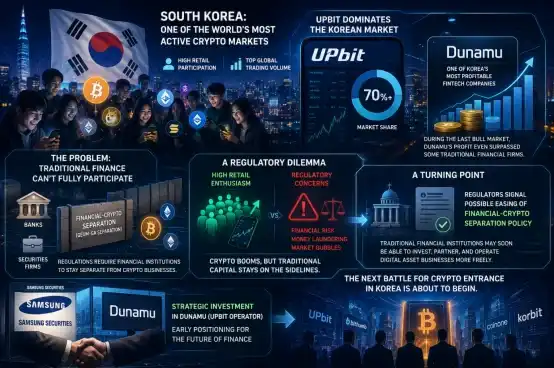
As South Korea's largest cryptocurrency exchange, Upbit has long occupied the vast majority of the trading share in the South Korean market. Its operator, Dunamu, is also one of the most profitable fintech companies in the country.

During the last bull market, Dunamu's profits even surpassed those of some traditional financial institutions in South Korea for a period.

But over the past few years, one issue has persisted. Although South Korean traditional financial institutions were aware of the immense traffic and profits in the crypto industry, they were unable to truly participate deeply.

This was due to South Korea's long-standing implementation of the so-called 'separation of finance and virtual assets' policy. In simple terms, there had to be a certain separation between financial institutions and the virtual asset industry; traditional financial institutions like banks and securities firms could not directly and deeply enter the Crypto industry chain.

The logic behind this regulation essentially reflects South Korea's long-standing dependency on and wariness towards the crypto industry. On one hand, South Korean retail investor trading enthusiasm is extremely high; on the other, regulators worry about financial risks, money laundering risks, and market bubbles.

Thus, over the past few years, a very peculiar situation emerged in South Korea. The Crypto market was extremely prosperous, yet traditional financial capital was largely absent. Now, this situation is changing.

Recently, South Korea's financial regulatory authorities have begun hinting that the separation of finance and virtual assets policy may be gradually relaxed in the future. This means that traditional financial institutions might in the future be able to invest in, cooperate with, or even operate digital asset businesses more freely. Samsung Securities' investment in Dunamu at this moment is essentially a preemptive move to secure a position.

Because all traditional financial institutions know that once regulations are truly loosened, the South Korean financial industry will inevitably erupt into a new round of competition for the crypto gateway.

II. Why is Samsung Securities Betting on Upbit Now?

Samsung Securities' investment in Dunamu appears on the surface to be just a financial investment. But in reality, it reflects the anxiety of South Korean traditional financial institutions about future changes in the financial system.

Over the past decade or more, the biggest change in the global financial industry has not been internet finance, but financial digitization. For example, the digitization of payments, the electronification of securities, the ETF-ification, and stablecoins. More and more financial activities are gradually migrating on-chain.
And crypto exchanges have also evolved from mere crypto trading platforms to become the next generation of financial infrastructure. Whether it's Coinbase, Robinhood, Hyperliquid, or Upbit, they are no longer just trading platforms.

They are more like new types of brokerages, new asset issuance platforms, new payment gateways, and even core nodes of future on-chain financial networks. What South Korean traditional securities firms fear most is that young users are gradually moving away from traditional securities markets.

Nowadays, more and more young users are no longer enthusiastic about traditional stocks. Instead, they are more interested in Crypto, stablecoins, and on-chain assets—these new financial trends are drawing away a massive amount of young user traffic.

For Samsung Securities, if it continues to remain within the traditional business logic, it may gradually lose its voice among young users and in the new financial markets in the future. Therefore, investing in Dunamu is essentially buying a ticket to the future digital financial era.

More importantly, what Upbit possesses is not just a trading business. It also has South Korea's largest crypto user base, the most mature Korean Won on/off-ramp system, the strongest virtual asset liquidity, and the most comprehensive Web3 ecosystem gateway in Korea.

In the future, whether it's RWA, stablecoins, on-chain securities, or digital ETFs, Upbit could potentially become one of South Korea's core financial gateways.

Samsung Securities' early investment now is equivalent to locking in future Korean digital financial infrastructure. And it's worth noting that the main sellers of the shares this time are Kakao-affiliated capital, not Dunamu's founding team.

This means Dunamu is not raising funds because it needs money, but rather it's more of a capital adjustment at the shareholder level. In other words, Samsung Securities is proactively securing a ticket at a high valuation stage.

This, in turn, indicates that traditional financial institutions have begun to genuinely and long-term believe in Crypto. Because only those who truly believe in the future are willing to position themselves early while the industry is still controversial.

III. South Korea is Entering the Era of Comprehensive On-Chain Finance

If we zoom out our perspective, we can see that what is happening in South Korea now is actually very similar to the trend in the United States over the past two years.

The biggest change in the US in recent years is not the rise in Bitcoin's price.

It's that Wall Street has begun to fully accept Crypto. BlackRock pushing for Bitcoin ETFs, Fidelity's foray into digital asset custody, Morgan Stanley opening up to crypto asset allocation, and more and more US banks researching stablecoins and on-chain settlement. In essence, the US has begun to incorporate Crypto into the traditional financial system.
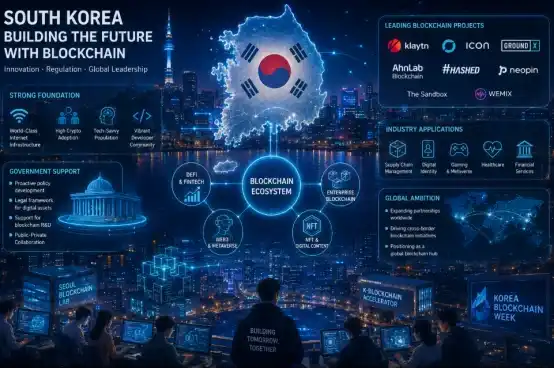
South Korea is now heading down the same path. Samsung Securities' investment in Dunamu is essentially the South Korean version of the 'traditional securities firm plus Coinbase' model.

In the coming years, several important trends are likely to emerge in the South Korean market.

First, traditional financial institutions will comprehensively enter the virtual asset industry. This includes crypto ETFs, digital asset custody, on-chain securities, etc.

Because all financial institutions understand that the next round of financial infrastructure upgrade will likely happen on-chain.

Second, crypto exchanges will become further financialized. In the past, many exchanges were essentially just matching trades. But in the future, they may gradually transform into comprehensive financial platforms.

Not only can they trade Crypto, but in the future, they might even trade on-chain stocks, digital bonds, and stablecoin yield products.

Third, South Korea may become Asia's new on-chain financial hub. In the past, Asia's digital finance competition was mainly concentrated in Hong Kong, Singapore, and Dubai. But South Korea has an extremely strong retail investor base, internet culture, and a highly active trading ecosystem.

Once regulations are truly relaxed, South Korea could quickly become one of Asia's most important on-chain financial markets. Especially in terms of young user participation, the South Korean market might even be more aggressive than Japan's.

And Dunamu's valuation of approximately 15.3 trillion won also sends a very crucial signal. The capital market has already begun to redefine crypto exchanges.

In the past, many considered exchanges to be highly volatile, high-risk cyclical businesses. But now, more and more capital is starting to see them as the next generation of financial infrastructure.

What is truly valuable is no longer just a particular Token. It's the users, liquidity, asset issuance capabilities, and the gateway status in the future digital financial world.

From this perspective, what Samsung Securities bought is not just 2% of Dunamu's shares. It's more like purchasing a seat at the table in South Korea's next-generation financial order.

Conclusion

Over the past few years, there has been a debate within the crypto industry. Will Crypto replace traditional finance, or will it eventually be absorbed by traditional finance?

Now the answer seems increasingly clear. The future financial world is likely not traditional finance VS Crypto, but traditional finance going fully on-chain.

Samsung Securities' investment in Upbit is the most typical epitome of this trend. South Korean financial capital has formally begun to enter the deep waters of Crypto.


Пов'язані питання

QWhat was the recent major investment announced by Samsung Securities, and what company is involved?

ASamsung Securities announced a major investment of approximately 306.37 billion Korean won (about $203 million) to acquire about a 2% stake in Dunamu, the operator of South Korea's largest cryptocurrency exchange, Upbit.

QWhat does the article suggest is the main significance of Samsung Securities' investment in Dunamu?

AThe article suggests the investment signifies a deep structural shift within South Korea's financial system. It represents traditional financial capital preemptively securing a foothold in the next generation of digital finance, anticipating the potential loosening of the 'separation of finance and crypto' policy.

QWhat is the 'separation of finance and crypto' policy mentioned in the article, and how is it changing?

AThe 'separation of finance and crypto' policy, or 'geum-ga bunri', is a long-standing regulation in South Korea that restricts traditional financial institutions (like banks and securities firms) from deeply engaging with the virtual asset industry. The article states that South Korean regulators have recently begun hinting at a potential relaxation of this policy in the future.

QAccording to the article, what is a key concern driving traditional financial institutions like Samsung Securities to invest in crypto-related businesses?

AA key concern is the fear of losing relevance with younger users and future market influence. Young users are increasingly drawn to crypto, stablecoins, and on-chain assets rather than traditional stock markets. Institutions worry about missing out on the next wave of financial infrastructure upgrades happening on-chain.

QWhat broader trend in global finance does the article compare South Korea's current situation to?

AThe article compares it to the trend in the United States over the past two years, where Wall Street has begun fully embracing crypto—through actions like BlackRock's Bitcoin ETF, Fidelity's digital asset custody, and major banks exploring stablecoins. It suggests South Korea is on a similar path of integrating crypto into the traditional financial system.

Пов'язані матеріали

Bloomberg Uncovered: How Do China's Wealthy Circumvent the Annual $50,000 Limit to Transfer Assets?

**Summary: How Wealthy Chinese Circumvent $50,000 Annual Foreign Exchange Limits** Despite China's strict capital controls, including an annual $50,000 per person foreign exchange quota, an estimated $150 billion in funds still leaves the country annually via various gray and underground channels. This report outlines the evolution of China's "capital wall" and the methods used to bypass it. **The Evolving Capital Controls:** * **Foundation (1994):** The system of "current account convertibility with strict capital account controls" was established. * **Quota Set (2007):** The $50,000 individual annual forex purchase limit was formalized. * **Crackdown Begins (2015-2017):** Following market volatility, enforcement tightened. Banks were required to scrutinize transactions, and channels like using UnionPay cards for Hong Kong insurance premiums or buying overseas property were blocked. * **Digital & Legal Upgrades (2024-2026):** Enhanced algorithms now flag suspicious patterns (e.g., "smurfing"). The Common Reporting Standard (CRS) provides Chinese tax authorities with data on citizens' offshore accounts. Unlicensed cross-border brokers have been targeted. **Five Primary Methods for Moving Capital:** 1. **Underground Banking / "Hawala" (Duiqiao):** The largest-scale method. No money crosses borders. Clients pay RMB to a domestic account; an overseas associate deposits equivalent foreign currency into the client's offshore account. Risks include high fees, account freezes, and legal penalties. 2. **"Smurfing" or "Ant Moving":** Using multiple individuals' $50,000 quotas to pool funds for one offshore recipient. Increasingly detected by anti-money laundering algorithms. 3. **Trade Invoice Manipulation:** Businesses over-invoice imports or under-invoice exports via offshore shell companies, creating a pretext to transfer excess funds abroad under the guise of trade. 4. **Channel Migration:** After a crackdown on internet brokers, funds flow toward more compliant but costly channels like major banks' cross-border wealth management services or Qualified Domestic Institutional Investor (QDII) quotas. 5. **Structural Arrangements:** High-net-worth individuals use complex, high-cost legal structures involving offshore trusts, insurance, and investment migration programs to transfer asset ownership. **Regulatory Response: Focusing on People, Not Just Money** The current strategy extends oversight from enterprises to **individual residents**. Tools like CRS allow retroactive visibility into offshore assets. Cryptocurrencies, once seen as a potential loophole, are now actively monitored and prosecuted as an illegal channel. The underlying driver remains: with significant wealth concentrated among millions of affluent households seeking diversification amid domestic economic shifts, the incentive to move assets offshore persists despite regulatory barriers.

marsbit19 хв тому

Bloomberg Uncovered: How Do China's Wealthy Circumvent the Annual $50,000 Limit to Transfer Assets?

marsbit19 хв тому

Ethereum's Ballmer Moment: As Everyone Is Bearish, the Circulating Supply Is Disappearing

"Ethereum's Ballmer Moment: Circulation Shrinks Amid Bearish Sentiment" Amid widespread bearish sentiment, with prominent figures like Bankless founder David Hoffman selling ETH and young developers flocking to Solana, some argue Ethereum is entering its "Ballmer era"—akin to Microsoft's perceived stagnation under Steve Ballmer. While surface-level criticisms about slow protocol development, cautious leadership, and competitive pressure are valid, underlying fundamentals tell a different story. Approximately 30% of ETH is staked, major holders like BitMine are accumulating, and spot ETFs continue to absorb supply. Regulatory clarity, including the SEC/CFTC's March ruling on staking rewards and the potential passage of the CLARITY Act, is transforming crypto from a regulatory threat into a legitimized framework. This institutionalization, alongside a shrinking circulating supply (with net issuance around 0.23% annually), creates significant buy-side pressure independent of fee-based value capture. The broader crypto total addressable market is expanding through regulated stablecoins, tokenized assets, and institutional adoption. While public chains face competition from permissioned alternatives, the winning model appears to be permissioned assets settling on public chains like Ethereum and Solana. The author advocates a non-maximalist, barbell strategy: holding ETH for its institutional role and supply squeeze, SOL for consumer/throughput trends, BTC as a macro hedge, and a basket of next-gen L1s. Key bullish drivers for ETH include rapid circulation shrinkage, potential Q2 staked ETF approvals, regulatory tailwinds solidifying its role as a default settlement layer, and the optionality of an eventual "Satya moment" leadership shift. Despite bearish consensus, the current setup—where crypto is "not hot" and regulatory groundwork is being laid—presents a compelling investment opportunity. The crypto cycle's focus may have shifted to AI, but blockchain infrastructure is gaining a legal and institutional foothold precisely while attention is elsewhere.

marsbit19 хв тому

Ethereum's Ballmer Moment: As Everyone Is Bearish, the Circulating Supply Is Disappearing

marsbit19 хв тому

Claude Code Introduces Dynamic Workflows: Enabling AI to Form Teams and Collaborate

Claude Code introduces dynamic workflows, enabling AI to coordinate teams of specialized agents for complex tasks. This transforms Claude from a code assistant into a programmable workbench. Workflows address key limitations of single-agent systems: agentic laziness (premature task completion), self-preferential bias (favoring own outputs), and goal drift (losing sight of original objectives). The system allows Claude to dynamically create execution frameworks using JavaScript. It can split tasks, dispatch parallel agents for isolated work (e.g., in separate worktrees), implement adversarial validation, run tournaments, and synthesize results. This multi-agent approach is valuable for tasks requiring deep research, factual verification, code migration, root cause analysis, large-scale triage, and qualitative sorting. Key patterns include: classify-and-route, fan-out-and-synthesize, adversarial verification, generate-and-filter, tournaments, and loop-until-done. While token usage is higher, workflows excel where tasks resemble programming—needing problem decomposition, isolated context, hypothesis testing, and handling many details. They extend Claude Code's utility beyond technical work to areas like business plan review, resume screening, and naming brainstorm. The feature is not a universal solution but points to a future where AI tool competitiveness depends on organizing reliable, reusable, and auditable execution flows for complex goals.

marsbit1 год тому

Claude Code Introduces Dynamic Workflows: Enabling AI to Form Teams and Collaborate

marsbit1 год тому

Торгівля

Спот
Ф'ючерси
活动图片