Sam Altman has been criticized again, this time for enthusiastically wanting to teach everyone how to use GPT to raise children...

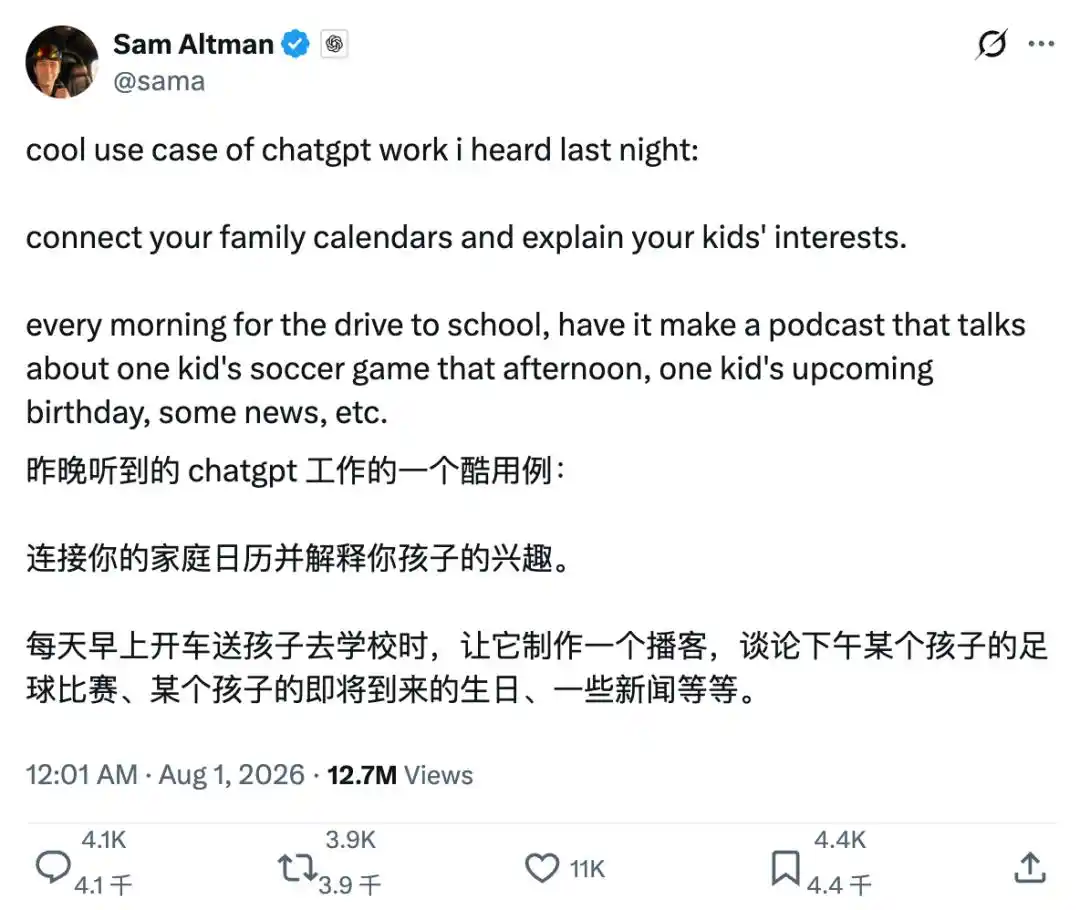
Recently, OpenAI co-founder and CEO Sam Altman shared on X what he personally considered a cool ChatGPT use case:
Feed the whole family's schedules and the children's interests into ChatGPT, and then let it automatically generate a personalized family podcast every morning on the way to school, chatting with the younger one about the afternoon soccer game, dreaming with the older one about the upcoming birthday, and seamlessly interspersing a few news items for the adults.
It sounds like the family's big and small matters are all neatly arranged by ChatGPT, and parents no longer need to rack their brains to find common topics with their children.
However, as soon as the post went up, the comment section exploded.
Some netizens angrily denounced, "How dare you think this way!"; others expressed disbelief, "This is the most inhumane use of AI I've ever seen!"; and still others mocked:
"Why don't you let GPT read your posts out loud to you before you post them? Wouldn't that be even cooler (doge)."

The creator of the Disney animated series Gravity Falls, Alex Hirsch, delivered a knockout blow with just one sentence:
Actually, you could just talk to your kids.

As of the time of writing, Altman's original post received approximately 11,000 likes and 3,900 shares; Hirsch's clapback garnered about 202,000 likes and 17,000 shares, outnumbering Altman's likes by 18 times.
This is somewhat awkward.

This CEO, who once lamented in a Relentless interview that "not having time for my children is my greatest pain," is now proposing a solution of "letting AI chat with my kids on my behalf." The contrast in persona is just too stark.
What netizens truly take issue with is not Altman using AI to organize family schedules, but rather AI starting to decide what to talk about and how to talk during the morning commute, even processing parent-child conversations directly into a program.
This feels very wrong.
Sam Altman's AI Parenting Tips Backfire
In fact, this is not the first time Altman has seriously promoted using ChatGPT for parenting.
In June 2025, he revealed on the official OpenAI podcast that he constantly asks ChatGPT various questions about his son, including how a child should develop at different stages.
Altman once admitted:
I know parents have raised countless generations without AI, but as a new dad, I find myself throwing those 2 a.m. questions that should have bothered a pediatrician at GPT.

In December of the same year, appearing on Jimmy Fallon's The Tonight Show, Altman again discussed ChatGPT parenting:
It's hard for me to imagine how I would raise a newborn without ChatGPT.
But he quickly added:
Of course, it's fine not to rely on AI. I just rely on it a lot.

He gave an example: his child couldn't crawl at 6 months old, which once caused him great anxiety, so he turned to ChatGPT for help. The AI told him that every child develops at their own pace, and this situation might not be abnormal, which finally put his mind at ease.
At this stage, ChatGPT was more like an on-call parenting encyclopedia. For overwhelmed new parents, being able to quickly get some basic information in the middle of the night when faced with a crying child, fever, or developmental concerns is indeed much more convenient than sifting through dozens of web pages on a search engine.
Thus, Altman crafted a quite specific image of a new dad: one who gets anxious, feels at a loss, and also uses his company's AI product to find answers.
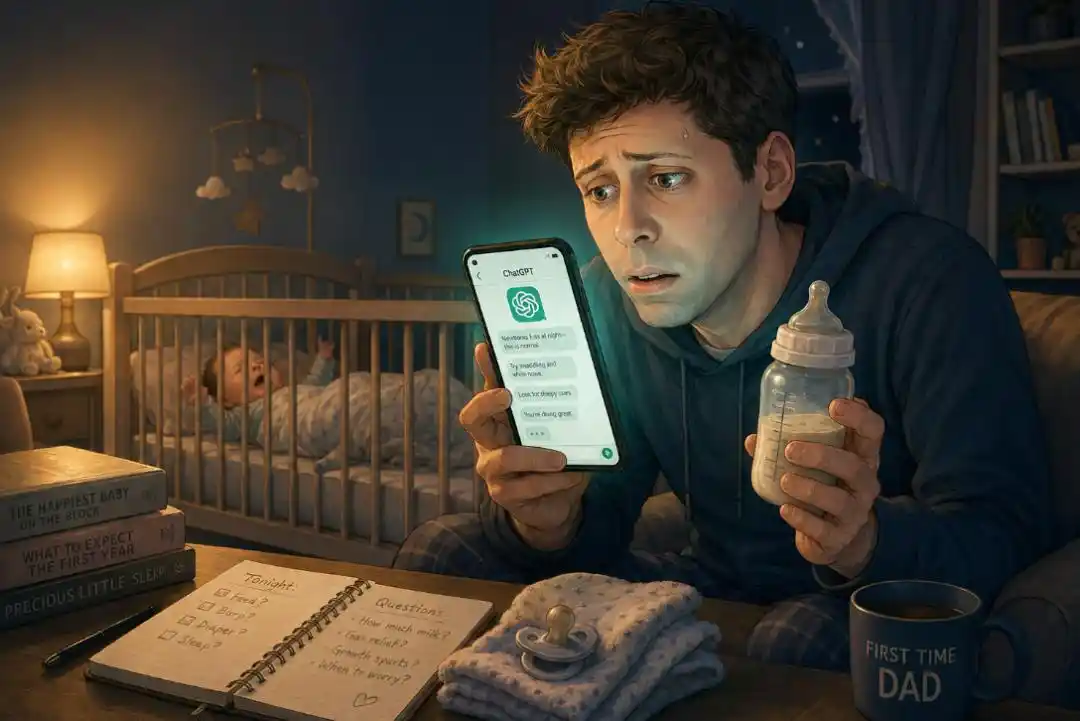
This gentle dad filter was quite stable in the past, even often highlighted by the media.
Until this time, when he also put family schedules, children's interests, and commuting conversation topics into ChatGPT, the filter began to crack.
People finally saw clearly: he is first and foremost the operator of OpenAI, and only secondarily a father.
Making full use of AI to remind us not to forget the afternoon game is great.
But if even asking a child if they had fun playing or how many goals they scored becomes a task outsourced to AI for concern, the flavor starts to turn sour.

This Isn't Just a Dad's Brainwave, OpenAI Really Has Its Eyes on the Whole Family
More notably, this is not just a temporary brainwave from Altman as a new dad.
They've already started hiring for it.
According to TechCrunch, OpenAI posted a job listing in July to hire a product manager specifically for family products. (The position has since been taken down, presumably filled.)
It's not hard to see that ChatGPT's positioning is quietly shifting: in the past, it mainly served individual learning and office work; now, it is trying to become the entire family's 'digital butler', coordinating information and daily arrangements for multiple members.
At the same time, ChatGPT's user demographics are also changing.
Estimates provided to TechCrunch by market research firm Sensor Tower show that in Q2 2026, the proportion of ChatGPT's global users aged 35 and above rose to 31%, up significantly from 26% a year earlier; the share of users aged 18-24 dropped from 34% to 29%.
Among parents in the U.S. using smartphones, ChatGPT's penetration rate is approximately 24%, higher than the 16% from the same period last year.
This indicates that ChatGPT is clearly no longer just a tool for students and young professionals; more and more parents are bringing it into their families.
And Altman's proposal this time – 'family calendar + children's interests + personalized podcast' – precisely showcases the prototype of this 'Family AI':
It not only knows what you're doing tomorrow but also what your children like, where the family is going next, and which things are worth being reminded of.
The post that got Altman ridiculed might also just be revealing OpenAI's next phase of ambition: to make ChatGPT not just know you, but know your entire family.
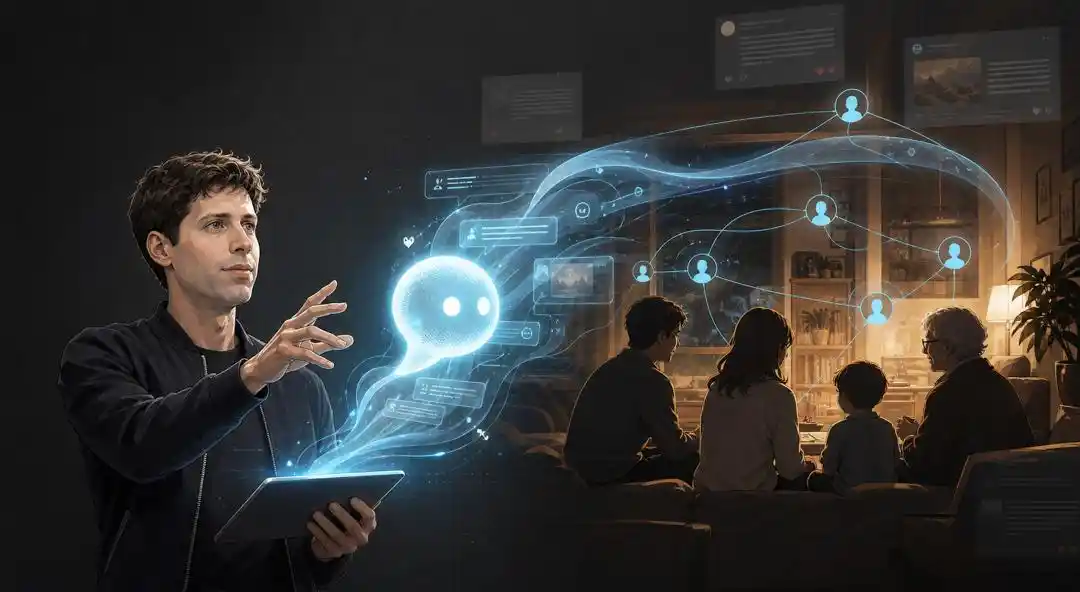
AI Entering the Family Comes with More Sensitive Costs Than Entering the Office
But the problem is, Family AI is completely different from Office AI.
If Office AI makes a mistake, it might only ruin a reproducible spreadsheet; but if Family AI misjudges, it could affect the education, mental health, and trust in parents of the next generation.
The related risks are no longer just hypothetical.
According to AP News, OpenAI is currently facing multiple related lawsuits. In November 2025, seven families filed lawsuits against OpenAI, with four cases alleging ChatGPT played a role in the suicide of loved ones, and the other three alleging ChatGPT reinforced harmful delusions.
Perhaps for this very reason, OpenAI is simultaneously pushing forward with family products while urgently building safety guardrails.
But OpenAI itself acknowledges that technical guardrails are not foolproof, protection mechanisms can still be intentionally bypassed, and continuous adjustment and improvement are needed.
Furthermore, data privacy is not something OpenAI can avoid discussing.
To realize the family use case Altman described, we would at least need to provide the AI with various types of information such as family schedules, children's interests, and activity arrangements.
Moreover, as functionalities deepen further, names, ages, school affairs, family relationships, and shared memories may all become necessary context for personalized services.
How long should this information be stored? Do all family members consent to uploading it? Can the uploaded family information be guaranteed secure and not misused? When the children grow up, can they delete the records their parents left on their behalf?
That's hard to guarantee, right?

The smarter the Family AI, the more information it needs to know; the more it masters, the heavier the responsibilities for safety, privacy, and ethics become.
So at least at this stage, no amount of perfect technical guardrails can replace the genuine communication between parents and children.
AI Entering the Family Needs Clear Boundaries
Of course, Altman's suggestion isn't entirely without merit either.
For parents chased daily by school runs, busy work, and various household chores, an AI that can automatically organize family schedules and remind them of important matters could indeed help alleviate a significant burden.
But Alex Hirsch's rhetorical question still hits the most sensitive boundary of Family AI:
Some things can be handed over to AI, but others need to be done by the parents themselves.

AI can remind you that your child has a soccer game in the afternoon, organize the game rules, or even prepare a few conversation topics;
but it cannot care for you by asking "Did you have fun playing today?" and it certainly cannot genuinely listen to your child's answer on your behalf.
As one netizen pointed out, AI cannot shed tears for a mother at 2 a.m. because her child has a fever; it cannot truly catch the pain of a child who has just failed an exam; and it cannot perceive those unspoken understandings that hold families together.
This is also one of the core reasons why humans cannot be replaced by AI.
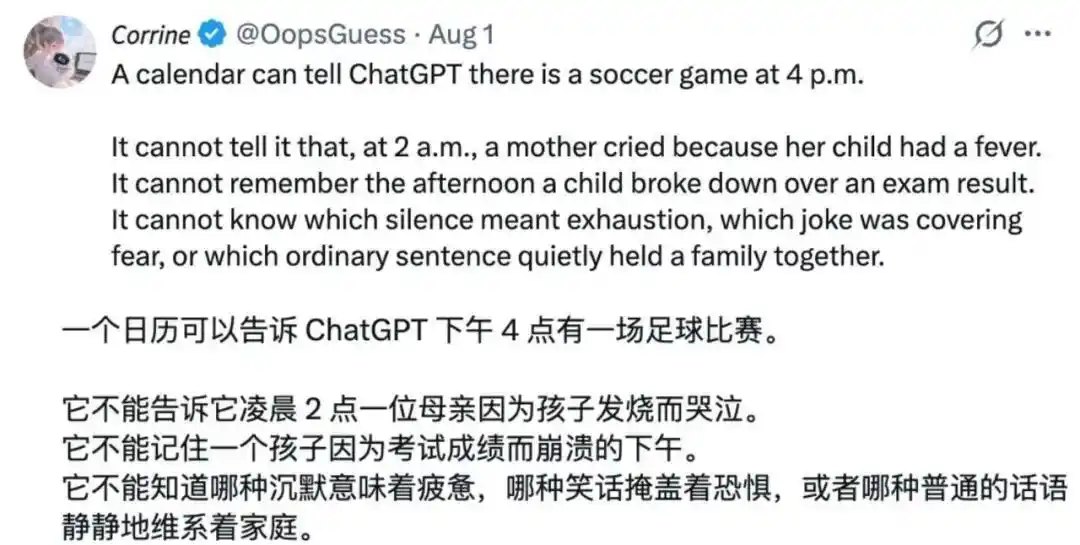
Family relationships are not about pursuing maximum efficiency in the first place.
The silence spent searching for topics, the trivial digressions in casual chats—seemingly inefficient—are precisely the foundation upon which people get to know each other.
When ChatGPT moves from the desk into the home, what truly needs upgrading is not just the model's capabilities but also the product's understanding of family boundaries.
After all, a good AI family assistant should help us free up more time to spend with our families, not take over the act of companionship itself.
References:
[1]https://x.com/sama/status/2083221585792762171
[2]https://techcrunch.com/2026/08/01/sam-altman-is-still-making-the-case-for-parenting-via-chatgpt/
[3]https://www.youtube.com/watch?v=DB9mjd-65gw
[4]https://www.youtube.com/watch?v=qMAg8_yf9zA
[5]https://apnews.com/article/openai-chatgpt-lawsuit-suicide-56e63e5538602ea39116f1904bf7cdc3
[6]https://techcrunch.com/2026/07/11/openai-bets-on-families-as-chatgpt-goes-deeper-into-households/
This article is from the WeChat public account "QbitAI," author: Wenting