This weekly report covers the period from December 27, 2025, to January 2, 2026.
This week, the total on-chain RWA market cap steadily increased to $19.21 billion, with the number of holders approaching 600,000, though growth was moderate, suggesting that the on-chain migration of traditional assets may be facing demand bottlenecks. The total stablecoin market cap slightly decreased to $2.9708 trillion, while the monthly transfer volume surged by 13.77%. The divergence between market cap and transfer volume highlights the market's entry into a "stock efficiency-driven" phase, where improving capital turnover efficiency becomes the new focus. More notably, the TVL of RWA protocols has surpassed that of DEXs, becoming the fifth largest DeFi category.
China's digital yuan regulatory framework continues to deepen: The central bank has clarified that it will introduce a digital yuan management and service system plan. The six major state-owned banks announced interest payments on digital yuan wallet balances, promoting its evolution towards M1 functionality. On the application level: The implementation of the digital yuan for cross-border payments is accelerating, with the Bank of China completing the first cross-border QR code payment between China and Laos.
Project level: Tokenized assets continue to expand. BlackRock's BUIDL fund has distributed over $100 million in cumulative dividends. Ondo's tokenized silver product saw its market cap surge over 155% within a month, indicating that RWA is penetrating beyond government bonds and money market funds into a wider range of hard asset classes, with the ecosystem maturing and diversifying.
Data Perspective
RWA Sector Overview
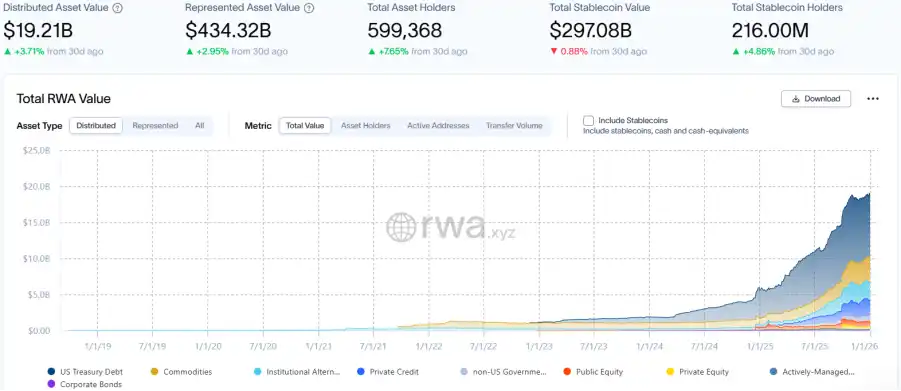
Latest data from RWA.xyz reveals that as of January 2, 2026, the total on-chain RWA market cap reached $19.21 billion, a slight increase of 3.71% month-on-month, maintaining steady growth; the total number of asset holders increased to approximately 599,400, up 7.65% month-on-month, indicating a rapidly expanding investor base. The divergence between "scale contraction but user expansion" may reflect demand bottlenecks for traditional assets moving on-chain.
However, as tokenized bond products, private credit products, and commodities quickly become core components of on-chain finance, the Total Value Locked (TVL) in Real World Asset (RWA) protocols has surpassed that of Decentralized Exchanges (DEXs), becoming the fifth largest DeFi category.
Stablecoin Market
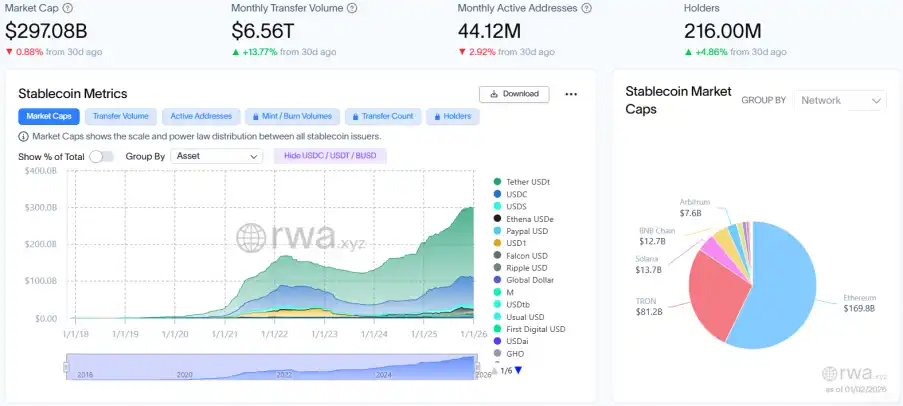
The total stablecoin market cap reached $2.9708 trillion, a slight decrease of 0.88% month-on-month, with overall size remaining stable; monthly transfer volume significantly increased to $6.56 trillion, up 13.77% month-on-month; the total number of monthly active addresses decreased to 44.12 million, a slight drop of 2.92% month-on-month; the total number of holders steadily increased to approximately 216 million, a slight increase of 4.86% month-on-month. The data suggests the market may have entered a "stock efficiency-driven" phase, with the divergence between market cap contraction and transfer volume growth highlighting improved capital utilization. The leading stablecoins are USDT, USDC, and USDS. Among them, USDT's market cap increased slightly by 1.34% month-on-month; USDC's market cap decreased by 5.24% month-on-month; USDS's market cap decreased by 3.14% month-on-month.
Regulatory News
Central Bank to Issue "Action Plan on Further Strengthening the Digital Yuan Management Service System and Related Financial Infrastructure"
According to a report by the Financial News, Lu Lei, Deputy Governor of the People's Bank of China, stated in an article that the PBOC will issue the "Action Plan on Further Strengthening the Digital Yuan Management Service System and Related Financial Infrastructure." A new generation digital yuan measurement framework, management system, operational mechanism, and ecosystem will be officially launched and implemented on January 1, 2026.
US FASB Plans to Study in 2026 Whether Stablecoins and Other Crypto Assets Can Be Classified as Cash Equivalents
The US Financial Accounting Standards Board (FASB) plans to study in 2026 whether some crypto assets can be classified as cash equivalents and how to account for the transfer of crypto assets. This decision comes against the backdrop of the Trump administration's push for crypto investment.
FASB recently added these two crypto projects to its agenda, focusing primarily on the accounting treatment of assets like fiat-pegged stablecoins and "wrapped tokens." Previously, in 2023, FASB required companies to use fair value accounting for crypto assets like Bitcoin, but this did not cover NFTs and some stablecoins.
The GENIUS Act passed by the Trump administration established a regulatory framework for stablecoins but did not clarify whether they can be considered cash equivalents. FASB Chairman Rich Jones stated that it is equally important to clarify which assets do not meet the cash equivalent criteria.
Additionally, FASB plans to explore accounting rules for crypto asset transfers to fill gaps in existing standards. Although currently only a few companies (like Tesla, Block, etc.) hold Bitcoin on their balance sheets, demand for stablecoins is expected to increase with the implementation of the GENIUS Act.
These moves indicate that the US is attempting to support the crypto industry by完善ing accounting standards, while also responding to industry and public feedback. FASB is expected to finalize its agenda priorities by the summer of 2026.
Indian Central Bank Recommends Countries Prioritize CBDC Development Over Stablecoins
According to a Cointelegraph report, the Reserve Bank of India (RBI) has urged countries to prioritize the development of Central Bank Digital Currencies (CBDCs) over privately issued stablecoins, citing concerns that the latter could affect financial stability.
In its December financial stability report, the Reserve Bank of India noted that CBDCs can maintain the "singularity of money and the integrity of the financial system" and should continue to serve as the "final settlement asset" and "cornerstone of monetary trust." "Therefore, the RBI strongly recommends that countries prioritize the development of CBDCs over privately issued stablecoins to maintain monetary trust, ensure financial stability, and build a faster, cheaper, and safer next-generation payment infrastructure."
The RBI also pointed out that the introduction of stablecoins could create new channels for financial stability risks, especially during periods of market stress. Therefore, "countries must carefully assess the associated risks and develop policy responses suitable for their financial systems."
Cyberspace Administration of China: 1,418 Imitation Websites Removed This Year, Involving Inducements to Purchase "Stablecoin" Financial Products
According to a通报 from the Cyberspace Administration of China, based on clues provided by netizens, 1,418 illegal imitation/counterfeit website platforms were investigated and dealt with this year, an increase of 1.7 times compared to last year. Among them: 323 websites imitating state-owned enterprises and institutions like State Grid and Sinopec, publishing虚假 investment and top-up information to诱导 netizens into purchasing virtual goods, fake fuel cards, etc., leading to netizens being scammed; 61 websites imitating financial institutions like招商证券 and中信银行, inducing netizens to download apps for stock trading or purchasing so-called "stablecoin" financial products, causing property losses.
Local Dynamics
Bank of China Completes First Cross-Border Digital Currency QR Code Consumption Payment Business in Laos
The Bank of China has completed the first cross-border digital currency QR code consumption payment business between the two countries in Laos. Under the joint guidance of relevant departments of the People's Bank of China and the Lao central bank, the Bank of China was among the first to participate in the cross-border pilot project for digital payments and central bank digital currency cooperation between the two countries.
Simultaneously, the Bank of China Vientiane Branch was among the first to connect to the People's Bank of China's digital yuan cross-border digital payment platform. The Bank of China provided real-time exchange rate quotes and efficient clearing services, successfully completing the production verification of QR code payments for merchants within Laos. This business service will significantly lower the threshold for China-Laos cross-border settlement, achieving a seamless experience throughout the "payment-exchange-clearing" process.
Six Major State-Owned Banks Announce: Starting January 1, 2026, Interest Will Be Paid on Digital Yuan Real-Name Wallet Balances, Current Demand Deposit Rate is 0.05%
The six major state-owned banks - Bank of China, Industrial and Commercial Bank of China, Agricultural Bank of China, China Construction Bank, Bank of Communications, and Postal Savings Bank of China -相继 announced today that starting January 1, 2026, they will pay interest on the balances of digital yuan real-name wallets opened at their banks according to their demand deposit listed interest rates. The interest calculation and payment rules are consistent with demand deposits. The current demand deposit listed interest rate is 0.05%. Currently, digital yuan wallets are divided into four categories. Among them, Category I, II, and III wallets are real-name wallets, while Category IV wallets are anonymous wallets. Category IV wallets are not included in the "real-name wallet" category eligible for interest from various banks.
ICBC stated that the wallet operating institutions will legally withhold and remit interest tax (if applicable). ICBC提示 that interest is calculated on the 20th of the last month of each quarter and credited on the 21st. If an account is closed before the interest calculation date, interest will be calculated at the demand deposit rate announced on the closing date up to the day before closure.
Project Progress
JPMorgan Freezes Accounts of Multiple Stablecoin Startups Operating in High-Risk Countries
According to a report by The Information, in recent months, JPMorgan has frozen accounts used by at least two fast-growing stablecoin startups operating in high-risk countries like Venezuela. The bank's move highlights the risks crypto transactions pose to banks, as they must understand who they are doing business with and the source of funds.
BlackRock's First Tokenized Money Market Fund, BUIDL, Has Distributed Over $100 Million in Cumulative Dividends
According to Finance Feeds, since its launch, BlackRock's first tokenized money market fund, BUIDL, has distributed over $100 million in cumulative dividends. This data indicates that tokenized securities have moved beyond the pilot and proof-of-concept stage into practical application. It is reported that the fund invests in short-term USD-denominated instruments, such as US Treasury bonds, repurchase agreements, and cash equivalents.
Ondo's Tokenized Silver SLVon Surges Over 155% in Market Cap to Nearly $18 Million in 30 Days
Data from RWA XYZ shows that Ondo's tokenized silver product, SLVon, surged over 155% in market cap to nearly $18 million within 30 days.
It is reported that SLVon is the tokenized version of the iShares Silver Trust on the Ondo platform. Token holders can obtain economic benefits similar to holding SLV and can reinvest dividends.
RWA Trading Platform MSX Lists Multiple Commodity Assets
According to official news, the RWA trading platform MSX has listed commodity assets such as $CPER.M (Copper), $URA.M (Uranium), $LIT.M (Lithium), $AA.M (Aluminum), $PALL.M (Palladium), and $USO.M (Crude Oil).
Insight Collection
After Gold and Silver Go Crazy, On-Chain Commodity Trading Heats Up
PANews Summary: Recent significant price increases in gold and silver, with gold breaking $4,500 per ounce and silver reaching $75, are primarily driven by Fed rate cuts, concerns about USD credit, and geopolitical conflicts. This rally is not only affecting traditional markets but also spilling over into the cryptocurrency space, fueling rapid growth in the "tokenized commodities" market (e.g., using blockchain to represent physical gold, silver), with a total market cap approaching $4 billion. Among them, Tether Gold and Paxos Gold are the two main tokenized gold products. Meanwhile, Perp DEXs have also started listing gold and silver trading pairs, allowing users to trade these commodities directly with cryptocurrency. Platforms like Ostium have performed notably, with commodities accounting for a high proportion of their trading. This reflects that crypto market users are expanding from pure cryptocurrency speculators to a more diverse group including "macro traders," and signifies the formation of an on-chain, smart contract-driven commodity trading market parallel to traditional finance.
Written at the End of 2025: Code, Power, and Stablecoins
PANews Summary: By 2025, the stablecoin market size has exceeded $300 billion and is predicted by mainstream institutions like JPMorgan and Citigroup to grow to trillions of dollars in the coming years, marking its emergence as critical financial infrastructure. Its fundamental advantage lies in blockchain-based transparency; users trust publicly verifiable code and reserves, not the opaque promises of intermediaries in traditional finance, a point underscored by the failure cases of traditional fintech companies like Synapse. However, stablecoins still carry issuer risk (e.g., if the issuing company has problems), but this risk is more monitorable and manageable compared to the "black box" risks of traditional banks. Stablecoins inherently have global reach, but the "last mile" conversion to local fiat still requires local合规 cooperation. The article also discusses the controversy around building new blockchains specifically for payments, pointing out the challenges new chains face in accumulating trust; and looks ahead to the prospects of "agent finance," where smart contracts allow AI agents to automate payment and other financial processes within strict permissions, which is safer than granting AI traditional bank access. Simultaneously, the article warns that security cannot be neglected during rapid expansion and points out that financial privacy (e.g., selective disclosure) will become a key requirement when real corporate business moves on-chain. Ultimately, the author believes the potential of stablecoins far exceeds "more efficient old finance"; their true value lies in unlocking new possibilities like programmable money, internet-native capital markets, and agent finance.
In-Depth Interpretation: The Strategic Significance and Marketization Hurdles of the Digital Yuan's Shift from M0 to M1
PANews Summary: The seemingly "lukewarm" development of the digital yuan in the past was not due to a wrong path, but because it was strictly defined as M0 (digital cash), primarily addressing cash digitization and支付 in extreme scenarios (like dual offline). However, these are low-frequency needs, making it difficult to attract daily user adoption. Shifting to M1意味着 the digital yuan will possess holding value (e.g., interest-bearing), thus entering users' asset choices for the first time, transforming from a mere payment tool into a currency that may be actively held. The article emphasizes that this is not a rejection of stablecoins or a change to the fundamental路线 of the central bank issuing sovereign currency, but a necessary phase shift in development. The goal is to enhance the market flexibility and usability of the digital yuan without sacrificing financial stability and sovereign credit. The real challenge is not technical or合规, but whether regulators can provide sufficient space for market exploration under controllable risks, allowing the digital yuan to form network effects through genuine demand rather than administrative push. It proposes a构想 of a dual-track design of "strict control onshore, flexibility offshore" to aid its internationalization.