RWA, Meme, and Privacy: Who Will Be the True Source of Alpha in 2026?

marsbitОпубліковано о 2026-01-21Востаннє оновлено о 2026-01-21

Анотація

The crypto market in 2026 is increasingly divided between two major investment camps: institutional-backed RWA (Real World Assets) and retail-driven Meme/Privacy coins. RWA, with its promise of tokenizing trillions in traditional assets like real estate, faces challenges such as low liquidity and regulatory delays despite strong institutional support. Meme coins have rebounded but remain a speculative, zero-sum game with inherent unlock selling pressures. Privacy coins, though seeing limited rebounds, struggle with regulatory scrutiny and a lack of mainstream adoption. The article argues that alpha is unlikely to come from any single sector. Instead, it may emerge from innovative intersections: Privacy-enhanced RWA, Meme IP tokenization, and compliant privacy layers that blend institutional patience with retail engagement. For retail investors, the optimal strategy may be to hold BTC/ETH and wait for clearer signals, avoiding the risks of chasing pumps and lacking conviction. The key is to avoid time horizon mismatches and capitalize on hybrid opportunities.

Author: Nikka / WolfDAO (X: @10xWolfdao)

By 2026, the crypto market is becoming increasingly polarized, with RWA, Meme, and privacy coins forming two major investment camps. Institutions are betting on the RWA revolution, anticipating a trillion-dollar market, but face risks of low liquidity and regulatory delays; Meme coins are rebounding but remain a game of existing players, with hidden risks of unlocking sell-offs; privacy coins have limited rebounds, caught in the dilemma of compliance and ideology. The article points out that a single sector is unlikely to yield Alpha, and opportunities lie in the intersection of these three areas. The best strategy for retail investors may be to hold BTC/ETH and wait for signals, avoiding the risks of chasing highs and failing to hold.

A Class Divide Unfolding

Are you all in on institutional narratives like RWA, or are you still chasing 100x quick gains in Meme/Privacy? This choice may determine whether you feast or starve in 2026.

Wall Street is betting on a "tokenization revolution." Bernstein predicts that 2026 will kick off a Tokenization supercycle, while Grayscale boldly claims that RWA (Real World Assets) will achieve a thousandfold growth by 2030. The institutional playbook is clear: tokenizing real estate, bonds, and treasury bonds on-chain to connect with trillion-dollar traditional markets.

But the story on the other end of the market is entirely different. Meme coins rose 23% at the beginning of the year, while privacy coin QUAI, once suppressed by regulation, surged 261%. Retail investors in Discord groups are still searching for the "next 100x coin," scoffing at the slow-money narratives of institutions.

This is not just an investment divergence; it is a collision of two worlds: suit-clad institutional investors calculating risk-reward ratios for RWA in boardrooms, and retail investors chasing Meme coin pumps at 3 a.m. while staring at K-line charts.
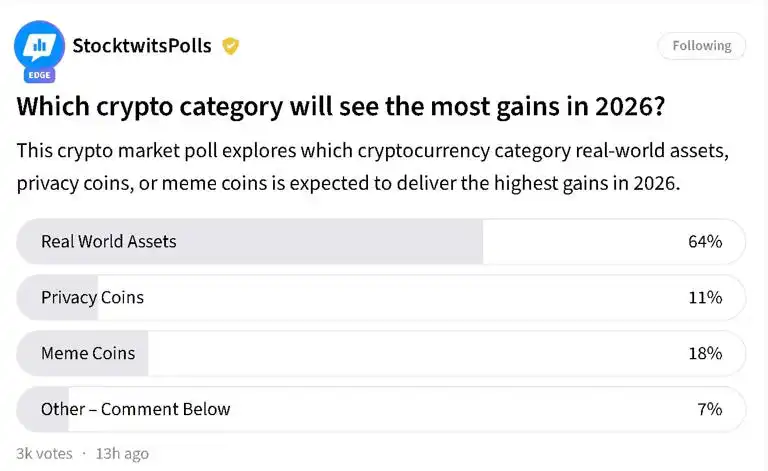
A recent Stocktwits poll shows: 64% of investors believe RWA will deliver the strongest returns in 2026, far exceeding Meme coins' 12% and privacy coins' 8%. But behind this number lies a question—when retail investors start clamoring to allocate to RWA, is it genuine cognitive upgrade, or just a PTSD response after the 2025 Meme crash?

RWA: The Promised Land for Institutions, or an Overcrowded Narrow Bridge?

Let’s first examine why Wall Street is so fascinated with RWA. The current total crypto market cap is approximately $3.2 trillion, with Bitcoin oscillating around $95,000. The market is searching for the next growth engine.

RWA’s logic seems flawless: Tokenizing traditional assets like real estate, bonds, and treasury bonds on-chain allows for both the efficiency advantages of blockchain and access to traditional finance’s trillion-dollar capital pool. This isn’t speculation; it’s "infrastructure building."

Grayscale, in its "2026 Digital Asset Outlook: Dawn of the Institutional Era" report, listed RWA as a core theme, predicting its scale will grow from the current $21 billion level to trillions by 2030. Behind this growth curve is a gradually clarifying regulatory environment—the potential passage of the U.S. CLARITY Act, and U.S. banks already allowing wealth advisors to allocate 1-4% of client assets to crypto.

Frontrunners have emerged. Ondo Finance focuses on RWA lending, with a current market cap of about $1.5 billion; Chainlink, as an oracle infrastructure, supports RWA data on-chain, with a market cap exceeding $20 billion. Bernstein explicitly expressed optimism about these projects and named Coinbase and MicroStrategy as indirect beneficiaries of the tokenization wave.

But here lies a paradox: When everyone knows RWA is the "correct answer," can it still deliver excess returns?
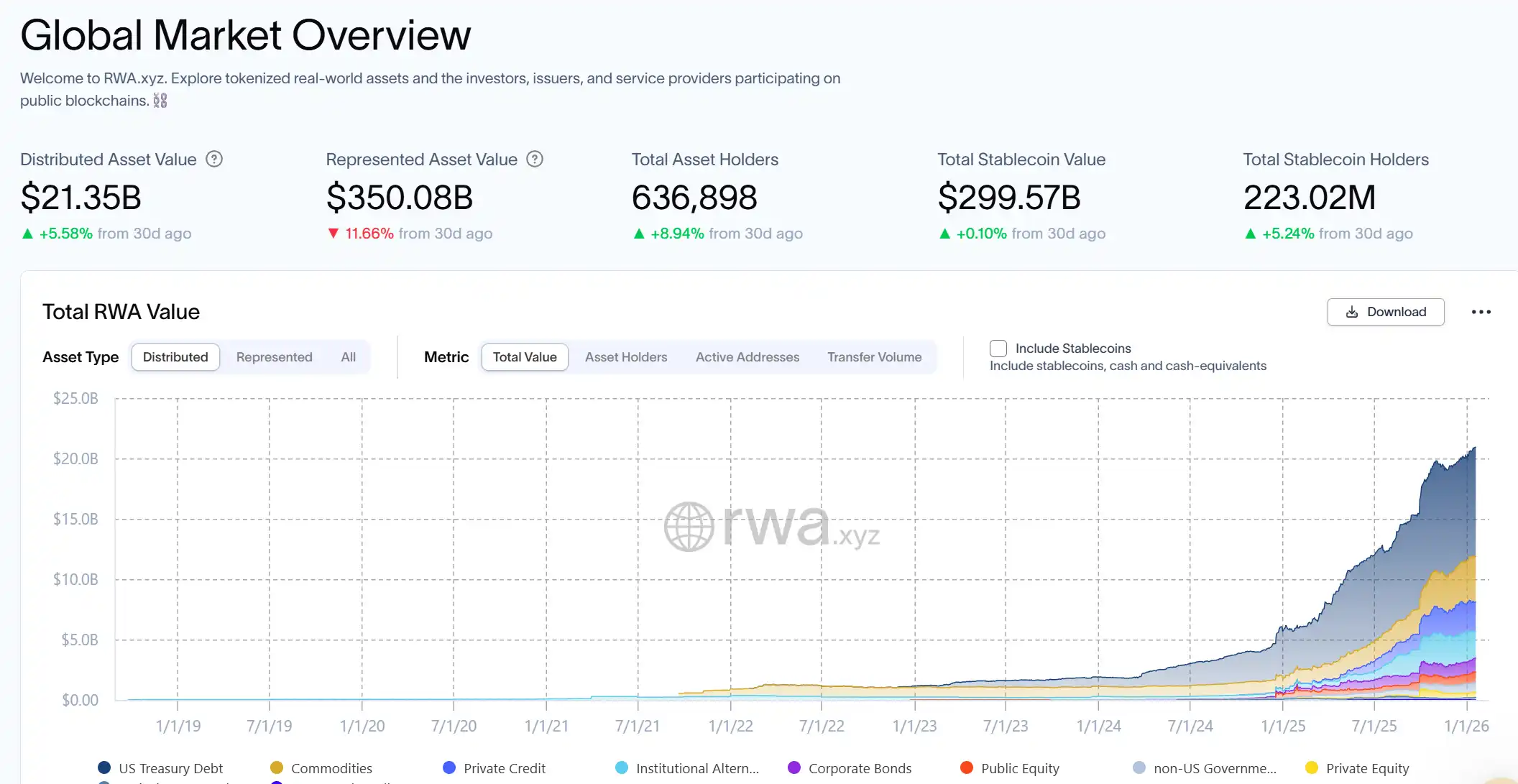
RWA’s current overall market cap is only around $20 billion, with extremely low liquidity. This means that once institutional funds pour in, prices could indeed surge; but the same logic applies to retreats—when the first batch of institutions starts taking profits, retail investors may find their RWA tokens unsellable.

A more realistic risk is regulatory delays: If the CLARITY Act is postponed, or if the Fed’s rate-cutting cycle lags behind expectations, the entire RWA narrative may need to wait another year or two amid volatility.

Institutions can endure this wait because they have advantages in funding costs and long-term allocation needs. But can retail investors? This is the most overlooked dimension of RWA investment—it requires not only correctly judging the direction but also having enough patience and liquidity to survive the vacuum period before the narrative materializes.

Meme: Cultural Renaissance or Final Carnival?

Compared to RWA’s rational narrative, Meme coins are more like the sentiment barometer of the crypto market. In early 2026, the total market cap of Meme coins rose from $150 billion at the end of 2025 to $185 billion, a 23% increase.

This number pales in comparison to the frenzy of 2021 or early 2025, but it still illustrates one fact: Meme is not dead.
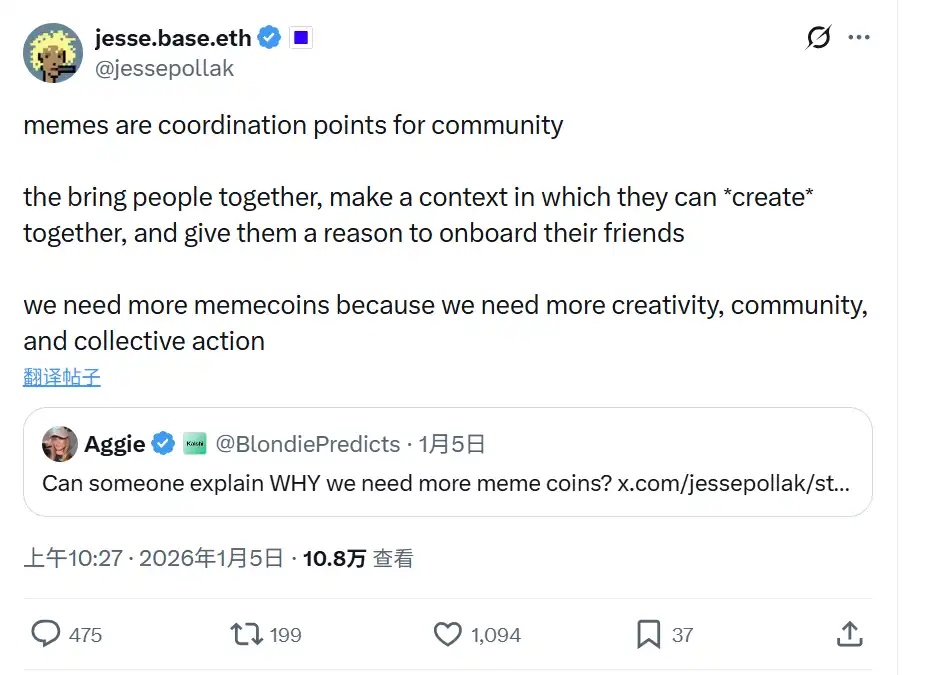
Base chain founder Jesse Pollak offers an interesting perspective. He repeatedly emphasizes that Meme is not just a speculative tool but the "core of on-chain culture." Through images, videos, music, and other content forms, Meme can attract millions of new users on-chain, becoming the entry point for Web3 mass adoption.

Meme projects on Base chain like TYBASEGOD, TOSHI, and BLOOFOSTERCOIN are validating this logic—they are not just tokens but更像是 vehicles for community culture.

But we must admit that this "cultural theory"更像是 justifications for platform ecosystems rather than genuine investment logic. The essence of Meme coins remains a zero-sum game: early participants profit through community consensus and viral spread, while later arrivals pay for liquidity.

The Stocktwits poll showing only 12% optimism for Meme reflects collective avoidance by institutions and rational retail investors. More critically, the 2025 Meme market crash left deep scars—many retail investors were deeply trapped buying at the top and have yet to break even.

So what does the 2026 Meme rebound mean? One interpretation is that Layer 2s like Base, with low costs and high throughput, have lowered the barriers to Meme creation and trading, allowing this sector to remain active with smaller capital flows.

But a more pessimistic interpretation is that this is just "existing player gambling"—old hands harvesting each other, with no new capital truly entering. If 2026 fails to birth new 100x myths (like Shiba Inu in 2021), Meme may gradually devolve into a niche game for enthusiasts.

More alarmingly, the密集 TGE (Token Generation Event) period in Q1 brings unlocking sell-off pressure. When large amounts of tokens unlock, market liquidity may be drained, and Meme, as the most fragile asset class, often bears the brunt first. This structural risk is rarely discussed in Meme communities but could be the main cause of retail losses in 2026.

Privacy: The Last Bastion of Idealism, or Regulation’s Next Target?

Privacy coins occupy the most awkward position in this discussion. On one hand, Quai Network surged 261% at the beginning of the year, rising from $0.03 to $0.11, with a market cap of about $86 million; Monero and Zcash also rebounded 10-50%.

On the other hand, the entire privacy coin category’s market cap is only around $5-10 billion, almost negligible in the $3.2 trillion total crypto market cap.

Privacy coin supporters will tell you this is because they represent crypto’s original intent—financial freedom and transaction privacy. Privacy coins uphold ideals of decentralization and censorship resistance. Quai’s surge partly stems from new mining hardware launches and DEX liquidity support, indicating that technical upgrades can still create short-term alpha for privacy coins.

But reality is harsher than ideals. The EU’s anti-money laundering laws are tightening regulations on privacy coins, and multiple exchanges have delisted coins like Monero. The Stocktwits poll showing only 8% optimism for privacy coins reflects not just regulatory concerns but also that privacy as an investment theme lacks sufficient market consensus.

A deeper issue: Can privacy and compliance coexist in the current regulatory environment? If not, privacy coins will either be marginalized as tools for geeks and dark web users or compromised into "pseudo-privacy" projects.

This dilemma makes it difficult for privacy coins to become mainstream investment targets. Of course, for true privacy believers, this恰恰 presents an opportunity for long-term contrarian accumulation—buying at historical lows after regulatory clarity may yield substantial returns. But this requires enduring 3-5 years of volatility and uncertainty, which is too long for most investors.

Polarization Is Inevitable, Where Is Alpha?

So, RWA, Meme, Privacy—who will be the true source of Alpha in 2026?

The answer may disappoint you: None of them, at least not in the way you imagine.

The essence of this polarization is a mismatch in time dimensions—RWA operates on a yearly scale, Meme on a weekly scale, Privacy on a quarterly scale. Institutions have the patience to lock up RWA, while retail seeks quick money but easily stops out repeatedly during volatility. The biggest risk isn’t "choosing the wrong sector" but "chasing highs + failing to hold."

True Alpha may lie in these two places:

1. The Intersection: Innovation Breaking Time Mismatch

True Alpha isn’t at the end of a single sector but in the intersection of narrative fusion:

  • Privacy-Enhanced RWA: Tokenized bonds, real estate on-chain, but with trading intent and holdings fully encrypted, disclosed only during audits. Transforming from "institution-exclusive" to playable by "institutions + high-net-worth retail."
  • Meme IP Tokenization: Viral Meme IP, once RWA-ized, generates cash flows from copyrights, merchandise, community shares. Evolving from "casino" to "cultural fund."
  • Compliant Privacy Layers: Default privacy + selective disclosure. Private stablecoins, private cross-chain bridges address institutional pain points (data leaks) and retail pain points (front-running).

The essence of these intersections: Using institutional patience to feed retail FOMO, and using retail viral spread to activate institutional liquidity. Pure sector players are easily washed out by time mismatch; intersection players find asymmetric opportunities.

2. Non-Participation: Retail’s Most Underrated Advantage

If you can’t understand this polarization, the best strategy may be non-participation. Hold BTC/ETH and wait for clearer market signals. FOMO will make you lose money in every sector; patience will let you go all-in at the right time. Retail’s biggest advantage is flexibility.


Пов'язані питання

QAccording to the article, what are the two main investment camps in the 2026 crypto market, and what are their primary focuses?

AThe two main investment camps are institutions betting on the RWA (Real World Asset) tokenization revolution and retail investors speculating on Meme and Privacy coins. Institutions focus on the long-term infrastructure play of bringing trillions in traditional capital on-chain, while retail investors chase quick, high-multiple returns in more speculative assets.

QWhat major risk does the article identify for investors in the RWA sector, despite its promising growth narrative?

AThe article identifies low liquidity as a major risk for RWA investors. While prices could surge if institutional money floods in, they could also crash dramatically if those same institutions decide to take profits, leaving retail investors unable to sell their tokens. Additionally, the narrative is vulnerable to regulatory delays.

QHow does the article characterize the current state of the Meme coin market in 2026?

AThe article characterizes the 2026 Meme coin market as a potential 'culture revival' but also a possible 'last狂欢 (carnival)' or game of '存量博弈 (存量博弈 -存量 game)' where existing players are harvesting each other. It has seen a 23% rebound but lacks new, massive capital inflow and is vulnerable to sell-pressure from token unlocks.

QWhy do Privacy coins face a significant challenge in becoming a mainstream investment, as per the article?

APrivacy coins face a significant challenge due to a fundamental conflict between privacy and compliance in the current regulatory environment. Tightening anti-money laundering laws in regions like the EU and delistings from major exchanges have marginalized them. They lack broad market consensus as an investment theme, trapped between being tools for ideologues or compromising their core values.

QWhere does the article suggest the true 'Alpha' or outperforming investment opportunity lies for 2026?

AThe article suggests the true 'Alpha' is not in any single pure-play sector but in the cross-pollination and innovation between them, such as Privacy-Enhanced RWA, Meme IP tokenization, and compliant privacy layers. Alternatively, it states that for many retail investors, the best strategy might be to not participate directly and instead hold core assets like BTC/ETH patiently until clearer signals emerge.

Пов'язані матеріали

Dialogue with a Macro Analyst: AI Drains All Liquidity from U.S. Stocks, $40K Bitcoin is the True Bottom

In a recent discussion, macro strategist Luke Groman, founder of FFT LC, presented a sobering analysis of current markets. He argues that while the S&P 500 hits new highs, this is largely driven by just seven AI stocks, which are "sucking all the oxygen and liquidity out of the room." Bitcoin, which he calls the "last working smoke alarm for liquidity," is signaling trouble, having entered a difficult period. Groman explains that the AI boom is fueled by accounting practices that front-load revenue, creating an illusion of high profits while cash is being depleted. He warns this cycle could reverse sharply when construction slows. His base case is that stocks will rise in dollar terms but fall significantly when measured in gold or Bitcoin, highlighting that long-term US Treasury futures have already lost 90% of their value against gold over the past decade. He points to major structural risks, including China's dominance in rare earths—a small commodity market underpinning trillions in tech stock value—and the prolonged closure of the Strait of Hormuz, which he calls a "Suez Moment" for the US. This, combined with a shift towards a "no ticky, no washy" proof-of-work system for settling trade (using gold, not trust), signals deeper systemic distrust. Regarding US debt, Groman notes that historically, all 58 countries that reached a 130% debt-to-GDP ratio defaulted, primarily through inflation. The US crossed this threshold in 2020. He also highlights a contradiction in the AI narrative: if it's as transformative as claimed, it must destroy white-collar jobs, threatening half of US tax revenue—a reality at odds with the "no job loss" messaging from tech leaders. On Bitcoin, Groman sold most of his position near the top and hasn't fully re-entered. Citing technical analysis from Northstar Bad Charts, he suggests a potential bottom around $40,000 could materialize in Q3 or Q4. He concludes that while he may be labeled a doomsayer, his view is simply realistic, grounded in historical precedents and current macro pressures.

marsbit4 год тому

Dialogue with a Macro Analyst: AI Drains All Liquidity from U.S. Stocks, $40K Bitcoin is the True Bottom

marsbit4 год тому

Торгівля

Спот
Ф'ючерси

Популярні статті

Що таке MEME 2.0

Memecoin 2.0: Поява $MEME 2.0 у світі криптовалюти Вступ У постійно змінному ландшафті криптовалюти з'явився новий претендент. Memecoin 2.0, що символізується як $MEME 2.0, підносить концепцію мем-криптовалют на захоплюючий новий рівень. Як побічний продукт оригінального Memecoin, цей проєкт привернув увагу крипто-спільноти, змістивши акцент з типової фінансової вигоди на захоплюючий і розважальний досвід. Працюючи на блокчейні Ethereum, Memecoin 2.0 сміливо переосмислює залучення спільноти у криптосфері. Що таке Memecoin 2.0, $MEME 2.0? У своїй основі, Memecoin 2.0 є криптовалютним проєктом, який надає пріоритет спільнотному духу і розвагам, пов'язаним з мем-культурою. На відміну від звичайних криптовалют, які зосереджені на практичних випадках використання та матеріальних вигодах, Memecoin 2.0 вирізняється тим, що обіймає легшу сторону цифрової валюти. Цей проєкт існує без обіцянок утиліти, структурованої дорожньої карти чи фінансових повернень, зосереджуючи увагу на створенні яскравої спільноти навколо мемів та спільних розваг. Зробивши це, він використовує зростаючу тенденцію мем-культури у онлайн-пробі, що робить його унікальним гравцем у світі цифрових активів. Творець Memecoin 2.0, $MEME 2.0 Не зважаючи на численні дослідження витоків Memecoin 2.0, чітка особистість його творця залишається невідомою. Ця анонімність не є рідкістю у крипто-спільноті, де багато проєктів очолюються особами або групами, які надають перевагу залишатися за лаштунками. Відсутність публічно доступної інформації про творця може розглядатися як стратегічний крок, що ставить в центр уваги залучення спільноти, а не індивідуальної популярності у цій сфері. Інвестори Memecoin 2.0, $MEME 2.0 Інформації щодо інвесторів або фінансової підтримки Memecoin 2.0 замало. Відсутність деталей може свідчити про те, що проєкт є самофінансованим або що його увага до спільноти, а не традиційних інвестиційних структур, привабила інший тип підтримки. Оскільки світ мем-криптовалют зазвичай передбачає більше участі низового рівня, а не інституційних інвестицій, цей підхід узгоджується з етосом проєктів, що управляються спільнотою. Як працює Memecoin 2.0, $MEME 2.0? Memecoin 2.0 повністю працює на блокчейні Ethereum, використовуючи його потужні функції безпеки та масштабованості. Використовуючи сильні сторони Ethereum, Memecoin 2.0 може запропонувати безпечне середовище для взаємодії користувачів, забезпечуючи при цьому, що транзакції є ефективними та економічними. Одна з унікальних характеристик Memecoin 2.0 полягає в його структурі, що керується спільнотою. Цінність та популярність токена $MEME 2.0 походять з активної участі його користувачів, а не з вродженої утиліти. Ця концепція підкреслює акцент проєкту на розважальному аспекті криптовалюти, натякаючи на те, що сміх та залучення спільноти є справжніми валютами, що ведуть до його успіху. Крім того, проєкт вписується в ширшу екосистему мем-криптовалют, де цінність кожної мем-криптовалюти коливається залежно від культури, тенденцій і участі спільноти, а не традиційних економічних принципів. Хронологія Memecoin 2.0, $MEME 2.0 Щоб краще зрозуміти еволюцію та віхи Memecoin 2.0, ось хронологія, що підкреслює значні події в його історії: 2024: Зародження Memecoin 2.0 вважається відгалуженням оригінального Memecoin, яке встановлює себе в процвітаючому контексті мем-криптовалют, працюючи на блокчейні Ethereum. 13 липня 2024: Memecoin 2.0 офіційно позиціонує себе як мем-криптовалюта, орієнтована на спільноту, в мережі Ethereum, підкреслюючи свій підхід, зосереджений на розвагах, який запрошує користувачів брати участь у його розвитку. Ключові моменти про Memecoin 2.0, $MEME 2.0 Кілька критичних характеристик визначають Memecoin 2.0: Спільнотно-центричний підхід: Основною метою Memecoin 2.0 є створення веселого, захоплюючого досвіду для спільноти, використовуючи колективне задоволення, що випливає з меметичної культури. Побудовано на Ethereum: Робота на блокчейні Ethereum надає проєкту важливу інфраструктуру, що забезпечує безпеку та масштабованість. Відсутність утиліти або дорожньої карти: У вражаючому відході від традиційних криптовалют, Memecoin 2.0 не обіцяє жодних утилітарних функцій або фінансових повернень, підтверджуючи свою прихильність до участі спільноти та соціального залучення. Акцент на меметичній культурі: Обіймаючи гумористичні та культурні аспекти мем-періоду, Memecoin 2.0 надає платформу для користувачів для залучення до крипти офлайн та онлайн. Додатковий контекст: Значення мем-криптовалют Мем-криптовалюти з'явилися як окрема класифікація криптовалюти, часто керуючись гумором та легким підходом до торгівлі. Ці валюти, як правило, не мають значної утиліти або розробницьких дорожніх карт, залучаючи користувачів обіцянкою розваг, взаємодії в спільноті та культурної значущості. В рамках ширшої екосистеми криптовалют, мем-криптовалюти відновлюють важливість залучення спільноти, протистоячи лише прибутковим підходам. Проєкти, такі як Memecoin 2.0, відкривають еру, в якій розваги можуть гармонізувати з фінансовими прагненнями, перетворюючи блокчейн на ігровий майданчик для творчості та соціальної взаємодії. Висновок Memecoin 2.0, або $MEME 2.0, втілює нову хвилю криптовалюти, яка надає пріоритет залученню спільноти над жорсткими фінансовими структурами. Зосереджуючись на гуморі та соціальній взаємодії, він використовує захоплення навколо мем-культури. Працюючи на блокчейні Ethereum, Memecoin 2.0 використовує можливості технології, залишаючись непохитним у своїй прихильності до розважальної цінності цифрової валюти. Коли простір навколо криптовалют продовжує еволюціонувати, Memecoin 2.0 служить доказом того, що майбутнє цифрових активів може значною мірою залежати від спільних досвідів, сміху та надійних зв'язків у спільноті. У непередбачуваному світі крипто, можливо, радість може бути такою ж цінною, як і традиційний фінансовий прибуток.

110 переглядів усьогоОпубліковано 2024.04.04Оновлено 2024.12.03

Що таке MEME 2.0

Як купити MEME

Ласкаво просимо до HTX.com! Ми зробили покупку Memeland (MEME) простою та зручною. Дотримуйтесь нашої покрокової інструкції, щоб розпочати свою криптовалютну подорож.Крок 1: Створіть обліковий запис на HTXВикористовуйте свою електронну пошту або номер телефону, щоб зареєструвати обліковий запис на HTX безплатно. Пройдіть безпроблемну реєстрацію й отримайте доступ до всіх функцій.ЗареєструватисьКрок 2: Перейдіть до розділу Купити крипту і виберіть спосіб оплатиКредитна/дебетова картка: використовуйте вашу картку Visa або Mastercard, щоб миттєво купити Memeland (MEME).Баланс: використовуйте кошти з балансу вашого рахунку HTX для безперешкодної торгівлі.Треті особи: ми додали популярні способи оплати, такі як Google Pay та Apple Pay, щоб підвищити зручність.P2P: Торгуйте безпосередньо з іншими користувачами на HTX.Позабіржова торгівля (OTC): ми пропонуємо індивідуальні послуги та конкурентні обмінні курси для трейдерів.Крок 3: Зберігайте свої Memeland (MEME)Після придбання Memeland (MEME) збережіть його у своєму обліковому записі на HTX. Крім того, ви можете відправити його в інше місце за допомогою блокчейн-переказу або використовувати його для торгівлі іншими криптовалютами.Крок 4: Торгівля Memeland (MEME)Легко торгуйте Memeland (MEME) на спотовому ринку HTX. Просто увійдіть до свого облікового запису, виберіть торгову пару, укладайте угоди та спостерігайте за ними в режимі реального часу. Ми пропонуємо зручний досвід як для початківців, так і для досвідчених трейдерів.

326 переглядів усьогоОпубліковано 2024.12.12Оновлено 2026.06.02

Як купити MEME

Обговорення

Ласкаво просимо до спільноти HTX. Тут ви можете бути в курсі останніх подій розвитку платформи та отримати доступ до професійної ринкової інформації. Нижче представлені думки користувачів щодо ціни MEME (MEME).

活动图片













