Russia, Iran-Linked Groups Turn To Crypto For Crowdfunded Drone Purchases – Report

bitcoinistОпубліковано о 2026-03-31Востаннє оновлено о 2026-03-31

Анотація

A recent Chainalysis report reveals that pro-Russia and Iran-affiliated groups are increasingly using cryptocurrency to fund purchases of commercially available drones and components, which have become central to modern conflict. These groups utilize crypto for both direct purchases from manufacturers and indirect acquisitions via third-party e-commerce platforms like Alibaba. Iran-linked entities, including the IRGC, have used crypto to buy drone parts, while pro-Russia militias have raised over $8.3 million in crypto donations since 2022 to purchase drones, often from Chinese manufacturers. The blockchain provides transparency into these transactions, highlighting how crypto is transforming conflict economics by enabling groups to crowdfund military equipment despite limited access to traditional finance.

A recent report has shared that Pro-Russia and Iran groups are turning to crypto to fund purchases of commercially available drones and related components, as the products become central to modern conflict.

Crypto-Funded Drone Purchases Linked To Russia, Iran

On Monday, blockchain analytics firm Chainalysis revealed that groups affiliated with Russia and Iran are utilizing crypto to fund the acquisition of low-cost military drones and their components.

The firm traced crypto flows from individual wallets linked to various paramilitary groups to the purchase of affordable drones and related components from vendors on e-commerce platforms.

According to the report, low-cost, commercially available drones have become central to modern conflict, enabling both state and non-state actors, including pro-Russia militias and Iran-backed terrorist organizations.

Most purchases use traditional financial channels, but Chainalysis noted that drone procurement networks are ⁠increasingly intersecting with the blockchain. As the firm explained, crypto can enter the drone procurement picture directly or indirectly. In the first scenario, a drone manufacturer openly accepts digital assets as payment on its website.

In the second scenario, electronics and dual-use component vendors that sell through third-party e-commerce platforms like Alibaba accept digital assets to sell drones and their parts to buyers whose identities and intended use are unclear.

The report found that Iran-linked groups have been using crypto to acquire drone components and sell military equipment, highlighting a wallet associated with Iran’s Islamic Revolutionary Guard Corps (IRGC) that purchased drone parts from a Hong Kong-based supplier.

As reported by Bitcoinist in January, Iran’s Ministry of Defence Export Center (Mindex), the state arms export arm, openly offered to accept crypto as payment for military hardware, including drones, air defense systems, warships, and ballistic missiles.

Paramilitary Groups ‘Crowdfund The Frontline’

Chainalysis also emphasized that the “most publicly visible crypto-drone nexus operates at the militia level, through open crowdfunding campaigns on social media platforms.”

The blockchain analytics firm has identified dozens of pro-Russia volunteer and paramilitary organizations asking for crypto donations for military equipment since Russia invaded Ukraine in ​2022.

Over the past four years, the pro-Russia groups have raised more than $8.3 million in these donations across various blockchains to purchase drones and associated components from global e-commerce platforms.

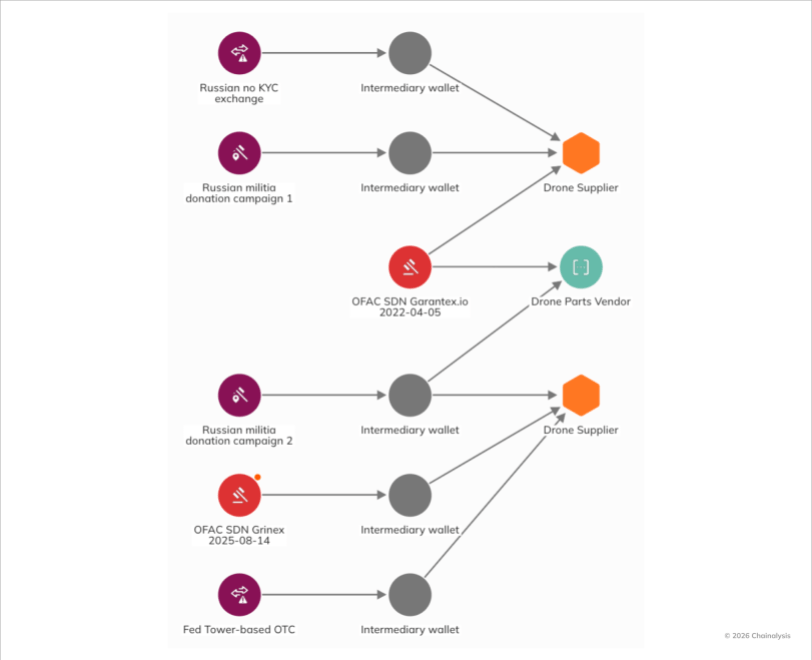
On-chain evidence shows Russian militia fundraising groups purchasing from a Hong Kong-based drone manufacturer and drone purchasers acquiring liquidity from Russian-language no-Know Your Client (KYC) exchanges, the sanctioned Russian exchanges Garantex and Grinex, and a Federation Tower-based OTC service.

To the firm, this strongly suggests that Russia-linked actors may have acquired drones from Chinese manufacturers for deployment in Ukraine. Chainalysis also matched crypto transactions between $2,200-$3,500 to the exact prices of drones and their components on ​e-commerce platforms.

Russian militia donation campaign wallets purchase drones via intermediaries. Source: Chainalysis

“The striking point is not the dollar figure, but the logic. At the militia level, low-cost commercial drones are among the most tactically significant items crowdfunded crypto can buy,” the report affirmed.

“At $2,200–$3,500 per unit, a single successful fundraising campaign translates directly into battlefield capability for groups that cannot access conventional finance,” it continued.

The firm underscored that the blockchain offers new opportunities to trace these flows and obtain a better understanding of how emerging technologies are “transforming the economics of conflict.”

“On the blockchain, there’s this incredible opportunity, once you have ‌identified the ⁠vendor to see the counterparty activity and make assessments that help clarify that utilization and the intent behind the purchase,” Andrew Fierman, Chainalysis’s head of national security intelligence, told Reuters
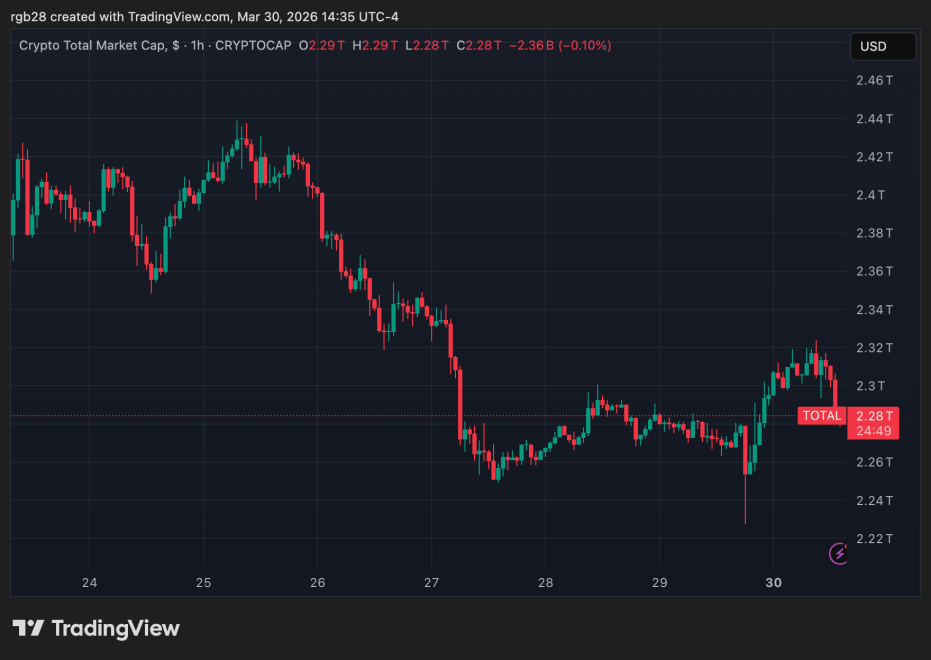
Total crypto market capitalization is at $2.28 trillion on the one-week chart. Source: TOTAL on TradingView

Пов'язані питання

QAccording to the report, how are pro-Russia and Iran-linked groups using cryptocurrency in relation to drone procurement?

AThey are using cryptocurrency to fund the acquisition of low-cost military drones and related components, often through crowdfunding campaigns on social media and purchases from vendors on e-commerce platforms.

QWhat are the two main scenarios described in which cryptocurrency enters the drone procurement process?

AThe first scenario is when a drone manufacturer openly accepts digital assets as payment on its website. The second is when electronics and dual-use component vendors on third-party e-commerce platforms accept crypto from buyers whose identities and intended use are unclear.

QWhich specific Iran-linked group was identified as using a crypto wallet to purchase drone parts, and from where?

AA wallet associated with Iran’s Islamic Revolutionary Guard Corps (IRGC) was used to purchase drone parts from a Hong Kong-based supplier.

QHow much money have pro-Russia groups raised through crypto donations for military equipment since the invasion of Ukraine, and what is its primary use?

APro-Russia groups have raised more than $8.3 million in crypto donations, which is primarily used to purchase drones and associated components from global e-commerce platforms.

QWhat does the report identify as the 'most striking point' about these crypto-funded drone purchases, and why?

AThe most striking point is not the dollar figure, but the logic. For militia-level groups that cannot access conventional finance, a single successful campaign raising $2,200–$3,500 can directly translate into significant battlefield capability by funding a low-cost commercial drone.

Пов'язані матеріали

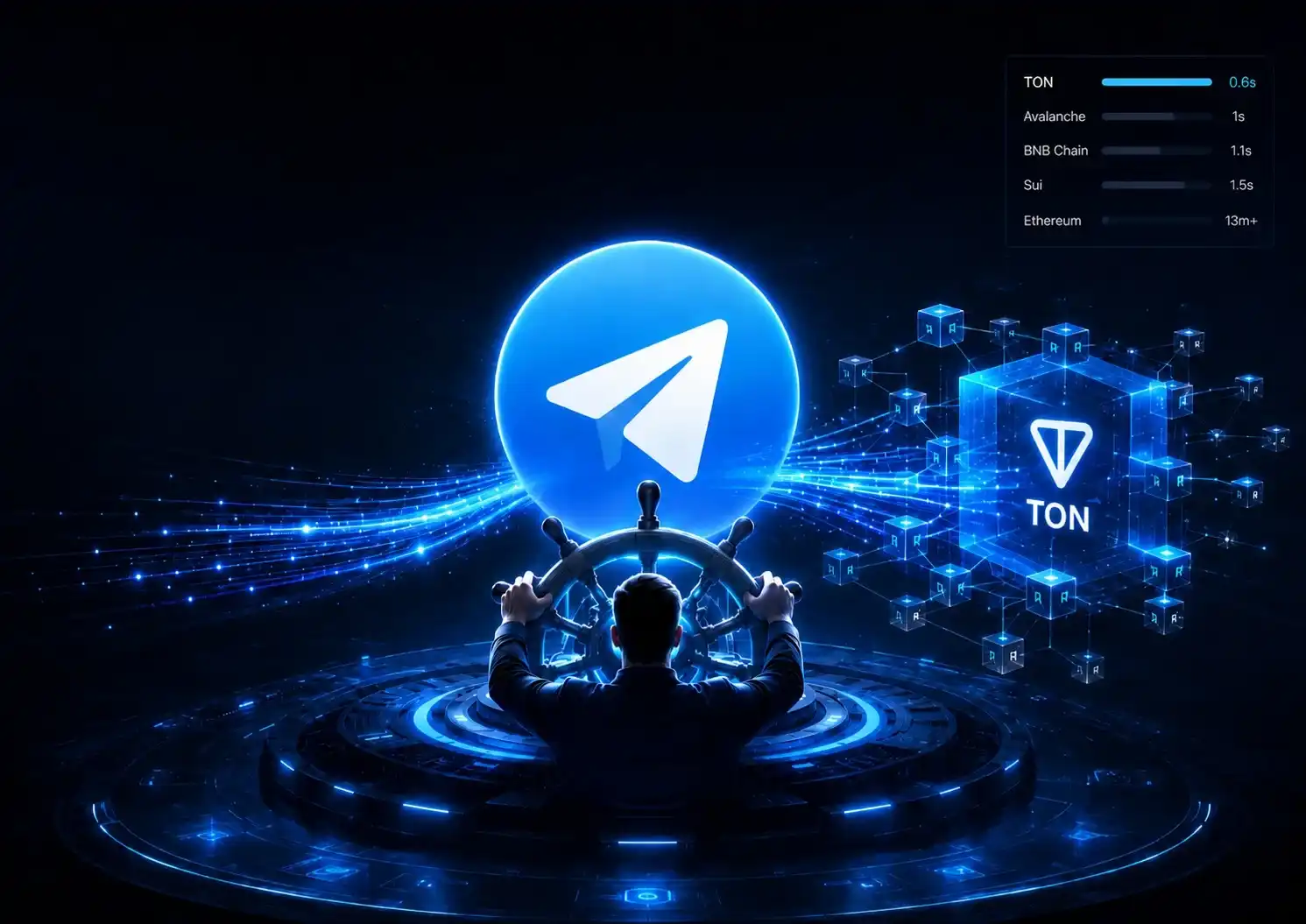
Telegram Takes Direct Control of TON, Social Traffic Rewrites the Public Chain Narrative

Telegram founder Pavel Durov announced that Telegram will replace the TON Foundation as the core driver and largest validator of The Open Network (TON). Key initiatives include a sixfold reduction in transaction fees, performance upgrades, and improved developer tools within the next few weeks. This marks a strategic shift from Telegram merely providing user access to deeply integrating TON into its platform's core infrastructure. The goal is to transform Telegram's massive social traffic into sustainable on-chain activity. While viral mini-apps like Notcoin have demonstrated Telegram's ability to drive user adoption, TON aims to support frequent, low-value transactions inherent to social platforms—such as tipping, in-app payments, and game rewards. Ultra-low fees and sub-second finality (0.6 seconds) are crucial to making blockchain interactions seamless and nearly invisible within the Telegram user experience. However, Telegram's increased central role raises questions about network decentralization. Durov argues that Telegram's participation will attract more large validators, thereby enhancing decentralization. TON also offers high annual staking rewards (18.8%), aiming to retain capital within its ecosystem. The fundamental challenge for TON is no longer leveraging Telegram's user base, but becoming an indispensable, seamless infrastructure layer for Telegram's everyday applications—moving from an adjacent chain to an embedded utility.

marsbit2 хв тому

Telegram Takes Direct Control of TON, Social Traffic Rewrites the Public Chain Narrative

marsbit2 хв тому

Telegram Takes Direct Control of TON, Social Traffic Reshapes Public Chain Narrative

Telegram's founder, Pavel Durov, has announced a major shift in the development of The Open Network (TON). Telegram will now become the core driver of TON, replacing the TON Foundation and becoming its largest validator. The focus will be on technical upgrades over the next few weeks, including slashing network fees by six times to near-zero and improving finality time to 0.6 seconds. This move signifies a deeper integration between Telegram and TON, moving beyond just providing a user base. The goal is to transform Telegram's vast social traffic and built-in features—like Mini Apps, payments, and bots—into sustainable, on-chain usage scenarios. The reduced fees and faster speeds are crucial for enabling the small, frequent transactions typical of social interactions. While this promises stronger execution and product alignment, it raises questions about centralization. Durov argues Telegram's involvement will attract more validators, enhancing decentralization, but the outcome remains to be seen. Additionally, TON's high annual staking reward of 18.8% aims to retain capital within the ecosystem. The key challenge for TON is no longer just leveraging Telegram's entry point, but becoming an invisible, seamless infrastructure layer within Telegram's daily use. Its success hinges on converting viral attention into lasting, embedded utility.

Odaily星球日报11 хв тому

Telegram Takes Direct Control of TON, Social Traffic Reshapes Public Chain Narrative

Odaily星球日报11 хв тому

OpenAI Post-Training Engineer Weng Jiayi Proposes a New Paradigm Hypothesis for Agentic AI

OpenAI engineer Weng Jiayi's "Heuristic Learning" experiments propose a new paradigm for Agentic AI, suggesting that intelligent agents can improve not just by training neural networks, but also by autonomously writing and refining code based on environmental feedback. In the experiment, a coding agent (powered by Codex) was tasked with developing and maintaining a programmatic strategy for the Atari game Breakout. Starting from a basic prompt, the agent iteratively wrote code, ran the game, analyzed logs and video replays to identify failures, and then modified the code. Through this engineering loop of "code-run-debug-update," it evolved a pure Python heuristic strategy that achieved a perfect score of 864 in Breakout and performed competitively with deep reinforcement learning (RL) algorithms in MuJoCo control tasks like Ant and HalfCheetah. This approach, termed Heuristic Learning (HL), contrasts with Deep RL. In HL, experience is captured in readable, modifiable code, tests, logs, and configurations—a software system—rather than being encoded solely into opaque neural network weights. This offers potential advantages in explainability, auditability for safety-critical applications, easier integration of regression tests to combat catastrophic forgetting, and more efficient sample use in early learning stages, as demonstrated in broader tests on 57 Atari games. However, the blog acknowledges clear limitations. Programmatic strategies struggle with tasks requiring long-horizon planning or complex perception (e.g., Montezuma's Revenge), areas where neural networks excel. The future vision is a hybrid architecture: specialized neural networks for fast perception (System 1), HL systems for rules, safety, and local recovery (also System 1), and LLM agents providing high-level feedback and learning from the HL system's data (System 2). The core proposition is that in the era of capable coding agents, a significant portion of an AI's learned experience could be maintained as an auditable, evolving software system.

marsbit1 год тому

OpenAI Post-Training Engineer Weng Jiayi Proposes a New Paradigm Hypothesis for Agentic AI

marsbit1 год тому

Your Claude Will Dream Tonight, Don't Disturb It

This article explores the recent phenomenon of AI companies increasingly using anthropomorphic language—like "thinking," "memory," "hallucination," and now "dreaming"—to describe machine learning processes. Focusing on Anthropic's newly announced "Dreaming" feature for its Claude Agent platform, the piece explains that this function is essentially an automated, offline batch processing of an agent's operational logs. It analyzes past task sessions to identify patterns, optimize future actions, and consolidate learnings into a persistent memory system, akin to a form of reinforcement learning and self-correction. The article draws parallels to similar features in other AI agent systems like Hermes Agent and OpenClaw, which also implement mechanisms for reviewing historical data, extracting reusable "skills," and strengthening long-term memory. It notes a key difference from human dreaming: these AI "dreams" still consume computational resources and user tokens. Further context is provided by discussing the technical challenges of managing AI "memory" or context, highlighting the computational expense of large context windows and innovations like Subquadratic's new model claiming drastically longer contexts. The core critique argues that this strategic use of human-centric vocabulary does more than market products; it subtly reshapes user perception. By framing algorithms with terms associated with consciousness, companies blur the line between tool and autonomous entity. This linguistic shift can influence user expectations, tolerance for errors, and even perceptions of responsibility when systems fail, potentially diverting scrutiny from the companies and engineers behind the technology. The article concludes by speculating that terms like "daydreaming" for predictive task simulation might be next, continuing this trend of embedding the idea of an "inner life" into computational processes.

marsbit1 год тому

Your Claude Will Dream Tonight, Don't Disturb It

marsbit1 год тому

Торгівля

Спот
Ф'ючерси
活动图片