Russia Advances Bill To Regulate Crypto Market, Eyes July 1st Implementation

bitcoinistОпубліковано о 2026-04-23Востаннє оновлено о 2026-04-23

Анотація

Russia has advanced a key crypto bill, "On Digital Currency and Digital Rights," through its first parliamentary reading, aiming to establish a regulatory framework by July 1, 2026. The legislation recognizes digital assets as property and grants the Central Bank of Russia authority to license and oversee the market, permitting only licensed entities like exchanges and brokers to operate. It prohibits using crypto for domestic payments but allows it for cross-border settlements to bypass sanctions. The bill also introduces investor protection measures, including annual purchase limits for non-qualified investors and stricter oversight of mining activities.

Russia has advanced a key crypto bill on its first reading, as part of its efforts to establish a framework and fully bring the digital assets market out of the shadows in the next few months.

Russia Moves To Regulate Crypto Market By Summer

On Tuesday, the State Duma, the lower house of Russia’s legislature, advanced a key bill to legalize cryptocurrencies and establish a framework to regulate the digital assets in the country’s market.

According to the state news agency TASS, lawmakers passed the bill “On Digital Currency and Digital Rights” on its first reading, with 327 deputies voting in favor. The Russian government first introduced the draft in December 2025, seeking to establish the regulatory framework by summer 2026.

After clearing its first review, the bill still needs to clear the second and third readings in the State Duma. Then, it would proceed to the Federation Council, the upper chamber of the Federal Assembly, for consideration before reaching the President’s desk for signature. If passed, the bill will take effect on July 1, 2026, except for provisions with different effective dates, TASS reported.

The draft will recognize digital assets as property and grant the Central Bank of Russia (CBR) the authority to license, regulate, and oversee the local crypto market. Under the proposed legislation, only licensed professional participants supervised by the Bank of Russia will be allowed into the market.

“No anonymous exchanges or ‘black’ brokers. Exchanges, brokers, and depositories will receive licenses, and the Central Bank will monitor compliance. Transactions conducted through underground platforms will automatically be at risk of being blocked and of losing funds,” Kaplan Panesh, deputy chairman of the State Duma Committee on Budget and Taxes, explained.

The bill also defines the entities authorized to facilitate the circulation of crypto assets in the country, including exchanges, brokers, trust managers, and digital depositories holding the relevant licenses from the central bank.

The proposed draft establishes rules and requirements for authorized entities, and a simplified access procedure for entities already operating under the CBR’s experimental legal regime. It also introduces a simplified procedure for banks and brokers wanting to dive into crypto.

Discussing the regulation of crypto mining activities using Russian information infrastructure facilities, the deputy highlighted that “It is now a legal activity, but with clear rules: the use of only Russian infrastructure, and the reporting of equipment and currency produced.”

Digital Assets Allowed For Cross-Border Settlements

Notably, the bill will prohibit the use of crypto for paying for goods, services, or labor within the country, the report noted. However, it will allow its use for cross-border settlements to bypass sanctions restrictions.

“We have a national currency—the ruble—and it must remain the sole legal tender,” Deputy Panesh emphasized. “But we are making an exception for foreign trade. This allows Russian companies to settle accounts with foreign counterparties using cryptocurrency, bypassing sanctions restrictions. In effect, we are creating a legal instrument for cross-border settlements.”

The legislation will also introduce a tiered system that would limit the investor’s access depending on classification, aiming to “protect ordinary people from losing all their savings in a volatile market.”

As Bitcoinist previously reported, non-qualified investors would be limited to purchasing up to 300,000 rubles annually, worth around $3,800, in the most liquid cryptocurrencies after passing a knowledge test. Meanwhile, qualified investors would be able to purchase unlimited amounts of any digital asset after passing a risk-awareness test.

Panesh noted that the digital asset market in Russia has been in a gray area for years, creating risks for both citizens and the economy, adding that the legislation marks a crucial step for the local market.

“Now we are clearly defining: digital currency is property. This means it can be defended in court, included in the bankruptcy estate, and taken into account in divorce proceedings. This is a crucial step for the legal protection of millions of people who already own such assets,” he concluded.
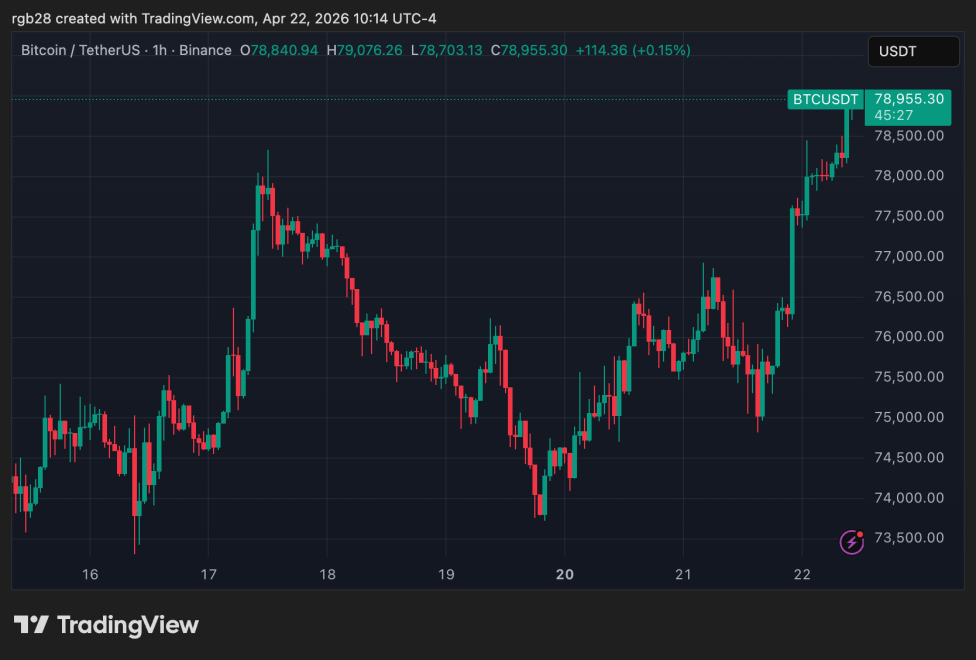
Bitcoin (BTC) trades at $78,955 in the one-week chart. Source: BTCUSDT on TradingView


Пов'язані питання

QWhat is the main purpose of the crypto bill advanced by Russia's State Duma?

AThe main purpose of the bill is to legalize cryptocurrencies and establish a regulatory framework to bring the digital assets market out of the shadows, recognizing crypto as property and granting the Central Bank of Russia authority to license, regulate, and oversee the market.

QBy what date is the bill expected to take effect if passed, and what is one key exception to this date?

AThe bill is expected to take effect on July 1, 2026, except for provisions that have different effective dates.

QHow does the bill propose to regulate the use of cryptocurrency for payments within Russia and for international trade?

AThe bill prohibits the use of cryptocurrency for paying for goods, services, or labor within Russia, but allows its use for cross-border settlements to bypass sanctions restrictions in foreign trade.

QWhat are the investment limits for non-qualified investors under the proposed tiered system?

ANon-qualified investors would be limited to purchasing up to 300,000 rubles (approximately $3,800) annually in the most liquid cryptocurrencies after passing a knowledge test.

QWhich government body will be granted the authority to license and oversee the local crypto market according to the bill?

AThe Central Bank of Russia (CBR) will be granted the authority to license, regulate, and oversee the local crypto market.

Пов'язані матеріали

Anthropic's IPO Launch: Commercial Miracle or Valuation Bubble?

Anthropic has confidentially filed for an IPO, led by Morgan Stanley and Goldman Sachs, potentially going public by October. Following its latest $650 billion funding round, its pre-IPO valuation stands at $965 billion, with projections reaching up to $2 trillion at listing, which would make it the highest-valued private company ever. The article, written by Fu Sheng, addresses skepticism that this represents an AI bubble akin to the 2000 dot-com crash. It argues the current situation differs fundamentally. Unlike the internet bubble era, which relied on speculative narratives with little revenue, Anthropic's valuation is backed by unprecedented, measurable financial performance. Key data points include: * **Revenue Growth:** ARR skyrocketed from $10 billion in early 2025 to $470 billion by May 2026, targeting $100 billion by year-end—a growth curve unmatched in business history. * **Profitability:** It achieved operating profitability in Q2 2026 with an estimated $5.6 billion profit. * **Efficiency:** With ~3,000 employees and ~$470 billion ARR, its revenue per employee exceeds $10 million. Products like Claude Code, launched less than a year ago, already generate $25 billion in annualized revenue. * **Enterprise Adoption:** It boasts a strong enterprise client base, with 8 of the Fortune 10 and over 1,000 large firms spending over $1 million annually on Claude. The valuation is framed using a traditional SaaS model (e.g., a 10x Price-to-Sales multiple on $100 billion revenue). The author contends the core question for analysts has shifted from "How big could this be?" to "How much is it earning and will earn next quarter?" The discussion extends beyond Anthropic to a broader paradigm shift: the transition from a "carbon-based" to a "silicon-based" economy. Companies are increasingly prioritizing investment in compute and AI capabilities over human resources, as these directly scale productivity and competitive advantage. Anthropic's IPO is thus positioned not just as a corporate milestone, but as a price anchor for this new economic era.

链捕手2 год тому

Anthropic's IPO Launch: Commercial Miracle or Valuation Bubble?

链捕手2 год тому

Near Returns to the AI Stage: Transformation into a Public Chain Due to 'Payroll Difficulties,' Agent and Privacy Emerge as New Growth Narratives

NEAR Returns to AI Origins: From Payroll Struggles to Blockchain, Now Focusing on AI Agents and Privacy NEAR Protocol's journey began not with grand blockchain ambitions, but from a practical hurdle: its AI startup founders, including Transformer paper co-author Illia Polosukhin, couldn't efficiently pay international developers in 2017. This led them to pivot and build a high-performance, scalable blockchain. After years navigating various crypto narratives like sharding and cross-chain interoperability, NEAR is now leveraging its AI roots to re-enter the AI arena. A key driver is its "NEAR Intents" layer, which abstracts complex cross-chain transactions. Users simply state their goal (e.g., swap BTC for ETH), and a solver network finds the optimal route. This system has processed over $20B in cross-chain volume, generating significant fee revenue. A major growth area is private transactions via "Confidential Intents/Swaps," which hide trade details until settlement to protect against MEV and front-running. Remarkably, private swaps recently accounted for over 40% of NEAR's transaction volume, highlighting strong demand but also potential regulatory scrutiny. With its AI-founder pedigree, NEAR is positioning itself at the intersection of blockchain, AI agents, and privacy, aiming to become infrastructure for the emerging agent economy while navigating the challenges of its rapid adoption.

marsbit4 год тому

Near Returns to the AI Stage: Transformation into a Public Chain Due to 'Payroll Difficulties,' Agent and Privacy Emerge as New Growth Narratives

marsbit4 год тому

Торгівля

Спот
Ф'ючерси
活动图片




