Robinhood, the First Stock in the Predictive Market Concept

marsbitОпубліковано о 2026-06-16Востаннє оновлено о 2026-06-16

Анотація

The online brokerage Robinhood, which previously partnered with prediction market platform Kalshi to offer event contract trading to its users, is now becoming a direct competitor. This shift began after Robinhood, through a joint venture, acquired and rebranded a CFTC-regulated exchange (now Rothera Exchange). Robinhood's motivation stems from the rapid growth of prediction markets on its platform, which significantly boosted its "other transaction revenue." Recognizing that its vast retail user base is the most critical asset, Robinhood aims to capture more value by routing orders to its own exchange instead of sharing fees with Kalshi. It strategically launched its Rothera platform during the high-traffic 2026 FIFA World Cup, successfully processing tens of millions of contracts in its initial days. This move signals a pivotal power shift in the prediction market industry: control over user distribution and access is emerging as a more decisive advantage than the underlying market infrastructure itself. The future competition may increasingly revolve around which platforms control the major user gateways.

Author: Azuma, Odaily Planet Daily

The battle of the World Cup has begun, and the total trading volume of the predictive market continues to hit new highs. However, as the industry leader, Kalshi might not be in the best mood right now.

The reason is not due to fluctuations in Kalshi's own business data, but because Kalshi now "suddenly" faces another formidable rival besides Polymarket, and this opponent was once its most important ally.
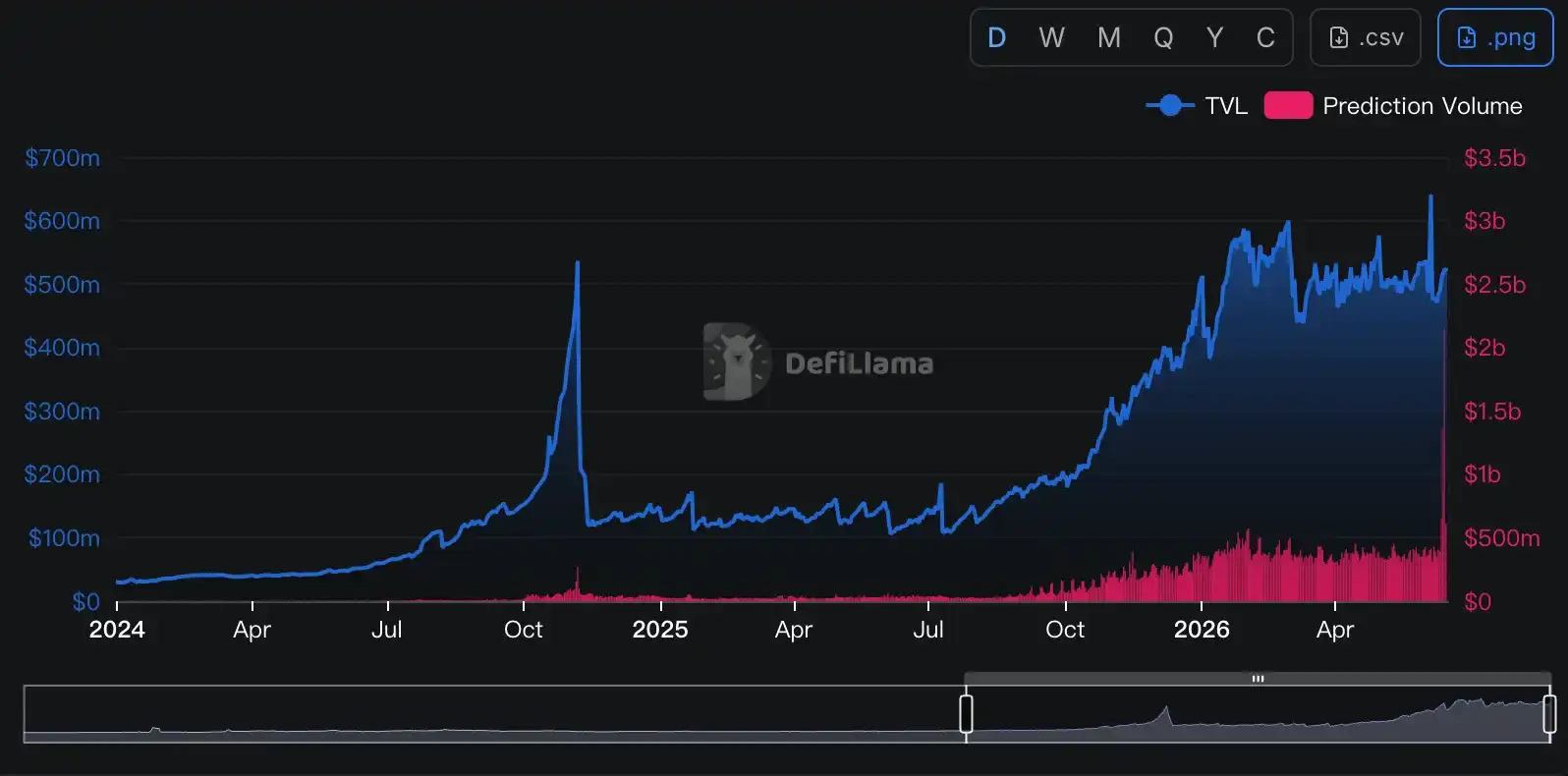
  • Odaily Note: Data sourced from Defillama.

Kalshi's Most Important Traffic Channel — Robinhood

Rewind to March 2025. At that time, Kalshi announced a partnership with the US online broker Robinhood, where the latter would use Kalshi's services to offer its users predictive market trading, allowing them to place bets on events like politics, economics, and sports.

From a business model perspective, this was a typical case of "mutual benefit" — Robinhood, responsible for user access and transaction distribution, could directly use Kalshi's mature product; Kalshi, responsible for the underlying market, matching, clearing, and regulatory compliance systems, could reach Robinhood's massive retail user pool.

The subsequent story proved the "win-win" outcome of this partnership. Through Robinhood's channel distribution, Kalshi indirectly gained massive users and transaction volume. Piper Sandler analysts once estimated that "trading volume completed through Robinhood's channel accounted for about 25%-35% of Kalshi's total trading volume." These orders ultimately translated into revenue for both parties — Robinhood would independently charge for all Kalshi event contracts traded through its channel, a fixed fee of $0.01 per contract per direction, and then share the revenue with Kalshi (the specific proportion was not disclosed).
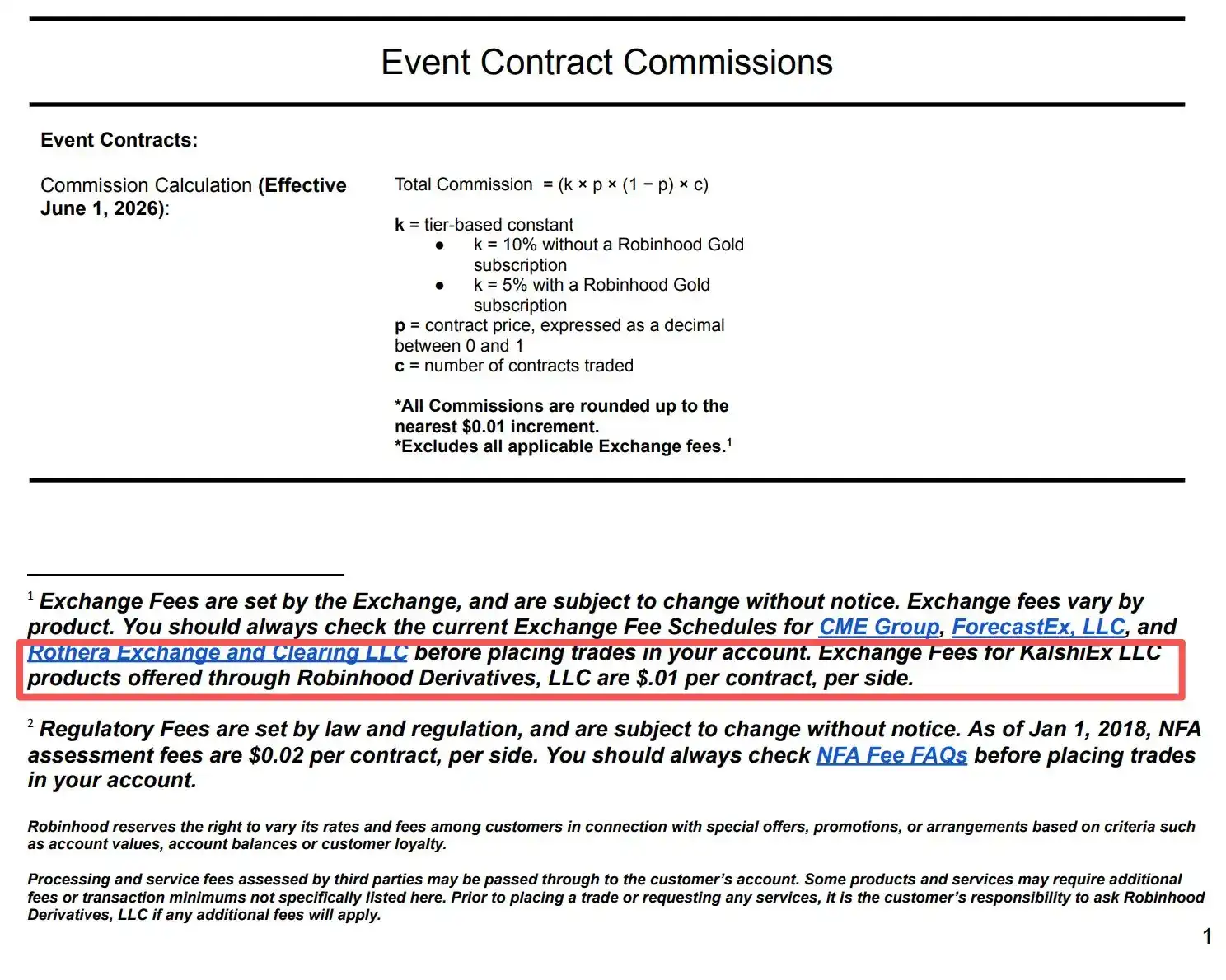
The Q1 financial report disclosed at the end of April showed that Robinhood facilitated the trading of 8.8 billion event contracts in Q1, driving "other trading revenue" to grow by 320% year-on-year, reaching $147 million. The predictive market has become the brightest new growth engine in Robinhood's product line.

However, recently, this relationship has undergone some subtle changes.

Robinhood's Ambition: Taking Back the Cake Shared with Kalshi

As internet history has proven countless times, when a channel gains enough leverage, it is no longer content with being just a channel. Robinhood is no exception.

Although the partnership with Kalshi also brought substantial revenue to Robinhood, as the predictive market became one of the fastest-growing new businesses on the platform, Robinhood was no longer satisfied with the current revenue-sharing arrangement.

In their cooperation model, Kalshi was responsible for providing the market and infrastructure, while Robinhood was responsible for providing users and order flow. However, as the partnership deepened, Robinhood gradually realized that what is truly scarce might not be the market itself, but the user access it firmly controls. After all, for most Robinhood users, they don't care whether their orders are ultimately executed on Kalshi or another platform — users only see a trading entry within the Robinhood app, not the underlying infrastructure provider.

In other words, Robinhood always held one of the most critical resources for the predictive market — distribution power. If the users belong to Robinhood, why should the order flow go to someone else?

In fact, just as Robinhood was quickly validating the demand for predictive markets through Kalshi, a Plan B was quietly launched shortly thereafter.

In November 2025, Robinhood announced the formation of a joint venture with Wall Street quantitative trading giant Susquehanna and planned to acquire the CFTC-regulated derivatives exchange MIAXdx. According to the official statement, this joint venture would operate an independent futures and derivatives exchange and clearing organization in the future, with predictive markets being one of its key focus areas. At the time, the outside world largely viewed it as an infrastructure investment. However, as more information was disclosed later, people gradually realized Robinhood's goal was far beyond just finding a new partner for predictive markets.

In January 2026, the transaction was completed. Robinhood and Susquehanna gained 90% control of MIAXdx, simultaneously acquiring a complete CFTC regulatory framework, including Designated Contract Market (DCM) and Derivatives Clearing Organization (DCO) licenses. Subsequently, MIAXdx was renamed Rothera Exchange, and its clearing organization was renamed Rothera Clearing.

At this point, Robinhood possessed the core elements needed to independently operate a predictive market, lacking only a mature product comparable to Kalshi. However, for Robinhood, with its rich experience in internet product development, this was evidently not a difficult task.

Rothera's Opportunity: The World Cup

In June 2026, after about half a year of accelerated development, the Rothera product gradually took shape, and Robinhood finally made the move that was almost destined to happen — gradually shifting the orders that originally flowed to Kalshi into its own controlled system.

Robinhood specifically chose an ideal launch battleground for Rothera — the World Cup. For predictive markets, the World Cup is undoubtedly one of the most high-traffic trading themes. Whether it's match outcomes, advancement results, or champion predictions, related markets can attract a large number of new users to trade in a short period. For the newly launched Rothera platform, there is no better scenario for a cold start than the World Cup.

According to Robinhood's official disclosure, during this World Cup with a total of 104 matches, some event contracts will be directed to Rothera for matching and clearing, including markets for single World Cup match results, the ultimate World Cup champion, total goals in a single match, and others. Compared to the previous model that relied entirely on Kalshi, this marks the first time Robinhood has introduced predictive market orders into its own trading system on a large scale.
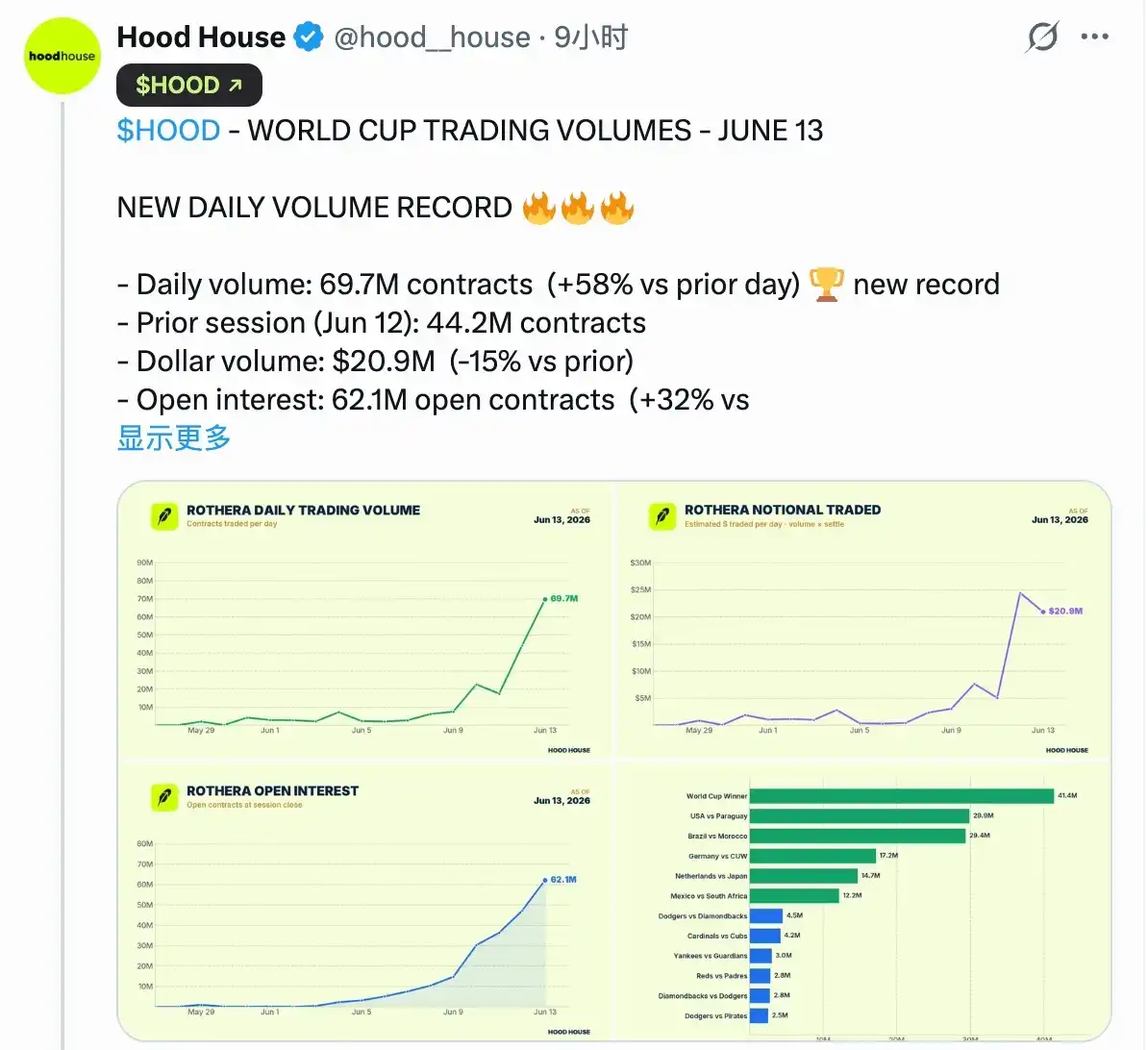
Judging by the results, Rothera clearly seized this opportunity. According to data disclosed by Hood House, an investment research media tracking Robinhood's activities, on June 12, Rothera completed 44.2 million contract trades, corresponding to a dollar trading volume of approximately $24.4 million; on June 13, Rothera completed 69.7 million contract trades, corresponding to a dollar trading volume of approximately $20.9 million... Although these figures still lag behind Kalshi's popular markets, which often involve hundreds of millions of dollars, considering that Rothera has literally just launched a few days ago, this performance is sufficiently successful.

For both Robinhood and Kalshi, this signifies that the balance of their cooperation has begun to tilt. From Robinhood's perspective, the transaction fee revenue that previously had to be shared with Kalshi can now be kept more within its own ecosystem. From Kalshi's perspective, this means that one of its most important growth engines has begun to show signs of weakening.

And the World Cup is clearly just the beginning of Rothera's encroachment on Kalshi. Looking further into the future, Robinhood will inevitably expand Rothera's coverage to more sporting events, as well as economic and political themes. Those orders that originally flowed to Kalshi will be intercepted one by one by Rothera.

Since Robinhood and Kalshi have never publicly disclosed their revenue-sharing ratio (some reports say 50%:50%, but no official information is available), we cannot know the exact monetary value of this interception. However, considering that Robinhood alone generated $147 million in predictive market-related revenue in Q1, and the Q2 World Cup and the more distant mid-term elections will likely bring even larger-scale trading activities, calculated on an annual basis, the value of this interception could reach several billion dollars.

Who Controls Distribution, Controls Everything

The drama of Robinhood and Kalshi moving from allies to opponents once again illustrates a logic repeatedly proven in the internet market — products are easy to build, but traffic is hard to find; whoever controls distribution controls everything.

Over the past few years, the market generally believed that Kalshi's core moat came from regulatory licenses, exchange qualifications, and clearing capabilities. Therefore, whether it was brokers like Robinhood or various media, communities, and traffic platforms, they were essentially just Kalshi's channel partners and traffic inlets. However, the emergence of Rothera proves one thing: in today's landscape of severe product homogenization, the product itself might not be the most critical element. What is truly scarce is always the user.

Where the users are, the liquidity is; where the liquidity is, the market will be. When Robinhood controls the access to tens of millions of retail users, it has the full capability to direct these users to any trading venue. For users, they don't care whether their orders are ultimately executed on Kalshi or Rothera. As long as the experience doesn't significantly differ, it doesn't matter who is matching or clearing behind the scenes.

If the theme of the predictive market industry in the past few years was the market battle between Polymarket and Kalshi, then the theme for the coming years might become a channel war. Robinhood incubating Rothera is essentially a reverse integration initiated by the channel side towards the market layer. As more and more platforms with traffic inlets begin to realize the strategic value of predictive markets, similar stories are highly likely to continue occurring. Whether it's exchanges, brokers, social platforms, or media platforms, they could all become new predictive market entry points.

And when inlets start to control the market, and channels begin to have pricing power, the ultimate winner in the predictive market industry might no longer be the platform responsible for order matching, but the one closest to the user and most capable of controlling distribution.

This was true in the internet era and the mobile internet era. This time, there's no exception either.


Трендові криптовалюти

Пов'язані питання

QAccording to the article, why did Robinhood partner with Kalshi initially?

ARobinhood partnered with Kalshi in March 2025 to leverage Kalshi's established product and regulatory infrastructure to offer prediction market trading services to its users. This allowed Robinhood to enter the prediction market quickly while Kalshi gained access to Robinhood's large retail user base.

QWhat is the core reason Robinhood decided to develop its own prediction market platform, Rothera Exchange?

AThe core reason is that Robinhood realized it controlled the most critical resource: the user distribution channel. Since users only interacted through the Robinhood app and didn't care about the backend infrastructure, Robinhood saw an opportunity to capture more revenue by diverting orders from Kalshi to its own controlled platform, thereby keeping more of the transaction fees.

QWhat event did Robinhood choose to launch Rothera Exchange, and why was it strategic?

ARobinhood strategically chose the 2026 FIFA World Cup to launch Rothera Exchange. The World Cup is a major event that generates high trading volume and attracts many new users to prediction markets, making it an ideal scenario for the platform's initial growth and market penetration.

QHow significant was the volume of prediction market trades for Robinhood in Q1 of 2026 according to the article?

AAccording to the article, Robinhood's Q1 2026 earnings report showed it facilitated 8.8 billion event contracts, driving a 320% year-over-year growth in 'other transaction revenue' to $147 million. This made prediction markets the fastest-growing new business line for Robinhood at the time.

QWhat broader industry shift does the article suggest is occurring with the rise of Rothera and similar moves by other platforms?

AThe article suggests the industry is shifting from a market-centric competition (like between Polymarket and Kalshi) to a 'channel war' or 'distribution war.' Platforms with large user bases and distribution power (like Robinhood, brokerages, social media) are recognizing the value of prediction markets and may integrate or build their own, challenging the dominance of pure infrastructure providers.

Пов'язані матеріали

7 Months After the Collapse of Huiwang, Southeast Asia's Escrow Platforms Undergo a Major Reshuffle

Following the collapse of Huione Pay—dubbed the "Alipay of Southeast Asia"—seven months ago, the region's underground financial guarantee platform sector is undergoing a significant reshuffle. This power vacuum has been swiftly filled by emerging platforms such as XinBi, Tiger/Navigator, JinBei (renamed JinBo), Dali/Tiancheng, and FullyLight. These platforms, operating largely via Telegram and offering services like escrow for illicit transactions, have absorbed the vast user base and markets left behind by Huione. While positioning themselves as "trust intermediaries," their primary clientele consists of networks involved in online scams, money laundering, illegal gambling, and even human trafficking. For instance, the Tiger/Navigator platform explicitly provides "escrow" services for kidnapping-for-ransom operations ("强押车交易"). Data underscores the immense scale: Huione alone processed over $103 billion in cryptocurrency payments and facilitated over $31 billion through its escrow market before its downfall, linking it to Cambodia's notorious Prince Group. Since its collapse, competitors have seen explosive growth. For example, the XinBi platform has accumulated over $1.6 billion in total USDT revenue, while platforms like NewPay, OkPay (under Dali), and FullyLight Wallet collectively processed over $4.8 billion in USDT in a single year. This ecosystem thrives in regions like Cambodia and Myanmar, where regulatory gaps allow these platforms to act as critical financial infrastructure for sprawling cybercrime industries, from scam compounds to online casinos. The article concludes that the moniker "Southeast Asian Alipay" is a misnomer, obscuring the platforms' fundamental role in enabling serious criminal enterprises rather than representing legitimate financial innovation.

Odaily星球日报20 хв тому

7 Months After the Collapse of Huiwang, Southeast Asia's Escrow Platforms Undergo a Major Reshuffle

Odaily星球日报20 хв тому

The Changing Landscape: What Are Crypto VCs Experiencing?

Title: The Shifting Landscape of Crypto Venture Capital The era of dedicated crypto venture capital funds is undergoing a significant transformation. Once essential for navigating the sector's complexity and high risk, these specialized funds are now facing an identity crisis as the market matures. This shift mirrors historical patterns in other specialized investment classes like cleantech and SPACs, where initial information advantages dissipate as technologies become mainstream and integrated into existing industry frameworks. The article argues that crypto is reaching a critical inflection point, transitioning from a "building phase" to an "integration phase." Major players like Stripe, BlackRock, and Visa now engage with crypto not for its novel mechanics but as a foundational financial infrastructure. Their needs—regulatory compliance, banking partnerships, distribution channels—align with traditional fintech, a domain easily understood by large, generalist funds like Sequoia and Founders Fund. This evolution creates a "barbell effect" within the VC landscape. On one end are massive, diversified platforms that can incorporate crypto as one vertical among many. On the other are small, nimble funds focused on niche, experimental projects. The middle ground—medium-sized dedicated crypto funds—is being squeezed out. Their typical fund size makes it impossible to generate sufficient returns solely from early-stage crypto bets, yet they cannot compete with giants for later-stage deals. Consequently, leading crypto-native firms like Paradigm and Framework Ventures are expanding into AI, robotics, and other sectors, driven partly by LP pressure for better returns amid a broader VC DPI crisis. Others, like Dragonfly and a16z, have narrowed their crypto focus predominantly to financial infrastructure like stablecoins, reframing the sector's core narrative. For crypto entrepreneurs, this consolidation presents challenges. While generalist funds offer larger checks and broader resources, crypto projects now compete fiercely with AI for attention and capital within these firms. Furthermore, the long-term, non-commercial foundational work that built the ecosystem—funded by dedicated crypto VCs—is less likely to attract generalist capital focused on direct returns. The conclusion is that "crypto investor" as a standalone category is becoming obsolete, akin to "internet investor." Crypto is becoming a baseline infrastructure layer. The future will see a barbell structure: large-scale growth financing handled by generalist funds, while pioneering, speculative projects are funded by small, specialized vehicles. The dedicated crypto funds of the 2017-2021 boom, which incubated core infrastructure, are giving way to this new, bifurcated reality.

Foresight News37 хв тому

The Changing Landscape: What Are Crypto VCs Experiencing?

Foresight News37 хв тому

As Consensus Accelerates, What Are Young Investors Betting On?

Title: As Consensus Forms Faster, What Are Young Investors Betting On? In the rapid evolution of tech investment, a new generation of young investors is navigating a landscape where AI, robotics, commercial aerospace, and quantum computing are advancing simultaneously. Traditional investment logic based on financial models is giving way to a need for deep technical understanding and the ability to act before industry consensus forms. An analysis of trends from the "WAIC FUTURE TECH" list of young investment leaders reveals key shifts in focus. The first major trend is the movement of AI from the digital screen into the physical world. Investment is shifting from large language models and chatbots towards embodied AI, robotics, AI hardware, and edge computing. While demonstrations generate excitement, the real challenge lies in achieving scalable, reliable, and cost-effective delivery in complex real-world environments like factories and logistics. Success depends not just on algorithms but on the integration of sensors, actuators, and control systems. Second, the competitive focus for large models is moving beyond raw capability toward building an "intelligence flywheel." The goal is to create self-reinforcing systems where user interaction generates data, improving the model, which in turn enhances the user experience and attracts more engagement. Companies that successfully embed AI into workflows to create these closed-loop systems can build lasting value that isn't easily erased by the next model upgrade. Third, facing a potential bottleneck in high-quality human-generated data, investors are looking at new underlying technologies. Reinforcement learning and self-play, as demonstrated by AlphaGo Zero, offer paths for AI to generate its own experience. Scientific foundation models, which aim to build general AI capabilities for fields like life sciences and materials discovery, represent a non-consensus direction that could unlock new frontiers of knowledge and data. Finally, in deep-tech areas like quantum computing, commercial aerospace, and space-based infrastructure, patient capital is essential. These fields have long, uncertain development and validation cycles involving complex engineering, supply chains, and regulations. Investment here requires a long-term view, focusing on foundational team capabilities and the eventual emergence of market demand, even if commercial returns are distant. Collectively, these trends illustrate how young investors are adapting to a new era. They are learning to make earlier, technically-informed judgments, balance hype with real-world viability, and provide the patient capital needed to build the deep-tech foundations of the future.

marsbit1 год тому

As Consensus Accelerates, What Are Young Investors Betting On?

marsbit1 год тому

Торгівля

Спот

Популярні статті

Як купити T

Ласкаво просимо до HTX.com! Ми зробили покупку Threshold Network Token (T) простою та зручною. Дотримуйтесь нашої покрокової інструкції, щоб розпочати свою криптовалютну подорож.Крок 1: Створіть обліковий запис на HTXВикористовуйте свою електронну пошту або номер телефону, щоб зареєструвати обліковий запис на HTX безплатно. Пройдіть безпроблемну реєстрацію й отримайте доступ до всіх функцій.ЗареєструватисьКрок 2: Перейдіть до розділу Купити крипту і виберіть спосіб оплатиКредитна/дебетова картка: використовуйте вашу картку Visa або Mastercard, щоб миттєво купити Threshold Network Token (T).Баланс: використовуйте кошти з балансу вашого рахунку HTX для безперешкодної торгівлі.Треті особи: ми додали популярні способи оплати, такі як Google Pay та Apple Pay, щоб підвищити зручність.P2P: Торгуйте безпосередньо з іншими користувачами на HTX.Позабіржова торгівля (OTC): ми пропонуємо індивідуальні послуги та конкурентні обмінні курси для трейдерів.Крок 3: Зберігайте свої Threshold Network Token (T)Після придбання Threshold Network Token (T) збережіть його у своєму обліковому записі на HTX. Крім того, ви можете відправити його в інше місце за допомогою блокчейн-переказу або використовувати його для торгівлі іншими криптовалютами.Крок 4: Торгівля Threshold Network Token (T)Легко торгуйте Threshold Network Token (T) на спотовому ринку HTX. Просто увійдіть до свого облікового запису, виберіть торгову пару, укладайте угоди та спостерігайте за ними в режимі реального часу. Ми пропонуємо зручний досвід як для початківців, так і для досвідчених трейдерів.

486 переглядів усьогоОпубліковано 2024.12.10Оновлено 2026.06.02

Як купити T

Обговорення

Ласкаво просимо до спільноти HTX. Тут ви можете бути в курсі останніх подій розвитку платформи та отримати доступ до професійної ринкової інформації. Нижче представлені думки користувачів щодо ціни T (T).

活动图片












