Robinhood Chain's First Breakout Hit Is a Meme Cat: Retail Investors Dig Out CashCat's 'Original Name,' CEO Jumps on the Trend

marsbitОпубліковано о 2026-07-08Востаннє оновлено о 2026-07-08

Анотація

Robinhood Chain launched its mainnet on July 1st, promoting tokenized U.S. stocks as its core feature. However, the first asset to gain significant traction was a meme token called CASHCAT, which surged over 1700% in 24 hours, reaching a market cap of $120 million. The token's narrative stems from Robinhood's early history: CEO Vlad Tenev revealed the company's initial working name was "CashCat." CASHCAT has no official ties to Robinhood and declares itself as "pure cat" with zero utility. Tenev added fuel by tweeting on July 8th that the chain is "great for memes," which the community saw as implicit approval. The hype has attracted copycat tokens on other chains like Solana and impersonator accounts promoting scams. The article highlights the extreme volatility and risks associated with this new, illiquid meme token on a fledgling blockchain, cautioning investors to verify contracts and treat any investment as high-risk speculation.

Author: Claude, Shenchao TechFlow

Shenchao Introduction: One week after the Robinhood Chain mainnet launch, while the officially promoted stock token hasn't gone viral yet, a Meme cat called CASHCAT has taken off first, with its price surging over 1700% in 24 hours at one point and its market cap exceeding $120M. Its entire narrative boils down to one sentence: the working name for Robinhood during its startup phase was CashCat. CEO Tenev himself shared this history and even tweeted a meme on the day of the surge. Meanwhile, copycat tokens and fake 'Roaring Kitty' shilling accounts are already in position.
Attracting traffic and retail investor attention still depends on Memes.

Robinhood spent a year paving the way for its own blockchain, pitching tokenized stocks as the core story. However, the first truly viral asset on the chain turned out to be a cartoon cat holding cash.

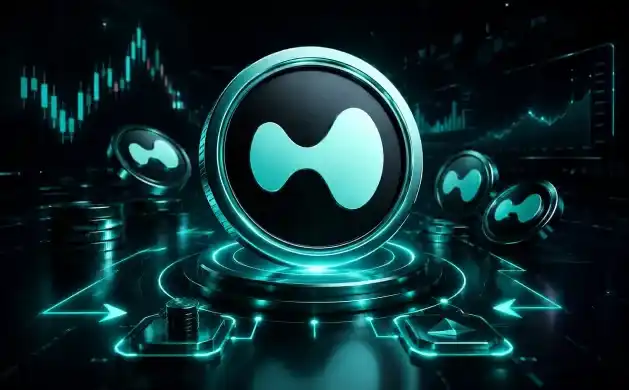
According to GMGN monitoring, on July 8th, the market capitalization of the Meme token CASHCAT on Robinhood Chain exceeded $120 million, with a 24-hour increase of over 1700%. In the following hours, readings from different data platforms continued to rise. According to CoinGecko data, CASHCAT primarily trades on the Uniswap V3 deployed on Robinhood Chain, with the CASHCAT/WETH pair seeing a 24-hour trading volume of approximately $28 million. For a new chain that has only been live for a week and has very few ecosystem applications, this cat is the current traffic itself.

Seventh Day Post-Mainnet Launch, The First Viral Asset Is a Meme

First, some background.

On July 1st, Robinhood officially launched the public mainnet for Robinhood Chain at an event in London. This is an Ethereum Layer 2 based on Arbitrum technology, unveiled by CEO Vlad Tenev and crypto business head Johann Kerbrat. The official positioning of this chain is quite 'serious'. Its core product, Stock Tokens, tracks the price performance of over 200 US stocks and ETFs and is open to users in over 120 jurisdictions (excluding US users). DeFi protocols like Uniswap and 1inch were deployed on day one, and Robinhood pledged to cover all Gas fees for the first 90 days.

According to the official script, the protagonists of this chain should have been tokenized stocks and RWA (Real World Assets). However, the script didn't follow the plan. In the first week after the mainnet launch, the most actively traded pair on the chain wasn't any stock token, but CASHCAT. Retail investors set the tone for this 'retail broker's chain' first.

A clear warning for holders: CASHCAT's current trading depth is concentrated on a single trading pair within a single DEX. Liquidity is thin on a new chain, price readings vary significantly across platforms, and both slippage and wick risk upon entry/exit are far higher than for Memes on mature chains.

Archaeology of the 'Original Name', Tenev Himself Told the CashCat Story

CASHCAT's success relies on a real piece of company history.

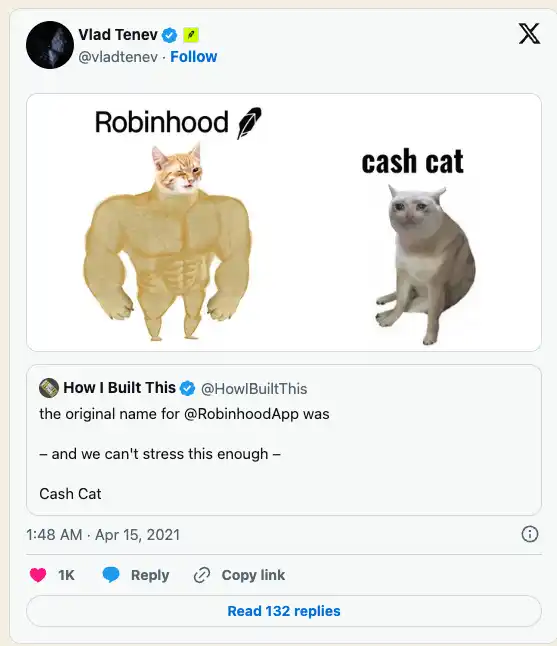
In early interviews, Tenev recalled the company naming process: "The original working name was actually CashCat, but everyone felt it wasn't powerful enough. My wife would introduce me to her friends by saying, 'They're the Robin Hoods of finance, doing things for the little guy.' That's how the name Robinhood stuck." This account has been cited in numerous company retrospectives after the GameStop saga, making it verifiable 'archaeological material.' This is the biggest difference between CASHCAT and other cat/dog coins built on fabricated stories.

The token's structure is as simple as it gets. According to the project's website, the total supply is 1 billion tokens, with zero buy/sell taxes. The liquidity pool tokens have been fully burned, and it self-identifies as "zero utility, one hundred percent cat." The website also explicitly states that the project has no affiliation with Robinhood, calling it "fan fiction with a ticker."

The narrative is real, the product is unrelated. Readers need to distinguish these two facts: Robinhood's history provides this cat with viral material, but the company does not endorse it. The token's value is built entirely on attention, with no safety net when that attention fades.
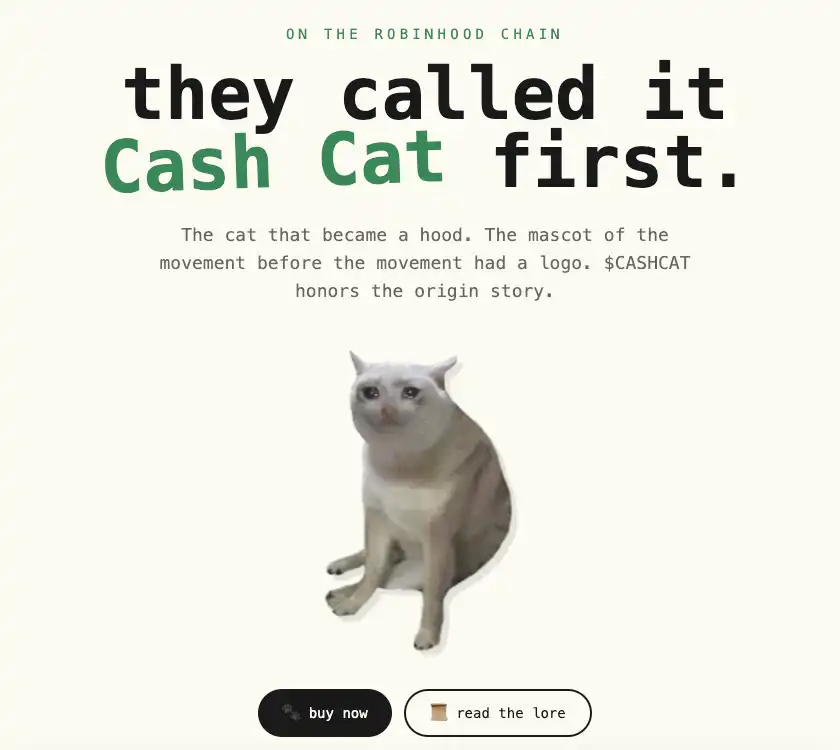
Tenev Tweets Meme, Market Interprets It as Semi-Endorsement

What truly pushed the frenzy to its peak was Tenev himself.

On July 8th, Tenev posted on X (formerly Twitter): "We're making Robinhood Chain the best RWA public chain... but it runs Memes really well too." The post garnered over 500,000 views within hours. While he didn't mention CASHCAT by name, the timing coincided with the day of the massive surge. The community interpreted it as implicit approval, if not an assist, for the Meme frenzy on the chain.

There's a layer of historical irony here. During the 2021 GameStop short squeeze, Robinhood was thrust into Congressional hearings for restricting retail buys of GME, becoming the 'villain' in the retail narrative. Five years later, this company's blockchain completes its cold start, precisely relying on the Meme culture that retail investors excel at, with the object of speculation being the name the company itself discarded. The CASHCAT website even specifically plays on this irony: "Cash Cat doesn't do options, and it doesn't do PFOF (Payment for Order Flow)."
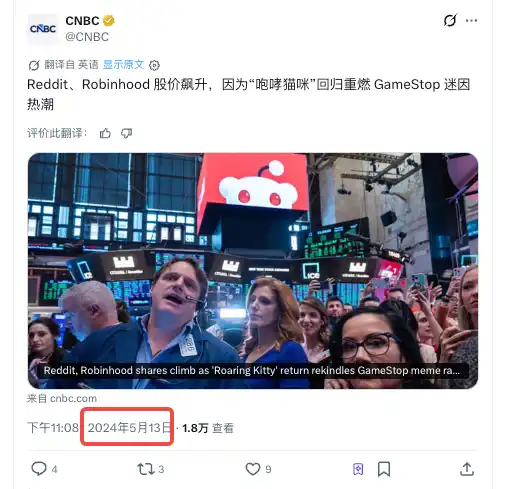
For traders, it's necessary to heavily discount the actual value of this tweet. A playful tweet from Tenev and an official Robinhood endorsement are separated by an entire compliance department. The company has no commitments regarding custody, listing, or providing liquidity for the Meme token. The effectiveness of such sentiment catalysts typically lasts only hours.

Copycat Tokens and Fake 'Roaring Kitty' Accounts Are Already in Position

Once the heat arrived, the tools to hunt retail investors followed.

First, cross-chain copycat tokens. According to aggregated monitoring information from CoinGecko, an identically named CASHCAT has already been deployed on the Solana chain. The original contract is deployed on Robinhood Chain with an address starting with 0x020b and ending with 18b4; identically named tokens on other chains are unrelated to the original.

Second, impersonator accounts shilling. For example, an X account with the handle "RK" and a username highly similar to GameStop saga protagonist 'Roaring Kitty' Keith Gill tweeted, "CASHCAT is the first major Meme on Robinhood chain," and included a Solana contract address in the post.

New chain, new Meme, fake accounts, cross-chain copycats—this combination has claimed victims in every past Meme cycle. If you still decide to participate now, at least do these three things: verify the contract address, use only official or reputable cross-chain bridges, and keep your position size to lottery-ticket levels.

CASHCAT's current total value is just a good story plus a wave of attention, neither of which has a retention mechanism.


Трендові криптовалюти

Пов'язані питання

QWhat is CASHCAT, and why did it become the first viral asset on Robinhood Chain after its mainnet launch?

ACASHCAT is a meme token featuring a cartoon cat holding cash. It became the first viral asset on Robinhood Chain, launched on July 1, due to its connection to Robinhood's early history. The name 'CashCat' was Robinhood's original working name before it adopted 'Robinhood,' a fact shared by CEO Vlad Tenev. The token's price surged over 1700% in 24 hours, capturing significant market attention and liquidity on the new chain.

QWhat historical anecdote about Robinhood gives CASHCAT its narrative foundation?

AThe narrative foundation for CASHCAT comes from an anecdote shared by Robinhood CEO Vlad Tenev. He revealed that the company's original working name during its early days was 'CashCat,' but it was changed to 'Robinhood' because the latter was perceived as more powerful and aligned with the idea of 'stealing from the rich to give to the poor.' This true piece of company history differentiates CASHCAT from other meme tokens with fabricated backstories.

QHow did Robinhood CEO Vlad Tenev's actions on social media contribute to the hype around CASHCAT?

AOn July 8, Vlad Tenev posted on X, stating, 'We're building Robinhood Chain to be the best RWA public chain... but it runs Memes pretty well too.' Although he didn't mention CASHCAT by name, the timing coincided with the token's massive price surge. The community interpreted the post as a tacit endorsement or acknowledgment of the meme token activity on the chain, significantly fueling the hype and market speculation.

QWhat are the key risks associated with trading CASHCAT as highlighted in the article?

AThe article highlights several key risks: 1) The token's trading is concentrated on a single DEX (Uniswap V3) and a single trading pair (CASHCAT/WETH) on the new Robinhood Chain, leading to thin liquidity. 2) This results in high slippage, price volatility, and significant differences in price readings across data platforms. 3) The token's value is based solely on a historical narrative and market attention, with no underlying utility or backing from Robinhood, making it highly susceptible to rapid value loss when hype fades.

QWhat fraudulent activities emerged following CASHCAT's price surge, and what precautions should investors take?

AFollowing the surge, fraudulent activities included: 1) The deployment of fake 'CASHCAT' tokens on other blockchains like Solana, which are unrelated to the original Robinhood Chain token. 2) Impersonator accounts on social media, such as one mimicking 'Roaring Kitty' (Keith Gill), promoting these fake tokens. Investors are advised to: verify the correct contract address (the original starts with 0x020b and ends with 18b4), use only official or reputable cross-chain bridges, and limit their investment to an amount they are prepared to lose ('lottery ticket' sized positions).

Пов'язані матеріали

Just Now, Sam Altman Blasts Dario Amodei as 'Anti-Human', Secret Model Exposed the Same Day

Just now, Sam Altman strongly criticized Dario (Amodei, co-founder of Anthropic), denouncing his "doomsday marketing" as "anti-human dictator rhetoric." This came alongside the accidental exposure of OpenAI's next-generation model, codenamed "gpt-nathree," hinting at the imminent release of GPT-6 Astra. The leak occurred when an OpenAI employee's public GitHub commit mentioned the codename. Combined with previous leaks of "gpt-mewfour," it suggests these are iterative checkpoints for OpenAI's upcoming agent model, Astra. Astra is known for multi-agent collaboration and long-duration task handling, having reportedly solved previously unsolved mathematical problems. Meanwhile, two new Anthropic model codenames, "claude-marshmallow-eap" and "claude-melon-eap," were also exposed but are believed to be iterations of the Claude 5 series, not a new flagship. In a wide-ranging podcast interview, Altman admitted he was wrong about the speed of AI-driven disruption, acknowledging societal inertia slows adoption. He fiercely criticized rivals' marketing that simultaneously promises immense benefits (like curing cancer) and warns of existential risk, calling it a dangerous "benevolent dictator" narrative that seeks to concentrate power. He emphasized that people are the ultimate purpose of AI. Altman also revealed OpenAI's unconventional, consensus-defying path: spending four and a half years in the "dark" without a public product before ChatGPT's breakthrough, driven by scaling laws rather than early customer feedback. He concluded that even with superintelligent AI, genuine human connection will remain irreplaceably valuable.

marsbit19 хв тому

Just Now, Sam Altman Blasts Dario Amodei as 'Anti-Human', Secret Model Exposed the Same Day

marsbit19 хв тому

The 'Saving U.S. Treasuries' Baton Pass: Bessent Fumbled Last Week, This Week It's Wash's Turn

"Rescuing US Treasuries" Relay: After Bessent's Miss, All Eyes Are on Walsh Last week, US Treasury Secretary Bessent's announcement to at least double long-term Treasury buybacks failed to sustainably lower yields, which quickly rebounded. The market response saw a drop in the dollar alongside surges in gold and Bitcoin, interpreted as a "pressure release valve" for anxiety. The focus now shifts to Fed Chairman Walsh's upcoming Jackson Hole speech. Markets are highly sensitive to his message, seeking clarity on the Fed's policy response to stubborn inflation and worsening fiscal conditions. Analysts warn that a lack of new guidance could disappoint markets and worsen the sell-off in long-dated bonds. Analysts question the scale of Bessent's operations, noting they are too small relative to the overall debt market and do not constitute quantitative easing. A key issue is the Fed's massive holdings of long-term bonds, which distorts the market. With the Fed holding low-yielding short-term bonds that are losing money relative to its policy rate, discussion is growing around a potential Fed-led "Operation Twist." This would involve selling short-term bonds to buy long-term ones, aiming to lower long-end yields without expanding the balance sheet. The upcoming PCE inflation data will set the stage for Walsh's speech. However, the window for action is narrowing amid political pressures. A critical threshold is the 30-year yield at 5%; holding above it could increase stress on the dollar and leveraged sectors. Overall, the article suggests that without coordinated Fed action to anchor inflation expectations, Treasury interventions may ultimately fail, with investors increasingly looking to assets like gold as hedges.

marsbit49 хв тому

The 'Saving U.S. Treasuries' Baton Pass: Bessent Fumbled Last Week, This Week It's Wash's Turn

marsbit49 хв тому

Hyperliquid's Compliance Journey: From Permissionless to Permissioned via HIP-3

Hyperliquid’s Compliance Path: From Permissionless to Permissioned HIP-3 Hyperliquid currently blocks U.S. access because its permissionless, on-chain infrastructure conflicts with U.S. market structure laws, which restrict futures trading to registered exchanges, clearinghouses, and brokers. Through its Hyperliquid Policy Center (HPC), the project is advocating for regulatory modernization, proposing that regulated entities be allowed to build products on HyperCore (its exchange and clearing layer) while fulfilling their compliance obligations. The platform’s modular stack separates roles like a traditional exchange (DCM), clearinghouse (DCO), and broker (FCM), but reconstructs them on-chain with code. This enables permissionless access, self-custody, and 24/7 global trading, but clashes with U.S. rules requiring KYC, specific margin models, and custodial arrangements. To resolve this, HPC is engaging with U.S. regulators (CFTC, SEC) to seek clarity that deploying on-chain software does not itself trigger licensing, and to establish exemptions allowing non-custodial wallets to route users to regulated derivatives. Recent political signals suggest openness to this approach. On the technical side, Hyperliquid Labs has introduced permissioned HIP-3 deployers on testnet. These allow regulated entities to launch markets, perform KYC, and whitelist compliant users. While these create separate order books, whitelisted market makers can bridge liquidity between them, ensuring deep, shared liquidity across the same L1. Features like payload-based “PA” permissions enable DEX-level account controls (e.g., reduce-only orders), mirroring traditional broker authorities. The strategy is not to open the native, permissionless front-end to U.S. users, but to position Hyperliquid as neutral infrastructure that U.S. regulated firms can use while meeting their legal duties. This paves a compliant path for U.S. investor access while preserving the protocol’s core, permissionless nature.

marsbit1 год тому

Hyperliquid's Compliance Journey: From Permissionless to Permissioned via HIP-3

marsbit1 год тому

Two Funding Rounds in Three Months: The Chinese Version of Palantir is on Fire

Investment Community AI has learned that Beijing Zhongshu Ruizhi Technology Co., Ltd., a domestic industrial-grade causal intelligence and high-reliability decision-making AI company, has recently completed a strategic financing round worth hundreds of millions of RMB. This round saw participation from China Internet Investment Fund, Suzhou Chuangtou National Social Security Fund, Financial Street Capital, ICBC Capital, Kunlun Capital, among others, with existing shareholders also increasing their investment. This follows a Series B funding round in the hundreds of millions completed just three months prior. The rapid succession of two major funding rounds signifies strong market recognition of the company's underlying original technology and scaled commercial implementation. Often referred to as the "Chinese version of Palantir," Zhongshu Ruizhi is entering a new phase of accelerated technological iteration, widespread scenario replication, and scaled performance release, mirroring the explosive growth of China's AI market. Founded in April 2020 by Dr. Han Han, a Tsinghua University Ph.D. and former core drafter of national AI policies, the company is mission-driven to "move AI from the digital world to the physical world." It focuses on the high-reliability, strong-decision industrial AI track and enterprise-grade AI Agent full-stack infrastructure. The team tackles the challenge of applying AI to China's vast and complex industrial and energy systems by developing a new intelligent operating system from scratch. Its core technological breakthrough lies in three proprietary底层 technologies: meta-causal cognitive theory, causal models, and a dynamic ontology engine. These address critical pain points of generative large models in industrial settings—such as AI hallucinations, insufficient reasoning, lack of temporal logic, unverifiable decisions, and multi-source rule conflicts—thereby providing trustworthy, explainable, and executable智能决策 capabilities. Commercially, Zhongshu Ruizhi has achieved scaled deployment, serving over 50 central state-owned enterprises and industrial groups in sectors like power, petroleum, and aerospace, with implementations in more than 800 highly complex production scenarios. The company reported doubled revenue in 2025, demonstrating strong self-sufficiency and a viable business model—a rarity among new-generation AI firms. The latest funds will be allocated towards advancing foundational theoretical research, replicating successful application models to expand market presence (including overseas), and attracting top-tier talent. Lead investor China Internet Investment Fund highlighted that in the current shift from general AI capability contests to deep industrial empowerment, industrial-grade causal intelligence is crucial for building China's modern digital foundation and fostering new quality productive forces. They expressed support for the company's efforts to define decision-making paradigms and trustworthy standards for industrial intelligence, aiming to secure a rule-making voice in the global physical AI arena.

marsbit1 год тому

Two Funding Rounds in Three Months: The Chinese Version of Palantir is on Fire

marsbit1 год тому

Торгівля

Спот

Популярні статті

Як купити CAT

Ласкаво просимо до HTX.com! Ми зробили покупку Simon's Cat (CAT) простою та зручною. Дотримуйтесь нашої покрокової інструкції, щоб розпочати свою криптовалютну подорож.Крок 1: Створіть обліковий запис на HTXВикористовуйте свою електронну пошту або номер телефону, щоб зареєструвати обліковий запис на HTX безплатно. Пройдіть безпроблемну реєстрацію й отримайте доступ до всіх функцій.ЗареєструватисьКрок 2: Перейдіть до розділу Купити крипту і виберіть спосіб оплатиКредитна/дебетова картка: використовуйте вашу картку Visa або Mastercard, щоб миттєво купити Simon's Cat (CAT).Баланс: використовуйте кошти з балансу вашого рахунку HTX для безперешкодної торгівлі.Треті особи: ми додали популярні способи оплати, такі як Google Pay та Apple Pay, щоб підвищити зручність.P2P: Торгуйте безпосередньо з іншими користувачами на HTX.Позабіржова торгівля (OTC): ми пропонуємо індивідуальні послуги та конкурентні обмінні курси для трейдерів.Крок 3: Зберігайте свої Simon's Cat (CAT)Після придбання Simon's Cat (CAT) збережіть його у своєму обліковому записі на HTX. Крім того, ви можете відправити його в інше місце за допомогою блокчейн-переказу або використовувати його для торгівлі іншими криптовалютами.Крок 4: Торгівля Simon's Cat (CAT)Легко торгуйте Simon's Cat (CAT) на спотовому ринку HTX. Просто увійдіть до свого облікового запису, виберіть торгову пару, укладайте угоди та спостерігайте за ними в режимі реального часу. Ми пропонуємо зручний досвід як для початківців, так і для досвідчених трейдерів.

285 переглядів усьогоОпубліковано 2024.12.13Оновлено 2026.06.02

Як купити CAT

Що таке TRUMP CAT

Трамп Кіт Сім'я, $Трамп Кіт: Розгадана Таємниця Вступ У постійно змінюваному ландшафті крипто-проектів та інновацій web3 виникло цікаве явище — таке, що, здається, перебуває на межі між криптовалютою та культурою інтернет-мемів. Це загадкова “Трамп Кіт Сім'я”, також відома як “$Трамп Кіт”. Хоча це може викликати цікавість серед криптоентузіастів, реальність виглядає набагато далі від стандартного визначення крипто-проекту. Ця стаття має на меті дослідити концепцію Трамп Кіт Сім'ї, висвітлити контекст, що її оточує, та прояснити її статус у крипто-сфері. Що таке Трамп Кіт Сім'я, $Трамп Кіт? На перший погляд, можна подумати, що “Трамп Кіт Сім'я” стосується легітимної криптовалюти або проекту web3. Однак, при глибшому розслідуванні стає очевидним, що термін позбавлений атрибутів традиційного крипто-підприємства. Натомість “Трамп Кіт” здається переважно пов'язаним з вірусною культурою мемів, що виникла після суперечливих висловлювань колишнього президента США Дональда Трампа щодо гаїтянських іммігрантів. Медійне висвітлення викликало безліч мемів, гумористичних інтерпретацій та хвилю соціальних коментарів. Ці меми зображують різні форми сатири, зосереджені на діалозі Трампа, часто використовуючи котів у комедійних і часом абсурдних сценаріях. Замість структурованого проекту, спрямованого на вирішення технологічних досягнень або фінансових транзакцій, концепція “Трамп Кіт Сім'я” існує переважно в царині інтернет-гумору. Хто є творцем Трамп Кіт Сім'ї, $Трамп Кіт? При розслідуванні того, хто стоїть за “Трамп Кіт Сім'єю”, стає очевидним, що не існує впізнаваного творця або засновника. Це явище, здається, виникло з колективного вираження в інтернеті, а не від єдиного візіонера з визначеною метою проекту. Ця анонімність ще більше підкреслює його статус як мем, а не структуровану ініціативу, подібну до більшості відомих крипто-проектів. Хто є інвесторами Трамп Кіт Сім'ї, $Трамп Кіт? Оскільки “Трамп Кіт Сім'я” не відповідає характеристикам авторитетного крипто-проекту, питання інвестицій стає недоцільним. Не було жодних заснованих фондів або організацій, які б висловлювали підтримку проекту з такою назвою. Натомість існують окремі учасники мем-культури — хобісти, художники та користувачі соціальних мереж, які колективно заповнюють інтернет своїми інтерпретаціями та гумором навколо терміна “Трамп Кіт”. Цей органічний ріст у цифровій людській комунікації більше відображає соціальний коментар, ніж фінансовий інвестиційний ландшафт. Як працює Трамп Кіт Сім'я, $Трамп Кіт? Якщо хтось прагне з'ясувати, як “Трамп Кіт Сім'я” функціонує, відповідь кардинально відрізняється від того, що можна було б очікувати від стандартних крипто-проектів. Не існує операційних механізмів, технологічних інновацій або унікальних особливостей, притаманних цьому явищу. Натомість воно існує через вірусне поширення в інтернеті, покладаючись на платформи соціальних медіа для розповсюдження. “Як” лежить у царині культури та комунікації — його суть походить з динаміки соціальної взаємодії, а не з усталених крипто-протоколів або функціональностей блокчейну. Те, що робить “Трамп Кіт” унікальним, якщо це можна так назвати, — це спосіб, яким він драматизує політичний діалог через гумор. Люди використовують захоплюючі візуальні образи, внутрішні жарти та креативне оповідання, щоб передати почуття щодо політичних фігур і соціальних проблем. Сила мемів виходить за межі традиційної комунікації, втілюючи складні думки в формі, яка широко резонує, але залишається неясною з точки зору кількісного успіху або структурованих цілей. Хронологія Трамп Кіт Сім'ї, $Трамп Кіт Вересень 2024: Дискурс навколо коментарів Дональда Трампа щодо гаїтянських іммігрантів, які нібито споживають домашніх тварин, набирає популярності в інтернеті, що призводить до розквіту мемів та пародійних інтерпретацій на різних платформах. Триваючий вплив: Після цього періоду явище “Трамп Кіт” продовжує жити, оскільки користувачі соціальних медіа використовують гумор, щоб торкнутися, критикувати або просто святкувати абсурдність політичних розмов і подій. Важливо зазначити, що оскільки “Трамп Кіт Сім'я” не має формальної структури традиційного проекту, хронологія складається переважно з анекдотичних спостережень, а не з визначних віх, які зазвичай зустрічаються в визнаних крипто-підприємствах. Ключові моменти Культура мемів: Замість структурованої крипто-ініціативи “Трамп Кіт” більше відповідає еволюціонуючому ландшафту інтернет-мемів. Походження терміна: Генезис “Трамп Кіт” безпосередньо пов'язаний з коментарями президента Трампа щодо гаїтянських іммігрантів, що викликало широке гумористичне представлення. Відсутність проектної структури: Термін не відповідає жодним визначеним проектним цілям, творцям або інвесторам, що позначає його як новий культурний досвід, а не крипто-проект. Висновок Підсумовуючи, розслідування “Трамп Кіт Сім'я, $Трамп Кіт” виявляє явище, укорінене в культурі інтернет-мемів, а не визнаному проекті в секторах криптовалюти чи web3. Вірусність терміна виникає з колективної участі користувачів, відображаючи сучасний цифровий дискурс, а не формалізовану ініціативу зі структурою чи стратегічним баченням. Для всього інтересу, який це може викликати серед тих, хто шукає наступний великий крипто-проект, “Трамп Кіт Сім'я” слугує свідченням творчості людства, гумору та часто абсурдних стосунків з політикою в цифрову епоху.

403 переглядів усьогоОпубліковано 2025.01.22Оновлено 2025.01.22

Що таке TRUMP CAT

Обговорення

Ласкаво просимо до спільноти HTX. Тут ви можете бути в курсі останніх подій розвитку платформи та отримати доступ до професійної ринкової інформації. Нижче представлені думки користувачів щодо ціни CAT (CAT).

活动图片