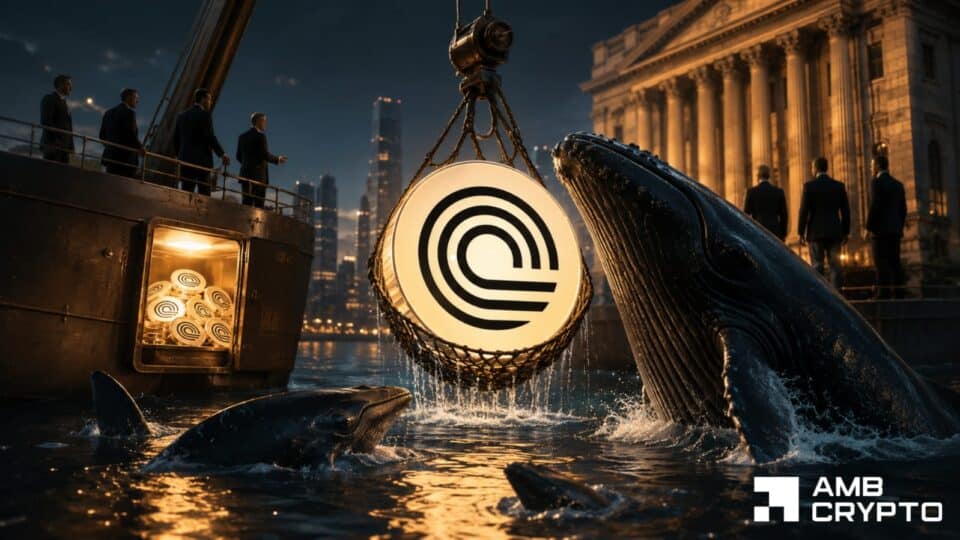
Robinhood Chain Testnet Hits 4M Transactions in Week One

TheNewsCryptoОпубліковано о 2026-02-19Востаннє оновлено о 2026-02-19

Анотація

Robinhood Chain, the company's Ethereum Layer 2 testnet built on Arbitrum, processed 4 million transactions in its first week, indicating strong developer interest. Launched on February 10 after six months of private testing, the permissionless blockchain is designed for high-throughput financial applications, including tokenized equities and ETFs. CEO Vlad Tenev emphasized the platform's role in the future of on-chain finance. Despite a 38% year-over-year drop in Q4 2025 crypto revenue, Robinhood plans to expand its tokenized stock offerings with 24/7 trading and self-custody. The mainnet is expected to launch later this year.

The public testnet of Robinhood for its own blockchain has captivated four million transactions in its initial week, as per the chief executive officer of the firm, Vlad Tenev.

On February 18, Tenev posted on X stating that developers are so far making our L2, made for tokenised real-world assets and on-chain financial services. The upcoming chapter of finance operates on-chain.

The U.S. financial trading giant rolled out the testnet for Robinhood Chain on February 10 as an Ethereum Layer 2 made on Arbitrum. The chain, which went through six months of private testing before the public testnet rollout, is made as a permissionless blockchain platform for high-throughput financial applications, having native support for tokenised equities, ETFs, and other real-world assets.

The Plan of Widening

Robinhood has so far amalgamated prominent infrastructure partners, comprising Alchemy, LayerZero and Chainlink. The quick accumulation of transactions through the testnet shows strong early developer interest in the network, which mostly strengthens the long-term aim of crypto and the tokenisation of Robinhood, regardless of the recent market pullback.

Robinhood witnessed its crypto transaction revenue slip 38% year-over-year to $221 million at the time of Q4 of 2025. Robinhood publicised in January 2026 that it plans to widen its tokenized stock offering to comprise round-the-clock trading, near-real-time settlement and self-custody.

The CEO has so far contrasted tokenisation to a freight train, mentioning that it “can’t be stopped” and will then end the whole financial system. The imminent rollout of Robinhood Chain is anticipated later this year, though the exact date of the launch hasn’t been announced yet.

Made on Arbitrum, Robinhood Chain was launched by Johann Kerbrat, SVP and General Manager of Robinhood Crypto at Consensus Hong Kong. The launch became the first one after being announced at the Cannes keynote of the company in 2025.

The testnet will give developers access to entry points, documentation and complete compatibility with standard Ethereum tools.

Highlighted Crypto News Today:

Ethereum Sets Three Core Priorities for 2026 Protocol Development

TagsMainnetRobinhoodTestnet

Трендові криптовалюти

Пов'язані питання

QHow many transactions did the Robinhood Chain testnet process in its first week?

AThe Robinhood Chain testnet processed four million transactions in its initial week.

QOn which Layer 2 scaling solution is the Robinhood Chain built?

AThe Robinhood Chain is built on Arbitrum as an Ethereum Layer 2.

QWhat is the primary purpose of the Robinhood Chain as stated by the company?

AThe Robinhood Chain is designed as a permissionless blockchain platform for high-throughput financial applications, with native support for tokenized equities, ETFs, and other real-world assets.

QWhich three infrastructure partners did Robinhood integrate for its chain?

ARobinhood integrated three prominent infrastructure partners: Alchemy, LayerZero, and Chainlink.

QWhat key feature did Robinhood announce it would add to its tokenized stock offering in January 2026?

AIn January 2026, Robinhood announced plans to widen its tokenized stock offering to include round-the-clock trading, near-real-time settlement, and self-custody.

Пов'язані матеріали

Global Stock Market's Storm Center: South Korea's Stock Market De-leveraging Is Largely Complete

Storm's Eye: South Korean Market De-leveraging Nears Completion The recent sharp correction in South Korean equities, with the KOSPI index dropping 32% from its June high, has been a key trigger for global tech stock volatility. The core driver was not a fundamental shift but a forced de-leveraging process within the market's unique structure, which is now largely complete. Two main leverage channels amplified the sell-off: 1. **Leveraged ETFs:** Their size, proportionally four times larger than in the U.S., peaked near $50 billion. Their mandatory daily rebalancing mechanism created a vicious cycle of "price drop → forced selling → further drop." Approximately 75% of this excess has been unwound, shrinking to $26 billion, with regulatory curbs now blocking new inflows. 2. **Hedge Fund Leverage:** Using swaps to magnify exposure, hedge funds saw their net long positioning fall by over 50% from peak levels. The most intense phase of this institutional de-leveraging is over. In contrast, **retail margin debt** poses minimal systemic risk. At 0.5% of market cap, it is far lower than in the U.S. or China, lacks automatic triggers, and is concentrated in smaller stocks. The conclusion: the high-leverage structures most prone to "chain-reaction selling" have been substantially cleared. The market is transitioning from a liquidity-driven crash to one priced more on fundamentals. The article argues that the AI trend—centered on Korean memory chips—remains intact. This episode represents a painful but necessary clearing of crowded trades, not the end of the AI revolution. For investors, the key question is conviction in the long-term AI direction; if the trend is real, current volatility is a cost of entry, not a terminal risk.

链捕手46 хв тому

Global Stock Market's Storm Center: South Korea's Stock Market De-leveraging Is Largely Complete

链捕手46 хв тому

The Eternal Fragments of Money: Third-Party Payment Has No First Principle

"The Enduring Fragments of Money: Third-Party Payments Lack a First Principle" Stripe is reportedly attempting to acquire PayPal, marking a significant shift reminiscent of PayPal's merger with the original X.com 30 years ago. The article analyzes Stripe's strategic challenges and the broader payments industry landscape. Despite its initial success with a developer-friendly API model, Stripe missed its optimal IPO window during the pandemic and has since seen its valuation decline. Its attempts to expand through acquisitions and new ventures, particularly in stablecoins (like its OUSD project) and Agent-focused payments (ACP/MPP protocols), have faced headwinds. The author argues that the payment industry remains highly fragmented and is ultimately an adjunct to the traditional banking system. This structure limits the potential for any single player, including Stripe, to achieve complete dominance. While stablecoins and the future rise of autonomous Agent economies present potential growth avenues, they are not yet mainstream and still require integration with the existing financial system. For now, Agent-based transactions are largely used for speculative "volume boosting" rather than substantive business applications. Stripe's current move to acquire PayPal is seen as an attempt to bolster its weak consumer-facing (C-side) business after its stablecoin-focused strategies faltered. Meanwhile, PayPal is described as structurally outdated, unable to revive itself through new products like Venmo or PYUSD. The future of payments may lie not in payments themselves but in value-added services like more efficient settlement networks. The author suggests that companies like Stripe and Circle, which are building their own blockchains (Tempo, Arc) and stablecoins, are positioning themselves to eventually profit from high-efficiency settlement systems. These new networks could potentially bypass some traditional banking layers. In conclusion, the article posits that third-party payment is a perpetually fragmented battlefield where scale alone cannot ensure victory. Players must find new models, focusing on efficiency to compete with the entrenched banking system. Stripe's acquisition of PayPal represents a bet on this uncertain future.

链捕手1 год тому

The Eternal Fragments of Money: Third-Party Payment Has No First Principle

链捕手1 год тому

Торгівля

Спот

Популярні статті

Як купити ONE

Ласкаво просимо до HTX.com! Ми зробили покупку Harmony (ONE) простою та зручною. Дотримуйтесь нашої покрокової інструкції, щоб розпочати свою криптовалютну подорож.Крок 1: Створіть обліковий запис на HTXВикористовуйте свою електронну пошту або номер телефону, щоб зареєструвати обліковий запис на HTX безплатно. Пройдіть безпроблемну реєстрацію й отримайте доступ до всіх функцій.ЗареєструватисьКрок 2: Перейдіть до розділу Купити крипту і виберіть спосіб оплатиКредитна/дебетова картка: використовуйте вашу картку Visa або Mastercard, щоб миттєво купити Harmony (ONE).Баланс: використовуйте кошти з балансу вашого рахунку HTX для безперешкодної торгівлі.Треті особи: ми додали популярні способи оплати, такі як Google Pay та Apple Pay, щоб підвищити зручність.P2P: Торгуйте безпосередньо з іншими користувачами на HTX.Позабіржова торгівля (OTC): ми пропонуємо індивідуальні послуги та конкурентні обмінні курси для трейдерів.Крок 3: Зберігайте свої Harmony (ONE)Після придбання Harmony (ONE) збережіть його у своєму обліковому записі на HTX. Крім того, ви можете відправити його в інше місце за допомогою блокчейн-переказу або використовувати його для торгівлі іншими криптовалютами.Крок 4: Торгівля Harmony (ONE)Легко торгуйте Harmony (ONE) на спотовому ринку HTX. Просто увійдіть до свого облікового запису, виберіть торгову пару, укладайте угоди та спостерігайте за ними в режимі реального часу. Ми пропонуємо зручний досвід як для початківців, так і для досвідчених трейдерів.

428 переглядів усьогоОпубліковано 2024.12.12Оновлено 2026.06.02

Як купити ONE

Обговорення

Ласкаво просимо до спільноти HTX. Тут ви можете бути в курсі останніх подій розвитку платформи та отримати доступ до професійної ринкової інформації. Нижче представлені думки користувачів щодо ціни ONE (ONE).

活动图片