Original author: angelilu, Foresight News
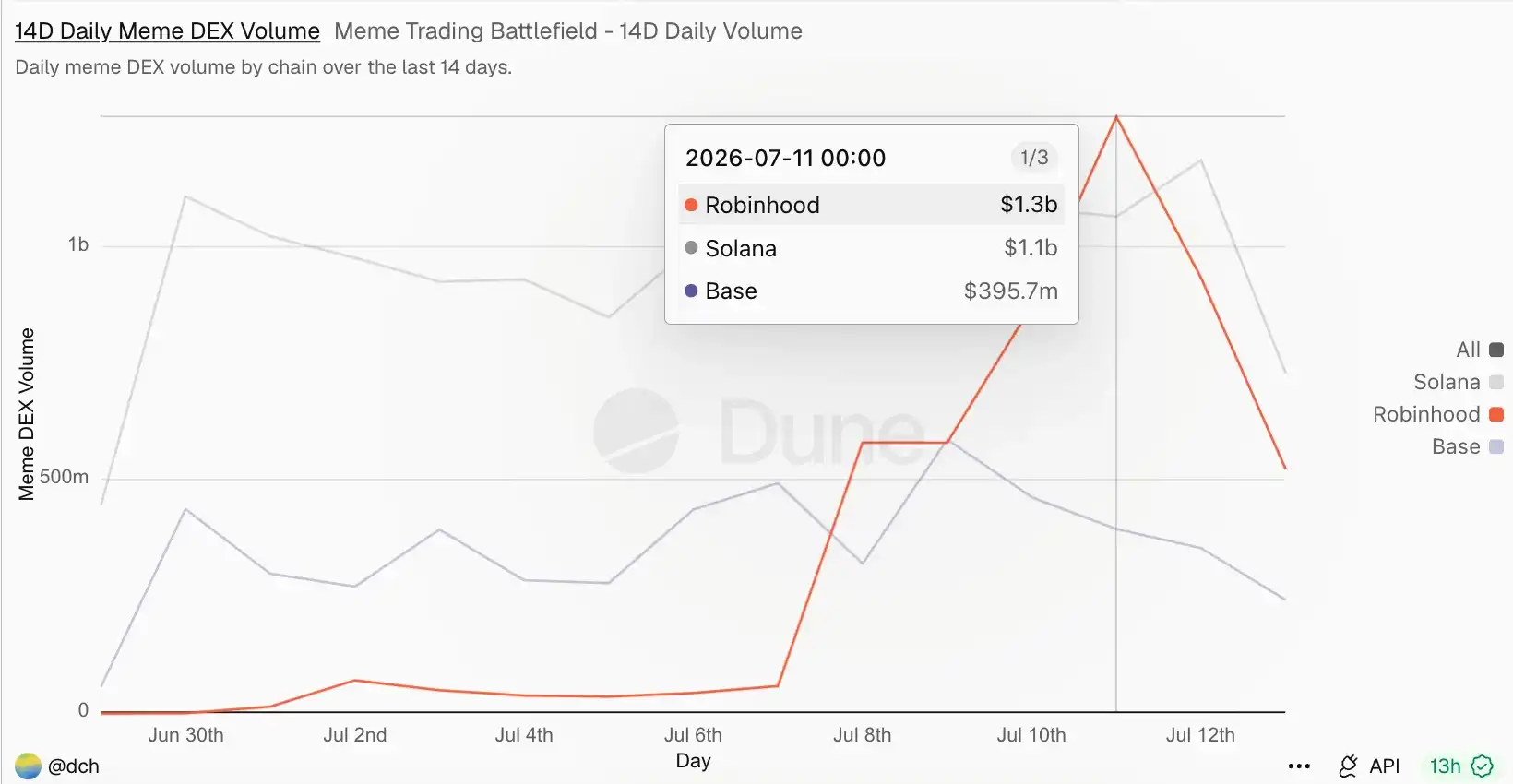
Two weeks after its launch, Robinhood Chain has achieved far more than expected popularity by riding the wave of Meme coins—first-week DEX trading volume exceeded $3.1 billion, ranking it among the top five blockchains by DEX trading volume. On July 11, the daily Meme DEX trading volume on Robinhood Chain once surged to $1.3 billion, surpassing the usual Meme leader chain Solana (approximately $1.1 billion).
The Meme craze has spread to a number of 'launchpads.' The most dramatic episode involves NOXA—the hottest Meme launchpad on this chain. It had just made a fortune from transaction fees, only to abruptly shut down its core functionality. According to Onchain Lens, the protocol generated about $7.66 million in fees on the Robinhood ecosystem in the week before its suspension, with a single-day peak (July 11) reaching $2.33 million, four times that of Pump.fun (approximately $575,000) on the same day. The largest meme on Robinhood Chain, 'CASHCAT,' also originated from NOXA. Its market capitalization peaked at over $200 million on July 11.
However, on July 11, NOXA suddenly suspended its new token launch function. The reason given was ongoing user feedback about the proliferation of new coins and copycat issues, with the team discovering that some bots were mass-creating and copying new tokens hourly. Subsequently, its web domain also became temporarily inaccessible due to Cloudflare and other issues. The team stated at the time that they were migrating the interface to an ENS domain and expected to resume soon.
It wasn't until the evening of July 14 that NOXA launched a new interface. The team stated, 'We will keep the new token issuance function closed. This is the only solution to prevent dilution of the core token.' According to NOXA, the rampant market of 'vampire attacks' by tokens and endless new coin spam had exceeded the original design capacity of its infrastructure. The new interface retains only three functions: viewing a snapshot of historically launched tokens, viewing one's own launched tokens and fees, and claiming remaining creator fees. Simultaneously, the official directed 100% of transaction fees to creators.
This move also raised doubts within the community. Some voices believe that shutting down new coin issuance, taking control of the interface and domain with a new team-controlled site, and adjusting fee structures pose a risk of a 'soft rug pull.' The official explained this fee adjustment as '100% to creators' and retained the historical query and creator fee claim functions. However, on the flip side, token holders' assets now heavily depend on whether a new, unaudited interface can continue to operate, which remains to be seen.
Following this announcement, Meme tokens launched via NOXA experienced a broad decline. Among them, CASHCAT fell approximately 16% in one hour, with its market capitalization dropping to $163 million; JUGGERNAUT fell over 18% in one hour, with its market capitalization falling to $11.7 million.
After NOXA's Suspension, the Launchpad Leader Position Becomes Vacant
So-called 'launchpads' are one-click token creation tools—allowing ordinary users to launch a Meme without writing a single line of code, just by uploading an image and naming it, with a fee taken from each subsequent transaction.
NOXA employed a direct launch model: tokens were launched directly on Uniswap V3 and were instantly tradable, with liquidity permanently locked. Unlike Pump.fun, there was no need to first run through an internal market before 'graduating' and migrating to a DEX.
NOXA's dominance on Robinhood Chain largely stemmed from 'first-mover advantage'—the team specialized in deploying on newly launched or even pre-launch chains. They had previously launched on multiple chains like Monad, MegaETH, Merlin, and DeBank's DBK Chain, and were an early supporter of Robinhood Chain. They also spawned the Meme leader CASHCAT (Cash Cat), whose market capitalization peaked at over $200 million on July 11, soaring over 4000% in a week, standing at $188 million at the time of writing.
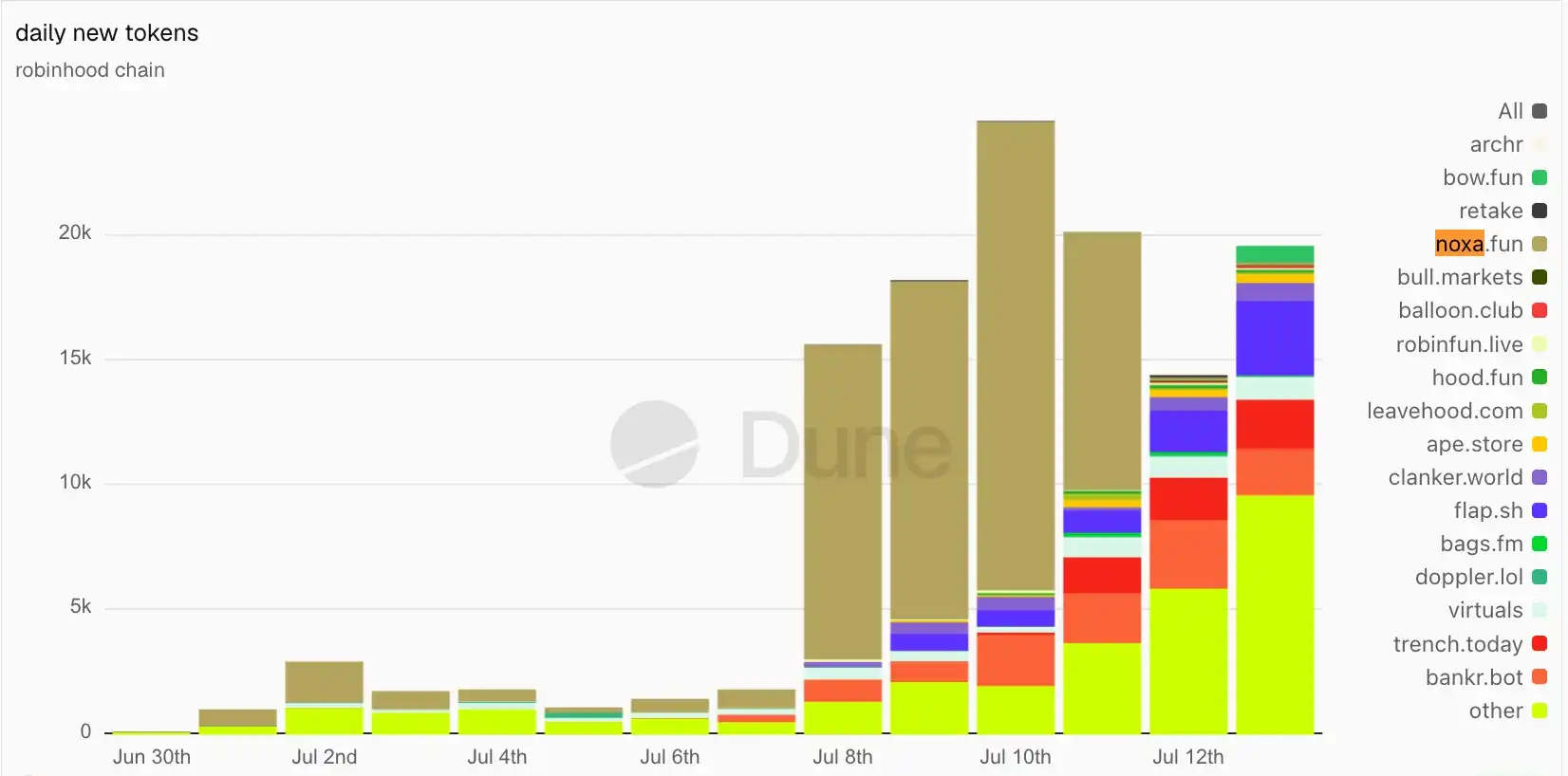
According to Dune data, over a dozen platforms participate in daily token launches on Robinhood Chain—besides NOXA, there are Bags, Flap, Clanker, Doppler, Trench, Bow, etc. In early July, NOXA once held an absolute dominant position. After suspending launches, no clear 'successor' has yet emerged.
Meanwhile, Uniswap Brings 'Auction' On-Chain
Notably, on July 13, Uniswap officially integrated its 'auction-based token launch' mechanism, CCA, into Robinhood Chain. The battle for Robinhood Chain's launchpad supremacy has entered a new round.
The CCA brought by Uniswap this time, short for Continuous Clearing Auctions, takes a very different path in pricing compared to 'instant execution.'
Users only need to provide two values when participating: a budget (how much they intend to spend) and an acceptable maximum price. The protocol does not throw this entire amount into a single block. Instead, according to the launch schedule, it automatically spreads the purchase across multiple remaining blocks of the auction for gradual execution (this is the 'Continuous Clearing'—segmented, continuous clearing). It clears one block (one period) at a time, dynamically calculating a 'uniform price' for each block. Everyone who transacts within the same block buys at this price. Those with bids above the clearing price get their full allocation; those exactly at the price may get partial fills; those below do not transact in that round. As subsequent demand accumulates, the clearing price adjusts gradually block by block, rather than being explosively pumped or crashed in the opening moment.
The entire process is also completely code-free: the initiator fills in parameters on the Uniswap webpage, and a factory contract deploys an ERC-20 token with a 1 billion supply. After the auction ends, the raised funds are automatically injected into a Uniswap v4 trading pool. The fee tier for the pool is set by the initiator during pool creation (options include 0.01%, 0.05%, 0.3%, 1%, etc., or custom). Each transaction on this pool incurs a fixed percentage fee. Under standard configuration, the LP position (an NFT) representing this pool's liquidity is locked into a locking contract, with developers relinquishing control. Revenue comes from the transaction fees of this pool.
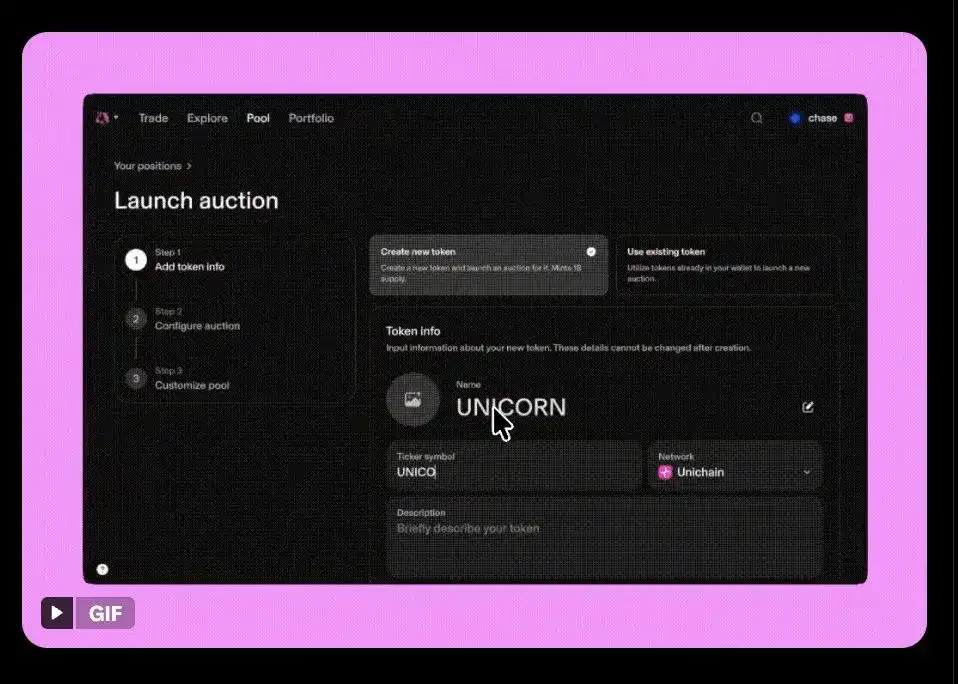
Among the Meme coins launched via the CCA mechanism on Robinhood Chain, the highest current market capitalization belongs to UNICORN, which peaked at $2.13 million and stands at $685,000 at the time of writing. Previously, this token name appeared in Uniswap's official presentation materials (note: the demo document mentioned Unichain, not Robinhood Chain).
Another Meme, TRASH, peaked at a market capitalization of $2.2 million and has fallen to about $350,000 at the time of writing. This Meme incorporates the narrative of the gimmick where 'trash from Taylor Swift's wedding was collected and sold at a price.' Uniswap founder Hayden Adams once retweeted a post asking, 'How much could be made if this transaction were tokenized as an RWA?'
Foresight News reminder: This article does not constitute investment advice. Most Meme coins lack practical utility and are highly volatile. Invest with caution.
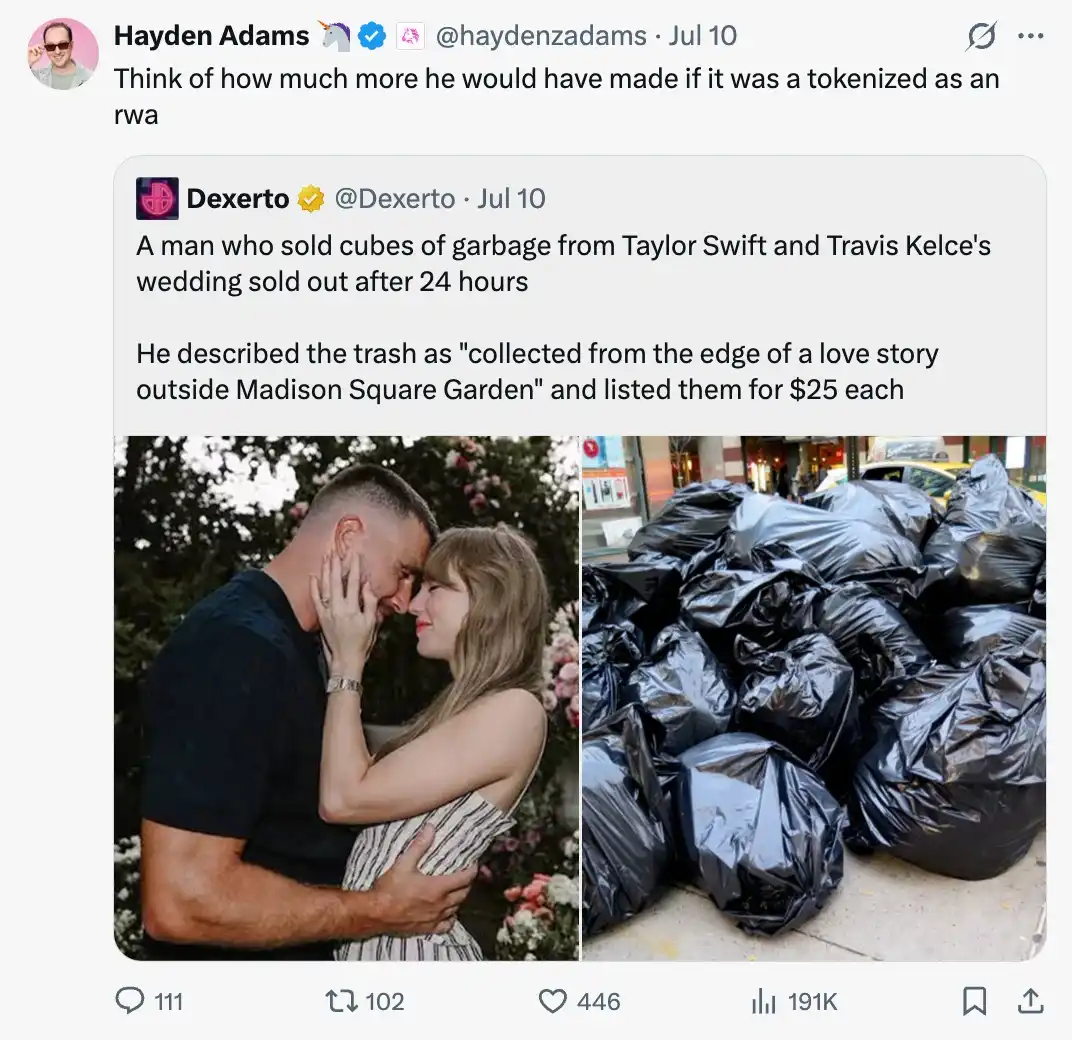
There are also reservations within the community about whether the CCA mechanism suits Meme coins. Although the issuer does not pre-allocate tokens to themselves initially, unsold portions from the auction are returned to them, meaning the issuer could still accumulate a significant amount of tokens. This 'anti-snipe, pro-fairness' auction might not actually fit Meme coins, which rely on sentiment and fast rotations. Those looking for new projects in Uniswap auctions need to scrutinize the issuer's holdings and potential selling activity.
First Run the Chain with Memes, Then Gradually Introduce RWA
For ordinary users participating in new token launches, a few more points are worth noting: CCA auctions can significantly reduce the risk of being front-run at launch, but currently, the target market capitalizations are small and liquidity is thin. Instant-execution platforms have high热度 and allow quick entry, but the risks of sniping and dumping are equally high.
For Robinhood itself, half the battle is already won: regardless of which launch mechanism prevails, the path of 'first running the chain with Memes, then gradually introducing RWA' is being validated by the market. Whether the chain built for stocks will eventually be filled with tokenized stocks remains to be seen after this wave of speculative fever subsides.


![How high can MemeCore [M] rally as it leads top 100 with 16% gains?](https://d1x7dwosqaosdj.cloudfront.net/images/2026-07/3d45ef1ea56e45f6a19ae78972d369b7.jpg)