Ripple, Stellar Show Up In New Epstein Files, Ex-CTO Schwartz Reacts

bitcoinistОпубліковано о 2026-02-03Востаннє оновлено о 2026-02-03

Анотація

Newly released Jeffrey Epstein documents include a 2014 email from Blockstream co-founder Austin Hill that mentions Ripple and Stellar. In the email, Hill reportedly complained to Epstein and others about investors supporting competing projects, framing backers of Ripple or Stellar as "enemies/opponents" to his Bitcoin-centric ecosystem. Former Ripple CTO David Schwartz publicly responded, stating he knows of no direct connections between Epstein and either Ripple, XRP, or Stellar. He emphasized there is no evidence that anyone from these projects met with Epstein or his close associates. Schwartz criticized the "enemy/opponent" mindset as harmful to the entire crypto space and dismissed the notion of deeper involvement as speculative conspiracy. He also addressed a question about Ripple's for-profit structure versus Stellar's non-profit, revealing he had opposed the non-profit model early on, believing it seemed dishonest and borderline illegal. At the time of reporting, XRP was trading at $1.64.

Ripple and Stellar were pulled into a fresh round of social-media speculation this weekend after newly surfaced emails from the Epstein document release appeared to reference the two projects in a 2014 investor dispute. Former Ripple CTO David Schwartz pushed back publicly, saying he knows of no direct links between Epstein and either network, and framed the episode as another example of tribal politics bleeding into crypto.

Schwartz Reacts After Epstein Docs Mention Ripple, Stellar

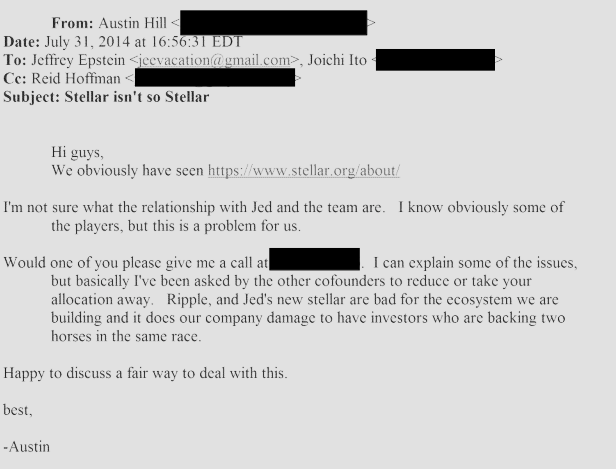
The spark came from a screenshot circulating on X that shows an email chain in which Austin Hill (co-founder of Blockstream) complained to a group of high-profile recipients, including Epstein, about investors allocating capital across competing projects. According to Schwartz, the document “is an email from Austin Hill to Jeffrey Epstein explaining that Hill felt that support for Ripple or Stellar made someone an enemy/opponent,” adding that Hill likely shared similar views “to many other people.”

As the image spread, some posts characterized the mere inclusion of Ripple and Stellar in the email as evidence of deeper involvement. Schwartz responded with a message that tried to separate inflammatory framing from what the document actually shows.

“I don’t know of any connections between Jeffrey Epstein and Ripple, XRP, or Stellar. [I don’t know of] any evidence anyone at Ripple or Stellar ever met with Epstein or anyone closely connected to him,” he wrote. “There are some indirect ties between Epstein and people connected to Bitcoin in various ways, but that’s probably true of most very wealthy people.”
Source: X @JoelKatz

Schwartz’s first post on the thread captured the mood of the day, both suspicion and a reluctance to feed it. “I hate to be a conspiracy theorist, but I wouldn’t be at all surprised if this is just the tip of a giant iceberg,” he wrote while linking to the DOJ-hosted file. He later argued the more corrosive issue was the “enemy/opponent” mindset, writing that “we really are all in this together and this kind of attitude hurts everyone in the space.”

In the underlying 2014 email described in the source material, Hill is portrayed as objecting to backers funding multiple “horses” at once, treating support for Ripple or Stellar as hostile to the bitcoin-centric “ecosystem” he was building at Blockstream. Reports summarizing the chain say it was sent to Joichi Ito, Epstein, and Reid Hoffman, and included language that investors in both camps were “backing two horses in the same race.”

The resurfaced email also revived an older fault line in how early projects structured themselves. In response to a user asking about Ripple versus Stellar’s nonprofit posture, Schwartz said the idea was debated early on and that he opposed it.

“We discussed it in the early days. I was strongly against it because it seemed dishonest and borderline illegal to have a non-profit whose success was so tied to the gains of private parties,” he wrote. “It felt, at least to me, like Walmart creating a non-profit to help educate people about how much money they could save by shopping at Walmart.”

At press time, XRP traded at $1.64.
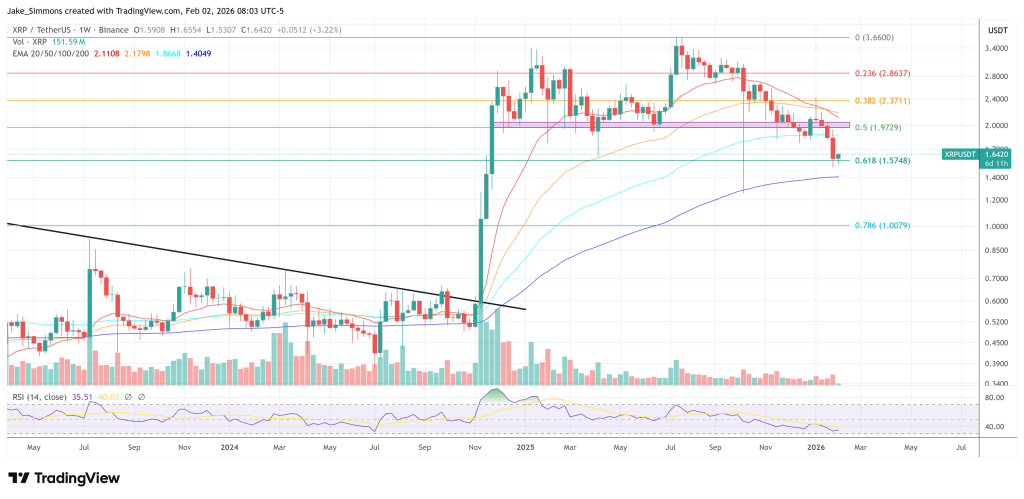
XRP holds above the 0.618 Fib, 1-week chart | Source: XRPUSDT on TradingView.com

Пов'язані питання

QWhat sparked the recent social-media speculation involving Ripple and Stellar?

AThe speculation was ignited by a screenshot of a 2014 email chain from the Epstein document release, in which Blockstream co-founder Austin Hill complained to Jeffrey Epstein and others about investors allocating capital across competing projects like Ripple and Stellar.

QHow did former Ripple CTO David Schwartz respond to the allegations of connections between Epstein and Ripple/Stellar?

ADavid Schwartz publicly stated that he knows of no direct connections between Jeffrey Epstein and Ripple, XRP, or Stellar, and that he was unaware of any evidence that anyone at Ripple or Stellar had ever met with Epstein or anyone closely connected to him.

QWhat was the main complaint in Austin Hill's 2014 email as described in the article?

AIn the email, Austin Hill objected to investors funding multiple competing projects simultaneously, characterizing support for Ripple or Stellar as being hostile to the bitcoin-centric 'ecosystem' he was building at Blockstream, and referred to it as 'backing two horses in the same race.'

QWhat did David Schwartz identify as the more corrosive issue in the crypto space, beyond the Epstein speculation?

ASchwartz argued that the more corrosive issue was the 'enemy/opponent' mindset, stating that 'we really are all in this together and this kind of attitude hurts everyone in the space.'

QWhat was David Schwartz's stated position on Ripple adopting a non-profit structure in its early days?

ASchwartz said he was strongly opposed to the idea of Ripple becoming a non-profit because he felt it seemed dishonest and borderline illegal to have a non-profit whose success was so tied to the gains of private parties, comparing it to 'Walmart creating a non-profit to help educate people about how much money they could save by shopping at Walmart.'

Пов'язані матеріали

In Conversation with Ray Dalio: We Are Currently in an AI Bubble, with 1% of My Portfolio in Bitcoin

Ray Dalio, founder of Bridgewater Associates, warns in an interview that the current AI boom shows classic bubble characteristics, which could lead to significant economic downturns as seen in past cycles like 1929 or 2000. He explains that speculative enthusiasm, fueled by debt and overvaluation, often precedes a crash when rising rates or taxation force asset sales, causing widespread losses and recession. Dalio also outlines his "Big Cycle" theory, describing an approximate 80-year pattern where widening wealth gaps, massive government deficits, and shifting geopolitical power (like China's rise) create internal conflict and global instability. He emphasizes that we are in a late-cycle, transitional phase where traditional powers like the US and UK face decline. For personal wealth protection, Dalio advises diversification beyond cash into assets like stocks, bonds, real estate, and particularly gold, which he prefers over Bitcoin. While he holds about 1% of his portfolio in Bitcoin as a non-printable hard asset, he views gold as more secure from technological or governmental threats. Regarding AI's impact, Dalio believes it will disproportionately benefit capital owners, worsening inequality by replacing both physical and cognitive labor. He suggests that human intuition and emotional intelligence, combined with AI, will be key for future workers. On taxation, Dalio argues that wealth taxes are impractical and risk triggering asset sell-offs, reducing productive investment. He points to the UK as a cautionary example of debt, low productivity, and political strife. Geopolitically, Dalio foresees a more regionalized world, with the US showing weakness in prolonged conflicts like with Iran, akin to past imperial declines. The ideal outcome, he suggests, is coexisting powerful blocs (e.g., Americas, China-Asia Pacific) without major war.

marsbit3 год тому

In Conversation with Ray Dalio: We Are Currently in an AI Bubble, with 1% of My Portfolio in Bitcoin

marsbit3 год тому

Daily 7.2 Trillion KRW: Foreign Capital's Record Net Buying on Friday! Wall Street Says Headwinds for Korean Stock Fund Flows Have Subsided

South Korean stock market sees a dramatic shift in fund flows. On July 31, foreign investors made a record net purchase of approximately KRW 7.2 trillion in KOSPI stocks, marking a fundamental reversal from the persistent large-scale net outflows seen in previous months. This contributed to a significant narrowing of foreign net selling in July to KRW 9.8 trillion, down sharply from KRW 48.4 trillion in June and KRW 44.5 trillion in May. Simultaneously, domestic institutional pressure eased. South Korean pension funds and asset managers turned to a net buying position in July, purchasing KRW 1.0 trillion worth of KOSPI shares, contrasting with net sales in May and June. Market volatility is expected to be dampened by new financial regulations. Effective July 31, the Financial Services Commission tightened access for retail investors to single-stock leveraged ETFs by raising the minimum cash deposit requirement. Trading volumes for these products subsequently dropped to about 50% of their monthly average. Citigroup Research maintains its year-end KOSPI target of 10,000 points. The firm cites several supportive factors: the substantial easing of headwinds from capital outflows, a robust fundamental outlook for the semiconductor sector, historically low market valuations, strong economic fundamentals, and the potential for policy support from financial authorities if needed.

marsbit3 год тому

Daily 7.2 Trillion KRW: Foreign Capital's Record Net Buying on Friday! Wall Street Says Headwinds for Korean Stock Fund Flows Have Subsided

marsbit3 год тому

Thanks to Dice Rolls, Bitcoin Keys Are Stored Offline, But Not Everyone Will Do It

The article discusses using dice rolls to generate secure Bitcoin wallet seeds, providing entropy independent of potentially flawed hardware random number generators. It explains that each fair dice roll offers about 2.585 bits of entropy, with around 50 rolls needed for a standard 12-word seed phrase and 99+ recommended for higher security. This method gained attention after a vulnerability was revealed in some Coldcard hardware wallets, where a faulty firmware RNG (dating back to 2021) compromised generated keys. The analysis notes that while a dice-generated main seed was safe from this specific flaw, other Coldcard functions (like creating paper wallets, backup keys, or passwords) could still be vulnerable if they used the defective RNG. The piece argues that while dice-based entropy is technically robust, the manual process is error-prone, tedious, and unrealistic for most new users, who might make mistakes in recording or inputting rolls. It concludes that while manual entropy generation should remain an option for advanced users, the long-term goal is to develop reliable, user-friendly hardware and software that securely generates randomness without requiring specialized knowledge. Coldcard users are advised to check their firmware version and replace any secondary secrets (like paper wallet keys) created with vulnerable devices, while also considering multi-signature setups with devices from different manufacturers for added security.

cryptonews.ru8 год тому

Thanks to Dice Rolls, Bitcoin Keys Are Stored Offline, But Not Everyone Will Do It

cryptonews.ru8 год тому

Торгівля

Спот
活动图片





