Ripple Sends New Letter To The SEC: What It Could Mean For XRP

bitcoinistОпубліковано о 2026-01-13Востаннє оновлено о 2026-01-13

Анотація

Ripple has submitted a new letter to the SEC’s Crypto Task Force, urging a clear distinction between securities offerings and the underlying tokens traded in secondary markets. Dated January 9, 2026, the letter argues that regulatory focus should shift from "decentralization" to legal rights and obligations, emphasizing that the SEC’s jurisdiction should be time-bound to the lifespan of the obligation—not perpetual. Ripple contends that without this clarity, regulatory overreach could stifle secondary markets and create compliance burdens for issuers. The submission aligns with ongoing legislative efforts and could influence how XRP and similar tokens are regulated post-lawsuit. At the time of writing, XRP traded at $2.05.

Ripple has sent a new market-structure letter to the SEC’s Crypto Task Force, urging the agency to draw a hard line between a securities offering and the underlying token that may later trade in secondary markets, a framing that could matter for how XRP (post SEC lawsuit) and other tokens are treated in disclosure and jurisdiction debates.

In the January 9, 2026 submission, signed by Chief Legal Officer Stuart Alderoty, General Counsel Sameer Dhond, and Deputy General Counsel Deborah McCrimmon, Ripple positions its comments as input to ongoing Commission rulemaking or guidance, explicitly tying its argument to parallel legislative efforts on Capitol Hill.

The company references earlier letters from March 21, 2025 and May 27, 2025, and points to the House’s CLARITY Act of 2025 and Senate discussion drafts as evidence that classification choices will cascade into “jurisdiction, disclosures, and secondary-market treatment.”

Ripple Presses SEC To Cement XRP’s Post-Lawsuit Status

Ripple’s core thesis is that regulators should move away from “decentralization” as a legal metric because it is “not a binary state” and creates “intolerable uncertainty,” including both “false negative” and “false positive” outcomes.

One of Ripple’s key concerns is that an asset could be treated as stuck in a securities regime simply because an entity still holds inventory or continues contributing to development, a point with obvious parallels to Ripple. The company still holds a large chunk of all XRP in their escrow while developer arm RippleX contributes heavily to the development of the XRP Ledger.

Instead, Ripple pushes the SEC to ground jurisdiction in “legal rights and obligations,” emphasizing enforceable promises rather than market narratives about ongoing efforts. The letter argues that regulatory theories focusing on “efforts of others” risk collapsing the multi-part Howey analysis into a single factor and, in Ripple’s view, sweeping too broadly.

The most consequential section is Ripple’s argument that the SEC’s jurisdiction should be time-bound to the “lifespan of the obligation,” rather than treating the asset as permanently labeled. In a passage that goes directly to secondary-market implications, Ripple writes:

“The Commission’s jurisdiction should track the lifespan of the obligation; regulating the ‘promise’ while it exists, but liberating the ‘asset’ once that promise is fulfilled or otherwise ends. The dispositive factor is the holder’s legal rights, not their economic hopes. Without that bright line, the definition of a security, and the SEC’s jurisdictional limits, become amorphous and unbounded.”

That framing matters for XRP and draws parallels to the SEC lawsuit: whether secondary-market trading of a token can remain subject to securities-law oversight long after any initial distribution, marketing, or development-era statements. Ripple explicitly rejects the idea that active secondary trading is itself a jurisdictional hook, comparing high-velocity crypto markets to spot commodities like gold and silver and even secondary markets for consumer devices.

Ripple also spends meaningful time on the “capital raising” boundary, arguing for privity as a bright line that distinguishes primary distributions from exchange trading where counterparties are unknown and the issuer is “merely as another market actor.”

In that context, the letter warns that treating every issuer sale as a perpetual capital raise creates “perverse outcomes,” including what it calls a “Zombie Promise” and “Operational Paralysis”: language that, while generalized, clearly speaks to concerns around issuer-held token inventories and the compliance burdens that could attach to treasury management and sales practices.

Separately, Ripple endorses “fit-for purpose” disclosures in cases where securities regulation is actually warranted, rather than forcing “full corporate registration designed for traditional equity.” For XRP holders and market participants, that is a directional signal: Ripple is arguing for a regime where disclosure triggers attach to specific promises or specific forms of ongoing control, not to the token as an object indefinitely.

The timing is also notable. Ripple dated the letter January 9, 2026, less than a week before a January 15 markup on comprehensive digital-asset market structure legislation in the US Senate Banking Committee, an approaching deadline that could shape how classification language, jurisdictional lines, and disclosure concepts harden into legislative text.

At press time, XRP traded at $2.05.
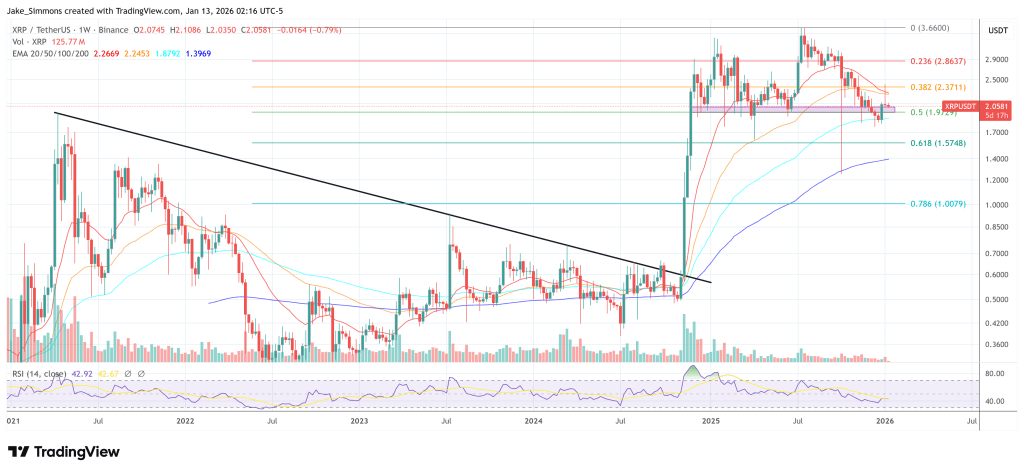
XRP rejected at the 0.382 Fib, 1-week chart | Source: XRPUSDT on TradingView.com

Пов'язані питання

QWhat is the core argument Ripple makes to the SEC regarding the classification of tokens?

ARipple's core argument is that regulators should move away from using 'decentralization' as a legal metric because it creates uncertainty. Instead, jurisdiction should be grounded in 'legal rights and obligations,' focusing on enforceable promises, and it should be time-bound to the 'lifespan of the obligation' rather than treating an asset as permanently labeled as a security.

QWhy does Ripple argue that the SEC's jurisdiction should be time-bound?

ARipple argues that the SEC's jurisdiction should be time-bound to the 'lifespan of the obligation' to create a clear regulatory bright line. This means the SEC regulates the 'promise' while it exists but should liberate the 'asset' once that promise is fulfilled or ends, preventing the asset from being perpetually subject to securities laws based on its initial offering.

QWhat specific concern does Ripple raise about an entity holding inventory or contributing to development?

ARipple is concerned that an asset could be incorrectly classified as a security indefinitely simply because an entity (like Ripple itself) still holds a large inventory in escrow or continues to contribute to the asset's development through its developer arm (RippleX), creating what it calls 'false positive' outcomes and 'intolerable uncertainty.'

QHow does Ripple's argument relate to secondary-market trading of tokens like XRP?

ARipple argues that active secondary-market trading of a token should not itself be a jurisdictional hook for the SEC. It compares crypto markets to spot commodities like gold, asserting that once the initial obligation is fulfilled, the token should be free from securities-law oversight in secondary markets, where trades occur between unknown counterparties and the original issuer is merely another market actor.

QWhat legislative context does Ripple's letter reference, and why is the timing significant?

ARipple's letter references the House’s CLARITY Act of 2025 and Senate discussion drafts. The timing is significant because it was submitted on January 9, 2026, just days before a January 15 markup on comprehensive digital-asset market structure legislation in the US Senate Banking Committee, aiming to influence how classification and jurisdictional language is written into law.

Пов'язані матеріали

After 50x Storage Surge, Justin Sun Always Looks to the Next Decade

Sun Yuchen, known for his controversial stunts like a $30 million lunch with Warren Buffett (canceled due to a kidney stone) and eating a $6.2 million duct-taped banana, is often overshadowed by a significant fact: his decade-long track record of spotting major investment trends. In 2016, he famously advised young people to invest in Bitcoin, Nvidia, Tesla, and Tencent instead of buying property. A hypothetical $20,000 investment in Nvidia and Tesla from that list would now be worth over 50 million RMB. His latest major call was on November 6, 2025, predicting a "50x storage opportunity" tied to the AI boom, which materialized with Sandisk's stock surging nearly 50-fold by 2026. Looking ahead, Sun now focuses on the next frontier: Physical AI. He identifies four key areas: 1. **Embodied AI/Robotics**: He sees this reaching its "iPhone moment," with companies like UBTech and Galaxy General leading in commercialization. 2. **Drones**: Viewed as the first commercially viable form of Physical AI, revolutionizing sectors from warfare (e.g., AeroVironment's Switchblade) to logistics. 3. **Spatial Computing**: Beyond VR, it's about AI understanding physical space, a foundational technology for robotics and autonomous systems, exemplified by Apple's Vision Pro. 4. **Space Exploration**: After a 2025 suborbital flight with Blue Origin, Sun advocates for space as the ultimate frontier, discussing blockchain's potential role in space asset management and data transactions. His investment philosophy involves betting on entire, inevitable trends rather than single companies. For robotics, he sees Tesla (the body/manufacturer) and Nvidia (the brain/AI platform) as complementary plays. In defense drones, he highlights companies making tanks obsolete (AeroVironment) and those augmenting fighter jets (Kratos). For space, he participated in Blue Origin's flight and anticipates SpaceX's potential IPO to redefine the sector's valuation. Sun Yuchen's vision frames the next two decades not as a revolution in information flow (like the internet), but in the fundamental operation of the physical world through AI-powered robots, autonomous systems, and spatial intelligence, ultimately extending human and AI activity into space. While many still focus on conventional assets, he continues to look toward the next technological horizon.

marsbit38 хв тому

After 50x Storage Surge, Justin Sun Always Looks to the Next Decade

marsbit38 хв тому

The Billionaires Behind the Most Expensive Midterm Election in History

"The Most Expensive Midterm Elections and Their Billionaire Backers" This analysis details the unprecedented scale of spending in the 2026 midterm elections, highlighting the key billionaire donors shaping the political landscape. Jeff Yass, founder of Susquehanna International Group, has contributed over $81 million, ranking third among individual donors behind George Soros ($102.6M) and Elon Musk ($84.8M). Yass is a major donor to Trump's MAGA Inc. and supports school choice and various candidates. Overall, federal committees have raised over $4.7 billion this cycle, with political ad spending projected to reach $10.8 billion. Republican-aligned groups are significantly out-raising their Democratic counterparts. "Dark money" from undisclosed sources continues to grow. The core stakes involve control of Congress and policy direction for Trump's final term. Donors are also motivated by specific issues: Sergey Brin and Chris Larsen are funding opposition to a proposed California wealth tax and supporting crypto-friendly policies. Other top donors include OpenAI's Greg Brockman and his wife Anna ($50M total to MAGA Inc. and an AI-focused PAC), Richard Uihlein ($45.3M to conservative causes), venture capitalists Marc Andreessen and Ben Horowitz (each over $44M to crypto/AI PACs and MAGA Inc.), Miriam Adelson ($42.6M to GOP leadership PACs), Paul Singer ($33.9M), and Diane Hendricks ($25.8M to MAGA Inc.). The article notes that the peak fundraising period is still ahead, with major primaries approaching.

marsbit40 хв тому

The Billionaires Behind the Most Expensive Midterm Election in History

marsbit40 хв тому

The Largest IPO in History Is Approaching, Surpassing SpaceX, 28 Years of AI Self-Iteration, Countdown to Intelligence Explosion

"Anthropic Nears Trillion-Dollar IPO, Fueled by Explosive Growth and 2028 'Intelligence Explosion' Warning Anthropic is considering a deal valuing the AI company near $1 trillion, potentially leading to one of the largest IPOs ever and surpassing SpaceX. Its revenue has skyrocketed, with Annual Recurring Revenue (ARR) reaching $45 billion in May 2026—a 500% increase in just five months. This vertical growth curve is attributed to its key products, Claude Code and Cowork, dominating AI coding and enterprise collaboration. Beyond commercial success, co-founder Jack Clark issued a pivotal warning in an interview: there is a greater than 50% chance that by the end of 2028, AI systems will achieve recursive self-improvement—the ability to autonomously build a 'better version' of themselves, initiating an 'intelligence explosion.' This prophecy underpins the company's astronomical valuation, as the market prices in the potential for transformative and disruptive AI. Further signaling its ambition, Anthropic formed a $1.5 billion joint venture with Goldman Sachs and Blackstone, aiming to disrupt traditional consulting firms like McKinsey by deploying Claude AI for complex strategic work. This move tests AI's capacity to replace high-level cognitive labor, a precursor to its predicted autonomous evolution. The narrative presents a dual future: unprecedented economic opportunity alongside significant risks like economic restructuring and security threats. Anthropic's meteoric rise and Clark's 2028 prediction frame the coming years as a countdown to a potential technological singularity."

marsbit52 хв тому

The Largest IPO in History Is Approaching, Surpassing SpaceX, 28 Years of AI Self-Iteration, Countdown to Intelligence Explosion

marsbit52 хв тому

Торгівля

Спот
Ф'ючерси

Популярні статті

Що таке XRP 2.0

XRP 2.0: Нова межа в світі криптовалют Вступ до XRP 2.0 У постійно змінюючомуся світі криптовалют нові проекти постійно з'являються, змагаючись за увагу та прийняття. Однією з таких обіцяючих ініціатив є XRP 2.0, новий криптовалютний проект, що має на меті використання сучасних технологій блокчейн та надійних методів шифрування. Хоча назва нагадує про XRP від Ripple, важливо зазначити, що XRP 2.0 функціонує автономно, концентруючи увагу на підвищенні безпеки транзакцій, конфіденційності та масштабованості. Оскільки цифровий фінансовий ландшафт все більше приймає децентралізовані рішення, XRP 2.0 прагне значно сприяти веб3 та загальному розширенню крипто проектів. Що таке XRP 2.0? У своїй основі XRP 2.0 є криптовалютним проектом, що має на меті створення безпечної та децентралізованої екосистеми цифрової валюти. Його фундаментальна технологія інтегрує складні принципи блокчейну з передовими техніками шифрування. Загальною метою XRP 2.0 є встановлення себе як надійної та ефективної платформи, що дозволяє швидко виконувати транзакції, при цьому надаючи пріоритет підвищеним захистам конфіденційності для своїх користувачів. Проект позиціонується як рішення багатьох обмежень, з якими стикаються існуючі криптовалюти, пропонуючи систему, яка може обробляти вищий обсяг транзакцій з покращеною швидкістю та конфіденційністю. Ця універсальність позиціонує XRP 2.0 як значного гравця на ринку, наповненому різними цифровими валютами. Хто творець XRP 2.0? Особистість творця XRP 2.0 була позначена як «Вілбур». Проте, вичерпні деталі про Вілбура або пов'язану з ним організацію залишаються недоступними. Анонімність багатьох творців криптовалют не є незвичним явищем в індустрії, часто запроваджена для збереження певного рівня конфіденційності та безпеки. Хто інвестори XRP 2.0? На даний момент конкретна інформація про інвестиційні фонди або організації, що підтримують XRP 2.0, не є публічно доступною. У секторі криптовалют підтримка від визнаних інвесторів може значно вплинути на кредитоспроможність і успіх проекту, але прозорість щодо фінансових підтримувачів XRP 2.0 не була встановлена. Як працює XRP 2.0? XRP 2.0 вирізняється використанням комбінації технології блокчейн та просунутих алгоритмів шифрування, що забезпечують безпечні та децентралізовані транзакції. Його інноваційна структура включає унікальні функції, спрямовані на залучення користувачів та розширення функціональності за межами традиційних транзакцій криптовалюти. Серед цих функцій, XRP 2.0 включає можливості на базі ШІ, такі як текст в зображення та текст в мову. Ці нововведення розроблені для покращення інтерактивного досвіду для користувачів, сприяючи ширшій застосовності в різних секторах. Завдяки поєднанню технологічних досягнень з орієнтованим на користувача дизайном, XRP 2.0 прагне привернути увагу різноманітних осіб і підприємств, які шукають способи інтеграції рішень криптовалют у свої операційні структури. Хронологія XRP 2.0 Розуміння XRP 2.0 вимагає вивчення основних етапів, які визначили його подорож до теперішнього часу: 23 липня 2023 року: XRP 2.0 представлено як новий криптовалютний проект, що має на меті революціонізувати безпечні та децентралізовані можливості транзакцій у галузі блокчейн. 8 вересня 2023 року: Запускається інший проект, XRP20, що відзначає виникнення токена ERC-20 на блокчейні Ethereum, який не пов'язаний з XRP 2.0. 13 листопада 2023 року: XRP Ledger зазнає значного оновлення з виходом програмного забезпечення rippled server версії 2.0.0. Важливо зазначити, що цей розвиток не пов'язаний з криптовалютним проектом XRP 2.0. Ключові моменти про XRP 2.0 Щоб узагальнити суть XRP 2.0, кілька критично важливих факторів emerge: Унікальні функції: Включення функцій, таких як текст в зображення і текст в мову на базі ШІ, ще більше розширює потенційні застосування XRP 2.0. Технологія блокчейн: Архітектура використовує сучасні механізми блокчейн і протоколи шифрування, забезпечуючи безпечне та децентралізоване середовище для транзакцій. Масштабованість і конфіденційність: XRP 2.0 надає пріоритет підвищеним захистам конфіденційності в процесах транзакцій і масштабованості, необхідній для задоволення зростаючої бази користувачів. Відсутність зв'язку з Ripple: Важливо, що, незважаючи на свою назву, XRP 2.0 не має жодної прив'язки чи співпраці з XRP від Ripple, що відрізняє його операційну структуру та цілі в рамках криптовалютної екосистеми. Висновок XRP 2.0 представляє амбітну ініціативу у світі криптовалют, прагнучи запропонувати поєднання безпеки, конфіденційності та ефективності у цифрових транзакціях. Інтегруючи складні технології та дружні до користувача функції, проект ставить за мету розширити горизонти того, що криптовалюта може досягти в сучасній цифровій економіці. Хоча анонімність його творця та відсутність розкритих інвесторів можуть викликати запитання у деяких, фокус XRP 2.0 на передових функціональностях і децентралізації підвищує його привабливість на дедалі більшому ринку криптовалют. Оскільки ландшафт криптовалют продовжує еволюціонувати, XRP 2.0 може ще стати важливим гравцем у розширенні безпечних і масштабованих рішень блокчейн.

162 переглядів усьогоОпубліковано 2024.04.05Оновлено 2024.12.03

Що таке XRP 2.0

Як купити XRP

Ласкаво просимо до HTX.com! Ми зробили покупку XRP (XRP) простою та зручною. Дотримуйтесь нашої покрокової інструкції, щоб розпочати свою криптовалютну подорож.Крок 1: Створіть обліковий запис на HTXВикористовуйте свою електронну пошту або номер телефону, щоб зареєструвати обліковий запис на HTX безплатно. Пройдіть безпроблемну реєстрацію й отримайте доступ до всіх функцій.ЗареєструватисьКрок 2: Перейдіть до розділу Купити крипту і виберіть спосіб оплатиКредитна/дебетова картка: використовуйте вашу картку Visa або Mastercard, щоб миттєво купити XRP (XRP).Баланс: використовуйте кошти з балансу вашого рахунку HTX для безперешкодної торгівлі.Треті особи: ми додали популярні способи оплати, такі як Google Pay та Apple Pay, щоб підвищити зручність.P2P: Торгуйте безпосередньо з іншими користувачами на HTX.Позабіржова торгівля (OTC): ми пропонуємо індивідуальні послуги та конкурентні обмінні курси для трейдерів.Крок 3: Зберігайте свої XRP (XRP)Після придбання XRP (XRP) збережіть його у своєму обліковому записі на HTX. Крім того, ви можете відправити його в інше місце за допомогою блокчейн-переказу або використовувати його для торгівлі іншими криптовалютами.Крок 4: Торгівля XRP (XRP)Легко торгуйте XRP (XRP) на спотовому ринку HTX. Просто увійдіть до свого облікового запису, виберіть торгову пару, укладайте угоди та спостерігайте за ними в режимі реального часу. Ми пропонуємо зручний досвід як для початківців, так і для досвідчених трейдерів.

1.4k переглядів усьогоОпубліковано 2024.12.10Оновлено 2025.03.21

Як купити XRP

Обговорення

Ласкаво просимо до спільноти HTX. Тут ви можете бути в курсі останніх подій розвитку платформи та отримати доступ до професійної ринкової інформації. Нижче представлені думки користувачів щодо ціни XRP (XRP).

活动图片














