Ripple Prime Integrates Hyperliquid to Open DeFi Derivatives Access

TheNewsCryptoОпубліковано о 2026-02-05Востаннє оновлено о 2026-02-05

Анотація

Ripple Prime, the institutional brokerage arm of Ripple, has integrated the Hyperliquid decentralized derivatives exchange into its platform. This partnership, announced on February 4, aims to bridge traditional finance with decentralized trading. The integration allows institutional clients to trade and margin perpetual futures and other derivatives on Hyperliquid's Layer 1 blockchain, alongside traditional products like FX and OTC swaps. A key benefit is a single counterparty framework with centralized risk controls and consolidated margin, eliminating operational barriers. This enables institutions to access on-chain derivatives without direct wallet or smart contract management. Ripple's International CEO stated this move continues their leadership in merging DeFi with prime brokerage. The integration is noted as a significant shift toward market access services and boosted the price of HYPE, Hyperliquid's native token, by 5%. Further DeFi integrations from Ripple are anticipated in the future.

The institutional brokerage arm of Ripple has permitted access to decentralised derivatives markets by amalgamating Hyperliquid into its Prime brokerage platform. The firm publicised the partnership through a statement published on February 4, keeping it as a step to connect traditional finance with decentralised trading.

Ripple has stated that Ripple Prime now backs trading and margining on Hyperliquid, a decentralised Layer 1 blockchain having completely on-chain order books. Via this amalgamation, institutional clients can have access to perpetual futures and other derivatives at the time of managing exposure along with FX, fixed income, OTC swaps, and cleared products.

Positions are managed under a sole counterparty framework, having centralised risk controls and consolidated margin. For a lot of institutions, the structure eliminated a prominent operational barrier.

Trading over decentralised venues now doesn’t need direct wallet management or smart contract contact, permitting companies to treat on-chain derivatives more like traditional exchange products.

What Did The CEO Say?

The International CEO of Ripple Prime, Michael Higgins, states that at Ripple Prime, the team is excited to carry on to lead the way in amalgamating decentralised finance with traditional prime brokerage services, providing direct support to trading, yield generation and a wide array of digital assets.

Ripple refers to this step as the first direct association to a decentralised trading protocol, indicating a shift from infrastructure and payment-targeted services toward market access and implementation.

Hyperliquid has come out as one of the biggest on-chain perpetuals platforms, backing high-volume trading and now, institutional-style market infrastructure. The analysts note that the amalgamation makes the role of HYPE more robust in institutional trading workflows but does not make a direct use case for XRP or the XRP Ledger.

After the announcement, the price of HYPE witnessed a 5% gain regardless of the current crypto market downturn. Any publicisation regarding extra DeFi amalgamations after the release hasn’t been made through Ripple. Although, the sources of the industry anticipate further platform expansions in 2026 as prime brokers compete for institutional crypto flows.

Highlighted Crypto News Today:

Bybit’s Mantle Vault Surpasses $150M AUM in Record Four-Week Growth

TagsHYPEHyperliquidRipple

Пов'язані питання

QWhat is the main purpose of Ripple Prime's integration with Hyperliquid?

AThe main purpose is to open access to decentralized derivatives markets for institutional clients, allowing them to trade perpetual futures and other derivatives while managing exposure to traditional assets like FX, fixed income, and OTC swaps.

QHow does the integration with Hyperliquid benefit institutional clients in terms of operational efficiency?

AIt eliminates the need for direct wallet management or smart contract interaction, allowing companies to treat on-chain derivatives more like traditional exchange products and manage positions under a single counterparty framework with centralized risk controls.

QWhat did Michael Higgins, the International CEO of Ripple Prime, say about this integration?

AHe stated that Ripple Prime is excited to lead the way in integrating decentralized finance with traditional prime brokerage services, providing direct support for trading, yield generation, and a wide array of digital assets.

QHow did the market react to the announcement of the Ripple-Hyperliquid integration?

AFollowing the announcement, the price of HYPE (Hyperliquid's native token) witnessed a 5% gain despite the broader crypto market downturn.

QWhat does this integration signify for Ripple's strategic direction according to the article?

AIt signifies a shift from infrastructure and payment-focused services towards providing market access and execution, marking Ripple's first direct association with a decentralized trading protocol.

Пов'язані матеріали

North Korean Hackers Loot $500 Million in a Single Month, Becoming the Top Threat to Crypto Security

North Korean hackers, particularly the notorious Lazarus Group and its subgroup TraderTraitor, have stolen over $500 million from cryptocurrency DeFi platforms in less than three weeks, bringing their total theft for the year to over $700 million. Recent major attacks on Drift Protocol and KelpDAO, resulting in losses of approximately $286 million and $290 million respectively, highlight a strategic shift: instead of targeting core smart contracts, attackers are now exploiting vulnerabilities in peripheral infrastructure. For instance, the KelpDAO attack involved compromising downstream RPC infrastructure used by LayerZero's decentralized validation network (DVN), allowing manipulation without breaching core cryptography. This sophisticated approach mirrors advanced corporate cyber-espionage. Additionally, North Korea has systematically infiltrated the global crypto workforce, with an estimated 100 operatives using fake identities to gain employment at blockchain companies, enabling long-term access to sensitive systems and facilitating large-scale thefts. According to Chainalysis, North Korean-linked hackers stole a record $2 billion in 2025, accounting for 60% of all global crypto theft that year. Their total historical crypto theft has reached $6.75 billion. Post-theft, they employ specialized money laundering methods, heavily relying on Chinese OTC brokers and cross-chain mixing services rather than standard decentralized exchanges. Security experts, while acknowledging the increased sophistication, emphasize that many attacks still exploit fundamental weaknesses like poor access controls and centralized operational risks. Strengthening private key management, limiting privileged access, and enhancing coordination among exchanges, analysts, and law enforcement immediately after an attack are critical to improving defense and fund recovery chances. The industry's challenge now extends beyond secure smart contracts to safeguarding operational security at the infrastructure level.

marsbit54 хв тому

North Korean Hackers Loot $500 Million in a Single Month, Becoming the Top Threat to Crypto Security

marsbit54 хв тому

Circle CEO's Seoul Visit: No Korean Won Stablecoin Issuance, But Met All Major Korean Banks

Circle CEO Jeremy Allaire's recent activities in Seoul indicate a strategic shift for the company, moving away from issuing a Korean won-backed stablecoin and instead focusing on embedding itself as a key infrastructure provider within Korea’s financial and crypto ecosystem. Despite Korea accounting for nearly 30% of global crypto trading volume—with a market characterized by high retail participation and altcoin dominance—Circle has chosen not to compete for the role of stablecoin issuer. Instead, Allaire met with major Korean banks (including Shinhan, KB, and Woori), financial groups, leading exchanges (Upbit, Bithumb, Coinone), and tech firms like Kakao. This approach reflects a broader industry transition: the core of stablecoin competition is shifting from issuance rights to systemic positioning. With Korean regulators still debating whether banks or tech companies should issue stablecoins, Circle is avoiding regulatory uncertainty by strengthening its role as a service and technology partner. The company is deepening integration with trading platforms, building connections, and promoting stablecoin infrastructure. This positions Circle to benefit regardless of which entity eventually issues a won stablecoin. Allaire also noted the potential for a Chinese yuan stablecoin in the next 3–5 years, underscoring a regional trend of stablecoins becoming more regulated and integrated with traditional finance. Ultimately, Circle’s strategy highlights that future influence in the stablecoin market will belong not necessarily to the issuers, but to the foundational infrastructure layers that enable cross-system transactions.

marsbit1 год тому

Circle CEO's Seoul Visit: No Korean Won Stablecoin Issuance, But Met All Major Korean Banks

marsbit1 год тому

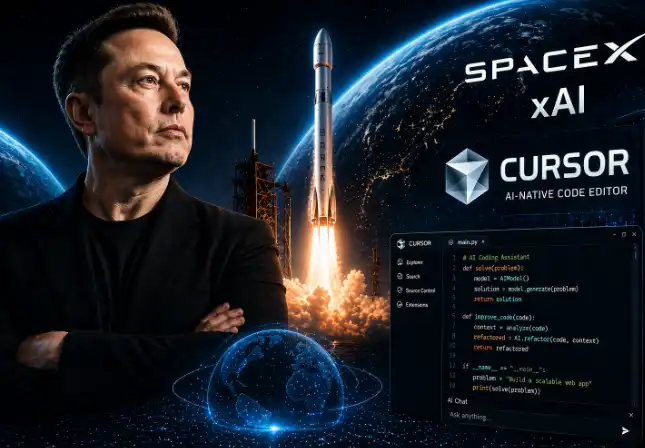
SpaceX Ties Up with Cursor: A High-Stakes AI Gambit of 'Lock First, Acquire Later'

SpaceX has secured an option to acquire AI programming company Cursor for $60 billion, with an alternative clause requiring a $10 billion collaboration fee if the acquisition does not proceed. This structure is not merely a potential acquisition but a strategic move to control core access points in the AI era. The deal is designed as a flexible, dual-path arrangement, allowing SpaceX to either fully acquire Cursor or maintain a binding partnership through high-cost collaboration. This "option-style" approach minimizes immediate regulatory and integration risks while ensuring long-term alignment between the two companies. At its core, the transaction exchanges critical AI-era resources: SpaceX provides its Colossus supercomputing cluster—one of the world’s most powerful AI training infrastructures—while Cursor contributes its AI-native developer environment and strong product adoption. This synergy connects compute power, models, and application layers, forming a closed-loop AI capability stack. Cursor, founded in 2022, has achieved rapid growth with over $1 billion in annual revenue and widespread enterprise adoption. Its value lies in transforming software development through AI agents capable of coding, debugging, and system design—positioning it as a gateway to future software production. For SpaceX, this move is part of a broader strategy to evolve from a aerospace company into an AI infrastructure empire, integrating xAI, supercomputing, and chip manufacturing. Controlling Cursor fills a gap in its developer tooling layer, strengthening its AI narrative ahead of a potential IPO. The deal reflects a shift in AI competition from model superiority to ecosystem and entry-point control. With programming tools as a key battleground, securing developer loyalty becomes crucial for dominating the software production landscape. Risks include questions around Cursor’s valuation, technical integration challenges, and potential regulatory scrutiny. Nevertheless, the deal underscores a strategic bet: controlling both compute and software development access may redefine power dynamics in the AI-driven future.

marsbit2 год тому

SpaceX Ties Up with Cursor: A High-Stakes AI Gambit of 'Lock First, Acquire Later'

marsbit2 год тому

Торгівля

Спот
Ф'ючерси
活动图片