Ripple Makes New AI Bet As XRP Ledger Targets Agentic Payments

bitcoinistОпубліковано о 2026-02-26Востаннє оновлено о 2026-02-26

Анотація

Ripple has invested in AI infrastructure startup t54 as part of a $5 million seed round, signaling a strategic move into autonomous payments and agent-driven financial systems. The investment aims to integrate the XRP Ledger as a key network for machine-to-machine commerce. t54 is developing a trust layer for the "agentic economy," focusing on verifiable agent identity (KYA), real-time risk assessment, and programmable accountability. The platform spans identity verification, risk management, credit, and settlement, with support for multiple blockchains including XRPL, Solana, and Base. Ripple executives emphasized the need for evolved financial infrastructure as AI agents become active economic participants. Survey data cited by t54 indicates growing consumer willingness to delegate financial tasks to AI, contingent on robust security. At the time of reporting, XRP was trading at $1.4397.

Ripple has backed AI infrastructure startup t54 in a $5 million seed round, a move that ties the company more closely to the emerging market for autonomous payments and agent-driven financial activity. The investment also puts the XRP Ledger in the frame as one of the networks being positioned for machine-to-machine commerce.

Ripple And The XRP Ledger Enter The Agentic Payments Race

t54 announced on February 25 that its seed round was led by Anagram, PL Capital, and Franklin Templeton, with strategic participation from Ripple, alongside Virtuals Ventures, Blockchain Coinvestors, and ABCDE. The company describes itself as a “trust layer for the agentic economy,” focused on a problem that is starting to attract more attention as AI systems move from recommendation to execution: how to verify an agent’s identity, evaluate its risk, and assign accountability when something goes wrong.

That framing was echoed by Ripple President Monica Long, who wrote on X that “as autonomous agents begin managing and transacting with real capital, trust infrastructure becomes a foundational piece of the equation.” She added that Ripple was “proud to be at the forefront of AI innovation,” calling out t54 as a team “building the trust layer for the agentic economy.”

The company’s pitch is that existing financial rails were built around humans, not software agents acting on delegated authority. In the press release, founder Chandler Fang laid that out directly:

“We are building trust infrastructure for the agentic economy. Financial systems were designed around human identity and human decision-making. As agents become autonomous participants, we need agent-native financial primitives—verifiable agent identity (KYA), real-time risk assessment, and programmable accountability—built for how agents operate.”

That thesis is not just about identity in the abstract. t54 says its platform is built across four pillars: identity and verification, risk and fraud, credit, and a broader operating platform that combines controls with settlement. The idea is to give institutions a way to bind agents to verified developers or human operators, monitor their behavior in real time, and decide when they should be allowed to transact, borrow, or execute payment flows.

The company is also making a direct bet on crypto rails as part of that stack. Among the products it listed is an “XRPL x402 Facilitator,” described as infrastructure that lets AI agents pay for services using XRP and RLUSD. It also highlighted an open-source secure layer on x402 and said its ecosystem spans XRPL, Solana, Base, and Virtuals, suggesting it is not building for a single chain, even if Ripple’s involvement gives XRPL special relevance.

That matters because Ripple’s interest here goes beyond venture exposure. Markus Infanger, SVP at RippleX, framed the opportunity as a shift in the nature of economic actors themselves:

“Autonomous systems are becoming participants in economic activity, not just tools. The financial infrastructure that supports them must evolve accordingly. We support t54’s efforts to build the identity and risk capabilities that will be foundational as AI agents operate across payments, treasury, and capital markets.”

Tony Pecore, Franklin Templeton SVP and director of digital asset management, said:

“As institutions embrace tokenization and autonomous systems, the infrastructure layer must evolve to match. t54 is building the trust and verification framework that institutional finance will require as AI agents become participants in financial markets.”

t54 also backed its market argument with survey data. It cited a recent YouGov study showing 42% of US consumers would allow an AI agent to make purchases on their behalf if it secured the lowest price.

At the same time, research from Keyfactor found 86% of cybersecurity professionals believe autonomous systems and AI agents should have unique, dynamic digital identities. Together, those figures capture the tension t54 is trying to monetize: growing willingness to delegate financial actions to software, but only with tighter controls.

For Ripple and XRPL, the bet is clear. If autonomous agents do become active users of payment rails, then Ripple wants XRP Ledger infrastructure to be part of that next layer.

At press time, XRP traded at $1.4397.
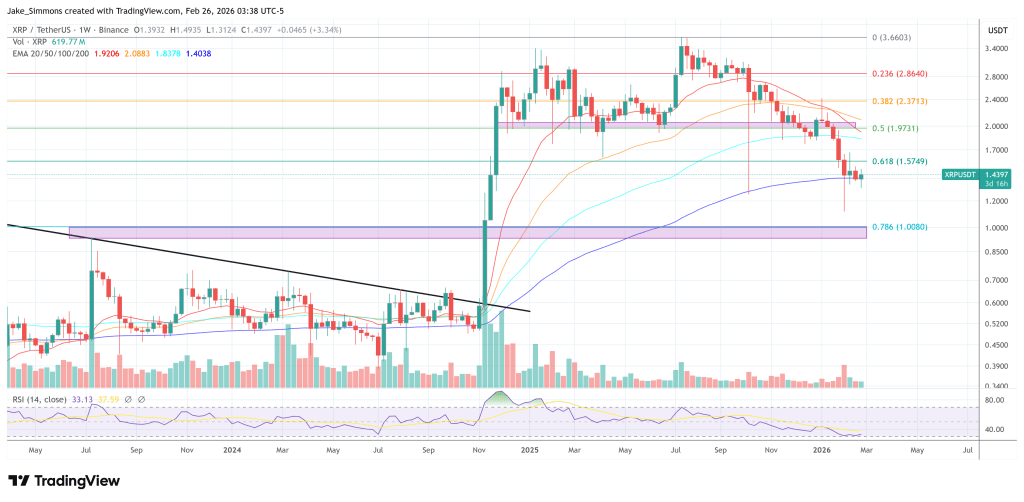
XRP rises back above the 200-week EMA, 1-week chart | Source: XRPUSDT on TradingView.com

Пов'язані питання

QWhat is the main focus of t54, the AI infrastructure startup that Ripple invested in?

At54 is building a trust layer for the agentic economy, focusing on providing verifiable agent identity (KYA), real-time risk assessment, and programmable accountability for autonomous AI agents operating in financial systems.

QWhich financial networks is t54's platform being built to support?

At54's ecosystem spans multiple networks, including XRP Ledger (XRPL), Solana, Base, and Virtuals, indicating it is not building for a single blockchain.

QAccording to Ripple President Monica Long, why is trust infrastructure becoming crucial?

AMonica Long stated that as autonomous agents begin managing and transacting with real capital, trust infrastructure becomes a foundational piece of the equation to ensure security and accountability.

QWhat key statistic from a YouGov study did t54 cite to support its market argument?

At54 cited a YouGov study showing 42% of US consumers would allow an AI agent to make purchases on their behalf if it secured the lowest price.

QHow did Markus Infanger from RippleX describe the shift in economic activity?

AMarkus Infanger described it as autonomous systems becoming participants in economic activity, not just tools, necessitating an evolution in the financial infrastructure that supports them.

Пов'язані матеріали

TechFlow Intelligence: Trump-Linked Companies Transfer $12 Million in Assets Before China Visit, 'The Big Short' Protagonist Warns of Stock Market Bubble Again

The article reports multiple developments across tech, crypto, and finance. In AI, Mozilla used AI for large-scale code review, Google confirmed hackers used AI to find zero-day exploits, and OpenAI deployed GPT-5.5 to find errors in math benchmarks. A court ruled Anthropic's scanning and destroying books for AI training as fair use, while its Claude platform launched on AWS. Google's new video model 'Omni' was leaked. In crypto/Web3, Trump-linked companies transferred $12M in crypto assets before a China visit. BlackRock chose Ethereum for tokenized funds, and a hacker stole $174k via a malicious NFT that tricked an AI. Jack Dorsey's first tweet NFT plummeted from $2.9M to under $5. In chips/hardware, TSMC approved an additional $20B for its Arizona plant. Apple's Tim Cook and Elon Musk will accompany Trump to China, while Nvidia's Jensen Huang is notably absent. For markets, Michael Burry warned of parabolic stock rises and suggested near-total sell-offs, with online discussions comparing current sentiment to the 1999 bubble. Other notes include WTI oil surpassing $100, a 20% price hike for Beijing-Shanghai high-speed rail, and new products like Unitree's $26.9k humanoid robot. The underlying theme suggests AI is becoming infrastructure, creating pressure on old systems while a new order is not yet ready, leaving investors anxious.

marsbit6 хв тому

TechFlow Intelligence: Trump-Linked Companies Transfer $12 Million in Assets Before China Visit, 'The Big Short' Protagonist Warns of Stock Market Bubble Again

marsbit6 хв тому

2026 New Policy Interpretation: The "Mutual Pursuit" of Intelligent Agents and AI Terminals, and the Three Major Value Reconstructions in the AIoT Industry

In May 2026, China's national ministries released two pivotal policy documents that jointly establish a strategic "dual-track" framework for the AIoT industry. The "Intelligent Agent Standardized Application and Innovation Development Implementation Opinions" defines the "soul"—positioning intelligent agents as core AI products. The "Artificial Intelligence Terminal Intelligence Grading" national standard defines the "body"—establishing a four-tier capability ladder (L1 to L4) for AI hardware. This synchronized policy approach is globally unique, moving beyond market-led (US) or risk-focused (EU) models. It frames AIoT as a new type of "intelligent infrastructure," comparable to electricity or the internet in historical significance. The core analysis identifies a value evolution from IoT 1.0 (connection) to AIoT 4.0 (collaboration, represented by the forward-looking L4 level). This "L4" signifies a paradigm shift: from users operating tools to delegating tasks to agent-like devices ("Intelligent Action of All Things"). The article outlines three strategic paths for companies: becoming Standard Definers, Scenario Integrators (focusing on 19 specified application areas), or Infrastructure Builders. A critical 18-24 month window is identified for strategic positioning. A "Four Levers" strategy is proposed: leveraging Standards (L-level certification), leveraging Scenarios (deep vertical focus), leveraging Open Source (for cost reduction and ecosystem influence), and leveraging Momentum (engaging in global protocol ecosystems). In conclusion, these policies are a starting gun for a decade-long industrial transformation, shifting the industry narrative from "Intelligent Connection of All Things" to "Intelligent Action of All Things," with companies needing to choose their赛道and execution strategy decisively.

marsbit1 год тому

2026 New Policy Interpretation: The "Mutual Pursuit" of Intelligent Agents and AI Terminals, and the Three Major Value Reconstructions in the AIoT Industry

marsbit1 год тому

Splashing Out 27 Billion Yuan, OpenAI Establishes New Company to Accelerate AI Deployment

On May 11th, OpenAI announced the formation of a new company, "OpenAI Deployment Company," with an initial investment of over $4 billion (approximately 27.2 billion RMB). This venture aims to help businesses build and deploy AI solutions. OpenAI is also acquiring the AI consulting firm Toromo to rapidly scale the deployment company's capabilities. This new entity, majority-owned by OpenAI, brings together 19 investment, consulting, and system integration partners, led by TPG with co-lead founding partners including Advent International, Bain Capital, and Brookfield. OpenAI's Chief Revenue Officer, Denise Dresser, stated that while AI is becoming increasingly capable, the current challenge lies in integrating these systems into core business infrastructure and workflows. The deployment company is designed to bridge this gap and translate AI capabilities into operational impact. This move comes as OpenAI emphasizes the next competitive phase will depend on the efficiency of deploying AI in real business scenarios. The company reports over 1 million businesses already use its products and APIs. OpenAI is significantly increasing its investments in computing power, with co-founder Greg Brockman stating the company expects to spend $50 billion on compute this year, a dramatic increase from $3 million in 2017. The announcement follows OpenAI's recent completion of a record $122 billion funding round in late March, led by Amazon, Nvidia, and SoftBank, valuing the company at $852 billion post-money. Major strategic investors committed $110 billion as a base for this round. Concurrently, OpenAI is advancing its core model development. It has shifted focus from its Sora video generator to developing advanced robotics and AI models that interact with the physical world. It has also begun allowing select users access to a new model specialized in identifying software vulnerabilities and is reportedly preparing to launch an enhanced image generation model in the coming weeks. According to reports citing founder Sam Altman, OpenAI is considering an IPO as early as 2027, with a potential valuation around $1 trillion.

marsbit1 год тому

Splashing Out 27 Billion Yuan, OpenAI Establishes New Company to Accelerate AI Deployment

marsbit1 год тому

Торгівля

Спот
Ф'ючерси

Популярні статті

Що таке XRP 2.0

XRP 2.0: Нова межа в світі криптовалют Вступ до XRP 2.0 У постійно змінюючомуся світі криптовалют нові проекти постійно з'являються, змагаючись за увагу та прийняття. Однією з таких обіцяючих ініціатив є XRP 2.0, новий криптовалютний проект, що має на меті використання сучасних технологій блокчейн та надійних методів шифрування. Хоча назва нагадує про XRP від Ripple, важливо зазначити, що XRP 2.0 функціонує автономно, концентруючи увагу на підвищенні безпеки транзакцій, конфіденційності та масштабованості. Оскільки цифровий фінансовий ландшафт все більше приймає децентралізовані рішення, XRP 2.0 прагне значно сприяти веб3 та загальному розширенню крипто проектів. Що таке XRP 2.0? У своїй основі XRP 2.0 є криптовалютним проектом, що має на меті створення безпечної та децентралізованої екосистеми цифрової валюти. Його фундаментальна технологія інтегрує складні принципи блокчейну з передовими техніками шифрування. Загальною метою XRP 2.0 є встановлення себе як надійної та ефективної платформи, що дозволяє швидко виконувати транзакції, при цьому надаючи пріоритет підвищеним захистам конфіденційності для своїх користувачів. Проект позиціонується як рішення багатьох обмежень, з якими стикаються існуючі криптовалюти, пропонуючи систему, яка може обробляти вищий обсяг транзакцій з покращеною швидкістю та конфіденційністю. Ця універсальність позиціонує XRP 2.0 як значного гравця на ринку, наповненому різними цифровими валютами. Хто творець XRP 2.0? Особистість творця XRP 2.0 була позначена як «Вілбур». Проте, вичерпні деталі про Вілбура або пов'язану з ним організацію залишаються недоступними. Анонімність багатьох творців криптовалют не є незвичним явищем в індустрії, часто запроваджена для збереження певного рівня конфіденційності та безпеки. Хто інвестори XRP 2.0? На даний момент конкретна інформація про інвестиційні фонди або організації, що підтримують XRP 2.0, не є публічно доступною. У секторі криптовалют підтримка від визнаних інвесторів може значно вплинути на кредитоспроможність і успіх проекту, але прозорість щодо фінансових підтримувачів XRP 2.0 не була встановлена. Як працює XRP 2.0? XRP 2.0 вирізняється використанням комбінації технології блокчейн та просунутих алгоритмів шифрування, що забезпечують безпечні та децентралізовані транзакції. Його інноваційна структура включає унікальні функції, спрямовані на залучення користувачів та розширення функціональності за межами традиційних транзакцій криптовалюти. Серед цих функцій, XRP 2.0 включає можливості на базі ШІ, такі як текст в зображення та текст в мову. Ці нововведення розроблені для покращення інтерактивного досвіду для користувачів, сприяючи ширшій застосовності в різних секторах. Завдяки поєднанню технологічних досягнень з орієнтованим на користувача дизайном, XRP 2.0 прагне привернути увагу різноманітних осіб і підприємств, які шукають способи інтеграції рішень криптовалют у свої операційні структури. Хронологія XRP 2.0 Розуміння XRP 2.0 вимагає вивчення основних етапів, які визначили його подорож до теперішнього часу: 23 липня 2023 року: XRP 2.0 представлено як новий криптовалютний проект, що має на меті революціонізувати безпечні та децентралізовані можливості транзакцій у галузі блокчейн. 8 вересня 2023 року: Запускається інший проект, XRP20, що відзначає виникнення токена ERC-20 на блокчейні Ethereum, який не пов'язаний з XRP 2.0. 13 листопада 2023 року: XRP Ledger зазнає значного оновлення з виходом програмного забезпечення rippled server версії 2.0.0. Важливо зазначити, що цей розвиток не пов'язаний з криптовалютним проектом XRP 2.0. Ключові моменти про XRP 2.0 Щоб узагальнити суть XRP 2.0, кілька критично важливих факторів emerge: Унікальні функції: Включення функцій, таких як текст в зображення і текст в мову на базі ШІ, ще більше розширює потенційні застосування XRP 2.0. Технологія блокчейн: Архітектура використовує сучасні механізми блокчейн і протоколи шифрування, забезпечуючи безпечне та децентралізоване середовище для транзакцій. Масштабованість і конфіденційність: XRP 2.0 надає пріоритет підвищеним захистам конфіденційності в процесах транзакцій і масштабованості, необхідній для задоволення зростаючої бази користувачів. Відсутність зв'язку з Ripple: Важливо, що, незважаючи на свою назву, XRP 2.0 не має жодної прив'язки чи співпраці з XRP від Ripple, що відрізняє його операційну структуру та цілі в рамках криптовалютної екосистеми. Висновок XRP 2.0 представляє амбітну ініціативу у світі криптовалют, прагнучи запропонувати поєднання безпеки, конфіденційності та ефективності у цифрових транзакціях. Інтегруючи складні технології та дружні до користувача функції, проект ставить за мету розширити горизонти того, що криптовалюта може досягти в сучасній цифровій економіці. Хоча анонімність його творця та відсутність розкритих інвесторів можуть викликати запитання у деяких, фокус XRP 2.0 на передових функціональностях і децентралізації підвищує його привабливість на дедалі більшому ринку криптовалют. Оскільки ландшафт криптовалют продовжує еволюціонувати, XRP 2.0 може ще стати важливим гравцем у розширенні безпечних і масштабованих рішень блокчейн.

162 переглядів усьогоОпубліковано 2024.04.05Оновлено 2024.12.03

Що таке XRP 2.0

Як купити XRP

Ласкаво просимо до HTX.com! Ми зробили покупку XRP (XRP) простою та зручною. Дотримуйтесь нашої покрокової інструкції, щоб розпочати свою криптовалютну подорож.Крок 1: Створіть обліковий запис на HTXВикористовуйте свою електронну пошту або номер телефону, щоб зареєструвати обліковий запис на HTX безплатно. Пройдіть безпроблемну реєстрацію й отримайте доступ до всіх функцій.ЗареєструватисьКрок 2: Перейдіть до розділу Купити крипту і виберіть спосіб оплатиКредитна/дебетова картка: використовуйте вашу картку Visa або Mastercard, щоб миттєво купити XRP (XRP).Баланс: використовуйте кошти з балансу вашого рахунку HTX для безперешкодної торгівлі.Треті особи: ми додали популярні способи оплати, такі як Google Pay та Apple Pay, щоб підвищити зручність.P2P: Торгуйте безпосередньо з іншими користувачами на HTX.Позабіржова торгівля (OTC): ми пропонуємо індивідуальні послуги та конкурентні обмінні курси для трейдерів.Крок 3: Зберігайте свої XRP (XRP)Після придбання XRP (XRP) збережіть його у своєму обліковому записі на HTX. Крім того, ви можете відправити його в інше місце за допомогою блокчейн-переказу або використовувати його для торгівлі іншими криптовалютами.Крок 4: Торгівля XRP (XRP)Легко торгуйте XRP (XRP) на спотовому ринку HTX. Просто увійдіть до свого облікового запису, виберіть торгову пару, укладайте угоди та спостерігайте за ними в режимі реального часу. Ми пропонуємо зручний досвід як для початківців, так і для досвідчених трейдерів.

1.4k переглядів усьогоОпубліковано 2024.12.10Оновлено 2025.03.21

Як купити XRP

Обговорення

Ласкаво просимо до спільноти HTX. Тут ви можете бути в курсі останніх подій розвитку платформи та отримати доступ до професійної ринкової інформації. Нижче представлені думки користувачів щодо ціни XRP (XRP).

活动图片














