Ripple Links Up With $130 Billion Riyad Bank’s Innovation Arm Jeel

bitcoinistОпубліковано о 2026-01-27Востаннє оновлено о 2026-01-27

Анотація

Ripple has partnered with Jeel, the innovation arm of Riyad Bank, to explore blockchain applications in Saudi Arabia. The collaboration will focus on cross-border payments, digital asset custody, and tokenization within Jeel's regulatory sandbox. This initiative supports Saudi Arabia's Vision 2030 digital transformation goals by aiming to improve payment speed, cost efficiency, and transparency. Both companies plan to develop proofs-of-concept in a controlled environment to test scalable and interoperable financial infrastructure. Ripple's leadership emphasized the alignment with the Kingdom's ambitions to become a leading fintech hub.

Ripple has signed a partnership with Jeel, the innovation and technology arm of Riyad Bank, to explore blockchain applications across cross-border payments, digital asset custody, and tokenization in Saudi Arabia. The collaboration positions Ripple inside a regulated testing environment as the Kingdom accelerates its Vision 2030 digital transformation agenda.

Ripple Expands In Saudi With Riyad Bank

Jeel announced the tie-up on X: “We are pleased to announce in Jil our partnership with Ripple to explore advanced applications aimed at enhancing the speed and efficiency of payments. This partnership focuses on studying use cases for the custody of digital assets, alongside developing prototypes within Jil’s regulatory sandbox, in support of the objectives of Vision 2030.”

In a press release dated January 26, 2026, Jeel said the partnership will evaluate how blockchain can improve the “speed, cost efficiency, and transparency of cross-border payments,” while also exploring digital asset custody and tokenization use cases. The firms plan to develop proofs-of-concept within Jeel’s sandbox to test Ripple’s technologies “in a controlled, compliant environment,” with an emphasis on scalable and interoperable infrastructure for financial services across the Kingdom.

Jeel CEO George Harrak positioned the sandbox as the core mechanism for turning blockchain concepts into regulated experimentation. “This partnership with Ripple reflects our strategy of using the Jeel Sandbox to responsibly explore next-generation financial infrastructure,” Harrak said. “By combining regulated experimentation with global blockchain expertise, we are building the foundations to evaluate scalable use cases that enhance cross-border payments and digital asset capabilities in line with the Kingdom’s long-term digital ambitions.”

Ripple’s Managing Director for the Middle East and Africa, Reece Merrick, described the work as an effort to integrate enterprise blockchain into Saudi financial architecture, explicitly tying it to the Vision 2030 roadmap.

“Saudi Arabia’s visionary leadership has established the Kingdom as a forward-thinking global hub for digital transformation,” Merrick said. “It is against this progressive backdrop that Ripple has signed an MOU with Jeel to explore integrating secure, efficient blockchain solutions into the national financial architecture. We are committed to demonstrating how Ripple’s enterprise-grade digital assets technology can unlock significant efficiencies in areas like cross-border payments, aligning directly with Saudi Arabia’s goal of building a world-leading, competitive fintech ecosystem.”

Merrick echoed that messaging in a separate post, saying the partners will explore use cases spanning “cross-border payments, digital asset custody, and tokenization,” and adding that he is “excited to help shape the future of Saudi Arabia’s financial infrastructure.”

For Jeel, the partnership is pitched as a step beyond conventional fintech acceleration into “regulated blockchain experimentation,” extending its innovation mandate while supporting Riyad Bank’s ambitions to evaluate next-generation digital financial services. For Ripple, Jeel’s sandbox and institutional network offer a pathway into the Kingdom’s fast-growing fintech landscape, with the press release noting that the arrangement creates a venue to showcase Ripple’s infrastructure in a “highly regulated and innovation-driven environment.”

At press time, XRP traded at $1.90.
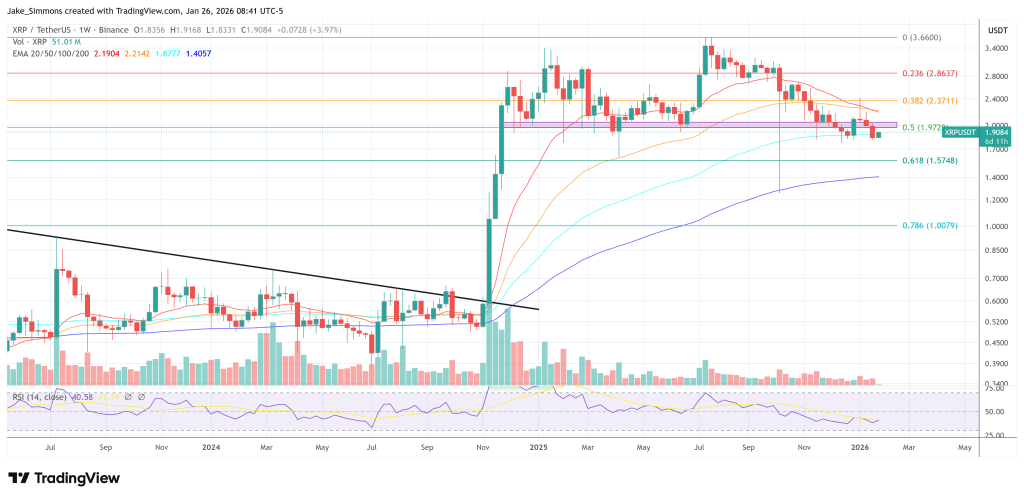
XRP tries to reclaim the 100-week EMA, 1-week chart | Source: XRPUSDT on TradingView.com

Трендові криптовалюти

Пов'язані питання

QWhat is the main purpose of the partnership between Ripple and Jeel?

AThe partnership aims to explore blockchain applications across cross-border payments, digital asset custody, and tokenization in Saudi Arabia within a regulated testing environment.

QWhich Saudi national initiative does this collaboration support?

AThe collaboration supports Saudi Arabia's Vision 2030 digital transformation agenda.

QWhat specific mechanism will be used to test Ripple's technologies?

AThe technologies will be tested through proofs-of-concept developed within Jeel's regulatory sandbox, which provides a controlled and compliant environment.

QWho is the CEO of Jeel and how did he describe the partnership's strategy?

AJeel CEO George Harrak described the strategy as using the Jeel Sandbox to responsibly explore next-generation financial infrastructure through regulated experimentation combined with global blockchain expertise.

QWhat role does Ripple's Managing Director for Middle East and Africa attribute to Saudi leadership in this initiative?

AReece Merrick stated that Saudi Arabia's visionary leadership has established the Kingdom as a forward-thinking global hub for digital transformation, creating a progressive backdrop for this blockchain integration.

Пов'язані матеріали

From South Korea to the United States: Blue-Collar Jobs Are Becoming Increasingly Popular, Thanks to AI

AI is reshaping the labor market's value proposition. The traditional four-year college degree is losing its appeal as a guaranteed career path, while skilled blue-collar trades like electricians, welders, and plumbers are experiencing historic demand and wage premiums. This shift is driven by dual pressures: AI's displacement of certain white-collar roles and a booming need for physical infrastructure and data center construction. Data confirms the trend. In the U.S., vocational school revenue surged, and a significant portion of recent layoffs are AI-related. Surveys show a majority of Gen Z adults plan to pursue blue-collar work, citing better job security against AI automation. Vocational education interest has exploded recently. Experts cite a psychological shift as younger generations seek tangible, AI-resistant careers and avoid high student debt. In many cases, salaries for skilled trades now match or exceed those requiring a bachelor's degree. In South Korea, semiconductor vocational high schools boast near-total employment, with graduates securing high-paying roles at companies like Samsung. The shortage is structural, exacerbated by a retiring baby boomer workforce and massive infrastructure projects. Companies like JPMorgan Chase, Meta, and Lowe's are investing heavily in training programs. However, overcoming historical stigma and a "perception gap" around trade careers remains a key challenge to closing the talent gap.

marsbit23 хв тому

From South Korea to the United States: Blue-Collar Jobs Are Becoming Increasingly Popular, Thanks to AI

marsbit23 хв тому

Qualcomm: AI Hype Subsides, When Will Smartphones Emerge from the Gloom?

Qualcomm reported its Q3 FY2026 results (ending June 2026), with revenue of $9.95B, down 4% YoY but above expectations. Gross margin declined to 53.1%, pressured by rising costs across manufacturing and memory. Key business segments showed mixed performance: Handset revenue fell 19.6% YoY to $5.09B, dragged by an 11% decline in non-Apple Android shipments and weaker high-end mix. Conversely, Automotive revenue surged 61% to $1.59B, and IoT grew 9% to $1.83B. Core operating profit dropped 41% YoY due to margin compression and higher expenses. Management's Q4 FY2026 guidance projects revenue of $9.7B-$10.5B, in line with consensus, but Non-GAAP EPS guidance of $2.05-$2.25 fell short of expectations. Amidst persistent weakness in its core handset market, Qualcomm is pursuing growth in AI, focusing on Edge AI (smartphones, PCs, automotive) and Data Center AI. Its data center strategy includes four pillars: AI accelerators (e.g., AI200), commercial CPUs (Dragonfly C1000), custom silicon, and connectivity solutions. While these initiatives initially boosted its stock, concerns over AI capital expenditure sustainability have since erased those gains. The company targets $5B in data center revenue for FY2027 and $15B for FY2029. The report concludes that with the traditional handset business still under pressure, the data center opportunity is currently viewed as a longer-term option, and a more conservative valuation based on core operations may be warranted until AI contributions materialize.

marsbit28 хв тому

Qualcomm: AI Hype Subsides, When Will Smartphones Emerge from the Gloom?

marsbit28 хв тому

From TPU to Self-Evolving Agents: How Jeff Dean Predicts the Next Step in AI

At the 2026 YC Startup School, Jeff Dean outlined his vision for AI's next phase, shifting focus from simply scaling models to building intelligent, autonomous systems. He believes AI's progress is no longer just about creating smarter models, but about integrating them into systems capable of long-term, iterative work, automated experimentation, and continuous learning. This evolution moves the competition from "who has the bigger model" to "who can best organize intelligence." Dean suggests AI capabilities are now comparable to a junior engineer, enabling the automation of complex workflows. However, the true challenge and opportunity lie in managing these AI "workers" at scale. He emphasizes the importance of **context engineering**—structuring tools, memory, and feedback loops—over raw model power. For startups, this means building deep expertise in niche domains where general models currently fail (near 0-1% success rates), leveraging proprietary data, specialized tools, and domain-specific evaluators. A recurring theme is re-examining fundamental constraints. Dean's past work, like moving Google's search index to memory or creating the TPU, stemmed from questioning outdated assumptions about hardware and cost. He sees similar inflection points today, particularly in **specialized inference hardware** to drastically reduce latency and energy consumption for real-time Agent operation. Notably, he points out that in modern AI systems, the dominant cost is often not computation but **data movement**. Reliable, long-running Agents require robust system design, borrowing concepts from distributed computing like checkpointing, state management, and parallel exploration to handle failures and maintain progress over days or weeks. As AI automates execution, the scarcest human skills will shift to **defining clear specifications**, **judging what problems are worth solving** (taste), and designing effective feedback loops. Ultimately, Dean's framework prioritizes understanding the problem deeply, identifying the true bottlenecks, and systematically building closed-loop systems where AI can not only perform tasks but also improve AI itself.

marsbit28 хв тому

From TPU to Self-Evolving Agents: How Jeff Dean Predicts the Next Step in AI

marsbit28 хв тому

Торгівля

Спот

Популярні статті

Що таке $BANK

Bank AI: Революційний крок у майбутнє банківської справи Вступ В епоху, що характеризується швидкими технологічними змінами, Bank AI знаходиться на перетині штучного інтелекту (ШІ) та банківських послуг. Цей інноваційний проєкт прагне переосмислити фінансовий ландшафт, підвищуючи ефективність роботи, заходи безпеки та досвід клієнтів завдяки потужності ШІ. Розпочинаючи дослідження Bank AI, ми заглибимося в суть проєкту, його операційні динаміки, історичний контекст і значущі етапи. Що таке Bank AI? У своїй основі Bank AI представляє собою трансформаційну ініціативу, спрямовану на інтеграцію штучного інтелекту в різні банківські операції. Цей проєкт використовує можливості ШІ для автоматизації процесів, покращення протоколів управління ризиками та підвищення взаємодії з клієнтами через персоналізовані послуги. Основні цілі Bank AI включають: Автоматизація банківських функцій: Використовуючи технології ШІ, Bank AI прагне автоматизувати рутинні завдання, зменшуючи навантаження на людські ресурси та підвищуючи ефективність. Покращене управління ризиками: Проєкт використовує алгоритми ШІ для прогнозування та виявлення ризиків, тим самим зміцнюючи заходи безпеки проти шахрайства та інших загроз. Персоналізація банківських послуг: Bank AI зосереджується на пропозиції індивідуальних фінансових продуктів і послуг, аналізуючи дані і поведінку клієнтів. Покращення досвіду клієнтів: Впровадження рішень на основі ШІ, таких як чат-боти та віртуальні асистенти, має на меті забезпечити користувачам більш природну взаємодію, революціонізуючи спосіб, яким клієнти спілкуються з банками. З цими цілями Bank AI займає важливу роль в робленні банківської справи більш ефективною, безпечною та орієнтованою на користувача. Хто є творцем Bank AI? Деталі стосовно творця Bank AI залишаються невідомими. Таким чином, жодна конкретна особа або організація не були ідентифіковані в доступній інформації. Анонімність навколо створення проєкту піднімає питання, але це не зменшує його амбітного бачення та цілей. Хто є інвесторами Bank AI? Аналогічно творцеві проєкту, конкретна інформація стосовно інвесторів або організацій, що підтримують Bank AI, не була розкрито. Без цієї інформації важко окреслити фінансову підтримку та інституційну підтримку, які могли б сприяти розвитку проєкту. Тим не менше, важливість наявності міцної інвестиційної бази є вирішальною для забезпечення розвитку в такій інноваційній сфері. Як працює Bank AI? Bank AI функціонує на кількох інноваційних фронтах, фокусуючись на унікальних факторах, які відрізняють його від традиційних банківських структур. Нижче наведено ключові операційні характеристики: Автоматизація: Застосовуючи алгоритми машинного навчання, Bank AI автоматизує різні ручні процеси в банках. Це призводить до зниження операційних витрат і дозволяє працівникам перенаправити свої зусилля на більш стратегічні завдання. Покращене управління ризиками: Інтеграція ШІ в практики управління ризиками забезпечує банки інструментами для точного прогнозування потенційних загроз, таких як шахрайство, забезпечуючи при цьому безпеку інформації і активів клієнтів. Індивідуальні фінансові рекомендації: Завдяки безперервному навчанню з інтерaktionen з клієнтами, системи ШІ розвивають тонке розуміння потреб користувачів, що дозволяє їм пропонувати персоналізовані поради щодо фінансових рішень. Покращені взаємодії з клієнтами: Використовуючи чат-ботів і віртуальних асистентів на базі ШІ, Bank AI дозволяє створити більш залучений досвід для клієнтів, дозволяючи користувачам швидше отримувати відповіді на свої запитання, зменшуючи час очікування та підвищуючи рівень задоволеності. Разом ці операційні характеристики позиціонують Bank AI як піонера в банківському секторі, встановлюючи нові стандарти для надання послуг і операційної досконалості. Хронологія Bank AI Для розуміння траєкторії Bank AI необхідно ознайомитися з його історичним контекстом. Нижче наведено хронологію, що підкреслює важливі етапи та розробки: Ранні 2010-ті: Концептуалізація інтеграції ШІ в банківські послуги почала привертати увагу, коли банківські установи визнали потенційні переваги. 2018: Відбулося помітне збільшення впровадження технологій ШІ, коли банки почали використовувати інструменти ШІ, такі як чат-боти для базового обслуговування клієнтів та системи управління ризиками для покращення безпеки. 2023: Софістикація ШІ продовжувала розвиватися, з введенням генеративного ШІ для більш складних завдань, таких як обробка документів і аналіз інвестицій в реальному часі. Цей рік став важливим стрибком у можливостях, які забезпечує технологія ШІ для банків. 2024-актуальний статус: Станом на цей рік, Bank AI знаходиться на зростаючій траєкторії, з постійними дослідженнями та розробками, які готові подальше покращити можливості в банківських операціях. Продовження дослідження застосувань ШІ натякає на захоплюючі події, які ще попереду. Ключові моменти про Bank AI Інтеграція ШІ в банківську справу: Bank AI зосереджується на прийнятті штучного інтелекту для оптимізації банківських процесів та покращення досвіду користувачів. Автоматизація та фокус на управлінні ризиками: Проєкт сильного підкреслює ці сфери, прагнучи зshift тягар рутинних завдань, водночас підвищуючи безпеку через прогнозну аналітику. Персоналізовані банківські рішення: Завдяки використанню даних клієнтів, Bank AI забезпечує персоналізовані банківські послуги, що відповідають потребам окремих користувачів. Прихильність до розвитку: Bank AI залишається відданим постійним дослідженням і розробкам, що забезпечують його адаптацію та постійну актуальність у міру того, як технології продовжують розвиватися. Висновок Підсумовуючи, Bank AI є важливим кроком вперед у банківській індустрії, використовуючи штучний інтелект для переформатування операційних парадигм, підвищення безпеки та сприяння задоволеності клієнтів. Незважаючи на прогалини в інформації щодо творця та інвесторів, чіткі цілі і функціональні механізми Bank AI забезпечують міцну основу для його подальшої еволюції. Оскільки технологія ШІ продовжує розвиватися та інтегруватися в банківський сектор, Bank AI має всі шанси суттєво вплинути на майбутнє фінансових послуг, покращуючи спосіб, яким ми розуміємо та взаємодіємо з банківською справою.

211 переглядів усьогоОпубліковано 2024.04.06Оновлено 2024.12.03

Що таке $BANK

Як купити BANK

Ласкаво просимо до HTX.com! Ми зробили покупку Lorenzo Protocol (BANK) простою та зручною. Дотримуйтесь нашої покрокової інструкції, щоб розпочати свою криптовалютну подорож.Крок 1: Створіть обліковий запис на HTXВикористовуйте свою електронну пошту або номер телефону, щоб зареєструвати обліковий запис на HTX безплатно. Пройдіть безпроблемну реєстрацію й отримайте доступ до всіх функцій.ЗареєструватисьКрок 2: Перейдіть до розділу Купити крипту і виберіть спосіб оплатиКредитна/дебетова картка: використовуйте вашу картку Visa або Mastercard, щоб миттєво купити Lorenzo Protocol (BANK).Баланс: використовуйте кошти з балансу вашого рахунку HTX для безперешкодної торгівлі.Треті особи: ми додали популярні способи оплати, такі як Google Pay та Apple Pay, щоб підвищити зручність.P2P: Торгуйте безпосередньо з іншими користувачами на HTX.Позабіржова торгівля (OTC): ми пропонуємо індивідуальні послуги та конкурентні обмінні курси для трейдерів.Крок 3: Зберігайте свої Lorenzo Protocol (BANK)Після придбання Lorenzo Protocol (BANK) збережіть його у своєму обліковому записі на HTX. Крім того, ви можете відправити його в інше місце за допомогою блокчейн-переказу або використовувати його для торгівлі іншими криптовалютами.Крок 4: Торгівля Lorenzo Protocol (BANK)Легко торгуйте Lorenzo Protocol (BANK) на спотовому ринку HTX. Просто увійдіть до свого облікового запису, виберіть торгову пару, укладайте угоди та спостерігайте за ними в режимі реального часу. Ми пропонуємо зручний досвід як для початківців, так і для досвідчених трейдерів.

784 переглядів усьогоОпубліковано 2025.05.09Оновлено 2026.06.02

Як купити BANK

Обговорення

Ласкаво просимо до спільноти HTX. Тут ви можете бути в курсі останніх подій розвитку платформи та отримати доступ до професійної ринкової інформації. Нижче представлені думки користувачів щодо ціни BANK (BANK).

活动图片














