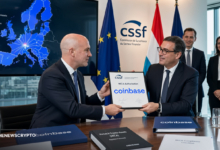
Ripple Exec Warns: Banks Without A Stablecoin Strategy ‘Will Get Left Behind’

bitcoinistОпубліковано о 2025-12-11Востаннє оновлено о 2025-12-11

Анотація

Ripple executive Reece Merrick warns that banks and financial institutions without a stablecoin strategy risk being left behind. He emphasized that stablecoins are becoming core to payments and treasury infrastructure. Ripple’s USD-backed stablecoin, RLUSD, recently gained regulatory approval in Abu Dhabi, allowing licensed institutions to use it for regulated activities. Backed by stringent regulators like NYDFS and FSRA, RLUSD aims to be an institutional-grade product. Though its circulation is modest compared to giants like Tether, Ripple targets integration into high-volume institutional flows through recent acquisitions and its existing cross-border payment network, which has processed $95 billion. Merrick highlighted trust, regulation, and real-world utility as key to driving adoption and future growth in the multi-trillion-dollar stablecoin market.

Ripple’s Middle East and Africa boss has a blunt message for the banking sector: if you still do not have a stablecoin strategy, you are already behind the curve.

“Look, I think there’s no bank, financial institution, payment entity that is not thinking, talking or incorporating a stablecoin strategy,” Ripple’s Reece Merrick told CNBC in Abu Dhabi. “And quite frankly, if they’re not, they will get left behind.”

Ripple’s Advantage In The Stablecoin Space

The interview came right after a significant regulatory win. Ripple’s USD-backed stablecoin, RLUSD, has been recognized by Abu Dhabi’s Financial Services Regulatory Authority (FSRA) as an “Accepted Fiat-Referenced Token,” allowing ADGM-licensed institutions to use it for regulated financial activity. For Ripple, this is less about marketing and more about foothold: it embeds RLUSD inside one of the Gulf’s most aggressively pro-crypto regulatory hubs.

“Firstly, what this does is it further validates Ripple’s value proposition here in the region and a compliance-first approach as it relates to issuing our own stablecoin, RLUSD, at the back end of last year,” Merrick said. The approval means ADGM entities can “utilize RLUSD within their flows, within their operations,” which he called “a great step forward for Ripple, great step forward for the region.”

The compliance drumbeat is deliberate. Before pushing RLUSD globally, Ripple went to what Merrick described as “the gold standard of regulators,” the New York Department of Financial Services, which oversees RLUSD issuance. The combination of NYDFS in the US and FSRA (plus Dubai’s DFSA, which earlier approved Ripple as the first blockchain-enabled payment solution provider) is meant to send a clear signal: this is an institutional product, not a fly-by-night dollar token.

The hard numbers are more modest. RLUSD has about 1.2 billion dollars in circulation, tiny next to Tether’s roughly 120 billion. Merrick did not try to spin that away; instead he pointed at the direction of travel. The stablecoin market is around 300 billion dollars today, he noted, dominated by USDT and USDC, but Ripple expects it “to be moving into the trillions” with “share for everyone.”

How to carve out that share is where Ripple’s strategy gets more specific. Merrick said Ripple wants RLUSD “to be the gold standard for institutions to adopt this stablecoin,” and he anchored that in concrete rails: recent acquisitions and existing payment volume.

He highlighted G-Treasury, a treasury management platform that sees “how Fortune 500 businesses are moving trillions of dollars between their own operations,” and Hidden Road, now rebranded as Ripple Prime, a prime broker that “turn[s] over three trillion in prime brokerage.” Ripple’s plan is to bake RLUSD directly into those flows. Since announcing GTreasury, Merrick said, the company has seen “so much inbound” from institutions exploring RLUSD for their internal operations.

Underneath sits Ripple’s long-running cross-border payments business, which has processed about 95 billion dollars in turnover using XRP and the XRP Ledger. RLUSD, Merrick argued, is a “natural step” after persistent customer demand for stablecoin payouts. With roughly half of global cross-border payments made in dollars and many of those not actually destined for the US, he called existing channels “inefficient and slow,” and positioned regulated dollar tokens as a cleaner alternative.

Trust and understanding are still the industry’s biggest problems, as CNBC’s Dan Murphy noted, citing boardroom confusion and skepticism even at Abu Dhabi Finance Week. Merrick’s response was predictable but also, frankly, the only credible one: stack regulation, collateral transparency and real-world utility until the narrative changes.

“Trust is paramount,” he said, pointing again to NYDFS, ADGM and DFSA approvals as the anchor. Once “large financial institutions, these large corporates” see the impact on their own business, he expects “that kind of hockey stick growth.”

He also highlighted the GENIUS Act in the US as having “paved the way for some of the largest global financial institutions to kind of play in this space,” shorthand for the broader legislative shift toward regulated stablecoin frameworks.

Taken together, Merrick’s remarks sketch a simple line in the sand. Stablecoins are no longer a side experiment; they are becoming core payments and treasury infrastructure. And for banks still stuck at the “internal working group” stage, the message from Ripple’s regional chief could not have been clearer: get a stablecoin strategy, or get comfortable watching your customers migrate to those who already do.

At press time, XRP traded at $2.0149.
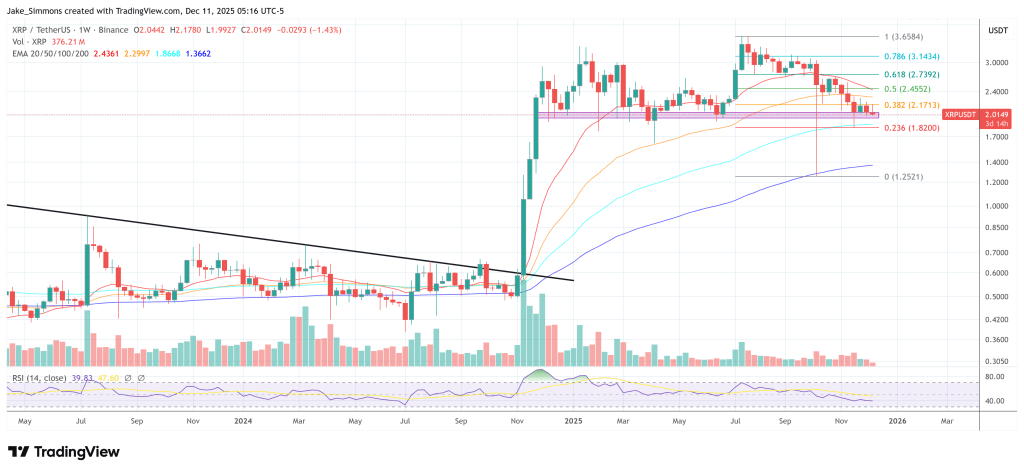
XRP holds above key support, 1-week chart | Source: XRPUSDT on TradingView.com

Трендові криптовалюти

Пов'язані матеріали

Meta Follows the Trend into Prediction Markets: Can It Avoid Repeating the Failure of the Metaverse?

Meta, the tech giant behind Facebook, has reportedly formed a team to develop "Arena," a new application focused on prediction markets. Users would use platform points to place bets on outcomes in politics, sports, and global events. This move follows Meta's massive, nearly $900 billion, losses from its heavily-invested metaverse division, Reality Labs. The prediction market industry is already showing strong demand, with leading platforms like Kalshi and Polymarket facilitating hundreds of billions in annual volume. Meta, with its 3.56 billion daily active users across its apps, possesses the unprecedented scale to bring this niche activity to a mainstream audience, similar to its past success in cloning features like Stories and Reels. However, Arena faces significant hurdles. Meta plans to start with a points-based system to avoid strict financial regulations, but this may dilute the core incentive of accurate prediction that real-money markets provide. More critically, Meta enters the space with a major trust deficit stemming from its past regulatory battles, notably the failed Libra/Diem stablecoin project, and its controversial history with political content and misinformation. The prediction market sector itself is under increasing regulatory scrutiny, with recent CFTC actions including fines and the first-ever insider trading case. While Meta's vast user base offers a unique opportunity to expand the market, its success hinges on navigating complex regulations and rebuilding the credibility necessary for a platform dealing with sensitive topics like elections. The outcome could range from Meta dramatically growing the industry to Arena becoming a high-profile regulatory target before it can scale.

Foresight News8 хв тому

Meta Follows the Trend into Prediction Markets: Can It Avoid Repeating the Failure of the Metaverse?

Foresight News8 хв тому

Stock Soars 1200% on First Day, 80s Sales Engineer's Reversal: From Selling FRP to a Fortune of 29 Billion

On its first day of listing, Zhenbao Technology (stock code "N Zhenbao") surged by 1207%, marking itself as the second "ten-bagger" new stock of the year on the STAR Market. The closing price of 585 yuan propelled it into the top 20 of the A-share market by stock price. Dubbed the "first share of semiconductor consumables," the company is backed by a comprehensive shareholder list including National Integrated Circuit Industry Investment Fund Phase II, SMIC, BOE, and YMTC. Zhenbao's business model focuses on supplying critical consumable components like silicon rings and quartz parts to semiconductor fabs. Unlike expensive core equipment with low repurchase rates, these consumables require frequent replacement as long as production lines are running, generating stable recurring revenue—a key reason for its high market valuation. Founder Wang Bing, an 80s-born former sales engineer, built the company by identifying a supply chain vulnerability: foreign monopolies on high-purity materials led to high costs and unstable deliveries for domestic fabs. Zhenbao's strategy emphasized reliability and speed over absolute top-tier performance, offering products at about 50% of the price with 80% of the performance but 100% on delivery and responsiveness. To achieve this, the company vertically integrated its operations across "raw materials + components + surface treatment," ensuring supply chain control and cost reduction. Its clientele now spans major domestic fabs like BOE and Huahong, as well as international players like SK Hynix and Texas Instruments. However, risks accompany its rapid expansion. The IPO raised approximately 1.605 billion yuan primarily for capacity expansion, which will bring significant annual depreciation costs, potentially impacting future profitability. The company's growth is heavily reliant on sustained high levels of fab expansion, making it vulnerable to the semiconductor industry's cyclical downturns. Other concerns include high accounts receivable (70.83% of revenue at one point in 2025), heavy reliance on its top five customers (over 70% of sales), and questions about the stability and authenticity of its R&D investments, evidenced by volatile R&D headcount and unusual spikes in R&D energy consumption. While the "consumables story" commands a premium, long-term valuation will depend on maintaining high capacity utilization and healthy cash flow conversion.

marsbit14 хв тому

Stock Soars 1200% on First Day, 80s Sales Engineer's Reversal: From Selling FRP to a Fortune of 29 Billion

marsbit14 хв тому

Warsh Deals a Heavy Blow to the 'Dollar Devaluation Trade'! Gold Crashes, Bitcoin Slumps, How Long Can the Chip Frenzy Hold?

The "dollar devaluation trade" that dominated Wall Street this year is rapidly unraveling, driven by a hawkish pivot from Fed Chairman Kevin Warsh and a surging U.S. dollar. This double pressure has triggered a sharp sell-off in non-yielding assets. Gold broke below $4,000 an ounce, silver tumbled below $60, and Bitcoin fell under $60,000, with all retreating significantly from their earlier 2025 peaks. The dollar index hit a 14-month high. Warsh's emphasis on price stability has solidified market expectations for aggressive rate hikes, increasing the opportunity cost of holding assets like precious metals. Concurrently, massive fund flows are rotating out of metals and cryptocurrencies into the semiconductor sector, providing a temporary boost to stocks like Micron and SK Hynix. However, analysts warn this chip rally shows signs of a speculative top. Extreme volatility, with semiconductor stocks seeing trillion-dollar swings, is historically characteristic of major market turning points. Factors like month-end rebalancing, a flood of new equity issuance, and insider selling further signal potential exhaustion. While Micron's strong earnings briefly stemmed selling, it may offer a favorable exit point for remaining chip bulls. The sustainability of the semiconductor frenzy is now in serious doubt as the broader market reprices assets around a stronger dollar and tighter monetary policy.

华尔街日报22 хв тому

Warsh Deals a Heavy Blow to the 'Dollar Devaluation Trade'! Gold Crashes, Bitcoin Slumps, How Long Can the Chip Frenzy Hold?

华尔街日报22 хв тому

Micron Shuts Up the Bears, Makes India's 'Buffett' Regret: Sold Too Early, Missed Out on $2 Billion

Indian value investor Mohnish Pabrai, a disciple of Warren Buffett, revealed his costly mistake of selling shares in Micron Technology too early. He initially invested in 2017, holding it for six years and building a position as large as 77% of his portfolio, based on a thesis that the memory chip industry would consolidate into a stable oligopoly of Samsung, SK Hynix, and Micron. However, he sold his entire stake in September 2023, fearing oversupply after Samsung announced production expansion. Shortly after his exit, demand for high-bandwidth memory (HBM) surged with the rise of AI, and Micron's stock price skyrocketed over 15 times in two years. Pabrai estimates this premature sale cost him roughly $20 billion in potential gains. He expressed similar regret over selling his investment in SK Hynix too soon, stating he violated his own principle of holding companies forever. Reflecting on these errors, Pabrai emphasized his core investment checklist principles: avoiding leverage, focusing on the durability of a company's competitive moat, and assessing management's character. Despite these personal trading missteps, his long-term view on the remaining memory chip leaders remains bullish, advising current holders not to sell as "the party is just getting started." He concluded by sharing his philosophical outlook, prioritizing character over wealth, and his goal to donate his entire fortune before his passing.

marsbit1 год тому

Micron Shuts Up the Bears, Makes India's 'Buffett' Regret: Sold Too Early, Missed Out on $2 Billion

marsbit1 год тому

Mihoyo's Next Protagonist Is Her, Who Plays the Piano

Mihoyo, widely recognized for its hit game Genshin Impact, has long harbored a grander ambition: creating a virtual world where one billion people would want to live. While its character design is unparalleled, the company recognizes a fundamental limitation—these beloved virtual characters are not truly "alive." Their dialogue and actions are pre-scripted. This drive for authentic "living" characters has guided Mihoyo's strategic investments in cutting-edge fields like brain-computer interfaces, AI (including an early investment in MiniMax), and nuclear fusion. Following the release of ChatGPT in late 2022, co-founder Cai Haoyu stepped down from management to lead a new overseas AI venture, Anuttacon, focused on creating AI-driven virtual beings. Mihoyo's path has involved experimentation and iteration. Anuttacon's early project, *Whisper of the Stars*, showcased real-time AI conversation but revealed limitations in underlying language models. The team subsequently focused its resources on developing a sophisticated "emotional" large language model, distinct from purely utilitarian AI. Co-founder Liu Wei (Dawei) announced plans to invest up to 100 billion RMB in this AI pursuit. The first tangible product of this vision is *BSide: Olivia Lin*, a free Steam application featuring a piano-playing virtual companion. Unlike typical AI chatbots demanding constant interaction, Olivia Lin operates on a slower, more deliberate rhythm—responding to letters, playing user-submitted melodies, and serving as a desktop presence. This design emphasizes "lifelikeness" over exhaustive conversation, strategically working around current technological constraints while building a sense of authentic connection. The company's journey traces back to its name, "miHoYo," where "mi" pays homage to the virtual singer Hatsune Miku. For nearly two decades, fans have loved Miku, a character unaware of their devotion. Mihoyo's ultimate goal, now backed by massive investment and AI research, is to bridge that gap—to create virtual beings that can truly know they are loved.

marsbit2 год тому

Mihoyo's Next Protagonist Is Her, Who Plays the Piano

marsbit2 год тому

Торгівля

Спот
Ф'ючерси

Популярні статті

Що таке NASDAQ100

Індекс Nasdaq-100 включає 100 найбільших нефінансових компаній, які котируються на фондовому ринку Nasdaq, і широко використовується як еталон для акцій великих компаній зростання та технологічних акцій у США.

15 переглядів усьогоОпубліковано 2026.06.18Оновлено 2026.06.18

Що таке NASDAQ100

Як купити NASDAQ100

Ласкаво просимо до HTX.com! Ми зробили покупку Nasdaq-100 Index (NASDAQ100) простою та зручною. Дотримуйтесь нашої покрокової інструкції, щоб розпочати свою криптовалютну подорож.Крок 1: Створіть обліковий запис на HTXВикористовуйте свою електронну пошту або номер телефону, щоб зареєструвати обліковий запис на HTX безплатно. Пройдіть безпроблемну реєстрацію й отримайте доступ до всіх функцій.ЗареєструватисьКрок 2: Перейдіть до розділу Купити крипту і виберіть спосіб оплатиКредитна/дебетова картка: використовуйте вашу картку Visa або Mastercard, щоб миттєво купити Nasdaq-100 Index (NASDAQ100).Баланс: використовуйте кошти з балансу вашого рахунку HTX для безперешкодної торгівлі.Треті особи: ми додали популярні способи оплати, такі як Google Pay та Apple Pay, щоб підвищити зручність.P2P: Торгуйте безпосередньо з іншими користувачами на HTX.Позабіржова торгівля (OTC): ми пропонуємо індивідуальні послуги та конкурентні обмінні курси для трейдерів.Крок 3: Зберігайте свої Nasdaq-100 Index (NASDAQ100)Після придбання Nasdaq-100 Index (NASDAQ100) збережіть його у своєму обліковому записі на HTX. Крім того, ви можете відправити його в інше місце за допомогою блокчейн-переказу або використовувати його для торгівлі іншими криптовалютами.Крок 4: Торгівля Nasdaq-100 Index (NASDAQ100)Легко торгуйте Nasdaq-100 Index (NASDAQ100) на спотовому ринку HTX. Просто увійдіть до свого облікового запису, виберіть торгову пару, укладайте угоди та спостерігайте за ними в режимі реального часу. Ми пропонуємо зручний досвід як для початківців, так і для досвідчених трейдерів.

13 переглядів усьогоОпубліковано 2026.06.18Оновлено 2026.06.18

Як купити NASDAQ100

Що таке RE

I. Вступ до проекту Re Protocol - це капітальний ринок на блокчейні, який з'єднує капітал стейблкоїнів з повністю забезпеченим, регульованим перестрахуванням. Перестрахування дозволяє страхових компаніям передавати частини своїх ризиків іншим спеціалізованим страховикам, допомагаючи їм поглинати великі збитки та продовжувати надавати покриття. II. Інформація про токен Назва токена: RE(Re) III. Пов'язані посилання Вебсайт:https://re.xyz/ Експлорери:https://bscscan.com/token/0xd41fdb03ba84762dd66a0af1a6c8540ff1ba5dfb https://etherscan.io/token/0x526526528f35ac738177003b8773b402b8df8143 Twitter:https://twitter.com/re Примітка: Вступ до проекту взято з матеріалів, опублікованих або наданих офіційною командою проекту, які є лише для довідки і не є інвестиційною порадою. HTX не несе відповідальності за будь-які прямі або непрямі збитки, що виникають внаслідок цього.

143 переглядів усьогоОпубліковано 2026.06.18Оновлено 2026.06.18

Що таке RE

Обговорення

Ласкаво просимо до спільноти HTX. Тут ви можете бути в курсі останніх подій розвитку платформи та отримати доступ до професійної ринкової інформації. Нижче представлені думки користувачів щодо ціни A (A).

活动图片