Ripple Exec Warns: Banks Without A Stablecoin Strategy ‘Will Get Left Behind’

bitcoinistОпубліковано о 2025-12-11Востаннє оновлено о 2025-12-11

Анотація

Ripple executive Reece Merrick warns that banks and financial institutions without a stablecoin strategy risk being left behind. He emphasized that stablecoins are becoming core to payments and treasury infrastructure. Ripple’s USD-backed stablecoin, RLUSD, recently gained regulatory approval in Abu Dhabi, allowing licensed institutions to use it for regulated activities. Backed by stringent regulators like NYDFS and FSRA, RLUSD aims to be an institutional-grade product. Though its circulation is modest compared to giants like Tether, Ripple targets integration into high-volume institutional flows through recent acquisitions and its existing cross-border payment network, which has processed $95 billion. Merrick highlighted trust, regulation, and real-world utility as key to driving adoption and future growth in the multi-trillion-dollar stablecoin market.

Ripple’s Middle East and Africa boss has a blunt message for the banking sector: if you still do not have a stablecoin strategy, you are already behind the curve.

“Look, I think there’s no bank, financial institution, payment entity that is not thinking, talking or incorporating a stablecoin strategy,” Ripple’s Reece Merrick told CNBC in Abu Dhabi. “And quite frankly, if they’re not, they will get left behind.”

Ripple’s Advantage In The Stablecoin Space

The interview came right after a significant regulatory win. Ripple’s USD-backed stablecoin, RLUSD, has been recognized by Abu Dhabi’s Financial Services Regulatory Authority (FSRA) as an “Accepted Fiat-Referenced Token,” allowing ADGM-licensed institutions to use it for regulated financial activity. For Ripple, this is less about marketing and more about foothold: it embeds RLUSD inside one of the Gulf’s most aggressively pro-crypto regulatory hubs.

“Firstly, what this does is it further validates Ripple’s value proposition here in the region and a compliance-first approach as it relates to issuing our own stablecoin, RLUSD, at the back end of last year,” Merrick said. The approval means ADGM entities can “utilize RLUSD within their flows, within their operations,” which he called “a great step forward for Ripple, great step forward for the region.”

The compliance drumbeat is deliberate. Before pushing RLUSD globally, Ripple went to what Merrick described as “the gold standard of regulators,” the New York Department of Financial Services, which oversees RLUSD issuance. The combination of NYDFS in the US and FSRA (plus Dubai’s DFSA, which earlier approved Ripple as the first blockchain-enabled payment solution provider) is meant to send a clear signal: this is an institutional product, not a fly-by-night dollar token.

The hard numbers are more modest. RLUSD has about 1.2 billion dollars in circulation, tiny next to Tether’s roughly 120 billion. Merrick did not try to spin that away; instead he pointed at the direction of travel. The stablecoin market is around 300 billion dollars today, he noted, dominated by USDT and USDC, but Ripple expects it “to be moving into the trillions” with “share for everyone.”

How to carve out that share is where Ripple’s strategy gets more specific. Merrick said Ripple wants RLUSD “to be the gold standard for institutions to adopt this stablecoin,” and he anchored that in concrete rails: recent acquisitions and existing payment volume.

He highlighted G-Treasury, a treasury management platform that sees “how Fortune 500 businesses are moving trillions of dollars between their own operations,” and Hidden Road, now rebranded as Ripple Prime, a prime broker that “turn[s] over three trillion in prime brokerage.” Ripple’s plan is to bake RLUSD directly into those flows. Since announcing GTreasury, Merrick said, the company has seen “so much inbound” from institutions exploring RLUSD for their internal operations.

Underneath sits Ripple’s long-running cross-border payments business, which has processed about 95 billion dollars in turnover using XRP and the XRP Ledger. RLUSD, Merrick argued, is a “natural step” after persistent customer demand for stablecoin payouts. With roughly half of global cross-border payments made in dollars and many of those not actually destined for the US, he called existing channels “inefficient and slow,” and positioned regulated dollar tokens as a cleaner alternative.

Trust and understanding are still the industry’s biggest problems, as CNBC’s Dan Murphy noted, citing boardroom confusion and skepticism even at Abu Dhabi Finance Week. Merrick’s response was predictable but also, frankly, the only credible one: stack regulation, collateral transparency and real-world utility until the narrative changes.

“Trust is paramount,” he said, pointing again to NYDFS, ADGM and DFSA approvals as the anchor. Once “large financial institutions, these large corporates” see the impact on their own business, he expects “that kind of hockey stick growth.”

He also highlighted the GENIUS Act in the US as having “paved the way for some of the largest global financial institutions to kind of play in this space,” shorthand for the broader legislative shift toward regulated stablecoin frameworks.

Taken together, Merrick’s remarks sketch a simple line in the sand. Stablecoins are no longer a side experiment; they are becoming core payments and treasury infrastructure. And for banks still stuck at the “internal working group” stage, the message from Ripple’s regional chief could not have been clearer: get a stablecoin strategy, or get comfortable watching your customers migrate to those who already do.

At press time, XRP traded at $2.0149.
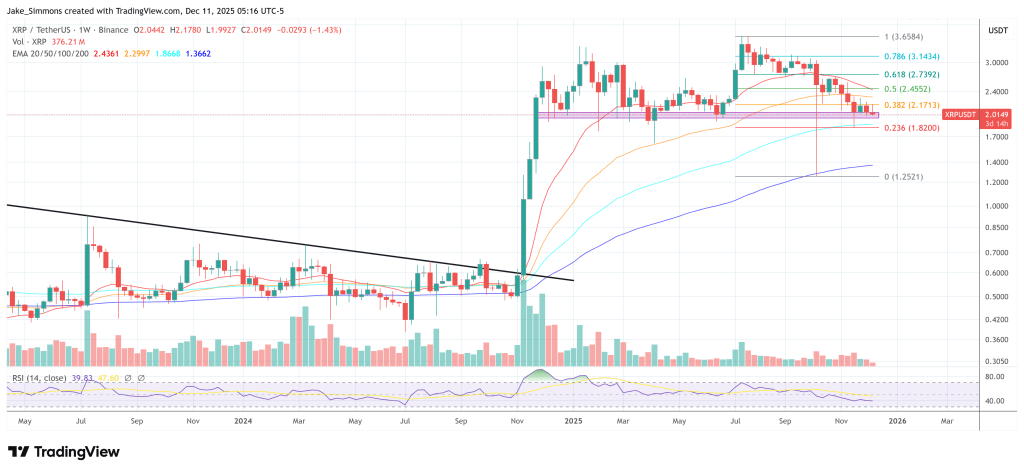
XRP holds above key support, 1-week chart | Source: XRPUSDT on TradingView.com

Трендові криптовалюти

Пов'язані матеріали

Ethereum Q1 2026 Report: Fees Decline, Users and Transaction Volume Hit New Highs

Ethereum Q1 2026 Report: Fees Down, Users & Transactions Hit New Highs Token Terminal's Q1 2026 report on Ethereum presents a pivotal development: the network achieved record highs in monthly active users (13.2M, +85.9% YoY), total transactions (200.4M, +81.5% YoY), and throughput (25.78 TPS), while transaction fees on the mainnet plummeted by 47.9% quarter-over-quarter. This shift is attributed to the network's strategic move into a "low fees for scale" phase, exemplified by the Fusaka upgrade which increased data capacity and lowered block space costs, releasing pent-up demand (a manifestation of Jevons's Paradox). The report highlights a core narrative shift for Ethereum: from a DeFi-centric blockchain to a global financial settlement layer. It maintains a dominant position in tokenized assets, holding majority market shares among top chains in stablecoins (61.8%), tokenized funds (73.0%), and tokenized commodities (84.0%). Growth in tokenized funds (+73.1% YoY) and commodities (+325.9% YoY) was particularly strong, driven by institutions like BlackRock and JPMorgan entering the space. Contrasting these usage gains, several USD-denominated value metrics declined in Q1: fully diluted market cap fell 30.3% QoQ, total value locked (TVL) dropped 11.0%, and ecosystem transaction volume decreased 24.0%. The report interprets this as Ethereum prioritizing long-term network expansion and cementing its role as the default settlement layer for finance over short-term fee capture. The commentary from Etherealize argues that, much like the early internet, Ethereum's open, permissionless model is poised to win over closed alternatives as institutional tokenization accelerates.

marsbit1 год тому

Ethereum Q1 2026 Report: Fees Decline, Users and Transaction Volume Hit New Highs

marsbit1 год тому

He Just Raised 2.7 Billion, and Li Fei-Fei Also Invested

Pete Florence, a former senior research scientist at Google DeepMind and a key contributor to the Vision-Language-Action (VLA) model architecture, is deliberately distancing his startup, Generalist AI, from the trendy "world model" label. He argues that the industry should prioritize concrete goals over buzzwords. His goal is to create robots that can perform a vast range of unseen tasks with high speed and success rates, without needing task-specific training data. Recently, his company raised $400 million (¥2.7 billion) at a $2 billion valuation. Notable investors include NVIDIA's NVentures, Bezos Expeditions, NFDG, as well as Xiaomi co-founder Lin Bin, Zoom founder Eric Yuan, and renowned AI scientist Fei-Fei Li. Florence's approach stems from his academic background at MIT under Professor Russ Tedrake, focusing on understanding the physical world. After joining DeepMind, he developed models like Transporter Network and co-created the VLA framework. He left in 2025 to found Generalist AI. The company has launched two models: GEN-0, which demonstrated that scaling laws apply to physical motion, and GEN-1. GEN-1 was trained on over 500,000 hours of physical interaction data collected via a specialized wearable device. It achieves a 99% success rate on precise mechanical tasks like folding boxes and maintains performance three times faster than its predecessor. Florence believes GEN-1 is reaching a commercial utility threshold similar to the GPT-3 inflection point. The substantial funding round, following GEN-1's release, signifies strong investor confidence in Generalist AI's practical, goal-driven path to creating versatile, useful robots, regardless of the "world model" terminology.

marsbit1 год тому

He Just Raised 2.7 Billion, and Li Fei-Fei Also Invested

marsbit1 год тому

Two Legends Lost in Three Days: Is Google's AI Talent Dam Cracking?

In three days, Google lost two AI legends. On June 18, Noam Shazeer, co-author of the seminal "Attention is All You Need" paper and Gemini co-lead, left for OpenAI. Just 48 hours later, John Jumper, 2024 Nobel laureate and AlphaFold lead, departed DeepMind for Anthropic. This follows Andrej Karpathy joining Anthropic in May. These moves highlight a structural trend: top AI talent is concentrating at mission-driven, pre-IPO firms like OpenAI and Anthropic, while Google becomes a primary source. The exodus stems from a core mission mismatch. Google's ad-centric model often subordinates AI research to product and revenue goals, creating friction for pioneers like Shazeer, who returned in 2024 only to leave again. In contrast, OpenAI and Anthropic offer singular focus on pushing AI boundaries, whether towards AGI or safety-aligned models, which deeply appeals to top researchers like Jumper. Financial incentives amplify the pull. With both OpenAI and Anthropic nearing IPO, employees stand to gain immensely from equity, an upside Google's mature stock cannot match. Furthermore, the 2023 merger of Google Brain and DeepMind, intended to consolidate strength, has instead created cultural tension and slowed the path from research to product, as evidenced by Gemini's pace. This talent redistribution is reshaping the AI landscape. While Google retains vast data and compute resources, its true crisis is the quiet, continuous loss of the people who define the field's future. The real moat in AI is not infrastructure, but the concentration of brilliant minds—a battle Google is currently losing.

marsbit3 год тому

Two Legends Lost in Three Days: Is Google's AI Talent Dam Cracking?

marsbit3 год тому

Behind the AI Report Card, Lies a Chinese 'Exam Setter'

Beyond the familiar performance charts like MMLU-Pro and MMMU, which major AI models strive to ace, stands a key "examiner": Chinese-Canadian researcher Wenhu Chen. An assistant professor at the University of Waterloo and founder of TIGERLab, Chen addresses the crucial need for more rigorous AI evaluation. As models like GPT-4 began scoring near-perfect results on older benchmarks like MMLU, it became difficult to distinguish their true capabilities. In response, Chen introduced MMLU-Pro in 2024, featuring harder, more reasoning-focused questions with more answer choices, successfully reintroducing meaningful performance gaps. His work extends to multi-modal evaluation with MMMU and its enhanced version, MMMU-Pro. These benchmarks test a model's ability to understand and reason with complex information from images, charts, and text across diverse academic subjects, exposing the significant challenges even top models face in genuine comprehension. Chen's background in complex QA, table reasoning, and his experience at Google DeepMind on projects like Gemini inform his approach. He understands that effective benchmarks must anticipate how models might "cheat" by memorizing data or avoiding visual analysis. His lab also actively researches video understanding and generation models (e.g., UniVideo, Vamba), ensuring his evaluation work is grounded in practical model-building challenges. Now at Meta's Super Intelligence Lab, Chen continues his focus on multi-modal data and evaluation, representing the deep yet often unseen contributions of Chinese talent in shaping the fundamental tools of the AI industry.

marsbit3 год тому

Behind the AI Report Card, Lies a Chinese 'Exam Setter'

marsbit3 год тому

Торгівля

Спот
Ф'ючерси

Популярні статті

Що таке XAG

XAGUSDT Перпетуальний контракт - це торговий символ для срібла, ціна якого вказана в доларах США, що представляє 1 тройську унцію срібла.

6 переглядів усьогоОпубліковано 2026.06.18Оновлено 2026.06.18

Що таке XAG

Як купити XAG

Ласкаво просимо до HTX.com! Ми зробили покупку Silver (XAG) простою та зручною. Дотримуйтесь нашої покрокової інструкції, щоб розпочати свою криптовалютну подорож.Крок 1: Створіть обліковий запис на HTXВикористовуйте свою електронну пошту або номер телефону, щоб зареєструвати обліковий запис на HTX безплатно. Пройдіть безпроблемну реєстрацію й отримайте доступ до всіх функцій.ЗареєструватисьКрок 2: Перейдіть до розділу Купити крипту і виберіть спосіб оплатиКредитна/дебетова картка: використовуйте вашу картку Visa або Mastercard, щоб миттєво купити Silver (XAG).Баланс: використовуйте кошти з балансу вашого рахунку HTX для безперешкодної торгівлі.Треті особи: ми додали популярні способи оплати, такі як Google Pay та Apple Pay, щоб підвищити зручність.P2P: Торгуйте безпосередньо з іншими користувачами на HTX.Позабіржова торгівля (OTC): ми пропонуємо індивідуальні послуги та конкурентні обмінні курси для трейдерів.Крок 3: Зберігайте свої Silver (XAG)Після придбання Silver (XAG) збережіть його у своєму обліковому записі на HTX. Крім того, ви можете відправити його в інше місце за допомогою блокчейн-переказу або використовувати його для торгівлі іншими криптовалютами.Крок 4: Торгівля Silver (XAG)Легко торгуйте Silver (XAG) на спотовому ринку HTX. Просто увійдіть до свого облікового запису, виберіть торгову пару, укладайте угоди та спостерігайте за ними в режимі реального часу. Ми пропонуємо зручний досвід як для початківців, так і для досвідчених трейдерів.

6 переглядів усьогоОпубліковано 2026.06.18Оновлено 2026.06.18

Як купити XAG

Як купити XAU

Ласкаво просимо до HTX.com! Ми зробили покупку Gold (XAU) простою та зручною. Дотримуйтесь нашої покрокової інструкції, щоб розпочати свою криптовалютну подорож.Крок 1: Створіть обліковий запис на HTXВикористовуйте свою електронну пошту або номер телефону, щоб зареєструвати обліковий запис на HTX безплатно. Пройдіть безпроблемну реєстрацію й отримайте доступ до всіх функцій.ЗареєструватисьКрок 2: Перейдіть до розділу Купити крипту і виберіть спосіб оплатиКредитна/дебетова картка: використовуйте вашу картку Visa або Mastercard, щоб миттєво купити Gold (XAU).Баланс: використовуйте кошти з балансу вашого рахунку HTX для безперешкодної торгівлі.Треті особи: ми додали популярні способи оплати, такі як Google Pay та Apple Pay, щоб підвищити зручність.P2P: Торгуйте безпосередньо з іншими користувачами на HTX.Позабіржова торгівля (OTC): ми пропонуємо індивідуальні послуги та конкурентні обмінні курси для трейдерів.Крок 3: Зберігайте свої Gold (XAU)Після придбання Gold (XAU) збережіть його у своєму обліковому записі на HTX. Крім того, ви можете відправити його в інше місце за допомогою блокчейн-переказу або використовувати його для торгівлі іншими криптовалютами.Крок 4: Торгівля Gold (XAU)Легко торгуйте Gold (XAU) на спотовому ринку HTX. Просто увійдіть до свого облікового запису, виберіть торгову пару, укладайте угоди та спостерігайте за ними в режимі реального часу. Ми пропонуємо зручний досвід як для початківців, так і для досвідчених трейдерів.

4 переглядів усьогоОпубліковано 2026.06.18Оновлено 2026.06.18

Як купити XAU

Обговорення

Ласкаво просимо до спільноти HTX. Тут ви можете бути в курсі останніх подій розвитку платформи та отримати доступ до професійної ринкової інформації. Нижче представлені думки користувачів щодо ціни A (A).

活动图片