Ripple Exec Pushes Central Banks To Back Regulated Stablecoins

bitcoinistОпубліковано о 2026-01-20Востаннє оновлено о 2026-01-20

Анотація

Ripple's UK & Europe policy director, Matthew Osborne, urges central banks to embrace regulated stablecoins as a stabilizing force rather than treat them as a threat. He argues that with proper oversight and access to official infrastructure, stablecoins can complement the existing financial system, particularly in cross-border payments and multi-chain markets. Osborne cites their growing adoption, with market value exceeding $300 billion and transaction volumes surpassing Visa and Mastercard combined. He calls for central banks to extend safety net features, such as allowing issuers to hold reserves in central bank accounts and providing liquidity insurance, to reduce vulnerability to shocks. The choice, he concludes, is between resisting stablecoins and risking uncontrolled growth or integrating them into the regulated financial framework.

Ripple’s UK & Europe policy director Matthew Osborne is urging central banks to stop treating stablecoins as an external threat and instead fold well-regulated issuers into core safeguards, arguing that oversight plus access to official infrastructure can make stablecoins a net stabiliser for payments and settlement.

Writing for the Official Monetary and Financial Institutions Forum on 19 January 2026, Osborne said stablecoins have moved well beyond a niche experiment, citing a market value “in excess of $300bn” and annual transaction volumes that he wrote now surpass Visa and Mastercard combined. He argued momentum could accelerate in the US after the Genius Act, which he said would introduce federal rules and allow banks to issue stablecoins.

The Ripple exec framed the shift as already visible among central banks themselves. He pointed to the European Central Bank’s recent recognition of stablecoins’ benefits for cross-border payments and its view that tomorrow’s financial system will host multiple forms of money. He also cited the Bank of England’s stance that stablecoins could support “faster, cheaper retail and wholesale payments” as part of a “multi-money” system underpinned by central bank money.

Ripple Exec: Bring Stablecoins Into The Safety Net

At the centre of his case is the claim that stablecoins should be treated as an incremental evolution rather than an adversarial replacement. “Regulated stablecoins could play a key role in financial markets alongside other forms of money,” Osborne wrote. “First, stablecoins are more likely to complement the existing financial system than replace it. This is evolution, not revolution.” He then added: “The solution lies in central banks channelling stablecoin momentum, not fighting it.”

Osborne argues central bank money will remain essential as a risk-free settlement asset and safe store of value, but its relative role could shift in digital markets. He pointed to atomic settlement, where legs of a transaction settle simultaneously and conditionally, as reducing the traditional need to use central bank money purely to mitigate settlement risk.

Where stablecoins could be structurally preferred, he wrote, is in cross-border flows and multi-chain markets. “Cross-border payments are one example, given that stablecoins can move value anywhere in the world in seconds,” the Ripple exec said.

“In contrast, central bank money is likely to be less suitable for cross-border payments given access may be geographically limited and adoption of on-chain central bank money is far from universal around the world.” He also argued stablecoins are likely to exist across more blockchain networks than central bank money, making same-chain settlement between tokenized assets and cash more achievable while interoperability remains uneven.

Central banks have repeatedly warned that stablecoins could pull funds from bank deposits, weakening bank credit creation and potentially amplifying stress events. Osborne pushed back, arguing the risk is overstated because markets already accommodate instruments backed by highly liquid assets, money market funds, e-money, and “narrow banks”, without causing sustained deposit runs.

His bigger point is that regulation, while necessary, is insufficient without a backstop. “But regulation alone is not enough,” Osborne wrote. “Stablecoin issuers lack access to the safety net that gives bank deposits their resilience. Without it, even well-managed stablecoins are more vulnerable to shocks – as seen when USDC temporarily lost its peg following exposure to Silicon Valley Bank in 2023.”

He argued central banks should consider extending elements of that safety net, including allowing well-regulated stablecoin issuers to hold part of their backing assets in central bank accounts, offering liquidity insurance against market-wide shocks, and granting more direct payment-system access to reduce tiering risk.

The Ripple exec closed by positioning the choice for central banks as strategic: resist stablecoins and risk the market scaling beyond official influence, or “bring them inside the tent,” shaping development through prudential oversight and infrastructure access as tokenized settlement rails mature.

At press time, XRP traded at $1.9216.
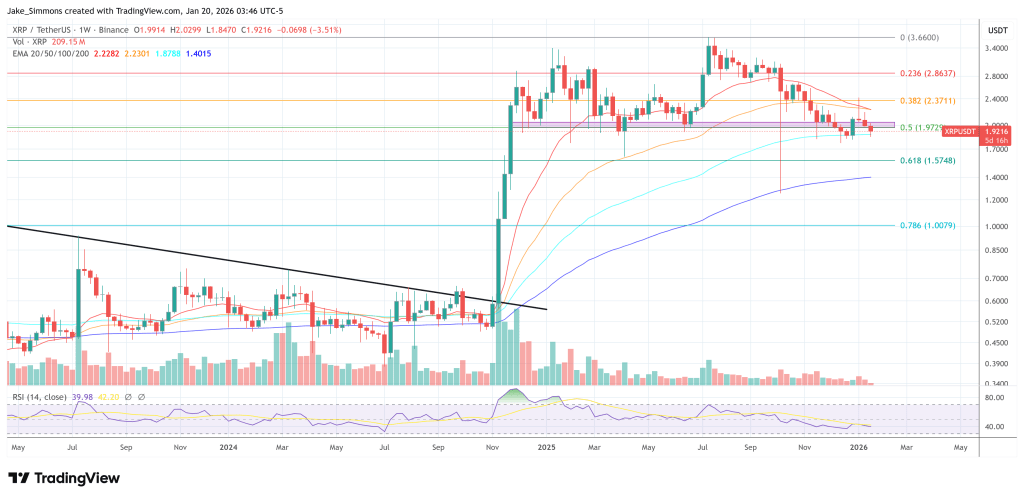
XRP holds above the 100-week EMA, 1-week chart | Source: XRPUSDT on TradingView.com

Пов'язані питання

QWhat is the main argument made by Ripple's Matthew Osborne regarding stablecoins and central banks?

AMatthew Osborne argues that central banks should stop treating stablecoins as a threat and instead integrate well-regulated stablecoin issuers into core financial safeguards, as they can act as a net stabilizer for payments and settlement.

QAccording to the article, what recent US legislation could accelerate stablecoin adoption?

AThe article states that stablecoin momentum could accelerate in the US after the Genius Act, which would introduce federal rules and allow banks to issue stablecoins.

QWhat two specific benefits of stablecoins for cross-border payments does Osborne highlight?

AOsborne highlights that stablecoins can move value anywhere in the world in seconds and are likely to exist across more blockchain networks than central bank money, making them more suitable for cross-border flows.

QWhy does Osborne claim that 'regulation alone is not enough' for stablecoins?

AHe claims regulation is insufficient because stablecoin issuers lack access to the safety net (like central bank accounts and liquidity insurance) that gives bank deposits their resilience, making them vulnerable to shocks even if well-managed.

QWhat strategic choice does Osborne present to central banks at the end of his argument?

AHe presents central banks with the choice to either resist stablecoins and risk the market scaling beyond official influence, or to 'bring them inside the tent' by shaping their development through prudential oversight and infrastructure access.

Пов'язані матеріали

Exploring Bitcoin Valuation in 2026 from Macro and On-Chain Structural Perspectives

Tiger Research analyzes Bitcoin's valuation outlook for 2026 from macro and on-chain perspectives. Despite a 27% price drop in Q1, the macro environment remains supportive. Global M2 hit a record $13.44 trillion, but Chinese liquidity, which contributed over 60% of M2 growth, has limited access to Bitcoin markets. The Iran conflict pushed oil prices higher, raising March CPI to 3.3% and narrowing the Fed's rate cut path. However, the easing direction remains intact. Bitcoin ETF flows turned positive in March after five months of outflows, and corporate accumulation continues. On-chain metrics show a shift from undervaluation to early equilibrium. Key indicators like MVRV-Z and NUPL have exited panic zones. The critical resistance is at $78k, the long-term holder cost basis, while the key support is at $54k. Although transaction counts increased, active addresses and average transfer size declined, indicating superficial growth rather than real network expansion. BTCFi ecosystem growth has weakened, leading to a -10% adjustment in fundamental metrics. The 12-month price target is set at $143k, based on a $132.5k neutral benchmark adjusted by -10% (fundamentals) and +20% (macro). This represents a 103% upside from current levels. Short-term catalysts include a break above $78k, sustained ETF inflows, and a Fed policy shift post-geopolitical de-escalation.

marsbit8 хв тому

Exploring Bitcoin Valuation in 2026 from Macro and On-Chain Structural Perspectives

marsbit8 хв тому

Anthropic Starts Poaching Scientists? $27K Weekly Onsite Stipend to Fix Claude's Expert-Level Errors

Anthropic has launched a new STEM Fellow program, offering $3,800 per week for a three-month, in-person residency in San Francisco. The role targets experts from science, technology, engineering, and mathematics (STEM) fields—machine learning experience is helpful but not required. Instead, Anthropic values scientific judgment and a willingness to learn quickly. Fellows will work with Claude models and internal tools under the guidance of an Anthropic researcher. Example projects include a materials scientist identifying errors in Claude’s reasoning or a climate scientist integrating atmospheric modeling software with Claude. The goal is to have experts "tell Claude where it's wrong" and improve its scientific capabilities. This initiative is part of Anthropic’s broader strategy to strengthen its scientific ecosystem, following earlier programs like the AI Safety Fellows and AI for Science programs. The company acknowledges that current AI models, while powerful, still produce high-confidence errors and lack end-to-end research autonomy. The program aims to embed domain expertise directly into model development, turning scientists into "high-level reviewers" for AI. Anthropic CEO Dario Amodei has previously emphasized AI’s potential to accelerate scientific breakthroughs, particularly in biology and healthcare. The company believes that the next phase of AI competition will depend not on scaling parameters, but on integrating human expertise to refine model accuracy and reliability.

marsbit38 хв тому

Anthropic Starts Poaching Scientists? $27K Weekly Onsite Stipend to Fix Claude's Expert-Level Errors

marsbit38 хв тому

On the Eve of X Money's Launch, Musk Dismantles the Referee First

"X Money Launches After Dismantling Regulator: Musk's 9-Day Power Play" In February 2025, a team from the "Department of Government Efficiency" (DOGE), led by Elon Musk, entered the Consumer Financial Protection Bureau (CFPB) headquarters. Shortly after, the CFPB was effectively dismantled—its funding frozen, activities suspended, and nearly 90% of staff laid off. This move came just nine days after X announced a partnership with Visa and as X Money prepared to launch. The article contrasts this with the decade-long regulatory battles faced by companies like Coinbase and PayPal. Coinbase spent over $75 million in political contributions and endured a major SEC lawsuit to operate legally. PayPal complied with strict state and federal rules for its stablecoin PYUSD, including 100% reserve requirements and monthly audits. However, Musk’s approach was different. After the CFPB introduced a rule placing large digital payment apps under federal oversight, Musk tweeted "Delete CFPB." Within months, the rule was revoked by Congress. Meanwhile, DOGE operatives gained "god-tier" access to CFPB databases, potentially obtaining sensitive competitive information from rivals like Apple, Google, and PayPal. The article also highlights a "suspicious exemption clause" in the GENIUS Act, which allows private companies like X to issue stablecoins with fewer restrictions. Senator Elizabeth Warren questioned whether Musk, who was a senior presidential advisor during the Act’s drafting, influenced this clause. X Money offers a 6% APY on deposits, despite FDIC warnings that stablecoin users are not insured. As X Money launches to 600 million monthly users, the article questions the fairness of a system where Musk can bypass regulations that others spent years and millions to comply with. The dismantling of the CFPB and the alleged regulatory advantages raise concerns about the future of equitable rule-making in the U.S. financial system.

marsbit47 хв тому

On the Eve of X Money's Launch, Musk Dismantles the Referee First

marsbit47 хв тому

Торгівля

Спот
Ф'ючерси
活动图片





