Ripple CTO Emeritus Fires Back at XRP Ledger Centralization Claims

bitcoinistОпубліковано о 2026-02-26Востаннє оновлено о 2026-02-26

Анотація

David Schwartz, Ripple's CTO Emeritus, refuted claims by Justin Bons, founder of Cyber Capital, that the XRP Ledger (XRPL) is centralized due to its Unique Node List (UNL) structure. Bons argued that the UNL grants Ripple "absolute power and control," making validators permissioned. Schwartz countered that the UNL does not enable censorship or double-spending, as validators cannot force dishonest actions on individual nodes. He explained that a malicious validator would simply be ignored by honest nodes, comparing a potential attack to a chain halt rather than a security breach. Schwartz emphasized that XRPL was intentionally designed to limit Ripple's control, even under legal pressure, and that abusing power would destroy trust in the network. He also contrasted XRPL's record with Bitcoin and Ethereum, claiming no history of transaction censorship or malicious re-ordering on XRPL.

Ripple CTO Emeritus David “JoelKatz” Schwartz pushed back against claims that the XRP Ledger (XRPL) is effectively centralized, after founder and CIO of Cyber Capital Justin Bons argued that XRPL’s Unique Node List (UNL) structure makes validators “permissioned” and gives Ripple-aligned entities “absolute power & control over the chain.”

The exchange, sparked by Bons’ broader thread calling for the industry to “reject all centralized ‘blockchains’,” quickly narrowed into a technical dispute over what XRPL validators can and cannot do in practice and what “control” means in a system that relies on curated validator lists rather than Proof-of-Work or Proof-of-Stake.

The XRP Ledger Centralization Allegation

In his thread, Bons lumped Ripple alongside Canton, Stellar, Hedera, and Algorand as networks with permissioned or semi-permissioned elements. His XRPL-specific charge was straightforward: because XRPL nodes typically rely on a published UNL, “any divergence from this centrally published list would cause a fork,” which in his view concentrates power in the hands of whoever publishes that list.

Bons framed it as a binary question: “either fully permissionless or it is not” and argued that even partial permissioning is a deal breaker. He also extended the critique into a broader institutional-adoption thesis: banks and incumbents may prefer controlled environments, but “those institutions will be left behind,” while “crypto natives” win by building and using fully permissionless systems.

Schwartz’s opening rebuttal attacked the logic of Bons’ “absolute power” framing. “‘...effectively giving the Ripple Foundation & company absolute power & control over the chain...’” Schwartz wrote, calling it “as objectively nonsensical as claiming someone with a majority of mining power can create a billion bitcoins.”

Bons responded that he wasn’t alleging supply manipulation or fund theft, but insisted majority influence can still matter. “They can not steal funds, either, but they could potentially double-spend & censor,” Bons said. “Which, again, is exactly the same if someone controlled the majority of mining power in BTC.” He then suggested they debate live on a podcast.

Schwartz rejected the equivalence on mechanics, emphasizing that XRPL nodes do not accept censorship or double-spend behavior simply because a validator says so. “That’s not true. XRPL and BTC don’t work the same,” Schwartz wrote. “You count the number of validators that agree with your node and your node will not agree to double spend or censor unless you, for some reason, want it to.”

He continued the point across multiple posts, leaning on a simple intuition: a dishonest validator is not an oracle; it’s just one vote. “If a validator tried to double spend or censor, an honest node would just count it as one validator that it did not agree with.”

What Schwartz Says The Real Attack Looks Like

Schwartz acknowledged there is still a failure mode, but described it as a liveness problem rather than a theft or double-spend scenario. “Validators could conspire to halt the chain from the point of view of honest nodes,” he said. “But that’s the XRPL equivalent of a dishonest majority attack except they never get to double spend. The cure is to pick a new UNL just as with BTC you’d need to pick a new mining algorithm.”

He also argued the empirical record matters, contrasting XRPL with other major networks. “The practical evidence tells this story,” Schwartz wrote. “Transactions are discriminated against all the time in BTC. Transactions are maliciously re-ordered or censored all the time on ETH. Nothing like this has ever happened to an XRPL transaction and it’s hard to imagine how it could.”

Schwartz later laid out a more detailed explanation of XRPL’s consensus model, emphasizing fast “live consensus” rounds—“every five seconds”—where validators vote on whether a transaction is included now or deferred to the next round. In that framing, the system’s key requirement is not blind trust in validators, but agreement on whether a transaction was seen before a cutoff.

He argued XRPL needs a UNL for two reasons: to prevent an attacker from spawning unlimited validators that force excessive work, and to prevent validators from simply not participating in a way that makes consensus impossible to measure. “That’s it. There’s no control or governance here other than coordinating activation of new features,” Schwartz wrote, adding that validators cannot force a node to enforce rules it does not have code for.

Schwartz closed with a longer, unusually candid rationale: that XRPL’s architecture was intentionally built to reduce Ripple’s ability to comply with demands to censor, even if Ripple itself wanted to be trusted.

“We carefully and intentionally designed XRPL so that we could not control it,” he wrote. “Ripple, for example, has to honor US court orders. It cannot say no... We absolutely and clearly decided that we DID NOT WANT control and that it would be to our own benefit to not have that control.”

He added a blunt incentive argument: even if Ripple could censor or double-spend, using that power would destroy trust in XRPL and therefore destroy the network’s utility. “And the best way to be able to say ‘no’ is to have to say ‘no’ because you cannot do the thing asked,” Schwartz wrote.

At press time, XRP traded at $1.3766.
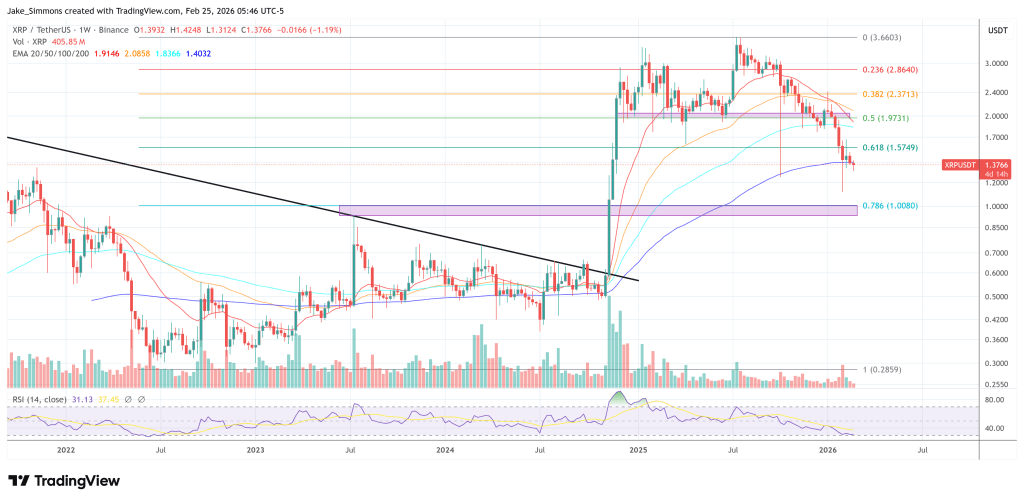
XRP trades below the 200-week EMA, 1-week chart | Source: XRPUSDT on TradingView.com

Пов'язані питання

QWhat was the main argument made by Justin Bons regarding the XRP Ledger's centralization?

AJustin Bons argued that the XRP Ledger's Unique Node List (UNL) structure makes validators 'permissioned' and gives Ripple-aligned entities 'absolute power & control over the chain'.

QHow did David Schwartz counter the claim that Ripple has 'absolute power' over the XRP Ledger?

ASchwartz called the claim 'objectively nonsensical,' explaining that validators cannot force a node to double-spend or censor transactions, and that dishonest validators are merely counted as one disagreeing vote by honest nodes.

QAccording to Schwartz, what is the real failure mode for the XRP Ledger, and how is it resolved?

ASchwartz described the failure mode as a liveness problem where validators could conspire to halt the chain, which is resolved by picking a new UNL, similar to how Bitcoin would require a new mining algorithm.

QWhat two reasons did Schwartz give for why the XRP Ledger needs a Unique Node List (UNL)?

ASchwartz stated the UNL is needed to prevent an attacker from spawning unlimited validators that force excessive work, and to prevent validators from not participating in a way that makes consensus impossible to measure.

QWhat was the key design intention behind the XRP Ledger's architecture, as explained by Schwartz?

ASchwartz stated that the XRP Ledger was 'carefully and intentionally designed' so that Ripple could not control it, even if they wanted to, to avoid being forced to comply with demands to censor and to protect the network's utility.

Пов'язані матеріали

Warsh Hearing Concludes: What Are the Notable Signals for the Crypto Industry?

The Senate Banking Committee held a confirmation hearing for Judy Shelton, a Federal Reserve nominee, who faced intense questioning regarding her ability to maintain the central bank's independence amid pressure from President Trump to lower interest rates. Shelton denied any pre-arranged commitments on rate cuts and emphasized her independence, though Democrats remained skeptical, citing contradictions with Trump's public statements. Shelton characterized post-pandemic inflation as a major policy failure and called for a "regime change" in the Fed’s approach, including reforms to inflation measurement and communication strategies. She criticized the current practice of Fed officials frequently signaling future rate moves and did not commit to maintaining post-meeting press conferences, suggesting potential reductions in transparency. Regarding crypto markets, Shelton’s extensive investments in digital asset companies—including Solana, DeFi, and blockchain infrastructure—were noted, though she has pledged to divest these holdings due to ethics rules. Her familiarity with the crypto industry and deregulatory leanings may signal a more open, though cautious, stance toward digital assets. However, concerns were raised about potential conflicts of interest, especially given Trump family involvement in crypto-financial ventures. The timing of her confirmation remains uncertain, pending a Justice Department investigation into current Chair Powell. Shelton’s potential leadership could lead to a more hawkish, productivity-focused Fed with tighter policy communication—factors that may significantly influence liquidity conditions and macro narratives for crypto markets.

marsbit2 год тому

Warsh Hearing Concludes: What Are the Notable Signals for the Crypto Industry?

marsbit2 год тому

Торгівля

Спот
Ф'ючерси

Популярні статті

Що таке XRP 2.0

XRP 2.0: Нова межа в світі криптовалют Вступ до XRP 2.0 У постійно змінюючомуся світі криптовалют нові проекти постійно з'являються, змагаючись за увагу та прийняття. Однією з таких обіцяючих ініціатив є XRP 2.0, новий криптовалютний проект, що має на меті використання сучасних технологій блокчейн та надійних методів шифрування. Хоча назва нагадує про XRP від Ripple, важливо зазначити, що XRP 2.0 функціонує автономно, концентруючи увагу на підвищенні безпеки транзакцій, конфіденційності та масштабованості. Оскільки цифровий фінансовий ландшафт все більше приймає децентралізовані рішення, XRP 2.0 прагне значно сприяти веб3 та загальному розширенню крипто проектів. Що таке XRP 2.0? У своїй основі XRP 2.0 є криптовалютним проектом, що має на меті створення безпечної та децентралізованої екосистеми цифрової валюти. Його фундаментальна технологія інтегрує складні принципи блокчейну з передовими техніками шифрування. Загальною метою XRP 2.0 є встановлення себе як надійної та ефективної платформи, що дозволяє швидко виконувати транзакції, при цьому надаючи пріоритет підвищеним захистам конфіденційності для своїх користувачів. Проект позиціонується як рішення багатьох обмежень, з якими стикаються існуючі криптовалюти, пропонуючи систему, яка може обробляти вищий обсяг транзакцій з покращеною швидкістю та конфіденційністю. Ця універсальність позиціонує XRP 2.0 як значного гравця на ринку, наповненому різними цифровими валютами. Хто творець XRP 2.0? Особистість творця XRP 2.0 була позначена як «Вілбур». Проте, вичерпні деталі про Вілбура або пов'язану з ним організацію залишаються недоступними. Анонімність багатьох творців криптовалют не є незвичним явищем в індустрії, часто запроваджена для збереження певного рівня конфіденційності та безпеки. Хто інвестори XRP 2.0? На даний момент конкретна інформація про інвестиційні фонди або організації, що підтримують XRP 2.0, не є публічно доступною. У секторі криптовалют підтримка від визнаних інвесторів може значно вплинути на кредитоспроможність і успіх проекту, але прозорість щодо фінансових підтримувачів XRP 2.0 не була встановлена. Як працює XRP 2.0? XRP 2.0 вирізняється використанням комбінації технології блокчейн та просунутих алгоритмів шифрування, що забезпечують безпечні та децентралізовані транзакції. Його інноваційна структура включає унікальні функції, спрямовані на залучення користувачів та розширення функціональності за межами традиційних транзакцій криптовалюти. Серед цих функцій, XRP 2.0 включає можливості на базі ШІ, такі як текст в зображення та текст в мову. Ці нововведення розроблені для покращення інтерактивного досвіду для користувачів, сприяючи ширшій застосовності в різних секторах. Завдяки поєднанню технологічних досягнень з орієнтованим на користувача дизайном, XRP 2.0 прагне привернути увагу різноманітних осіб і підприємств, які шукають способи інтеграції рішень криптовалют у свої операційні структури. Хронологія XRP 2.0 Розуміння XRP 2.0 вимагає вивчення основних етапів, які визначили його подорож до теперішнього часу: 23 липня 2023 року: XRP 2.0 представлено як новий криптовалютний проект, що має на меті революціонізувати безпечні та децентралізовані можливості транзакцій у галузі блокчейн. 8 вересня 2023 року: Запускається інший проект, XRP20, що відзначає виникнення токена ERC-20 на блокчейні Ethereum, який не пов'язаний з XRP 2.0. 13 листопада 2023 року: XRP Ledger зазнає значного оновлення з виходом програмного забезпечення rippled server версії 2.0.0. Важливо зазначити, що цей розвиток не пов'язаний з криптовалютним проектом XRP 2.0. Ключові моменти про XRP 2.0 Щоб узагальнити суть XRP 2.0, кілька критично важливих факторів emerge: Унікальні функції: Включення функцій, таких як текст в зображення і текст в мову на базі ШІ, ще більше розширює потенційні застосування XRP 2.0. Технологія блокчейн: Архітектура використовує сучасні механізми блокчейн і протоколи шифрування, забезпечуючи безпечне та децентралізоване середовище для транзакцій. Масштабованість і конфіденційність: XRP 2.0 надає пріоритет підвищеним захистам конфіденційності в процесах транзакцій і масштабованості, необхідній для задоволення зростаючої бази користувачів. Відсутність зв'язку з Ripple: Важливо, що, незважаючи на свою назву, XRP 2.0 не має жодної прив'язки чи співпраці з XRP від Ripple, що відрізняє його операційну структуру та цілі в рамках криптовалютної екосистеми. Висновок XRP 2.0 представляє амбітну ініціативу у світі криптовалют, прагнучи запропонувати поєднання безпеки, конфіденційності та ефективності у цифрових транзакціях. Інтегруючи складні технології та дружні до користувача функції, проект ставить за мету розширити горизонти того, що криптовалюта може досягти в сучасній цифровій економіці. Хоча анонімність його творця та відсутність розкритих інвесторів можуть викликати запитання у деяких, фокус XRP 2.0 на передових функціональностях і децентралізації підвищує його привабливість на дедалі більшому ринку криптовалют. Оскільки ландшафт криптовалют продовжує еволюціонувати, XRP 2.0 може ще стати важливим гравцем у розширенні безпечних і масштабованих рішень блокчейн.

162 переглядів усьогоОпубліковано 2024.04.05Оновлено 2024.12.03

Що таке XRP 2.0

Як купити XRP

Ласкаво просимо до HTX.com! Ми зробили покупку XRP (XRP) простою та зручною. Дотримуйтесь нашої покрокової інструкції, щоб розпочати свою криптовалютну подорож.Крок 1: Створіть обліковий запис на HTXВикористовуйте свою електронну пошту або номер телефону, щоб зареєструвати обліковий запис на HTX безплатно. Пройдіть безпроблемну реєстрацію й отримайте доступ до всіх функцій.ЗареєструватисьКрок 2: Перейдіть до розділу Купити крипту і виберіть спосіб оплатиКредитна/дебетова картка: використовуйте вашу картку Visa або Mastercard, щоб миттєво купити XRP (XRP).Баланс: використовуйте кошти з балансу вашого рахунку HTX для безперешкодної торгівлі.Треті особи: ми додали популярні способи оплати, такі як Google Pay та Apple Pay, щоб підвищити зручність.P2P: Торгуйте безпосередньо з іншими користувачами на HTX.Позабіржова торгівля (OTC): ми пропонуємо індивідуальні послуги та конкурентні обмінні курси для трейдерів.Крок 3: Зберігайте свої XRP (XRP)Після придбання XRP (XRP) збережіть його у своєму обліковому записі на HTX. Крім того, ви можете відправити його в інше місце за допомогою блокчейн-переказу або використовувати його для торгівлі іншими криптовалютами.Крок 4: Торгівля XRP (XRP)Легко торгуйте XRP (XRP) на спотовому ринку HTX. Просто увійдіть до свого облікового запису, виберіть торгову пару, укладайте угоди та спостерігайте за ними в режимі реального часу. Ми пропонуємо зручний досвід як для початківців, так і для досвідчених трейдерів.

1.2k переглядів усьогоОпубліковано 2024.12.10Оновлено 2025.03.21

Як купити XRP

Обговорення

Ласкаво просимо до спільноти HTX. Тут ви можете бути в курсі останніх подій розвитку платформи та отримати доступ до професійної ринкової інформації. Нижче представлені думки користувачів щодо ціни XRP (XRP).

活动图片