Ripple CEO Predicts Big Wins For Clarity Act And XRP

bitcoinistОпубліковано о 2026-02-20Востаннє оновлено о 2026-02-20

Анотація

Ripple CEO Brad Garlinghouse predicts the CLARITY Act will pass by April's end, bringing crucial regulatory clarity to the US crypto industry. He argues this will spur growth, contrasting it with the current "vacuum" that leads to enforcement battles. Garlinghouse emphasized that XRP has already gained legal clarity from a court ruling that it is not a security. He stated Ripple's strategy focuses on demonstrating real-world utility for enterprise use cases rather than retail speculation, and highlighted the company's $3 billion acquisition spree since 2023 to build out its infrastructure capabilities. He also noted that the policy debate is no longer "crypto vs. banks," as major financial incumbents now also want a clear rulebook to compete.

Ripple CEO Brad Garlinghouse used a Feb. 18 appearance on Fox to argue that US crypto policy is nearing a turning point, predicting the long-stalled CLARITY Act will pass by the end of April and framing regulatory certainty as a direct catalyst for broader industry growth, including for XRP, which he emphasized has already cleared a key legal hurdle.

Why Ripple CEO Garlinghouse Is Bullish

Garlinghouse pointed to shifting Washington momentum and said prediction markets have moved in favor of passage. “The CLARITY Act spiked because of comments yesterday, from [a] senator [...] I think now 90% will pass by the end of April,” he said. “I said a couple weeks ago I thought at the end of April [...] people talked about [being] optimistic.”

He added that the White House is now actively pressing stakeholders, describing a meeting “today with a lot of leaders on both sides (crypto and banking) in the White House, [...] [with] the White House pushing hard.”

Pressed on Ripple’s position, Garlinghouse argued the bill’s flaws are less important than ending what he cast as a policy vacuum that has pushed the sector into enforcement battles. “Our position [is] very much, don’t let perfection be the enemy of progress,” he said. “No bill is perfect [...] we need clarity.”

He contrasted Ripple’s posture with the broader industry’s situation by referencing the company’s long-running US legal fight. “Ripple has been fortunate — sued by [the] government — a judge [...] say[ing] XRP is not a security. We have clarity,” Garlinghouse said, before reiterating the point in starker terms when asked directly: “Not a security. Courts ruled clearly.”

In his telling, the CLARITY Act is meant to keep crypto from being forced into a securities regime that doesn’t map cleanly onto how many networks and tokens function. “If something is a security, all kinds of obligations because [...] you own part of the company,” he said, contrasting that with crypto tokens where holders typically don’t receive dividends or governance rights analogous to electing a board. He also claimed the prior administration’s approach “failed in courts,” arguing that a modern framework is required for the US to compete.

Ripple’ Strategy And XRP

The interview also touched on the sector’s pullback from highs. Garlinghouse tied some of that weakness to policy delays. He said the CLARITY Act getting “pushed [and] stalled, late January [...] did not help,” while arguing Ripple entered 2026 with strong momentum after what he called “a tremendous year in 2025.”

On relative performance, he claimed XRP has held up better than other majors. “To your point, crypto markets, XRP best performing major crypto, down 20%,” he said, while noting other assets were down materially more from peaks.

He framed Ripple’s strategy as proving demand through enterprise use cases rather than retail narratives: “The more we demonstrate real practical utility using technologies to solve real problems, [the] more you see that play out in a positive way.”

Garlinghouse cited Ripple’s M&A push as part of a broader effort to build infrastructure that appeals to corporate finance teams. He said Ripple has spent “three billion dollars [on] acquisitions since 2023,” including expanding into “custody, prime [brokerage], treasury management, stablecoin [and] payment” capabilities.

He highlighted the treasury-management firm it acquired, saying it “processed 13 trillion dollars payments last year,” and emphasizing how early institutional stablecoin adoption still is: “Crypto-enabled, zero of those were stablecoin enabled.”

For now, he suggested dealmaking is taking a back seat to integration. “We bought two big companies last year [...] the first half of this year [is] very much on let’s pause [...] integrate,” he said, adding: “For time being, we’re going to slow down, before we speed up.”

Garlinghouse also argued the CLARITY fight is no longer “crypto versus banks,” pointing to big incumbents wanting a rulebook. He said the “vast majority of the crypto industry” is prepared to accept imperfect language, including around customer rewards, because it would be “a major step forward.” He added that banks are now leaning in as well, citing Goldman Sachs leadership as wanting “the same level playing field” to compete as traditional finance moves deeper into crypto.

At press time, XRP traded at $1.4196.
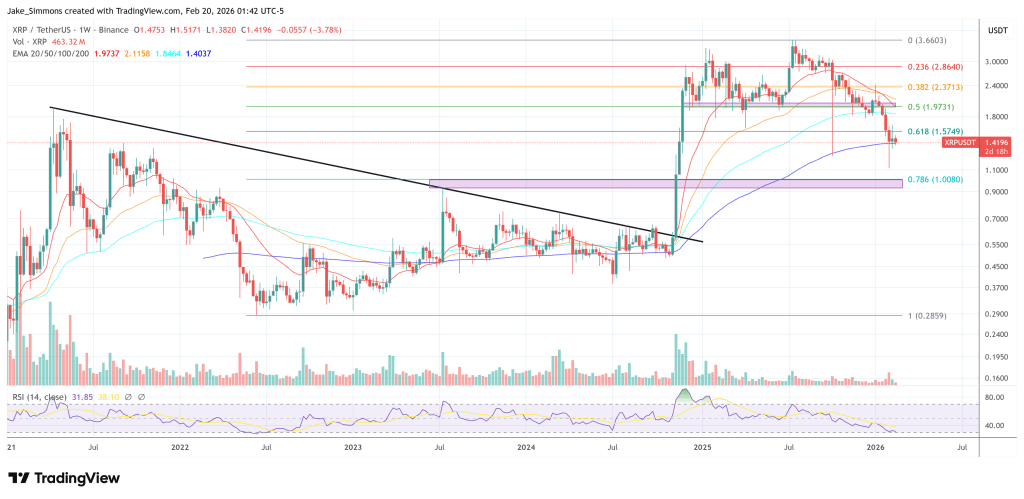
XRP remains above the 200-week EMA, 1-week chart | Source: XRPUSDT on TradingView.com

Пов'язані питання

QWhat is the CLARITY Act and when does Brad Garlinghouse predict it will pass?

AThe CLARITY Act is a proposed US crypto regulation bill. Ripple CEO Brad Garlinghouse predicts it will pass by the end of April, citing shifting momentum in Washington and prediction markets estimate of a 90% chance of passage.

QAccording to Garlinghouse, why is regulatory clarity so important for the crypto industry?

AGarlinghouse argues that regulatory clarity is a direct catalyst for broader industry growth. He states that ending the current policy vacuum is more important than a perfect bill, as the lack of clear rules has pushed the sector into enforcement battles and hindered progress.

QWhat key legal status for XRP did Garlinghouse emphasize during the interview?

AGarlinghouse emphasized that a US court has clearly ruled that XRP is not a security. He stated, 'Courts ruled clearly,' giving Ripple a significant advantage and clarity that many other crypto projects lack.

QHow does Garlinghouse describe Ripple's recent acquisition strategy and its current focus?

AGarlinghouse said Ripple has spent three billion dollars on acquisitions since 2023 to build infrastructure in areas like custody, prime brokerage, and treasury management. However, the current focus for the first half of the year is on pausing new deals to integrate the two big companies they acquired last year.

QHow did Garlinghouse characterize the current political dynamic around the CLARITY Act?

AGarlinghouse stated the fight is no longer 'crypto versus banks.' He explained that big incumbent financial institutions, like Goldman Sachs, now also want a clear rulebook to create a level playing field as traditional finance moves deeper into crypto, and the vast majority of the crypto industry is prepared to accept an imperfect bill as a major step forward.

Пов'язані матеріали

Three Months, 35 Billion Yuan: Investors Rush to Grab the OpenAI of the Physical World

Investors flock to a physical AI startup as the race for the "OpenAI of the physical world" heats up. Ji Jia Shi Jie (GigaWorld), a company dedicated to developing Artificial General Intelligence (AGI) for the physical world, has raised 3.5 billion RMB (approximately $490 million) in just three months, according to a report from investment media outlet Touzijie. The latest B2 funding round of 1 billion RMB attracted a wide range of top-tier investors, including sovereign wealth funds, industrial capital, and financial institutions. This brings the total funding for the young company, now valued over 10 billion RMB, to 3.5 billion RMB across three recent rounds. The company is led by Huang Guan, a post-90s Tsinghua University PhD with extensive experience in AI, autonomous driving, and entrepreneurship. Its core innovation is a "dual-pyramid" system comprising a five-layer data pyramid (from internet videos to real-world robot data) and a three-layer algorithm pyramid focused on world simulation, action alignment, and reinforcement learning. This system underpins its key models: the "World Action Model" (e.g., GigaBrain series for robot control) and the "World Generation Model" (e.g., GigaWorld series for simulating and understanding the physical world). Its models have reportedly achieved top rankings in global robotics benchmarks. Ji Jia Shi Jie argues that while current digital AGI excels in information processing, the next frontier is physical AGI—systems that can understand and interact with the real world. The company believes the field is approaching its "GPT-3 moment," a key inflection point in capability scaling. To achieve this, the company is pursuing a dual-market strategy. For the consumer (C) market, it launched the "SeeLight" brand and its S1 general-purpose humanoid robot, which has secured initial orders for deployment in real homes. For the business (B) market, it focuses on industrial automation with its Maker series robots, having signed agreements for large-scale deployment in factories, and its DriveDreamer world model for autonomous driving, which is already in use with over 30 automakers and tech companies. The report concludes that by bridging the gap between digital intelligence and physical action, Ji Jia Shi Jie aims to unlock a new wave of productivity, ultimately bringing physical AGI into everyday life.

marsbit22 хв тому

Three Months, 35 Billion Yuan: Investors Rush to Grab the OpenAI of the Physical World

marsbit22 хв тому

What's the Connection Between Pinduoduo's Huang Zheng and Blockchain?

This text explores the unexpected connection between Pinduoduo founder Colin Huang and blockchain, as suggested in his article *Turning Capitalism Upside Down*. Huang argues Pinduoduo's core business is about managing "uncertainty." He posits that wealth flows to the rich because they absorb life's uncertainties (e.g., illness, job loss) that devastate the poor, who pay a premium for certainty through insurance or stable prices. Pinduoduo's model attempts a "reverse insurance": by aggregating consumer demand via group-buying and flash sales, it creates a large, predictable order for manufacturers. This certainty allows factories to remove risk premiums, passing savings back as lower prices, thus partially reversing the wealth flow. The key obstacle, Huang notes, is that an individual's buying intent is an unreliable promise. He then asks if blockchain is the natural solution for this "reverse insurance." The text elaborates that blockchain, through smart contracts with binding deposits, could transform casual intent into a costly-to-break, enforceable commitment. This replaces interpersonal trust with coded rules, making promises credible, pricable, and resistant to fraud. Finally, the author draws a parallel to Bitcoin, framing two paths to creating certainty: the "Pinduoduo path" of aggregating decentralized will into scale, and the "Bitcoin path" of locking rules into immutable code. Both sacrifice something—personal freedom or system flexibility—to manufacture trust and predictability.

链捕手1 год тому

What's the Connection Between Pinduoduo's Huang Zheng and Blockchain?

链捕手1 год тому

The Storage Magnate Who Conquered a Trillion-Dollar Kingdom, Yet Ultimately Could Not Become the Richest

**Summary:** "The Memory Magnate Who Built a Trillion-Dollar Empire, Yet Never Became the Richest" explores the journey of Zhu Yiming, founder of GigaDevice (603986) and co-founder of the soon-to-IPO ChangXin Memory Technologies (CXMT). The article positions GigaDevice, a fabless chip designer now valued at ~¥340 billion, as a prequel to the massive IDM (Integrated Device Manufacturer) venture, CXMT. Starting in 2005 with minimal capital, Zhu strategically "picked up the pieces" by focusing on niche markets like NOR Flash and microcontrollers (MCUs), areas major players were exiting. This allowed GigaDevice to grow into a diversified semiconductor company, maintaining robust profitability even during industry downturns by controlling costs. However, the piece argues that in the highly cyclical and capital-intensive memory chip industry, the fabless model has limits. True resilience and scale require the ability for "counter-cyclical expansion" – investing heavily during downturns – a tactic only possible for IDMs like Samsung or SK Hynix. This insight led Zhu to partner with the Hefei city government in 2016 to establish CXMT, an IDM focused on DRAM. Zhu's symbolic moves, like forfeiting salary and diluting his equity, were crucial in securing the massive state and bank funding needed. CXMT's equipment base is now valued even higher than that of BYD's vast auto manufacturing empire. Despite the potential for CXMT to reach a market cap of ¥1-2 trillion upon its IPO, Zhu's indirect stake in both companies is estimated below 3%, placing his personal wealth far below that of China's top billionaires. The article concludes that his strategic vision built a trillion-yuan memory landscape, but the capital structure necessary to achieve it precluded a personal fortune of similar scale.

marsbit1 год тому

The Storage Magnate Who Conquered a Trillion-Dollar Kingdom, Yet Ultimately Could Not Become the Richest

marsbit1 год тому

XRP Ledger Daily Fees Drop Below $400 As Network Activity Question Returns

The XRP Ledger is drawing attention as daily network fees have fallen below $400. While low fees align with XRPL's design for affordable transactions and are often seen as a strength, the metric can also serve as an indicator of network demand and paid transaction volume. This data point of around $3,100 in weekly fee burn highlights the stark contrast with higher-fee chains like Ethereum and Bitcoin. The development fuels an ongoing debate. Proponents view low fees as a sign of efficiency and accessibility, while critics may question if the network is generating sufficient high-value activity relative to its market cap and payments-focused narrative. The article cautions against overstating the finding, noting a single low-fee day does not signify network failure. It instead adds context to discussions about XRPL's usage, especially alongside Ripple's broader initiatives in stablecoins (RLUSD), AI payments, and enterprise infrastructure. The report recommends monitoring for a fee rebound, checking transaction counts for a fuller picture, and confirming the trend via native explorers like Bithomp. It frames the story within a larger market shift where on-chain data, protocol updates, and infrastructure developments are becoming crucial alongside price action. The editorial stance is to present the verified data, explain its significance for assessing network activity, and avoid hype, positioning it as part of the daily crypto conversation.

bitcoinist6 год тому

XRP Ledger Daily Fees Drop Below $400 As Network Activity Question Returns

bitcoinist6 год тому

Торгівля

Спот
Ф'ючерси

Популярні статті

Що таке XRP 2.0

XRP 2.0: Нова межа в світі криптовалют Вступ до XRP 2.0 У постійно змінюючомуся світі криптовалют нові проекти постійно з'являються, змагаючись за увагу та прийняття. Однією з таких обіцяючих ініціатив є XRP 2.0, новий криптовалютний проект, що має на меті використання сучасних технологій блокчейн та надійних методів шифрування. Хоча назва нагадує про XRP від Ripple, важливо зазначити, що XRP 2.0 функціонує автономно, концентруючи увагу на підвищенні безпеки транзакцій, конфіденційності та масштабованості. Оскільки цифровий фінансовий ландшафт все більше приймає децентралізовані рішення, XRP 2.0 прагне значно сприяти веб3 та загальному розширенню крипто проектів. Що таке XRP 2.0? У своїй основі XRP 2.0 є криптовалютним проектом, що має на меті створення безпечної та децентралізованої екосистеми цифрової валюти. Його фундаментальна технологія інтегрує складні принципи блокчейну з передовими техніками шифрування. Загальною метою XRP 2.0 є встановлення себе як надійної та ефективної платформи, що дозволяє швидко виконувати транзакції, при цьому надаючи пріоритет підвищеним захистам конфіденційності для своїх користувачів. Проект позиціонується як рішення багатьох обмежень, з якими стикаються існуючі криптовалюти, пропонуючи систему, яка може обробляти вищий обсяг транзакцій з покращеною швидкістю та конфіденційністю. Ця універсальність позиціонує XRP 2.0 як значного гравця на ринку, наповненому різними цифровими валютами. Хто творець XRP 2.0? Особистість творця XRP 2.0 була позначена як «Вілбур». Проте, вичерпні деталі про Вілбура або пов'язану з ним організацію залишаються недоступними. Анонімність багатьох творців криптовалют не є незвичним явищем в індустрії, часто запроваджена для збереження певного рівня конфіденційності та безпеки. Хто інвестори XRP 2.0? На даний момент конкретна інформація про інвестиційні фонди або організації, що підтримують XRP 2.0, не є публічно доступною. У секторі криптовалют підтримка від визнаних інвесторів може значно вплинути на кредитоспроможність і успіх проекту, але прозорість щодо фінансових підтримувачів XRP 2.0 не була встановлена. Як працює XRP 2.0? XRP 2.0 вирізняється використанням комбінації технології блокчейн та просунутих алгоритмів шифрування, що забезпечують безпечні та децентралізовані транзакції. Його інноваційна структура включає унікальні функції, спрямовані на залучення користувачів та розширення функціональності за межами традиційних транзакцій криптовалюти. Серед цих функцій, XRP 2.0 включає можливості на базі ШІ, такі як текст в зображення та текст в мову. Ці нововведення розроблені для покращення інтерактивного досвіду для користувачів, сприяючи ширшій застосовності в різних секторах. Завдяки поєднанню технологічних досягнень з орієнтованим на користувача дизайном, XRP 2.0 прагне привернути увагу різноманітних осіб і підприємств, які шукають способи інтеграції рішень криптовалют у свої операційні структури. Хронологія XRP 2.0 Розуміння XRP 2.0 вимагає вивчення основних етапів, які визначили його подорож до теперішнього часу: 23 липня 2023 року: XRP 2.0 представлено як новий криптовалютний проект, що має на меті революціонізувати безпечні та децентралізовані можливості транзакцій у галузі блокчейн. 8 вересня 2023 року: Запускається інший проект, XRP20, що відзначає виникнення токена ERC-20 на блокчейні Ethereum, який не пов'язаний з XRP 2.0. 13 листопада 2023 року: XRP Ledger зазнає значного оновлення з виходом програмного забезпечення rippled server версії 2.0.0. Важливо зазначити, що цей розвиток не пов'язаний з криптовалютним проектом XRP 2.0. Ключові моменти про XRP 2.0 Щоб узагальнити суть XRP 2.0, кілька критично важливих факторів emerge: Унікальні функції: Включення функцій, таких як текст в зображення і текст в мову на базі ШІ, ще більше розширює потенційні застосування XRP 2.0. Технологія блокчейн: Архітектура використовує сучасні механізми блокчейн і протоколи шифрування, забезпечуючи безпечне та децентралізоване середовище для транзакцій. Масштабованість і конфіденційність: XRP 2.0 надає пріоритет підвищеним захистам конфіденційності в процесах транзакцій і масштабованості, необхідній для задоволення зростаючої бази користувачів. Відсутність зв'язку з Ripple: Важливо, що, незважаючи на свою назву, XRP 2.0 не має жодної прив'язки чи співпраці з XRP від Ripple, що відрізняє його операційну структуру та цілі в рамках криптовалютної екосистеми. Висновок XRP 2.0 представляє амбітну ініціативу у світі криптовалют, прагнучи запропонувати поєднання безпеки, конфіденційності та ефективності у цифрових транзакціях. Інтегруючи складні технології та дружні до користувача функції, проект ставить за мету розширити горизонти того, що криптовалюта може досягти в сучасній цифровій економіці. Хоча анонімність його творця та відсутність розкритих інвесторів можуть викликати запитання у деяких, фокус XRP 2.0 на передових функціональностях і децентралізації підвищує його привабливість на дедалі більшому ринку криптовалют. Оскільки ландшафт криптовалют продовжує еволюціонувати, XRP 2.0 може ще стати важливим гравцем у розширенні безпечних і масштабованих рішень блокчейн.

162 переглядів усьогоОпубліковано 2024.04.05Оновлено 2024.12.03

Що таке XRP 2.0

Як купити XRP

Ласкаво просимо до HTX.com! Ми зробили покупку XRP (XRP) простою та зручною. Дотримуйтесь нашої покрокової інструкції, щоб розпочати свою криптовалютну подорож.Крок 1: Створіть обліковий запис на HTXВикористовуйте свою електронну пошту або номер телефону, щоб зареєструвати обліковий запис на HTX безплатно. Пройдіть безпроблемну реєстрацію й отримайте доступ до всіх функцій.ЗареєструватисьКрок 2: Перейдіть до розділу Купити крипту і виберіть спосіб оплатиКредитна/дебетова картка: використовуйте вашу картку Visa або Mastercard, щоб миттєво купити XRP (XRP).Баланс: використовуйте кошти з балансу вашого рахунку HTX для безперешкодної торгівлі.Треті особи: ми додали популярні способи оплати, такі як Google Pay та Apple Pay, щоб підвищити зручність.P2P: Торгуйте безпосередньо з іншими користувачами на HTX.Позабіржова торгівля (OTC): ми пропонуємо індивідуальні послуги та конкурентні обмінні курси для трейдерів.Крок 3: Зберігайте свої XRP (XRP)Після придбання XRP (XRP) збережіть його у своєму обліковому записі на HTX. Крім того, ви можете відправити його в інше місце за допомогою блокчейн-переказу або використовувати його для торгівлі іншими криптовалютами.Крок 4: Торгівля XRP (XRP)Легко торгуйте XRP (XRP) на спотовому ринку HTX. Просто увійдіть до свого облікового запису, виберіть торгову пару, укладайте угоди та спостерігайте за ними в режимі реального часу. Ми пропонуємо зручний досвід як для початківців, так і для досвідчених трейдерів.

1.6k переглядів усьогоОпубліковано 2024.12.10Оновлено 2026.06.02

Як купити XRP

Обговорення

Ласкаво просимо до спільноти HTX. Тут ви можете бути в курсі останніх подій розвитку платформи та отримати доступ до професійної ринкової інформації. Нижче представлені думки користувачів щодо ціни XRP (XRP).

活动图片














