Reviewing the Epstein Files, Discovering He Met Satoshi Nakamoto

marsbitОпубліковано о 2026-02-03Востаннє оновлено о 2026-02-03

Анотація

U.S. Department of Justice recently released a batch of Epstein files, revealing his significant early involvement in the cryptocurrency space. As early as 2011, Epstein was discussing Bitcoin, calling it a "brilliant idea" with "serious flaws." The documents show his communications with tech elites, including former Microsoft executives and PayPal co-founder Peter Thiel, about cryptocurrency investments and ideology. Epstein invested in Blockstream's seed round, and emails suggest he may have also funded Ripple/Stellar, leading to internal conflicts. He was also connected to MIT's Digital Currency Initiative, which paid Bitcoin Core developers using his anonymous donations. Most notably, in a 2016 email, Epstein claimed to have "spoken with some of the Bitcoin creators," raising questions about Satoshi Nakamoto's identity and potential U.S. government awareness. However, he later advised against buying Bitcoin in 2017 when it was under $5,000. The files also note his brief encounter with MicroStrategy CEO Michael Saylor. With half the documents still unreleased, the full extent of Epstein's crypto connections remains unknown.

On January 30th, the U.S. Department of Justice disclosed a large number of "Epstein Files" for the first time, immediately attracting widespread attention and discussion globally. While we were seeing whether Musk "went to the island," Bill Gates' extramarital affair, or the next Federal Reserve Chair nominee Kevin Warsh also appeared on Epstein's party invitation list, these newly disclosed files also dropped a bombshell regarding the cryptocurrency industry.

The history of the cryptocurrency industry may have finally revealed the tip of the iceberg and could be rewritten from now on.

Was Epstein a "Crypto OG"?

As early as 2011, Epstein had already taken notice of Bitcoin. That year, the total annual trading volume of Bitcoin had not yet exceeded $100 million, and its price once broke $30 before plummeting by 90%.

The following email is dated June 12, 2011, right around the peak of Bitcoin's price that year. Epstein stated in the email, "Bitcoin is a brilliant idea, but it also has some serious shortcomings."
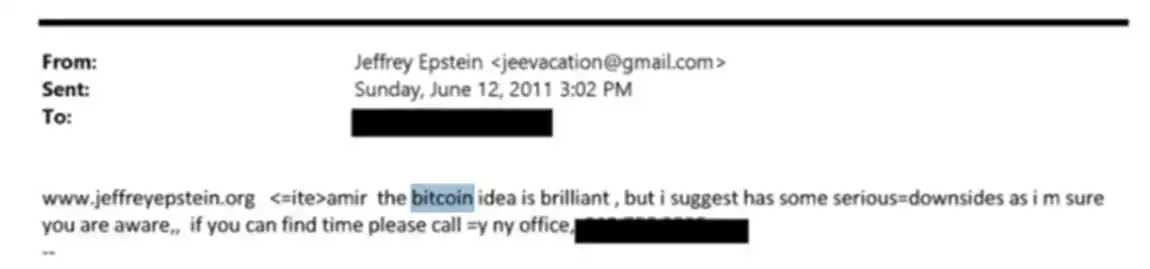
In 2013, the frequency of cryptocurrency mentions in Epstein's correspondence increased.

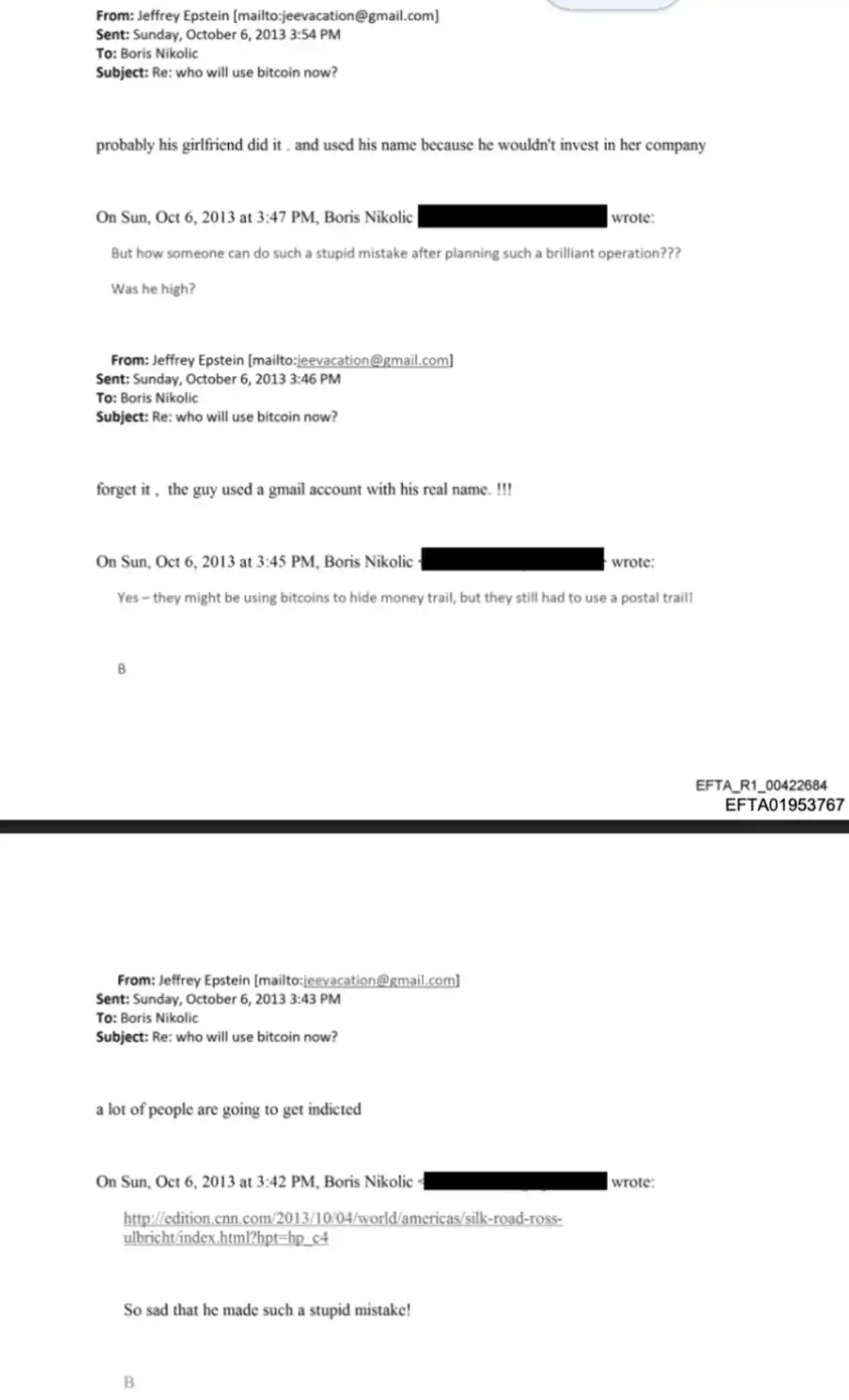
First, there was an email exchange with Boris Nikolic (who once served as Bill Gates' chief technology advisor and was named in Epstein's will), titled "Who Uses Bitcoin Now?". They jokingly and mockingly discussed Ross Ulbricht, the founder of Silk Road who was arrested that year, saying that Ross using a Gmail account with his real name was a stupid mistake.
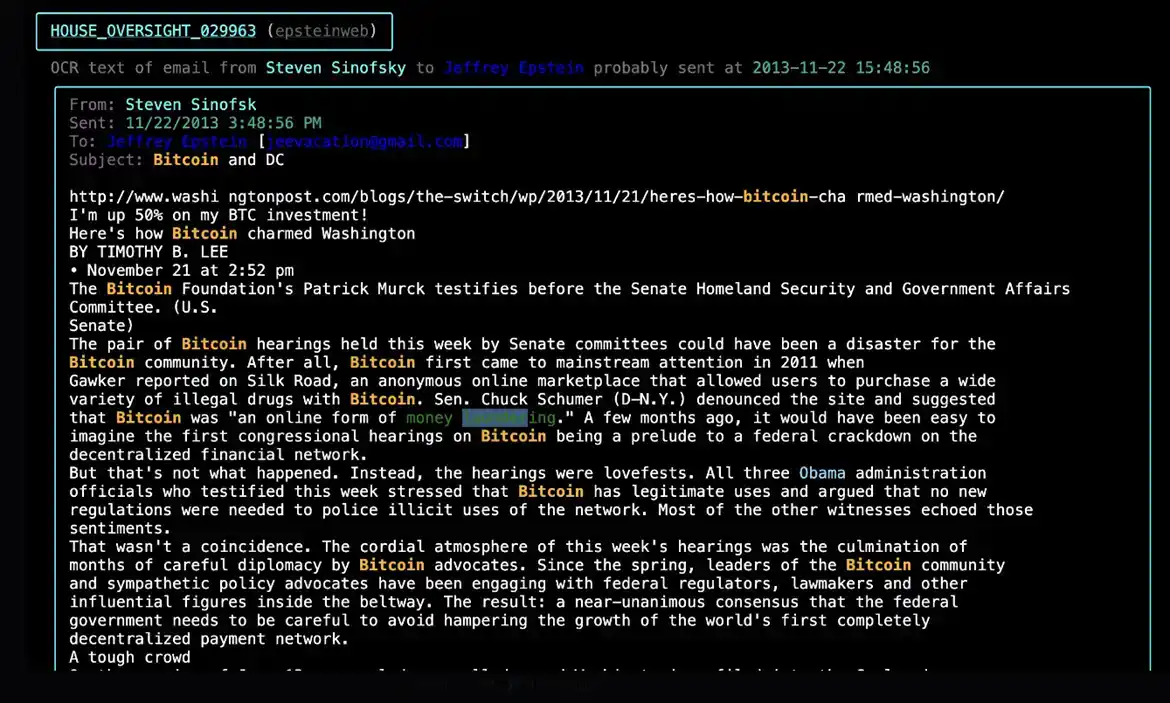
a16z board partner, former president of Microsoft's Windows division, Steven Sinofsky, emailed Epstein saying his Bitcoin investment had already increased by 50%, and shared Timothy B. Lee's article "How Bitcoin Captivated Washington".
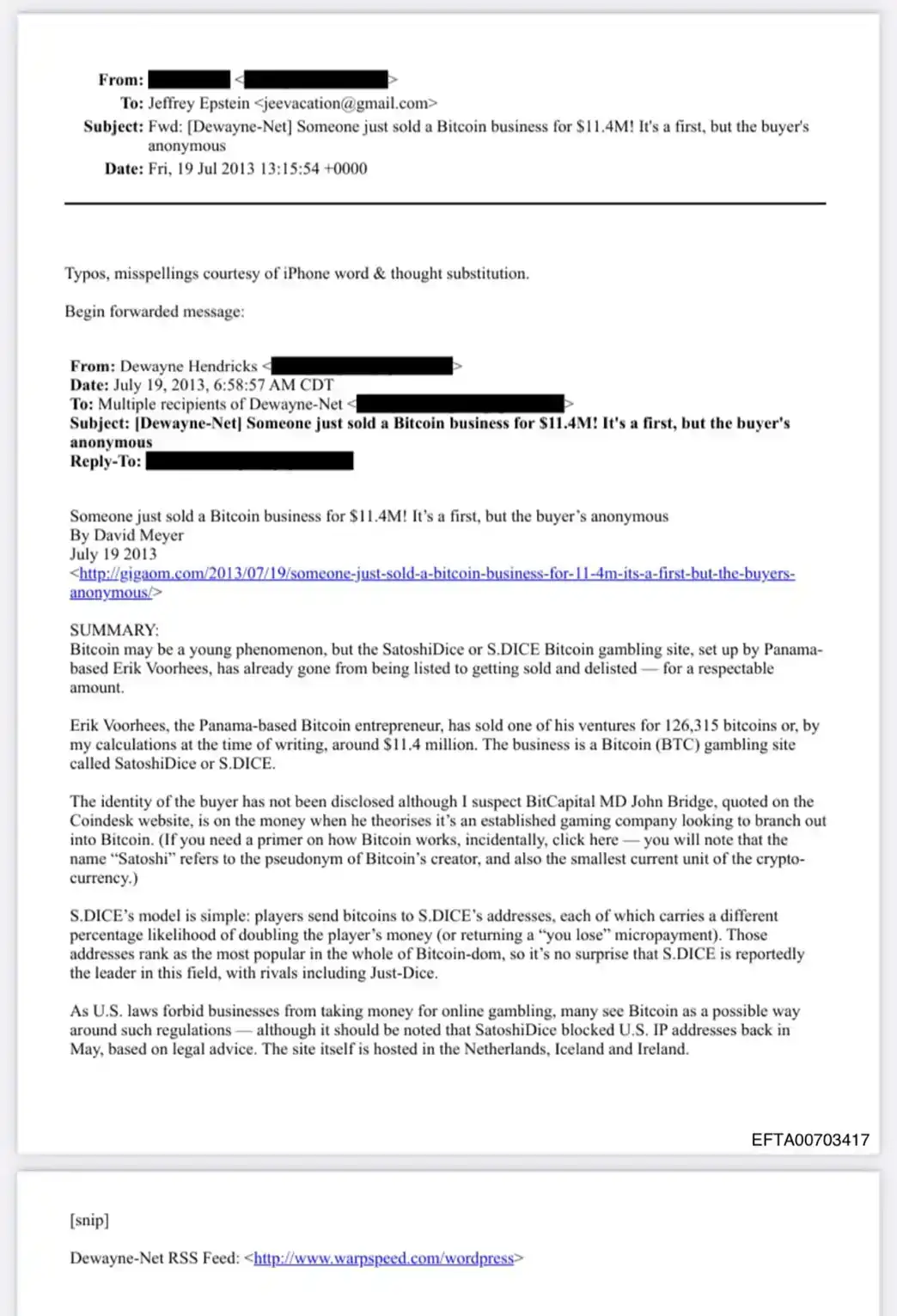
He also received news that the once-famous Bitcoin website Satoshi Dice was sold for $11.4 million.
In 2014, Epstein engaged in an in-depth discussion with PayPal co-founder Peter Thiel about the nature of Bitcoin.
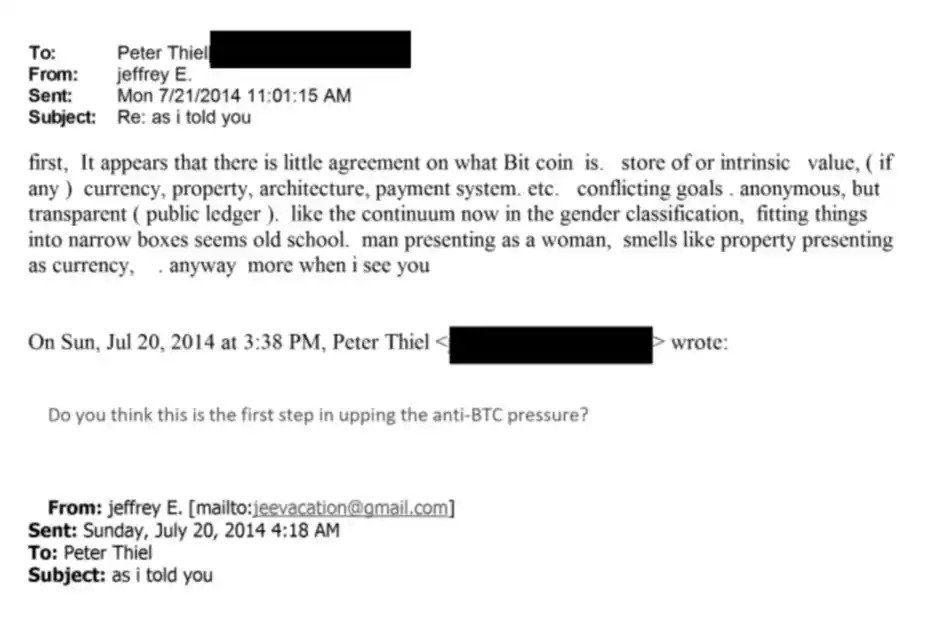
This conversation indicates that Epstein was already very familiar with the ideological debates surrounding Bitcoin's nature in the early stages of the cryptocurrency market. He even compared it to gender identity.

Another email shows that Epstein participated in the seed round financing of Bitcoin infrastructure company Blockstream. The total amount of this round was $18 million, and Epstein's investment increased from $50,000 to eventually $500,000.
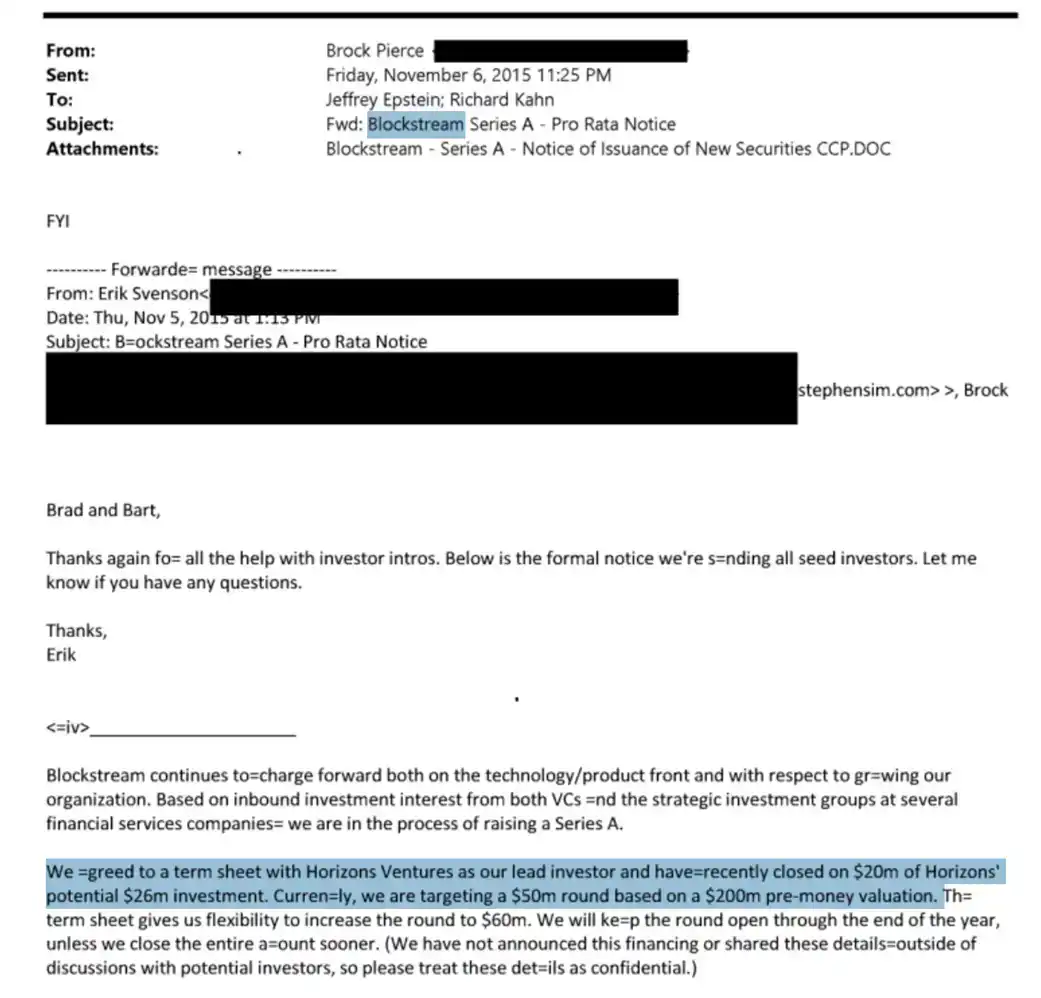
Blockstream CEO Adam Back recently issued a statement denying any direct or indirect financial connection between the company and Epstein or his estate. He explained that Epstein was once a limited partner in a fund that held a minority stake in Blockstream, but the fund has since completely divested.

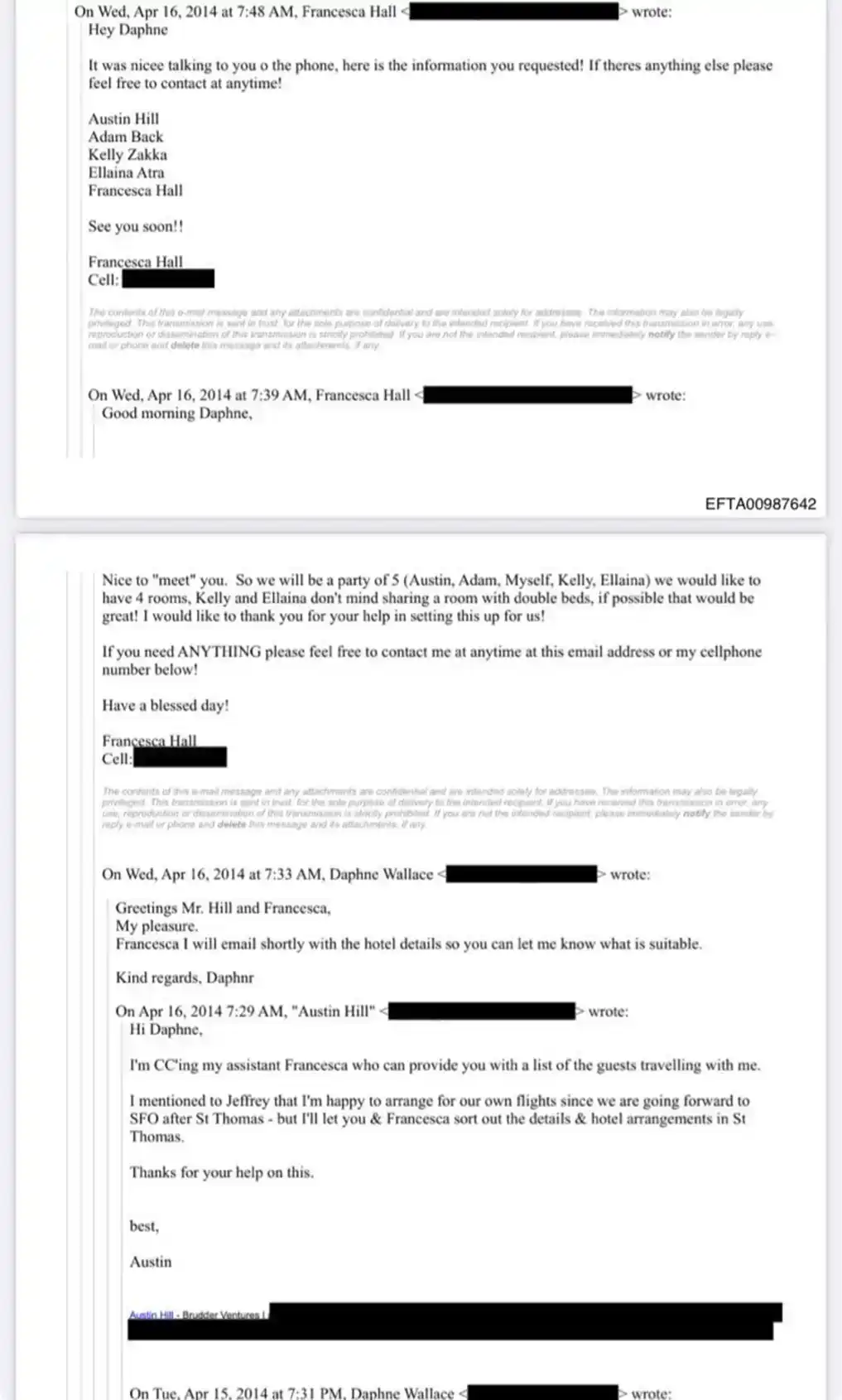
However, the names of Adam Back and Austin Hill (Blockstream co-founder) appeared in travel arrangement emails for St. Thomas Island (about 2 miles from "Epstein Island"):
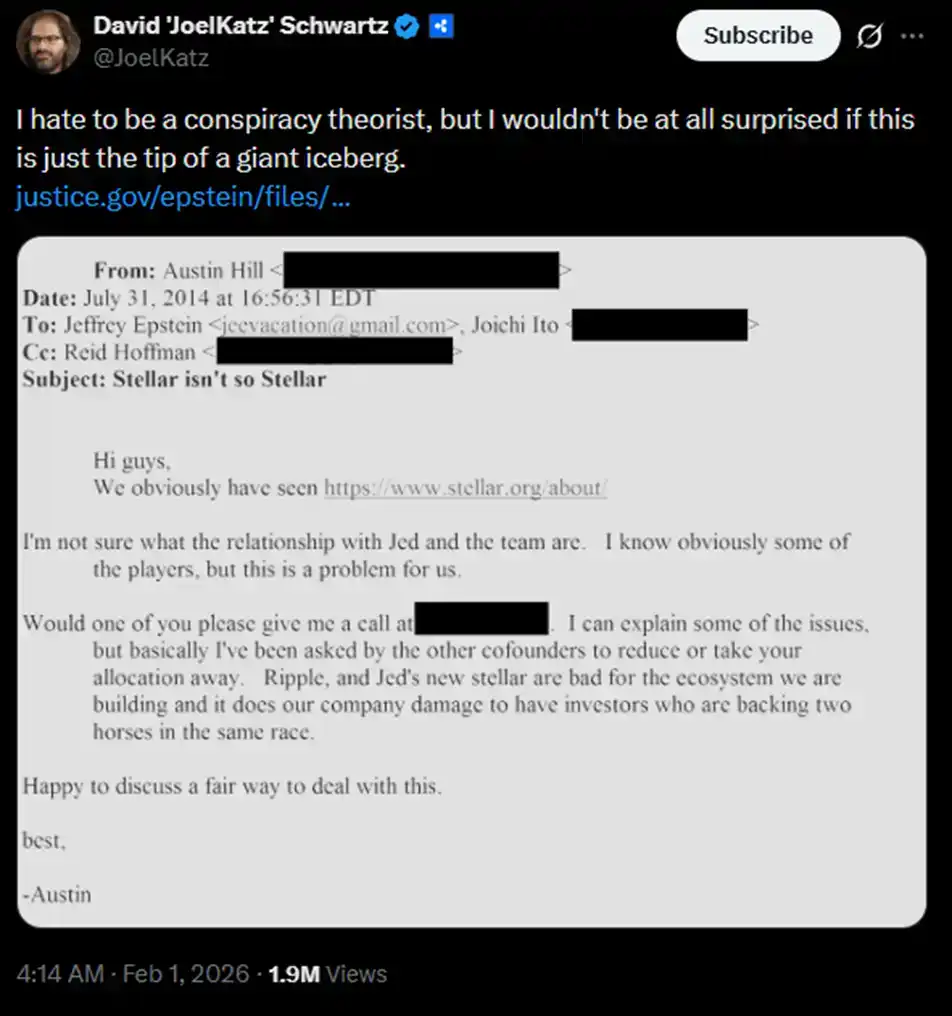
Furthermore, in 2014, Austin Hill emailed Epstein and Joi Ito (former director of the MIT Media Lab; Epstein invested in Blockstream through his fund). He stated that Ripple ($XRP) and Stellar (a new project by Ripple founder Jed McCaleb after leaving Ripple) had a negative impact on the ecosystem Blockstream was building and harmed Blockstream because their investors were "backing two horses in the same race."
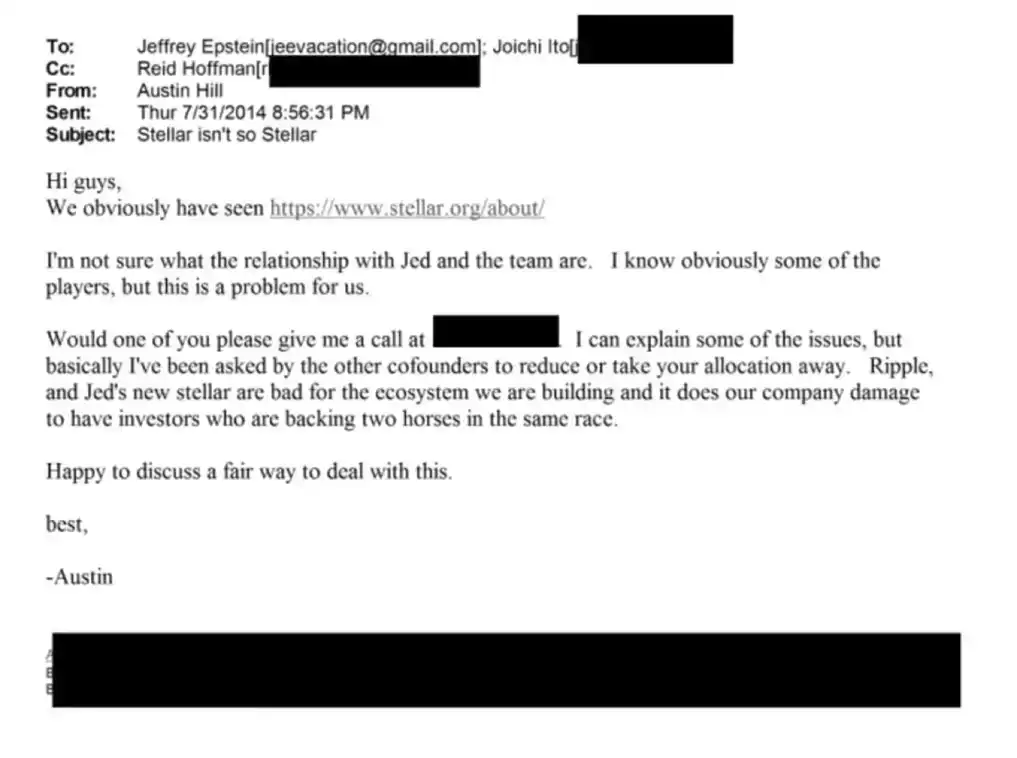
The interpretation of this in English-speaking circles has some divergence. Considering the context, my personal interpretation tends to be that Epstein might have also invested in Ripple/Stellar at the time, which caused Blockstream's dissatisfaction, leading Austin Hill to say in the email, "I was asked by other co-founders to reduce or even cancel your allocation."

Although the growth of Ripple and Stellar was not affected, we don't know if more, unknown, excellent cryptocurrency projects have been stifled in their infancy through such behind-the-scenes pressure, from then until now.

In response, former Ripple CTO David Schwartz tweeted, "I don't want to be a conspiracy theorist, but if this is just the tip of the iceberg, I wouldn't be surprised at all."
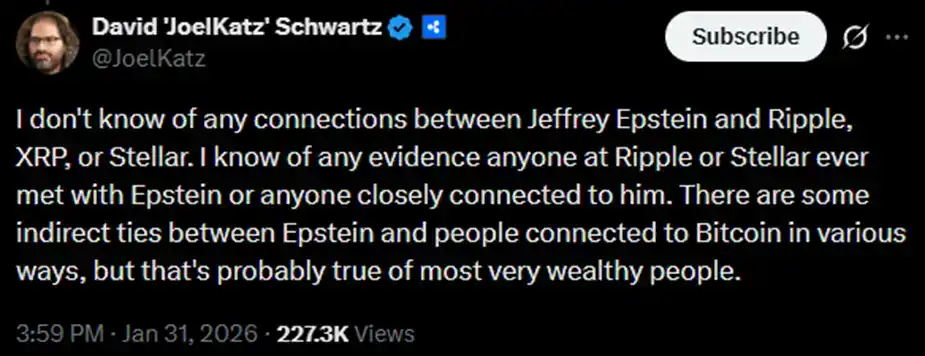
So does this mean Epstein's evil also existed in the cryptocurrency field? David Schwartz also said that for most ultra-wealthy individuals, having some connection to Bitcoin is probably very common.
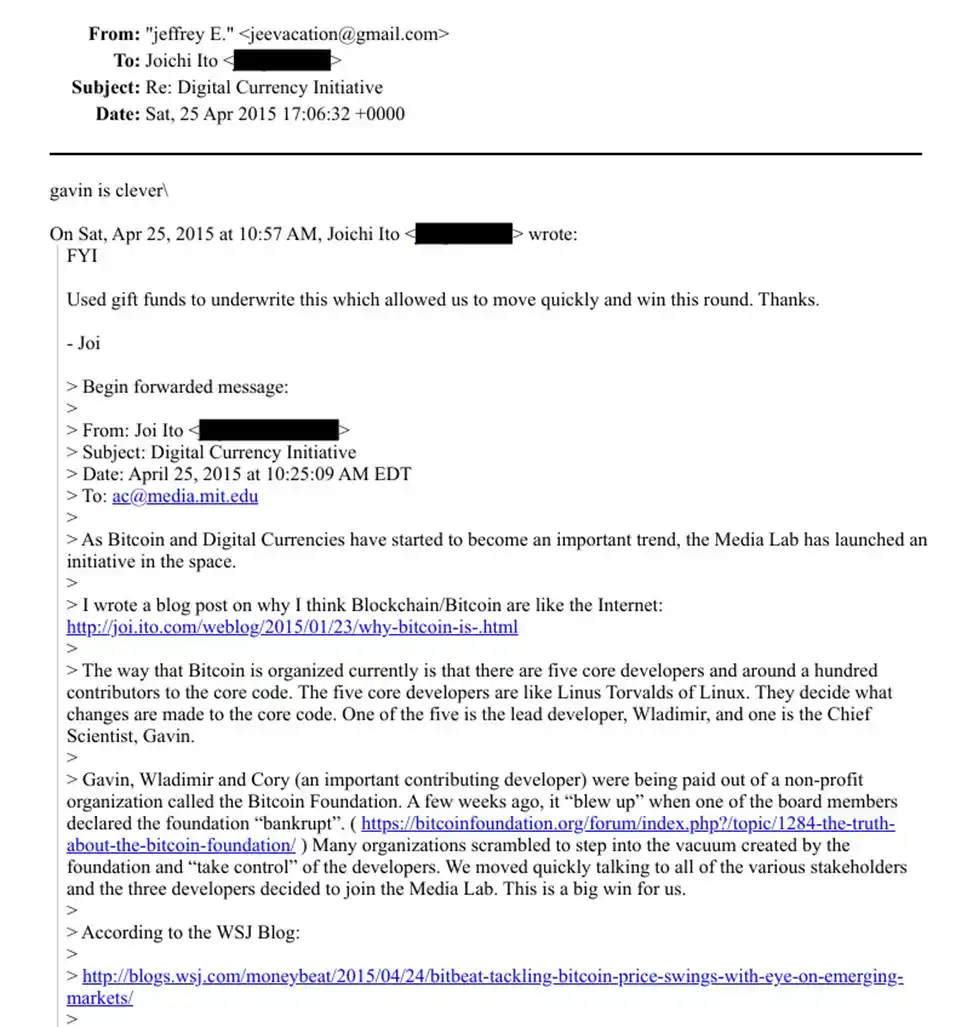
Even more, in 2014-2015, the collapse of the Bitcoin Foundation left Bitcoin Core developers without stable salaries. The MIT Media Lab's Digital Currency Initiative (DCI) began paying salaries to several Bitcoin Core developers. Gavin Andresen, Wladimir van der Laan, and Cory Fields, three Bitcoin Core developers, therefore decided to join the MIT Media Lab.

At that time, the scandal had not yet broken, and the public was unaware of Epstein's anonymous donations to the MIT Media Lab. Joi Ito thanked Epstein via email, not only explaining Bitcoin's development operations to Epstein but also stating that thanks to this money, the lab was "able to move quickly and score a huge victory" because "many organizations wanted to take advantage of the situation to control Bitcoin's developers."

Epstein's reply was a simple compliment about Gavin Andresen: "Gavin is very smart."
Did Epstein Meet Satoshi Nakamoto?

In 2016, Epstein emailed Saudi Royal Court advisor Raafat AlSabbagh and current Abu Dhabi Department of Culture and Tourism advisor Aziza Al Ahmadi, proposing two "radical ideas for creating two new currencies." One was a "Sharia" dollar; just like all U.S. dollar bills have "In God We Trust," the Middle East could have its own "Sharia" dollar for internal use.
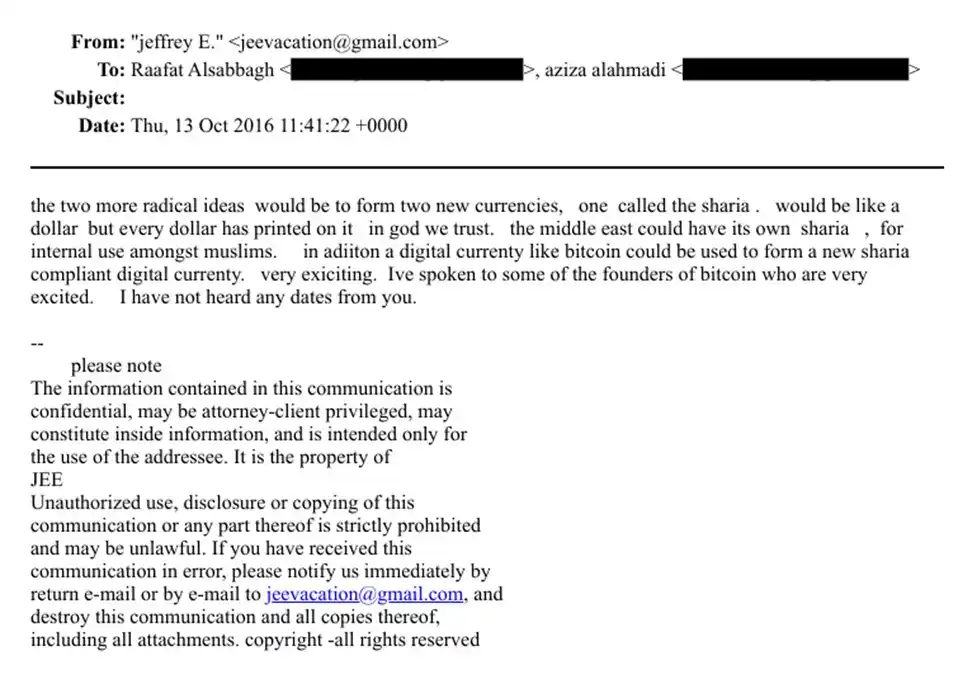
The other idea was to create a digital currency like Bitcoin to make money compliant with Sharia law. Then, after this idea, he casually and lightly dropped this message as if in small talk:

"I have spoken with some of the Bitcoin creators, and they are very excited."

Epstein's purpose at the time might have been more about炫耀 his connections to enhance his reliable image, so he just mentioned it offhand. But this could completely rewrite the entire history of Bitcoin and even the cryptocurrency industry. "Some Bitcoin creators"—does this mean Satoshi Nakamoto was not an individual but a team? If so, many mysteries surrounding Satoshi Nakamoto would have a reasonable explanation.

There are even more thought-provoking questions. Who was this team? What was the motivation for creating Bitcoin? If Epstein really met them, how did he initially find out who they were, and how did he establish a relationship with them? If even Epstein knew who created Bitcoin, wouldn't the U.S. government know? What motive has the U.S. government had for remaining silent on this issue all along?

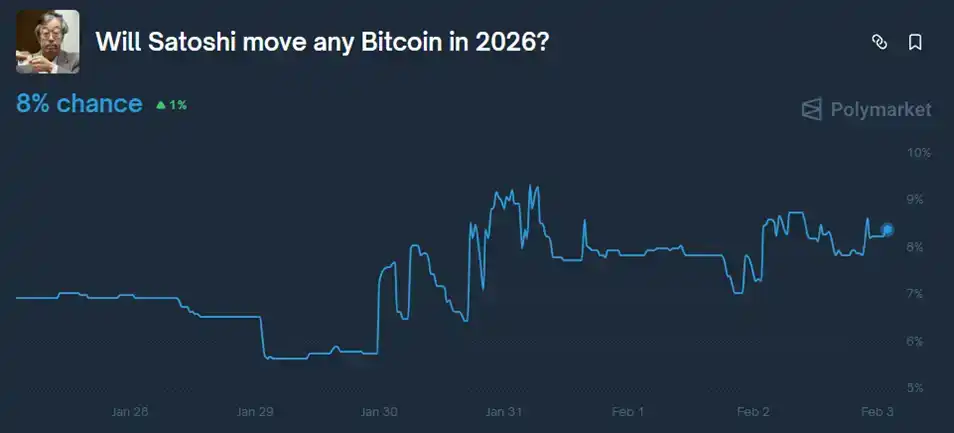
After this latest batch of Epstein files was disclosed, the probability on the prediction market Polymarket of "Satoshi Nakamoto's Bitcoin address taking action in 2026" rose from about 6% to about 9.3% at one point and is currently holding at 8%.
If Epstein did meet Satoshi Nakamoto, it seems Satoshi did not successfully evangelize Bitcoin to him during their contact. In an email exchange on August 31, 2017, when asked "Is it worth buying one Bitcoin?", Epstein simply replied "No." At that time, one Bitcoin was less than $5,000.

Whether Epstein actually met Satoshi Nakamoto, we currently have no way of knowing. However, we can know that he met the now most famous Bitcoin bull—MicroStrategy CEO Michael Saylor.

For years, Saylor's determination to only buy and never sell Bitcoin has been堪称变态 (abnormal/extraordinary). But in 2010, he was not yet famous for this identity.

That year, Comrade Saylor spent $25,000 to get into a party set up by Epstein's publicist Peggy Siegal and initially displayed his "autistic" traits at the party. This is how Peggy Siegal described Saylor:
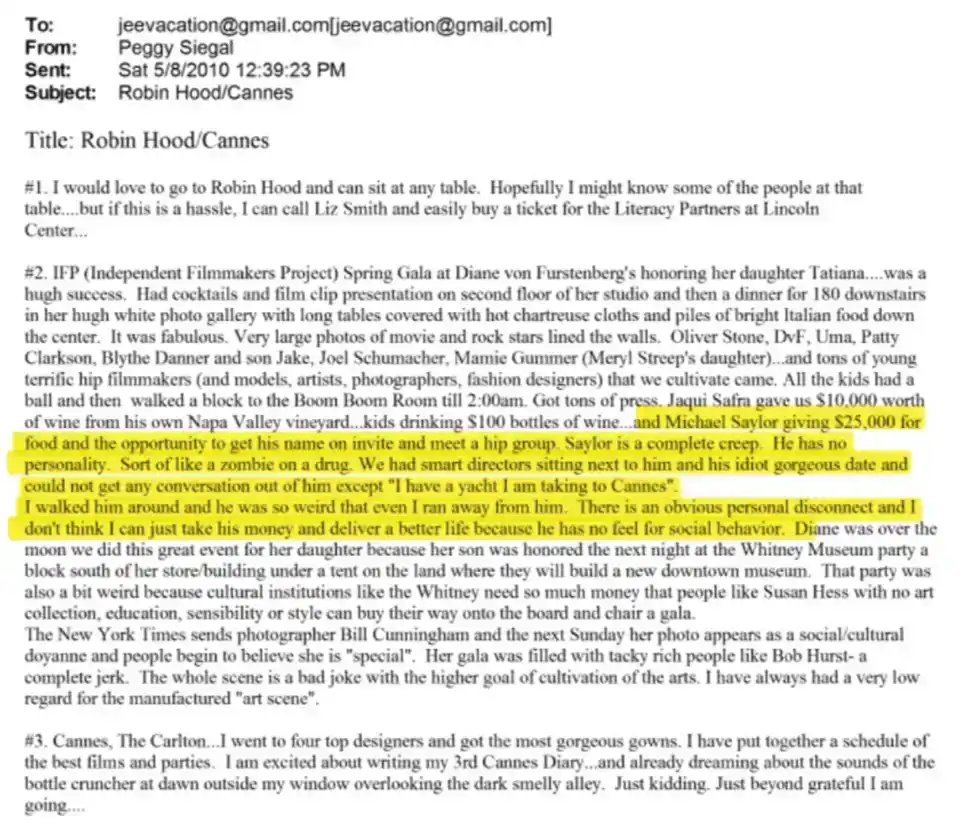
Being called变态 (abnormal/weird) by a变态 (abnormal/weird) subordinate shows just how变态 Saylor really is. Perhaps only a creation as great as Bitcoin could accommodate a变态 like Saylor and allow him to build a great enterprise.

Conclusion

About half of the Epstein files have not yet been disclosed. How many more bombshells related to the cryptocurrency industry are hidden in these remaining files?

Will time clear the fog?

Пов'язані питання

QWhat evidence from the article suggests that Jeffrey Epstein may have met Satoshi Nakamoto?

AThe article cites a 2016 email where Epstein stated, 'I have spoken with some of the creators of Bitcoin, and they are very excited,' while proposing a Sharia-compliant digital currency to Saudi and Abu Dhabi advisors.

QWhich Bitcoin infrastructure company did Epstein invest in, and what was the controversy surrounding it?

AEpstein invested in Blockstream's seed round, initially putting in $50,000 which grew to $500,000. The controversy involves emails showing Blockstream's co-founder, Austin Hill, traveling to an island near Epstein's and later expressing that Epstein's potential investment in rival projects Ripple/Stellar was harmful, suggesting pressure to reduce his stake.

QHow did Epstein's association with MIT's Media Lab connect to Bitcoin Core developers?

AEpstein made anonymous donations to the MIT Media Lab, which its director, Joi Ito, used to fund the salaries of Bitcoin Core developers like Gavin Andresen, Wladimir van der Laan, and Cory Fields after the Bitcoin Foundation collapsed, preventing other organizations from controlling them.

QWhat was Epstein's view on investing in Bitcoin in 2017, and how did it contrast with his earlier interest?

ADespite his early interest and discussions about Bitcoin since 2011, Epstein replied 'No' to an email in August 2017 when asked if it was worth buying a Bitcoin, which was then priced under $5,000.

QWhich prominent crypto figure was mentioned as having attended a party organized by Epstein's associate, and how was he described?

AMicroStrategy CEO Michael Saylor was mentioned as attending a party organized by Epstein's PR associate, Peggy Siegal, in 2010. Siegal described Saylor as exhibiting 'autistic' traits during the event.

Пов'язані матеріали

TechFlow Intelligence: Trump-Linked Companies Transfer $12 Million in Assets Before China Visit, 'The Big Short' Protagonist Warns of Stock Market Bubble Again

The article reports multiple developments across tech, crypto, and finance. In AI, Mozilla used AI for large-scale code review, Google confirmed hackers used AI to find zero-day exploits, and OpenAI deployed GPT-5.5 to find errors in math benchmarks. A court ruled Anthropic's scanning and destroying books for AI training as fair use, while its Claude platform launched on AWS. Google's new video model 'Omni' was leaked. In crypto/Web3, Trump-linked companies transferred $12M in crypto assets before a China visit. BlackRock chose Ethereum for tokenized funds, and a hacker stole $174k via a malicious NFT that tricked an AI. Jack Dorsey's first tweet NFT plummeted from $2.9M to under $5. In chips/hardware, TSMC approved an additional $20B for its Arizona plant. Apple's Tim Cook and Elon Musk will accompany Trump to China, while Nvidia's Jensen Huang is notably absent. For markets, Michael Burry warned of parabolic stock rises and suggested near-total sell-offs, with online discussions comparing current sentiment to the 1999 bubble. Other notes include WTI oil surpassing $100, a 20% price hike for Beijing-Shanghai high-speed rail, and new products like Unitree's $26.9k humanoid robot. The underlying theme suggests AI is becoming infrastructure, creating pressure on old systems while a new order is not yet ready, leaving investors anxious.

marsbit5 хв тому

TechFlow Intelligence: Trump-Linked Companies Transfer $12 Million in Assets Before China Visit, 'The Big Short' Protagonist Warns of Stock Market Bubble Again

marsbit5 хв тому

2026 New Policy Interpretation: The "Mutual Pursuit" of Intelligent Agents and AI Terminals, and the Three Major Value Reconstructions in the AIoT Industry

In May 2026, China's national ministries released two pivotal policy documents that jointly establish a strategic "dual-track" framework for the AIoT industry. The "Intelligent Agent Standardized Application and Innovation Development Implementation Opinions" defines the "soul"—positioning intelligent agents as core AI products. The "Artificial Intelligence Terminal Intelligence Grading" national standard defines the "body"—establishing a four-tier capability ladder (L1 to L4) for AI hardware. This synchronized policy approach is globally unique, moving beyond market-led (US) or risk-focused (EU) models. It frames AIoT as a new type of "intelligent infrastructure," comparable to electricity or the internet in historical significance. The core analysis identifies a value evolution from IoT 1.0 (connection) to AIoT 4.0 (collaboration, represented by the forward-looking L4 level). This "L4" signifies a paradigm shift: from users operating tools to delegating tasks to agent-like devices ("Intelligent Action of All Things"). The article outlines three strategic paths for companies: becoming Standard Definers, Scenario Integrators (focusing on 19 specified application areas), or Infrastructure Builders. A critical 18-24 month window is identified for strategic positioning. A "Four Levers" strategy is proposed: leveraging Standards (L-level certification), leveraging Scenarios (deep vertical focus), leveraging Open Source (for cost reduction and ecosystem influence), and leveraging Momentum (engaging in global protocol ecosystems). In conclusion, these policies are a starting gun for a decade-long industrial transformation, shifting the industry narrative from "Intelligent Connection of All Things" to "Intelligent Action of All Things," with companies needing to choose their赛道and execution strategy decisively.

marsbit1 год тому

2026 New Policy Interpretation: The "Mutual Pursuit" of Intelligent Agents and AI Terminals, and the Three Major Value Reconstructions in the AIoT Industry

marsbit1 год тому

Splashing Out 27 Billion Yuan, OpenAI Establishes New Company to Accelerate AI Deployment

On May 11th, OpenAI announced the formation of a new company, "OpenAI Deployment Company," with an initial investment of over $4 billion (approximately 27.2 billion RMB). This venture aims to help businesses build and deploy AI solutions. OpenAI is also acquiring the AI consulting firm Toromo to rapidly scale the deployment company's capabilities. This new entity, majority-owned by OpenAI, brings together 19 investment, consulting, and system integration partners, led by TPG with co-lead founding partners including Advent International, Bain Capital, and Brookfield. OpenAI's Chief Revenue Officer, Denise Dresser, stated that while AI is becoming increasingly capable, the current challenge lies in integrating these systems into core business infrastructure and workflows. The deployment company is designed to bridge this gap and translate AI capabilities into operational impact. This move comes as OpenAI emphasizes the next competitive phase will depend on the efficiency of deploying AI in real business scenarios. The company reports over 1 million businesses already use its products and APIs. OpenAI is significantly increasing its investments in computing power, with co-founder Greg Brockman stating the company expects to spend $50 billion on compute this year, a dramatic increase from $3 million in 2017. The announcement follows OpenAI's recent completion of a record $122 billion funding round in late March, led by Amazon, Nvidia, and SoftBank, valuing the company at $852 billion post-money. Major strategic investors committed $110 billion as a base for this round. Concurrently, OpenAI is advancing its core model development. It has shifted focus from its Sora video generator to developing advanced robotics and AI models that interact with the physical world. It has also begun allowing select users access to a new model specialized in identifying software vulnerabilities and is reportedly preparing to launch an enhanced image generation model in the coming weeks. According to reports citing founder Sam Altman, OpenAI is considering an IPO as early as 2027, with a potential valuation around $1 trillion.

marsbit1 год тому

Splashing Out 27 Billion Yuan, OpenAI Establishes New Company to Accelerate AI Deployment

marsbit1 год тому

Торгівля

Спот
Ф'ючерси
活动图片

