Author: Robozaps
Compiled by: Felix, PANews
The humanoid robotics industry is experiencing explosive growth, evolving from a handful of research labs to a global market valued at USD 29 billion in 2025, with projections reaching USD 40 to 180 billion by 2030. Dozens of humanoid robot companies are now racing to create machines that can walk, talk, and collaborate with humans.
This guide aims to introduce the mainstream humanoid robot companies of 2026, including their key robots, funding status, pricing, and what makes each company unique.
Key Points:
- Highest Valuation: Figure AI (Valued at USD 39 billion)
- Lowest Price: Unitree Robotics G1 (USD 16,000)
- Most Experienced: Boston Dynamics (Over 30 years)
- Largest Production Scale: Tesla (Target: 1 million units annually)
- First Commercial Deployment: Agility Robotics Digit
- Best for Home Use: 1X NEO (USD 20,000 or USD 499 per month)
Complete Comparison of Humanoid Robot Companies in 2026:
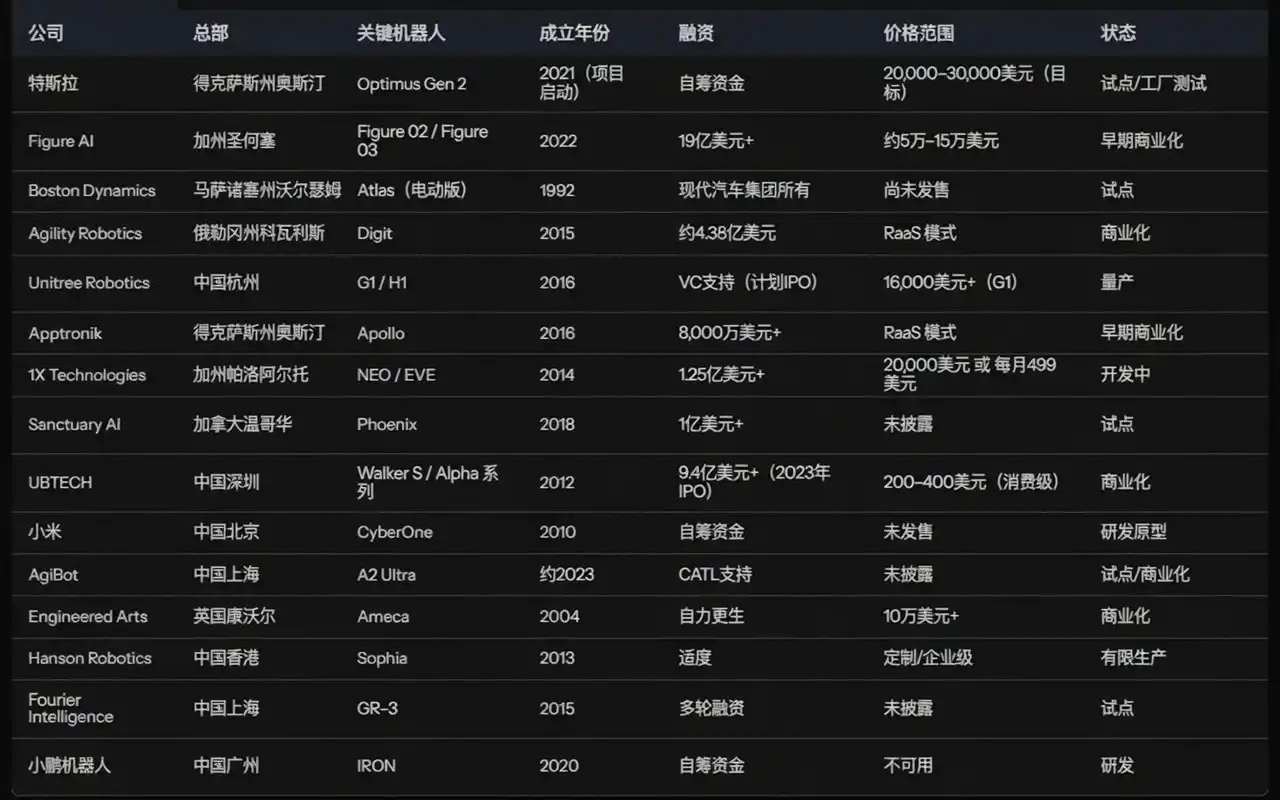
1. Tesla — Optimus
Headquarters: Austin, Texas | Founded: Robot project launched in 2021 | CEO: Elon Musk
Tesla is arguably the world's most watched humanoid robot company, largely thanks to Musk's bold claims about Tesla Optimus. The company leverages its existing AI infrastructure to train its humanoid robot, including its Full Self-Driving neural network and Dojo supercomputer.
Main Product: Optimus Gen 2 stands 5 feet 8 inches (approx. 1.73m) tall, weighs about 125 lbs (57kg), with hands alone featuring over 28 degrees of freedom. Tesla aims for a manufacturing cost of USD 20,000 per unit, with a retail target price of USD 20,000-30,000.
Current Status: According to Musk on the Q4 2025 earnings call, Optimus is performing basic tasks in Tesla's own factories but is "not yet substantively deployed." Tesla plans to retrofit its Fremont factory to produce up to 1 million Optimus units annually. Public sales are expected to begin by the end of 2027.
Unique Aspect: No other humanoid robot company possesses Tesla's manufacturing scale, AI compute infrastructure, or brand recognition. If even part of Musk's plans hold true, Tesla could dominate the consumer humanoid market with its sheer volume.
Funding: Self-funded by Tesla. The company has committed USD 20 billion in capital expenditures for 2026 for Optimus manufacturing and compute infrastructure, among other projects.
2. Figure AI
Headquarters: San Jose, California | Founded: 2022 | CEO: Brett Adcock
Figure AI is the fastest-growing humanoid robot company by valuation, reaching USD 39 billion after raising USD 1 billion in September 2025. In under three years, Figure has gone from a bootstrapped startup to one of the most funded robotics companies in history.
Main Products: Figure 02 is the company's industrial-grade humanoid, currently in pilot projects with BMW for car manufacturing. Figure 03 is the next-gen consumer model featuring palm cameras, tactile sensors detecting forces as low as 3 grams, wireless charging, and safety foam coating.
AI Platform: Figure's proprietary Helix Vision-Language-Action (VLA) model uses a dual-system architecture—System 1 runs at 200 Hz for low-level motor control, System 2 at 7–9 Hz for planning and reasoning. The company ended its OpenAI partnership in 2025 to build fully proprietary AI.
Production: Figure's dedicated humanoid factory is BotQ, targeting 12,000 units per year. This is the first factory built specifically for humanoid robots.
Funding: Over USD 1.9 billion total, from investors including Jeff Bezos, Microsoft, NVIDIA, Intel, Qualcomm, T-Mobile, Salesforce, and Brookfield.
Unique Aspect: Execution speed. No robotics company has scaled from founding to tens of billions in valuation as fast as Figure. The dedicated BotQ factory gives Figure a manufacturing edge most startups lack.
3. Boston Dynamics
Headquarters: Waltham, Massachusetts | Founded: 1992 | CEO: Robert Playter | Owner: Hyundai Motor Group
Boston Dynamics is the world's most iconic robotics company. Founded over 30 years ago as an MIT spin-off, it has created viral videos of robots doing backflips, parkour, and dancing. In 2024, Boston Dynamics retired its legendary hydraulic Atlas and unveiled a fully electric version designed for real-world industrial deployment.
Main Products: The new electric Atlas is built for industrial manipulation tasks. Its quadruped Spot (USD 75,000) is commercially available for inspection, data collection, and security. Stretch is for warehouse logistics.
Current Status: Hyundai announced plans to produce 30,000 humanoids annually, primarily for warehousing. Atlas is transitioning from R&D to commercial pilots.
Funding: Now part of Hyundai Motor Group (acquired in 2021 for ~USD 1.1 billion). Previously owned by SoftBank and Google/Alphabet.
Unique Aspect: Three decades of locomotion research give Boston Dynamics unmatched expertise in bipedal movement. Its Orbit cloud platform for fleet management is a key advantage for enterprise deployment.
4. Agility Robotics — Digit
Headquarters: Corvallis, Oregon | Founded: 2015 | CEO: Damion Shelton
Agility Robotics created the "world's first commercial humanoid robot." While others are still in pilot phases, Digit is deployed in customer warehouses.
Main Product: Digit is a bipedal humanoid designed for logistics, performing tasks like picking, stacking, and unloading. It aims to fill over 1 million US material-handling job openings.
Business Model: Robotics-as-a-Service (RaaS), with the Agility Arc cloud platform for fleet management.
Key Partners: Amazon (warehouse testing), GXO Logistics.
Funding: ~USD 438 million total. ~USD 150 million Series C in Oct 2024 (led by DCVC), post-money valuation ~USD 1.2 billion. Investors include DCVC, Playground Global, and Amazon.
Unique Aspect: First-mover advantage in commercial humanoid deployment. Built specifically for logistics, not trying to be a general-purpose robot, allowing faster time-to-market.
5. Unitree Robotics
Headquarters: Hangzhou, China | Founded: 2016 | CEO: Wang Xingxing
Unitree Robotics is on a mission to democratize humanoid robotics. Its G1 humanoid starts at just USD 16,000, making it the cheapest humanoid on the market.
Main Products: G1 is a compact, mass-producible humanoid. H1 is a full-size humanoid that set a world record for humanoid running speed at 3.3 m/s. Sixteen H1s performed on China's Spring Festival Gala, a cultural milestone for robotics.
Production Status: Mass production; G1 and quadrupeds (Go2 starting at USD 1,600) are commercially available and shipping globally.
Funding: Backed by Sequoia Capital China, Matrix Partners, and Shunwei Capital. Considering a Hong Kong IPO.
Unique Aspect: G1's USD 16,000 price tag is far below any competitor. Unitree is doing for humanoids what DJI did for drones: making advanced robotics accessible.
6. Apptronik — Apollo
Headquarters: Austin, Texas | Founded: 2016 | CEO: Jeff Cardenas
Apollo is Apptronik's general-purpose humanoid, standing 1.73m tall, weighing 73kg. It features swappable batteries for 4-hour runtime and a 25kg payload. These practical specs are designed for real warehouse work.
Target Markets: Third-party logistics (case picking, trailer unloading), retail (palletizing, sorting), and manufacturing (line replenishment, machine tending). Their pitch focuses on reducing workplace injuries (one-third of which are from overexertion).
Business Model: Robotics-as-a-Service (RaaS), promising "ROI from day one."
Funding: ~USD 935 million total. USD 403 million Series A (March 2025, led by Google) and USD 520 million Series A extension (Feb 2026), post-money valuation ~USD 5 billion. Named to CNBC Disruptor 50 list in 2025.
Unique Aspect: Pragmatic, ROI-driven approach. While competitors chase headlines, Apptronik focuses on proving economic value in specific logistics tasks. CEO Jeff Cardenas calls humanoids "the space race of our generation."
7. 1X Technologies — NEO
Headquarters: Palo Alto, California, US (Founded in Norway 2014 as Halodi Robotics; manufacturing facility in Hayward, CA opening April 2026) | Founded: 2014 | CEO: Bernt Børnich
1X Technologies is one of the few humanoid companies focused on the home market. Their NEO robot is designed as a domestic companion, while EVE serves commercial security and retail applications.
Partnership: OpenAI is both an investor and AI partner for 1X, giving it access to cutting-edge language and reasoning models.
Pricing: NEO's expected price is ~USD 20,000 or a USD 499 monthly subscription.
Funding: Over USD 125 million total from OpenAI, Tiger Global, and Samsung.
Unique Aspect: One of the few European humanoid companies and the clearest "home robot" strategy on the market. The OpenAI partnership could give NEO conversational and reasoning abilities rivals can't match.
8. Sanctuary AI — Phoenix
Headquarters: Vancouver, Canada | Founded: 2018 | CEO: Geordie Rose (Co-founder of D-Wave Quantum)
Phoenix is Sanctuary AI's industrial humanoid with an edge most competitors lack: industry-leading hydraulic hands with superior dexterity and tactile feedback.
AI Approach: Sanctuary builds an embodied AI cognitive architecture that mimics human motion and cognition, leveraging partnerships like NVIDIA Isaac Lab for sim-to-real transfer.
Partners: Microsoft (joint launch at Hannover Messe 2025), NVIDIA.
Funding: ~USD 140 million total. Strategic equity from Magna, a partner and equity investor, not an acquirer; Sanctuary remains independent.
Unique Aspect: Hydraulic hand technology gives Phoenix fine manipulation capabilities unmatched by current electric grippers. A robotics company led by a quantum computing pioneer (Geordie Rose) brings a unique cross-disciplinary perspective.
9. UBTECH Robotics
Headquarters: Shenzhen, China | Founded: 2012 | CEO: Zhou Jian
UBTECH is the commercial humanoid company with the highest consumer sales volume. Its Walker S is a full-size humanoid for service applications, while Alpha Mini and Alpha 1E are affordable consumer/education robots priced between USD 200-400.
Market Position: UBTECH listed on the Hong Kong Stock Exchange in December 2023, raising ~USD 130 million. Pre-IPO, it raised over USD 940 million in private funding, making it one of the most funded robotics companies globally.
Target Markets: Education (AI education solutions), elderly care, consumer hardware, and service robots. Already deployed in schools and institutions worldwide.
Unique Aspect: Dual focus on affordable consumer products and full-size humanoids. The Alpha series provides revenue and brand recognition, while Walker S pushes technological frontiers.
10. Xiaomi — CyberOne
Headquarters: Beijing, China | Founded: 2010 | CEO: Lei Jun
CyberOne is Xiaomi's humanoid, standing 177 cm tall, weighing 52 kg, with 21 degrees of freedom and emotion recognition. It remains a research prototype/tech demo, not yet commercially available.
Note: Xiaomi's quadruped CyberDog 2 is more mature and better showcases the company's manufacturing prowess.
Unique Aspect: Xiaomi's consumer electronics manufacturing capabilities are second to none. If they decide to mass-produce a humanoid, they could scale faster than almost any competitor.
11. AgiBot
Headquarters: Shanghai, China | Founded: ~2023 | Backer: CATL (world's largest EV battery maker)
AgiBot has one of the most ambitious product portfolios among humanoid companies: the A2 Ultra full-size humanoid, A2-W for flexible manufacturing, open-source X1/X2 research platforms, D1 quadruped, and OmniHand dexterous arm.
Unique Aspect: Backing by CATL means direct access to cutting-edge battery tech—a crucial advantage when runtime (typically 2-4 hours) is a major humanoid limitation. Their open-source X1 platform and "AGIBOT World dataset" indicate they're building an ecosystem, not just a product.
12. Engineered Arts — Ameca
Headquarters: Penryn, Cornwall, UK | Founded: 2004 | CEO: Will Jackson
Ameca gained viral fame for its hyper-realistic facial expressions, with 17 degrees of freedom in the face alone. It's a torso-only social humanoid designed for entertainment, exhibitions, and research, not physical labor.
Price: Reportedly over USD 100,000, available for purchase or lease.
Other Products: Mesmer (hyper-realistic humanoids) and RoboThespian (entertainment robots).
Unique Aspect: No other humanoid company creates more realistic, human-like expressions. With 20 years of experience, Engineered Arts has unmatched expertise in the social/expressive dimension of humanoids.
13. Hanson Robotics — Sophia
Headquarters: Hong Kong | Founded: 2013 | CEO: David Hanson
Sophia is the world's most famous robot. Granted Saudi Arabian citizenship, featured on countless talk shows, and a cultural icon. Hanson Robotics uses patented Frubber skin material for realistic facial expressions.
Current Position: More a media personality and research platform than a commercial product. The USD 150 consumer-education robot Little Sophia is discontinued.
Unique Aspect: Brand recognition and cultural impact. Sophia has done more to raise public awareness of humanoids than any other robot.
14. Fourier Intelligence — GR-3
Headquarters: Shanghai, China | Founded: 2015 | CEO: Gu Jie
Fourier Intelligence bridges medical rehabilitation robots with humanoid consumer products. Its GR-3 is positioned as a "considerate and reliable companion," while its RehabHub platform provides steady revenue in healthcare.
Unique Aspect: Deep expertise in rehabilitation robotics gives Fourier rich knowledge in human-robot interaction—key knowledge pure-play humanoid companies lack. They have a clinical-level understanding of human biomechanics.
15. XPeng Robotics — IRON
Headquarters: Guangzhou, China | Parent Company: XPeng Inc. (NYSE: XPEV)
XPeng follows Tesla's model: an electric vehicle company venturing into humanoids. IRON is its full-size bipedal humanoid, currently in R&D/prototype stage.
Unique Aspect: Like Tesla, XPeng can leverage EV manufacturing infrastructure, AI talent, and supply chain relationships. They represent the trend of automotive companies entering the humanoid space.
Other Notable Humanoid Robot Companies
The humanoid landscape extends far beyond the top 15. Here are other manufacturers to watch:
PAL Robotics (Barcelona, Spain): Over 20 years of building research humanoids. TALOS and TIAGo Pro sold to over 35 countries.
SoftBank Robotics (Tokyo, Japan): Developed Pepper and NAO but pivoted from humanoid manufacturing to robot integration.
Promobot (Russia/US operations): Service robots deployed in over 40 countries. Actively seeking distributors and partners.
Clone Robotics (Warsaw, Poland): Revolutionary musculoskeletal design using artificial tendons instead of traditional actuators.
Mentee Robotics (Israel): Founded by Mobileye co-founder Amnon Shashua. Its robots can be "instructed" via natural language.
LimX Dynamics (Shenzhen): Building COSA, an Embodied Intelligence OS merging advanced cognition with whole-body control.
Kepler Robot (Shanghai): Forerunner humanoid for industrial applications with ~40 degrees of freedom.
RobotEra (Beijing): STAR1 humanoid targeting manufacturing, logistics, and home care.
Noetix Robotics (Beijing): Founded Sept 2023. Its Bumi robot costs USD 1,400, among the most affordable humanoids. Raised USD 41 million.
MagicLab (China): Founded Dec 2023. Developing MagicBot Gen1 and Z1 humanoids for factory production applications.
Galbot (Shanghai): Founded May 2023. G1 humanoid. The company raised USD 800 million at a USD 3 billion valuation, one of China's highest-valued humanoid startups.
NEURA Robotics (Metzingen, Germany): Europe's leading humanoid company. Its 4NE-1 humanoid costs EUR 98,000 for industrial use. Known for cognitive robotics and human-robot interaction.
DEEP Robotics (Hangzhou): Its DR02 humanoid has an IP66 all-weather rating, making it one of the most rugged humanoids for outdoor/industrial environments.
Who is Investing in Humanoid Robot Companies?
In 2024 alone, venture capital in humanoids totaled over USD 3-4 billion. The largest single round was Figure AI's USD 1 billion raise in September 2025 at a USD 39 billion valuation.
- NVIDIA: Both investor and infrastructure provider (Isaac Sim, GR00T foundation model)
- Jeff Bezos — Personal investment in Figure AI
- Microsoft: Invested in Figure AI; partnered with Sanctuary AI
- OpenAI: Investor in 1X Technologies
- Samsung, Intel, Qualcomm: Strategic investments in multiple companies
- Amazon: Investor and tester of Agility Robotics' Digit
- Hyundai: Acquired Boston Dynamics for USD 1.1 billion
Industry Trends Shaping Humanoid Companies
Price Disruption
Unitree's USD 16,000 G1 marks the start of humanoid commoditization. Tesla targets USD 20,000-30,000. Within 5 years, sub-USD 20,000 consumer humanoids could be a reality.
AI Breakthroughs
Vision-Language-Action (VLA) models enable robots to learn tasks via demonstration rather than explicit programming. This is the biggest technical driver for the industry.
Production Scale
Figure's BotQ (12,000 units/year), Tesla's Fremont retrofit (target: 1 million/year), and Boston Dynamics/Hyundai (30,000/year) represent massive capacity increases.
Robotics-as-a-Service (RaaS)
Companies like Agility Robotics and Apptronik use subscription models to lower the barrier to enterprise adoption.
FAQs
How many humanoid robot companies are there today?
As of 2026, approximately 30-50 companies are actively developing humanoids. This includes major players like Tesla, Figure AI, and Boston Dynamics, plus dozens of smaller startups and Chinese manufacturers. The number has roughly doubled since 2023 as venture capital flooded the sector.
Which humanoid robot company is the most valuable?
As of September 2025, Figure AI has the highest private valuation at USD 39 billion. However, if Tesla's Optimus project were valued separately from the parent company, it could be higher. Musk has claimed 80% of Tesla's value will eventually come from Optimus. Among public pure-play robotics companies, UBTECH (HKEX) is notable.
What is the cheapest humanoid robot you can buy?
Unitree's G1 at ~USD 16,000 is currently the most affordable humanoid. For even cheaper options, UBTECH's Alpha series consumer robots start at ~USD 200-400, though these are small educational robots, not full-size humanoids.
Can you buy a humanoid robot now?
Yes. Several humanoids will be available in 2026: Unitree G1, Unitree H1, UBTECH Alpha series (USD 200-400), Engineered Arts Ameca (USD 100,000+), Boston Dynamics Spot (quadruped, USD 75,000), and Agility Robotics Digit (RaaS model).
Which companies are making home humanoid robots?
Companies focused on home/consumer humanoids include: 1X Technologies (NEO), Figure AI (Figure 03), Tesla (Optimus, long-term project), and Unitree (G1). Most products are still in R&D or early pilot phases.
What will the humanoid robot industry look like by 2030?
Market forecasts show a humanoid robot market size of USD 4 billion (conservative) to USD 18 billion (optimistic) by 2030. Key milestones to watch: Tesla's planned public sales start in late 2027, Figure AI scaling BotQ production, and whether consumer humanoid costs can drop below USD 20,000. The industry's trajectory heavily depends on AI capability improvements and manufacturing cost reductions.
Conclusion
The humanoid robot industry is at an inflection point. Billions in investment, AI breakthroughs, and manufacturing giants like Tesla entering the fray are accelerating the path for humanoids into factories, warehouses, and eventually homes.
No single company has "won" yet. Tesla has scale, Figure AI has momentum, Boston Dynamics has experience, and Unitree has price advantage. The next 2-3 years will determine which humanoid manufacturers can transition from demos to reliable, commercially viable products.
Further Reading: 11 Application Guides for Humanoid Robots: China Leads Globally, Who is Making Money, Who is Still Piloting?