This article is from: Fisher8 Capital
Compiled by | Odaily Planet Daily (@OdailyChina); Translator | Azuma (@azuma_eth)
Editor's Note: 2025 is now in the past. At the beginning of the new year, many VCs are rushing to publish their reviews of 2025 and predictions for 2026. However, due to their own business model orientation, VCs often focus more on a primary market perspective, which offers limited guidance for retail investors focused on the secondary market. This review and preparation content from the top liquidity fund Fisher8 Capital is different. It not only fully documents the fund's successful and unsuccessful secondary market operations throughout 2025 but also provides some thoughts on the market direction for 2026 that are more secondary-market oriented.
The following is the original content from Fisher8 Capital, compiled by Odaily Planet Daily.

Summary
2025 was an exceptionally difficult year for most liquidity funds, characterized by extremely aggressive capital rotation and crypto assets underperforming traditional assets overall. Although Fisher8 Capital achieved some results with mainstream assets and on-chain assets, due to our strong conviction in several long-term themes (such as AI, DePIN, etc.), we chose to continue holding related positions through significant drawdowns amidst the poor performance of some emerging sectors.
Ultimately, Fisher8 Capital closed the year with an annual return of 16.7%. We are confident that the discipline and insights accumulated during this highly volatile year will help us continue to outperform the market in the future. However, from a risk-adjusted perspective, we might have been better off just putting the money into a daycare center (Note: This is a sarcastic reference to the Minnesota daycare scandal).
If you are interested in collaborating with us or are working on some interesting and innovative projects, please feel free to contact us on X. We hope you enjoy our annual review and wish everyone all the best in the new year.
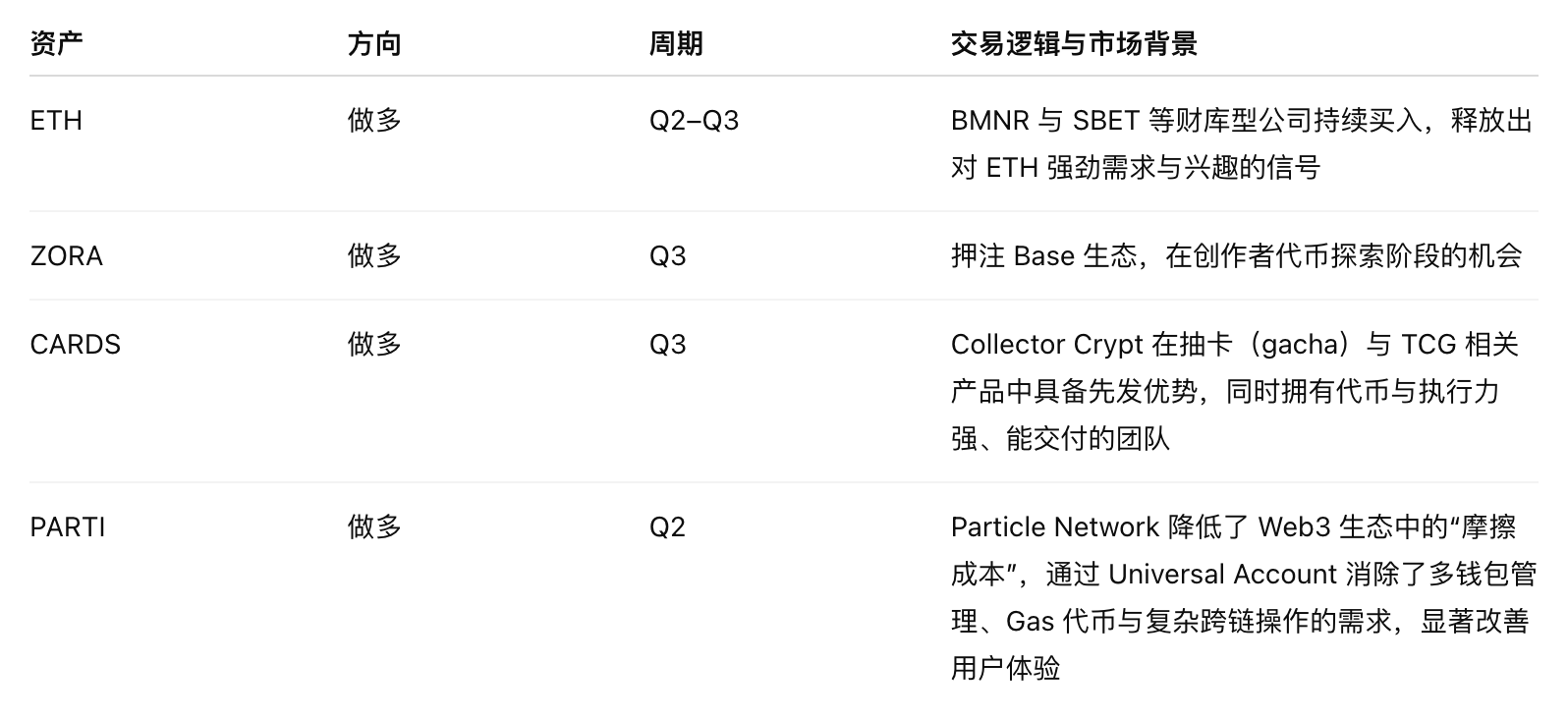
Trade Records
Our best trades in 2025 were as follows.
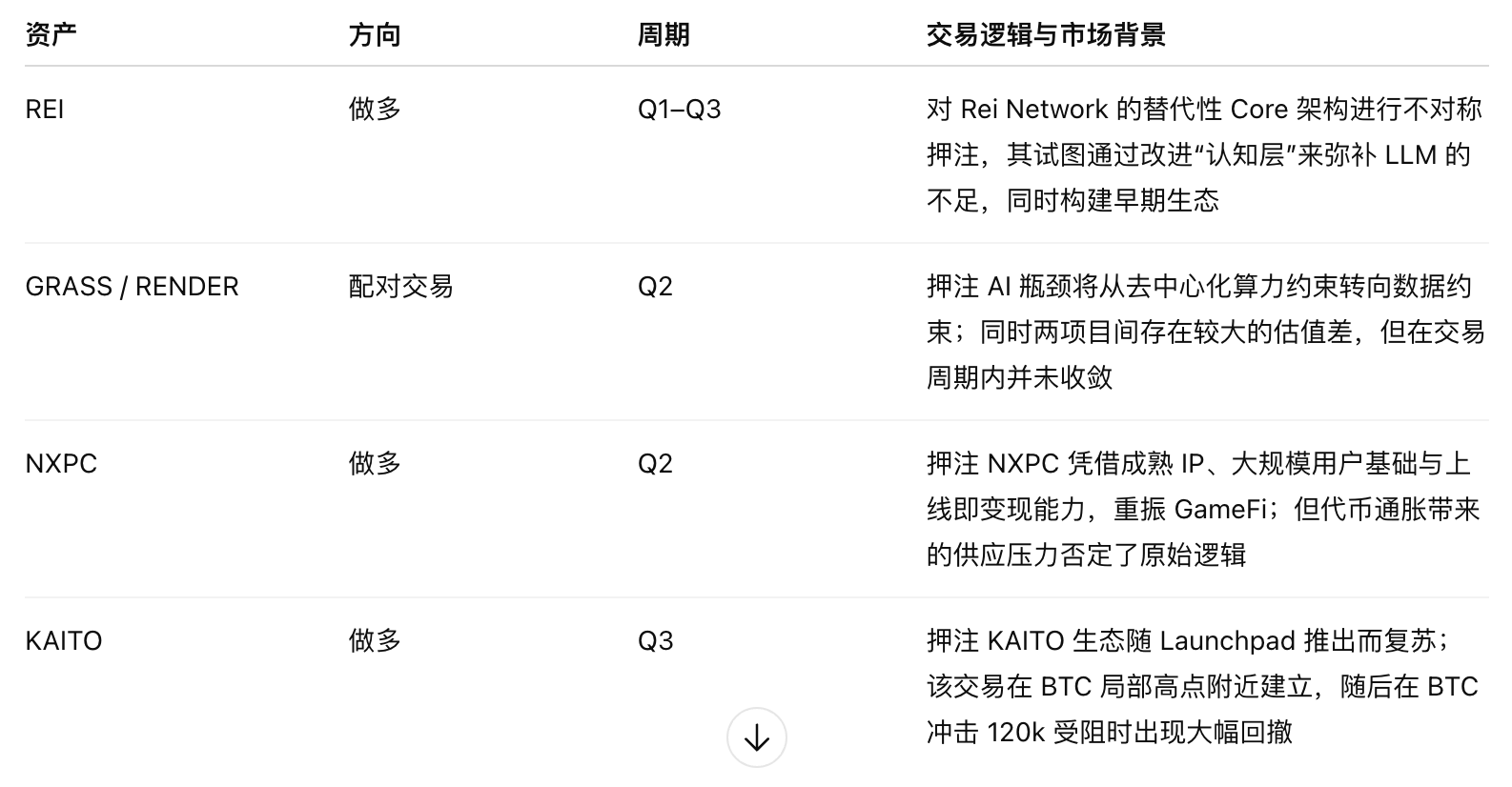
The worst trades were these.
2025 Market Review
The Clear Link Between Trump and the Crypto Market
Prior to the 2024 presidential election, the market widely anticipated that a Trump victory would be a major inflection point for cryptocurrency regulatory environment and valuation scale. Related expectations included:
- An end to "regulation by enforcement";
- Clear support for stablecoins;
- Exploring the establishment of a "Strategic Bitcoin Reserve";
- And the launch of Trump-related projects in September 2024, such as World Liberty Financial (WLFI);
These factors collectively made crypto assets one of the highest Beta expressions within the broader "Trump Trade," pricing immense policy optimism into the price before the election results were known.
However, post-election, this optimism began to recede, and the overall "Trump Trade" reversed. This phenomenon was evident not only in crypto assets but also in stocks highly correlated with Trump, such as DJT, whose stock price peaked before the election and then declined significantly. Although the post-election environment confirmed more crypto-friendly policy statements, the market faced inertia in legal and regulatory advancement, along with a series of scattered, incremental policy achievements, which were insufficient to offset the impact of overall de-risking on "Trump-concept assets."
Furthermore, Trump himself gained direct economic exposure to the cryptocurrency industry through his association with WLFI and the emergence of TRUMP. This intensified market concerns — crypto assets had become somewhat financialized around Trump's personal popularity, introducing a "perceived risk" — a decline in his political capital could directly translate into weaker prices for related assets.
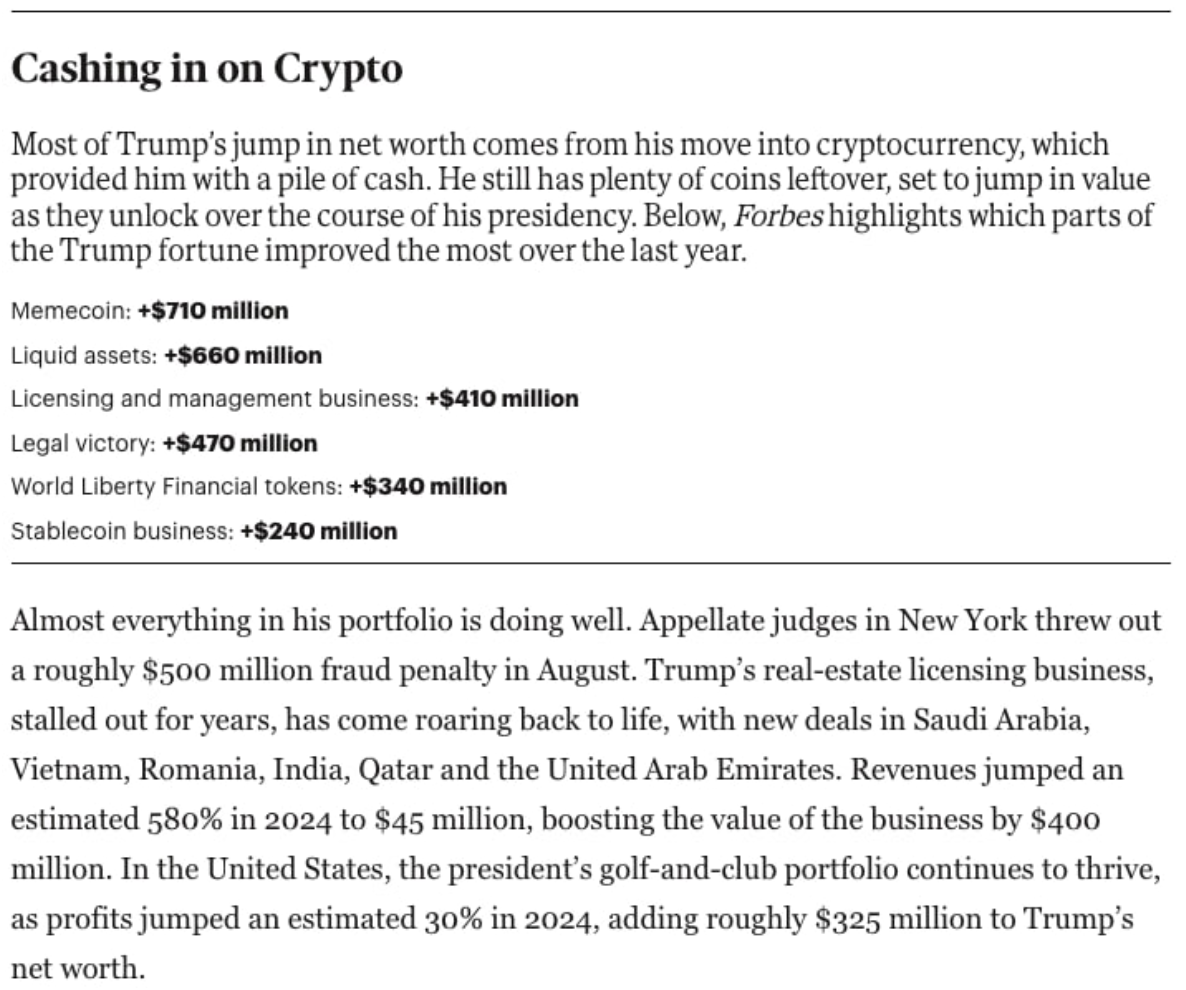
Odaily Note: Forbes reported that the presidency increased Trump's net worth by $3 billion in one year.
Although these concerns are not unfounded, they could be alleviated through the implementation of long-term policies or by reducing reliance on charisma-driven demand. Most notably, the "Executive Order on Expanding Access to Alternative Asset Investments" signed in August 2025 expanded the permission for 401(k) plan fiduciaries to include digital assets in their investment portfolios. Although the order did not mandate allocations, it effectively lowered the legal and reputational barriers for institutional participation, reshaping cryptocurrency from a speculative fringe asset to at least a permissible asset within long-term capital pools.
The true significance of this shift lies not in whether immediate large inflows occur, but in the change in market demand structure. With the potential inclusion of pension-related long-term capital, the crypto market began transitioning from a purely supply-driven halving cycle to a policy-modulated demand cycle, characterized by longer-term, stickier capital. Even marginal adoption on a scaled basis has the potential to raise the equilibrium price level and compress the downside volatility space compared to the 50–80% deep drawdowns seen in past cycles.
Narrowing Range of "Risk-On" Trades
The connotation of "risk-on" trades is becoming more complex. Unlike previous cycles where speculative capital flooded into Memes and long-tail assets during risk-on phases, the performance divergence among Beta assets in 2025 was exceptionally significant. This was particularly evident when Memes performed relatively flatly even as BTC hit a new all-time high in early October.
Instead, investors began concentrating capital allocation into a narrower subset of crypto assets, such as "stock-like assets" with crypto exposure (DATs, CEXs, and funds), prediction markets, or tokens with clear value capture mechanisms. This divergence reflects a maturing market structure: capital is becoming more selective and rapidly rotating, with fund flows becoming more short-term and narrative-driven. Investors chase local momentum, quickly harvest gains, and roll liquidity into the next narrative. In 2025, narrative cycles compressed, and trade durations became shorter than in previous cycles.
In this environment, the idea of holding altcoins long-term for massive returns has largely become a mirage. Apart from major tokens like BTC, ETH, and SOL, which benefit from institutional capital沉淀 (precipitation/settling), other tokens tend to appreciate only when compelling narratives are active. Once the narrative fades, liquidity dries up, and prices revert. The narrowed risk-on trading range hasn't extended the lifespan of altcoins; instead, it has accelerated the pace at which capital tests, squeezes, and abandons new narratives. This further reinforces the judgment that truly long-term crypto investment remains concentrated in a very few assets.
Expansion of Digital Asset Treasuries (DAT)
The rise of Digital Asset Treasuries (DATs) introduced a全新的 (brand new) capital formation mechanism designed to replicate MicroStrategy's successful path. DATs allow publicly traded companies to raise funds and directly allocate them to crypto assets, creating a built-in proxy for crypto exposure and bypassing regulatory gaps before altcoin ETFs are approved.
As these structures proliferated rapidly, the market also quickly showed signs of froth — numerous new vehicles争先恐后地 (scrambled) to package themselves as the "DAT" for some altcoin, even if the asset lacked real, sustained demand.
The capital structures adopted by many altcoin DATs can be classified as predatory. Specifically, these structures often employ financial engineering operations, such as contributing tokens in-kind in exchange for stock, aiming to introduce a new set of participants while creating exit liquidity; supplemented by private rounds with extremely low costs and very favorable lock-up conditions.
These mechanisms allow insiders to offload large quantities with extremely limited buy-side pressure, causing retail investors to have value extracted quickly in both the stock and token markets simultaneously. This scale mismatch was particularly evident in some aggressive DAT schemes — some companies attempted to raise funds far exceeding their own public market capitalization.
2026 Investment Themes
Conclusion One: Asymmetric Returns Will Appear at the Application Layer
The "monetary premium era" enjoyed by the new generation of alt-Layer1s is coming to an end. Historically, this premium was primarily supported by the "Fat Protocol Thesis" and "Moneyness" narratives — the belief that infrastructure would disproportionately capture value, and its tokens would eventually evolve into global stores of value.
However, the market has already consolidated this monetary function around mainstream assets like BTC, ETH, SOL, and stablecoins,彻底剥离 (completely stripping) the "moneyness" imagination space for new Layer1s.
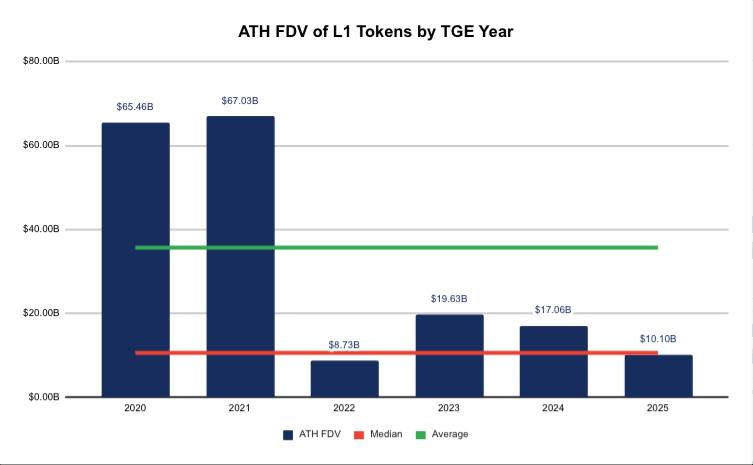
Odaily Note: Statistics on the All-Time High Fully Diluted Valuation (ATH FDV) of Layer1 tokens launched in each year.
With the disappearance of the "moneyness" moat, the social consensus that once赋予 (bestowed) new public chains with valuations of tens of billions of dollars is collapsing. Since 2020, the ATH FDV of alt-Layer1s has shown a clear structural downward trend, strongly indicating that the monetary premium is continuously fading.
Furthermore, the existing valuation "floor" is largely artificially created: in recent years, many Layer1s launched via fixed-price ICOs or directly on CEXs, with teams artificially setting initial prices. If these assets were forced to undergo genuine price discovery at launch, we believe their valuations would most likely not approach the historical averages of past cycles.
This valuation collapse trend is further amplified by the inertial advantages of existing公链 (public chains). Mature ecosystems already host a large number of "sticky applications" that lock in users, creating high entry barriers for new alt-Layer1s.
Data shows that since 2022, approximately 70–80% of DEX trading volume and TVL have consistently been concentrated on three chains. Among them, Ethereum always holds a seat, while the other two positions rotate between different cycles. For newcomers, breaking this oligopolistic structure is almost an uphill battle, and historical experience shows that most projects ultimately fail to secure a long-term seat.
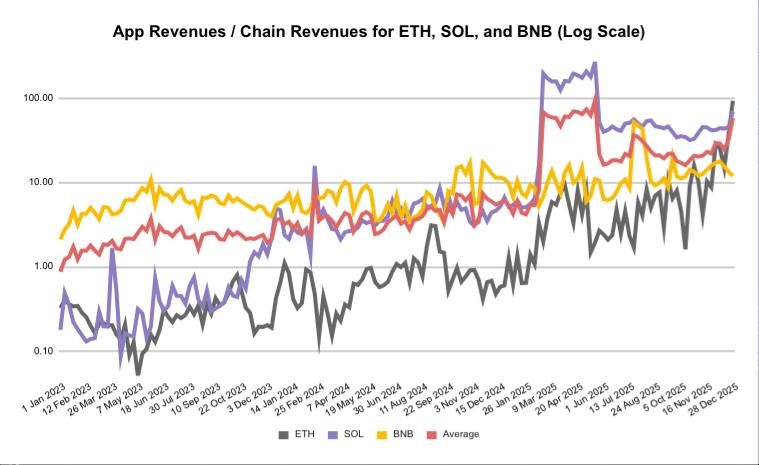
Odaily Note: Application revenue / Chain layer revenue comparison for ETH, SOL, and BNB.
We believe the revaluation of application tokens has already begun, driven primarily by the significant divergence in value capture capability between Layer1 tokens and the underlying applications. As shown above, application layer revenue and infrastructure revenue have明显脱钩 (clearly decoupled) over the past two years: application revenue growth in the ETH and SOL ecosystems reached 200–300 times.
Despite this, the market capitalization of applications remains only a fraction of the market cap of their underlying L1. As the market matures, we expect this mismatch to be corrected through capital rotation from overvalued infrastructure assets to applications with real revenue.
Conclusion Two: Midterm Elections Will Shape a High-Volatility Environment
The current policy focus of the Trump administration is clearly on ensuring victory in the 2026 midterm elections, with overall policy design leaning towards supporting short-term economic momentum. The "One Big Beautiful Bill Act (OBBBA)" stimulates demand through deficit financing, marginally increasing the probability of a reflation environment emerging. For digital assets, this fiscal expansion is beneficial for hard assets like Bitcoin, making them once again the ultimate "scarcity hedge."
Simultaneously, this fiscal expansion is also highly likely to encounter supply-side constraints in certain areas, such as grid capacity and manufacturing capacity. These bottlenecks will create inflationary pressures on input costs and wages in related industries, even if the aggregate level is still suppressed by structural deflationary forces like tariff normalization and AI productivity gains.
The resulting macro environment is characterized by — high nominal growth but simultaneously elevated volatility, with the market periodically repricing inflation risk. This tension will structurally push volatility higher. The market may swing repeatedly between "reflation optimism" and concerns about "resurgent inflation," especially as economic data gradually reveals capacity constraints rather than lack of demand.
Overlaying this macro background is the historical pattern that midterm election cycles历来 (traditionally) elevate political risk premiums — investors typically demand higher risk compensation before elections to cope with policy uncertainty. Supporting this landscape are clear political motives — tolerating, or even expanding, fiscal deficits during the midterm election cycle. Additionally, a more dovish Fed leadership would provide a looser liquidity environment for risk assets.
Although this combination implies higher volatility in the short term, from a long-term perspective, the impact of the OBBBA叠加 (coupled with) the continuous advancement of crypto-specific legislation still leads us to believe that 2026 will be a constructive year for digital assets, albeit with a bumpier path.
Conclusion Three: Increased Selectivity Shapes a K-Shaped, Differentiated Token Economy
The crypto market is moving past the stage of indiscriminate capital allocation and entering a brutal period of structural differentiation — a K-shaped economy dominated by selectivity. The era of a rising tide lifting all boats is over. The market has shifted from blindly chasing speculative narratives to paying more attention to real利益对齐 (interest alignment) between the protocol level and token holders.
The core of this shift is the market's comprehensive rejection of the "Equity-Token Split" model. This structure was initially designed to cope with regulatory pressure during the Gensler era, but its enforceability ambiguity始终是 (has always been) a huge hidden risk. In this model: insiders (team and VCs) hold the real value (IP, revenue, equity); retail investors receive only "governance tokens" without any enforceable rights.
This mismatch creates a two-tier system — insiders have the fundamentals, token holders have the sentiment. As the market struggles to distinguish the真实情况 (real situation) of different protocols, it ultimately chooses to discount the entire sector indiscriminately. Therefore, the current downturn is essentially a repricing of trust. Future winners will depend on their ability to demonstrate clear, enforceable, and durable value capture paths.
Under this new paradigm, the upper end of the "K-shape" (Upper K) will consist of teams that replace "trust me" with "verifiable." Here, credibility no longer comes from the founder's reputation or social capital, but from their willingness to actively impose structural constraints on themselves. These teams prove their ability to achieve value alignment by: making the value engine auditable; making the flow of revenue enforceable; actively剥离 (divesting) their ability to transfer value off-chain. This transparency will form the basis for token buy-side support — during downturns, sticky capital is willing to support its valuation because they trust the mechanism, not just the people.
Blockworks' Token Transparency dashboard is a good tool that categorizes protocols based on the level of information disclosure required by the framework.
Conversely, assets on the lower end of the "K-shape" are facing a liquidity crisis triggered by team credibility collapse. The market now views ambiguity as an admission of interest misalignment. If teams refuse to clarify the relationship between protocol revenue and the token, investors often assume that no such relationship exists. In the absence of the high-cost signal of "enforceable value capture," such tokens cannot be valued fundamentally, and when narratives recede, there are no natural buyers to provide a floor. Teams that require investors to rely on "good faith" or selective ambiguity about future promises are being systematically淘汰 (eliminated), destined to持续失血 (continuously bleed out) in competition with quality protocols.
Other Preliminary Judgments
The collectibles market will further expand — extending into sports memorabilia, especially items related to major historical moments with extremely high value. Example: Shohei Ohtani's 50/50 home run ball set a new record high at auction.
Prediction markets are expected to become the new Meta. Following the示范性效应 (demonstration effect) of Hyperliquid's TGE on the entire sector, the TGEs of Polymarket and Kalshi are expected to ignite the prediction market narrative.
Skepticism towards the "Equity-Token" dual structure will continue to intensify. More investors will demand clear, auditable explanations of value distribution, clarifying how economic value is divided between the equity structure and token holders; otherwise, they should move towards pure token structures.
The potential risk of DATs being excluded from the MSCI index (final decision time: January 15, 2026) is being closely watched by the market. Once this uncertainty is eliminated, it could trigger a new round of年初反弹行情 (New Year rally).
"Ownership Coins" will become the new normal, structurally reducing the risk of founders "slow rugging."
DApps with privacy capabilities will receive greater welcome from both retail and institutional investors. Protocols that can strike a balance between user experience and programmability while achieving high compliance will win the final victory in the privacy track.
Tokenized stocks will experience an accelerated "boom-bust" cycle, as their initial adoption scale is likely to remain limited.