Revealed: The "Super Small Shop" with Daily Revenue Over Ten Thousand? How NewOne Robot is Reconstructing the Coffee and Tea Beverage Business

marsbitОпубліковано о 2026-05-16Востаннє оновлено о 2026-05-16

Анотація

"New One Coffee," China's first robot-operated coffee and tea beverage shop, opened in Beijing, showcasing a highly automated "one person, one robot, one shop" model. This concept, powered by the fully integrated 'Robot in store' system, aims for ultimate staff efficiency, requiring only one employee per location. The store combines coffee, tea, and bakery items to drive all-day sales, overcoming the typical morning-only or afternoon-only traffic peaks of traditional cafes or tea shops. The business model focuses on super-compact stores (around 10 square meters) to minimize rental costs. Its robotic system, capable of handling numerous SKUs, uses big data for rapid, data-driven product development and selection. Furthermore, the automation frees up staff to focus on customer relationship and private community building. Targeting rapid national expansion, New One is offering a special rapid ROI partnership policy for its first 20 partners. This policy significantly lowers the initial investment barrier by waiving various traditional franchise fees, promising a lighter asset model and faster break-even period, supported by claimed high daily revenue potential.

One person and one set of robot integrated equipment can support a combined coffee and milk tea shop with daily revenue over ten thousand. This signifies that with collaborative robots and even humanoid robots entering the consumer sector, highly automated commercial terminals have become an industry norm within reach.

Are you still troubled by the high labor costs and difficult-to-standardize quality control in coffee shops?

Are you worried that your milk tea shop only has business in the afternoon, leaving the morning rent wasted?

Recently, the first robot coffee and milk tea combined store – NewOne Coffee – officially opened in Beijing's China World Center. With an impressive performance record, this shop offers a brand new solution for all small and micro entrepreneurs wanting to enter the tea and coffee market.

1

Aiming for Ultimate Human Efficiency:

Validating the "One Person, One Machine, One Store" Business Model

In today's climate of rising labor costs, traditional coffee shops often require at least 3-4 staff members on rotating shifts. NewOne Coffee boldly introduced the market's extremely rare "one person, one machine, one store" model.

What does this mean?

Each store only needs 1 staff member equipped with 1 self-developed robot application system.

This system is not a simple automatic tea maker, but a full-process smart integrated system called Robot in store, developed by the "Machine Stroll" team with over 85% experience from the internet industry. This system integrates robotic arms, coffee machines, milk tea machines, ice makers, cup dispensers, labeling machines, and other equipment. From ordering and payment processing to production, and even data analysis and marketing promotion, everything operates automatically.

What's the result? Data shows that on the opening day, some NewOne Coffee stores achieved a turnover close to 20,000 yuan, directly covering the entire month's rent, and this was accomplished without even launching delivery services.

2

The Super Smart Small Shop That Only Needs 10+ Square Meters

For investors struggling to find large storefronts, NewOne Coffee's site selection logic is highly attractive. Their site selection team primarily focuses on ultra-small shops around 10+ square meters, preferring areas like office buildings, street-side communities, and comprehensive commercial complexes. Besides Robot in store (Smart Store), NewOne Coffee also offers Robot in box (Unmanned Coffee Robot) and Robot in car (Trendy Street Food Truck) formats, featuring functional differentiation, full scenario coverage, and meeting the needs of different entrepreneurs and locations.
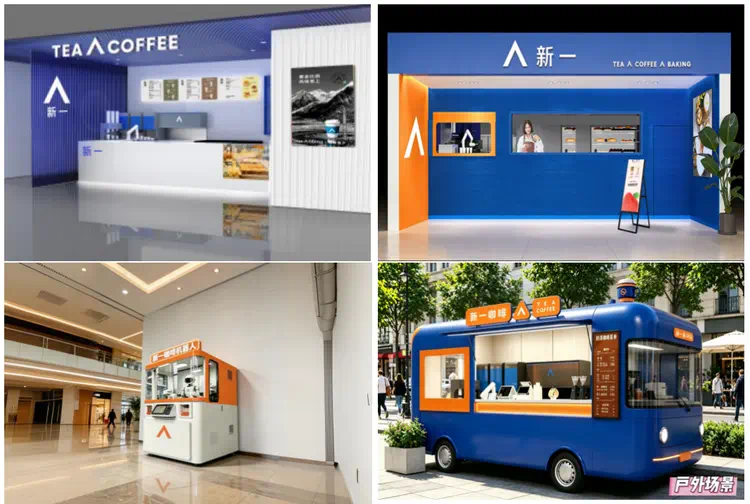
"As long as it can fit a set of robot systems, that's enough. We want to create the most ultimate small shop."

The extremely small area means extremely low rental pressure. Coupled with the high human efficiency of "human-machine collaboration," the store's risk resistance is greatly enhanced. In the previous trial operation shop in Wangjing, even facing away from the main road and being sandwiched by well-known major brands nearby, NewOne Coffee still achieved the excellent result of covering two days' rent with revenue.

3

A Hybrid Approach:

Make Your Store Earn Money from Morning to Night

Many coffee shop owners share a pain point: business concentrates in the morning. Meanwhile, milk tea shops and coffee shops do better business in the afternoon. NewOne Coffee's solution lies in being "hybrid."

Although its Chinese name is "NewOne Coffee," its English name is TEA^COFFEE^BAKING – with coffee and tea beverage SKUs basically balanced, and the product line combination of coffee + tea beverages + baking covers both breakfast and afternoon tea periods.

"Most coffee shop revenue is generated in the morning, and milk tea shop revenue is generated in the afternoon. We use a hybrid approach to maximize time utilization," the founder of NewOne explained.

This means you're not opening a simple coffee shop, but a super collection store covering all time periods and consumers across all age groups. Whether it's a latte with bread in the early morning or fruit tea in the afternoon, your store can meet the demand.

4

Embracing Big Data, Finding Popular Products from Popular Ones

For partners, the biggest concerns are slow product updates and excessive reliance on staff skills. NewOne Coffee's robot system can handle up to hundreds of SKUs, flexibly meeting different consumer taste preferences.

More noteworthy is its product selection logic. The team employs a big data-driven product selection model, featuring a dynamic global raw material insight system that continuously tracks market conditions and quality data from various producing regions. It uses a non-binding selection model, allowing quick switching to other high-quality regions if problems arise in a specific one. Through AI-powered second-level analysis of global online data, it accurately identifies trending elements. Robots standardize recipe execution, enabling agile development from selection to launch in just two weeks.

"In the past, Jinri Toutiao (Today's Headlines) said, 'What you want to see is the headline.' Here, 'What you want to eat is the signature.'" This means partners don't need to rack their brains developing new products; the system automatically helps filter the next potential hit.

5

Private Domain Accumulation:

Helping You Lock in Thousands of Customers Before Opening

In an era of increasingly expensive traffic, NewOne Coffee leverages its digital capabilities. Before the China World Center store even opened, it had already accumulated thousands of real customers in its private domain.

Because the system automates a large amount of order receiving and production work, staff can focus more energy on customer private domain operations. This means once you partner to open a store, you're not facing cold machines or frantic food prep. You only need to focus on one thing – making friends with customers and managing your community well.

"One person, one machine, one store" is the new quality productivity NewOne Coffee brings to the tea and coffee industry. We are looking for city partners who, like us, believe technology can change lives and are willing to embrace the future.

6

Rapid Payback Model, Empowering the First Batch of Joint-venture Entrepreneurs

To rapidly deploy nationwide and support the first batch of high-quality city partners, NewOne Robot has launched a rapid payback joint-venture policy, exclusive to the first 20 joint-venture partner stores, creating a new entrepreneurial model with ultra-low investment and ultra-fast payback in the industry.

Different from the traditional tea and coffee industry's high brand cooperation fees, management fees, training fees, and other multiple charges, this first batch of joint-venture clients can enjoy exclusive benefits with partial cooperation fees fully waived. Partners only need to bear the store security deposit, rent, basic equipment costs, and initial material costs to officially operate the store, with no hidden fees or extra brand premium costs.

This model fundamentally compresses initial investment costs, significantly lowering the entrepreneurial barrier. Traditional tea and coffee shops have high upfront investment and generally long payback periods. Relying on NewOne Coffee's advantages of high human efficiency, all-day profitability, automated operation, plus the exclusive joint-venture policy, partners' upfront investment is halved, cost recovery cycles are greatly shortened. Combined with the store's daily revenue capability of over ten thousand yuan, it truly enables lightweight asset entrepreneurship and rapid payback, thoroughly solving the core pain points of high investment risk and slow payback for small and micro entrepreneurs.

If you wish to own a robot-operated store with low investment cost, high human efficiency, a tech-savvy feel, and all-day profitability, you might want to learn more about NewOne Coffee's partnership policy.


Пов'язані питання

QWhat is the core business model innovation of the 'XinYi Coffee' robot store?

AThe core innovation is the 'one person, one machine, one store' model. This means each store operates with just one staff member supported by a fully integrated robotic application system called 'Robot in store,' which automates the entire process from ordering to drink preparation.

QHow does 'XinYi Coffee' address the issue of limited peak business hours common in traditional cafes and tea shops?

AIt employs a composite product strategy. The store offers a balanced mix of coffee, tea drinks, and baked goods. This combination attracts customers throughout the day, covering both morning coffee/breakfast and afternoon tea time, thus maximizing revenue across all business hours.

QWhat is a key advantage of the 'XinYi Coffee' system for franchisees regarding product development and selection?

AThe system uses big data and AI for dynamic product selection. It analyzes global trends and online data to identify popular elements and potential bestsellers. The robotic system can then standardize the execution of these new recipes, allowing for agile product development and updates within approximately two weeks.

QBesides reducing labor costs, what other operational benefit does the automation provide for store staff according to the article?

AAutomation frees up the single staff member from most order-taking and preparation tasks. This allows them to focus their energy on customer relationship management and private community (私域) operations, building loyalty and engaging with customers on a personal level even before the store officially opens.

QWhat is the primary financial incentive offered to the first 20 franchise partners under 'XinYi's' rapid return-on-investment policy?

AThe policy offers an ultra-low entry cost structure. For the first 20 partners, certain franchise fees are waived. Partners are mainly responsible for the store deposit, rent, basic equipment, and initial supplies, with no hidden costs or brand premium charges. This significantly lowers the initial investment and shortens the payback period.

Пов'язані матеріали

ETH Bull and Bear Views Compilation: Can Ethereum's Value Flow Back to ETH?

Titled "ETH Bull and Bear Views: Can Ethereum's Value Flow Back to ETH?", this article synthesizes the current heated debate around Ethereum's native token, ETH, following Bankless co-founder David Hoffman's decision to sell his entire ETH holdings. The **bullish case**, represented by figures like Tom Lee (BitMine CEO) and Raoul Pal, argues that ETH's core thesis remains intact. They contend Ethereum is the essential, secure, and neutral foundational layer for future finance—encompassing stablecoins, RWA, DeFi, L2s, and Agentic AI. Bulls bet on ETH's long-term revaluation as institutional adoption of on-chain finance grows, with significant buying activity from entities like BitMine and Consensys cited as evidence. Conversely, the **bearish perspective**, led by Hoffman and analysts like Markus Thielen, questions ETH's value capture mechanism. They acknowledge Ethereum's network success but argue that the value created by L2s, DeFi, and applications does not sufficiently accrue to the ETH token itself. Bears point to ETH's prolonged underperformance versus the broader crypto market, lack of traditional cash flows, weakening "ultrasound money" narrative, and apparent institutional retreat (e.g., Harvard Management Company exiting its ETH ETF position) as key concerns. The debate highlights a pivotal shift: ETH is no longer just a community belief asset. The central question is whether ETH can transition from being a "**used infrastructure**" to a "**continuously bought and held core asset**" as more value enters the Ethereum ecosystem. The market is now critically examining the direct link between network growth and ETH's value.

marsbit45 хв тому

ETH Bull and Bear Views Compilation: Can Ethereum's Value Flow Back to ETH?

marsbit45 хв тому

Crypto is dead, Perps are forever

The crypto industry is shifting from a focus on creating native assets (like altcoins and protocol tokens) to becoming a "global asset pipeline." Native cryptocurrencies, except for Bitcoin, are seen as failing in their value storage and utility promises, with demand driven largely by speculation. Attention and liquidity are now moving toward real-world assets (RWAs) like U.S. stocks, bonds, gold, and oil traded on-chain via perpetual contracts (Perps). Stablecoins like USDT and USDC set the precedent, proving blockchain's core strength is efficient global settlement and transfer, not inventing new monetary systems. Meanwhile, assets like Ethereum and many DeFi tokens struggle as their narratives weaken against tangible traditional assets and the rapid real-world progress of AI. Perpetual contracts have emerged as a pivotal innovation. They simplify trading by offering pure price exposure to any asset, bypassing complexities of ownership, custody, and traditional market hours. Projects like Hyperliquid gained traction by combining CEX-like efficiency with on-chain transparency, capitalizing on post-FTX distrust, macroeconomic volatility, and the surge in demand for 24/7 stock trading. In conclusion, while the era of speculative native "crypto assets" may be over, perpetual contracts persist as the industry's most potent financial instrument—transforming all assets into globally accessible, constantly tradable instruments centered on price speculation.

marsbit50 хв тому

Crypto is dead, Perps are forever

marsbit50 хв тому

Tencent, Alibaba, ByteDance in a Battle for the Skill Store

Skill is becoming a key concept in the AI field, essentially serving as a structured "instruction manual" for AI Agents that specifies tool calls, decision logic, and output standards. This allows Agents to execute predefined tasks. As the number of Skills grows, distribution platforms have emerged. Major tech companies are swiftly entering this space. In March, Tencent, Alibaba, and ByteDance launched Skill stores within their respective Agent platforms. Subsequently, players like Zhipu AI, Meituan, and Xiaohongshu joined the fray. This competition for the "Skill store" is fundamentally a battle for the AI-era user entry point; whoever controls distribution controls the users. While ByteDance's Coze has experimented with paid Skills, most platforms offer them for free. The real value lies not in the stores themselves but in using them to attract and retain users within an ecosystem, driving revenue from services like cloud computing, model calls, or advertising. The landscape features three main player types: 1) **Internet giants** (e.g., Alibaba, ByteDance, Tencent, Meituan), leveraging Skills to drive traffic and monetize through their broader ecosystems (cloud services, transactions, ads). 2) **Large model companies** (e.g., Zhipu AI, Moonshot AI), using Skill stores to increase user engagement and monetize model API calls. 3) **Content platforms** (e.g., Xiaohongshu), treating Skills as a new content format to generate traffic and ad revenue. However, transforming Skill stores into a sustainable business faces significant hurdles. Key challenges include: the **difficulty in pricing Skills** due to inconsistent outputs across different models and contexts; **lack of cost transparency** (varying token consumption); **security risks** like Skill poisoning; and the **absence of standardized protocols** for development and evaluation. Unlike standardized mobile apps, Skills are often personalized workflows resistant to uniformity, which hinders the establishment of a reliable review and monetization system akin to the App Store. While there is genuine user demand for paid Skills—particularly in enterprise (e.g., contract review) and certain personal productivity scenarios—current platforms offer developers limited and unpredictable distribution. The future of Skill stores depends on overcoming these standardization, evaluation, and safety challenges to make acquiring a Skill as straightforward as downloading an app. For now, the stores function more as display shelves than robust marketplaces.

marsbit50 хв тому

Tencent, Alibaba, ByteDance in a Battle for the Skill Store

marsbit50 хв тому

The Crypto Scene Is Dead, Perpetual Swaps Are Eternal

The crypto industry is undergoing a fundamental shift. The era defined by minting novel, native digital assets (altcoins) is fading. These assets, lacking real-world cash flows or clear value, are losing relevance as attention and capital flow elsewhere. Two powerful external forces are reshaping the space. First, traditional assets like U.S. stocks, bonds, gold, and oil are being tokenized and traded on-chain. Second, the explosive growth of AI, with its tangible products, has overshadowed crypto's once-dominant "future narrative." This marks a critical pivot: crypto is transitioning from being a "factory for new assets" to becoming a "global conduit for existing assets." Its validated utility is not complex financial reinvention but efficient global settlement, transfer, and trading—the original promise of blockchain. Stablecoins like USDT and USDC exemplify this, offering faster dollar movement rather than replacing it. Consequently, native ecosystems like Ethereum face profound challenges. While still crucial infrastructure, ETH struggles to capture value as users interact with Layer 2s or trade traditional assets without needing to hold it. DeFi's grand narrative of rebuilding finance has narrowed to core needs like cheap transfers and deep liquidity. The true breakout innovation is the perpetual contract (Perp). It brilliantly bypasses the complexities of direct asset ownership (custody, compliance, dividends) by creating pure price exposure. Users can speculate on the price movement of *any* asset—NVIDIA, gold, oil—24/7, globally, and with leverage. This "price casino" model, while risky and ethically fraught, delivers unmatched liquidity and accessibility. Projects like Hyperliquid succeeded not by inventing new mechanics but by perfecting the timing and execution of this model. Key drivers included making on-chain Perps feel like centralized exchanges, post-FTX trust migration towards transparency, and rising demand to trade macro assets and equities round-the-clock. In conclusion, the crypto world's most enduring successes are the dollar (via stablecoins), Bitcoin, and trading. Its new frontier is not creating alternative assets but providing a seamless, perpetual trading layer—a new API—for the world's existing financial system. The age of native altcoins is over; the age of perpetual synthetic exposure has begun.

Odaily星球日报59 хв тому

The Crypto Scene Is Dead, Perpetual Swaps Are Eternal

Odaily星球日报59 хв тому

Торгівля

Спот
Ф'ючерси

Популярні статті

Як купити ONE

Ласкаво просимо до HTX.com! Ми зробили покупку Harmony (ONE) простою та зручною. Дотримуйтесь нашої покрокової інструкції, щоб розпочати свою криптовалютну подорож.Крок 1: Створіть обліковий запис на HTXВикористовуйте свою електронну пошту або номер телефону, щоб зареєструвати обліковий запис на HTX безплатно. Пройдіть безпроблемну реєстрацію й отримайте доступ до всіх функцій.ЗареєструватисьКрок 2: Перейдіть до розділу Купити крипту і виберіть спосіб оплатиКредитна/дебетова картка: використовуйте вашу картку Visa або Mastercard, щоб миттєво купити Harmony (ONE).Баланс: використовуйте кошти з балансу вашого рахунку HTX для безперешкодної торгівлі.Треті особи: ми додали популярні способи оплати, такі як Google Pay та Apple Pay, щоб підвищити зручність.P2P: Торгуйте безпосередньо з іншими користувачами на HTX.Позабіржова торгівля (OTC): ми пропонуємо індивідуальні послуги та конкурентні обмінні курси для трейдерів.Крок 3: Зберігайте свої Harmony (ONE)Після придбання Harmony (ONE) збережіть його у своєму обліковому записі на HTX. Крім того, ви можете відправити його в інше місце за допомогою блокчейн-переказу або використовувати його для торгівлі іншими криптовалютами.Крок 4: Торгівля Harmony (ONE)Легко торгуйте Harmony (ONE) на спотовому ринку HTX. Просто увійдіть до свого облікового запису, виберіть торгову пару, укладайте угоди та спостерігайте за ними в режимі реального часу. Ми пропонуємо зручний досвід як для початківців, так і для досвідчених трейдерів.

346 переглядів усьогоОпубліковано 2024.12.12Оновлено 2026.06.02

Як купити ONE

Обговорення

Ласкаво просимо до спільноти HTX. Тут ви можете бути в курсі останніх подій розвитку платформи та отримати доступ до професійної ринкової інформації. Нижче представлені думки користувачів щодо ціни ONE (ONE).

活动图片












