Research: $35 Trillion in Annual Stablecoin Transaction Volume, How Much is Real Payment?

marsbitОпубліковано о 2026-04-07Востаннє оновлено о 2026-04-07

Анотація

A joint report by McKinsey and Artemis reveals that only about 1% of the annual $35 trillion stablecoin transaction volume represents real payments, totaling approximately $390 billion. Among these, 58% are B2B transactions—such as cross-border supplier settlements and financial operations—which grew by 733% year-over-year. Consumer usage, including card payments and remittances, remains negligible. The analysis identifies five structural reasons for this institutional dominance: 1) Greater financial efficiency gains for businesses compared to consumers; 2) Programmability benefits B2B workflows but lacks retail applications; 3) Regulatory frameworks favor institutional adoption; 4) Closed-loop B2B systems avoid the chicken-and-egg problem of consumer-merchant networks; 5) Corporate incentives prioritize internal efficiency over downstream consumer adoption. While B2B stablecoin payments are growing rapidly, consumer adoption may remain limited without breakthroughs in usability and regulatory clarity. The report suggests stablecoins may evolve primarily as an institutional settlement layer rather than a mainstream consumer payment tool.

Author: Stablecoin Insider / McKinsey×Artemis

Compiled by: Deep Tide TechFlow

Deep Tide Guide: The joint report by McKinsey and Artemis did something rarely done in the industry: it broke down the stablecoin transaction volume data. The conclusion: of the approximately $35 trillion in annual on-chain transaction volume, only about $390 billion (approximately 1%) represents real payment behavior, of which 58% is business-to-business financial operations, growing 733% year-on-year. Consumer-side stablecoin usage is almost negligible, and this is no coincidence—the article summarizes five structural reasons explaining why the gap between institutions and individuals is not just a temporary lag.

Full text as follows:

The stablecoin industry has a headline-level problem.

On one hand, raw on-chain data shows tens of trillions of dollars flowing on-chain annually, a figure that fuels endless comparisons with Visa and Mastercard, and predictions of SWIFT's imminent replacement.

On the other hand, a landmark report released by McKinsey & Company and Artemis Analytics in February 2026 stripped all this away and asked a more direct question: how much of this is real payment?

The answer is about 1%.

Of the approximately $35 trillion in annualized stablecoin transaction volume, only about $390 billion represents genuine end-user payments, such as supplier invoices, cross-border remittances, payroll disbursements, and card swipes. The rest is trading activity, internal fund shuffling, arbitrage behavior, and automated smart contract loops.
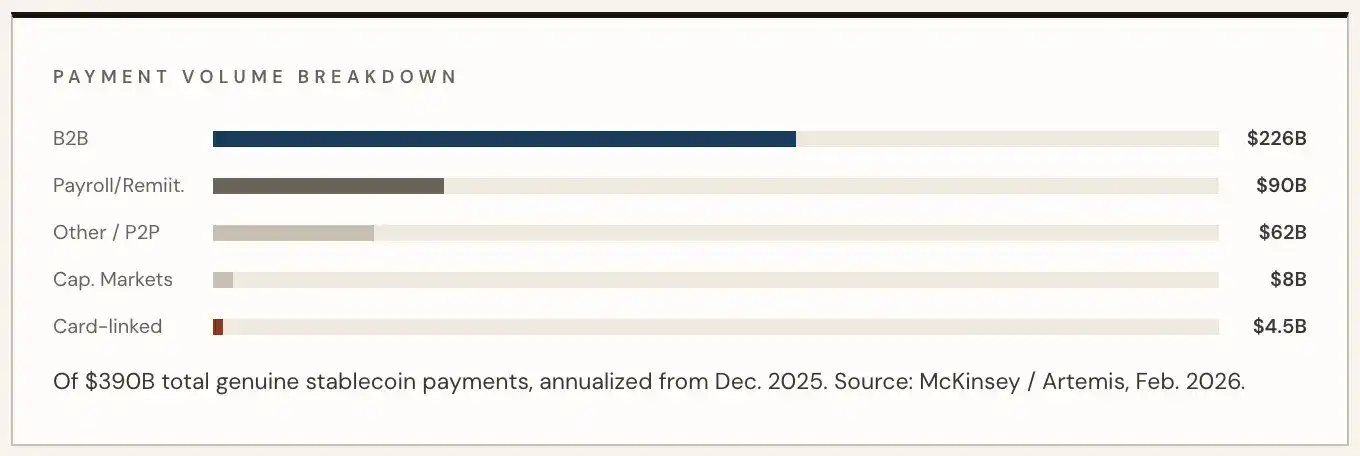
The report concluded that the inflated headline number should be "the starting point for analysis, not a proxy for measuring payment adoption."

But within this real $390 billion baseline, there is a story worth delving into, and it almost entirely revolves around corporate finance, not consumer wallets.

B2B Dominates: What the Data Actually Says

According to the McKinsey/Artemis analysis (based on activity data from December 2025), business-to-business transactions account for $226 billion of all real stablecoin payment volume, about 58%.

This figure represents a year-on-year growth of 733%, driven primarily by supply chain payments, cross-border supplier settlements, and financial liquidity management. Asia leads in geographical activity, but adoption is also accelerating in Latin America and Europe.

The remainder of the real payment space is distributed among payroll and remittances ($90 billion), capital market settlements ($8 billion), and linked card spending ($4.5 billion).

According to McKinsey, the amount spent on stablecoin-linked card swipes grew an impressive 673% year-on-year, but in absolute terms, it remains a small fraction of B2B流量.
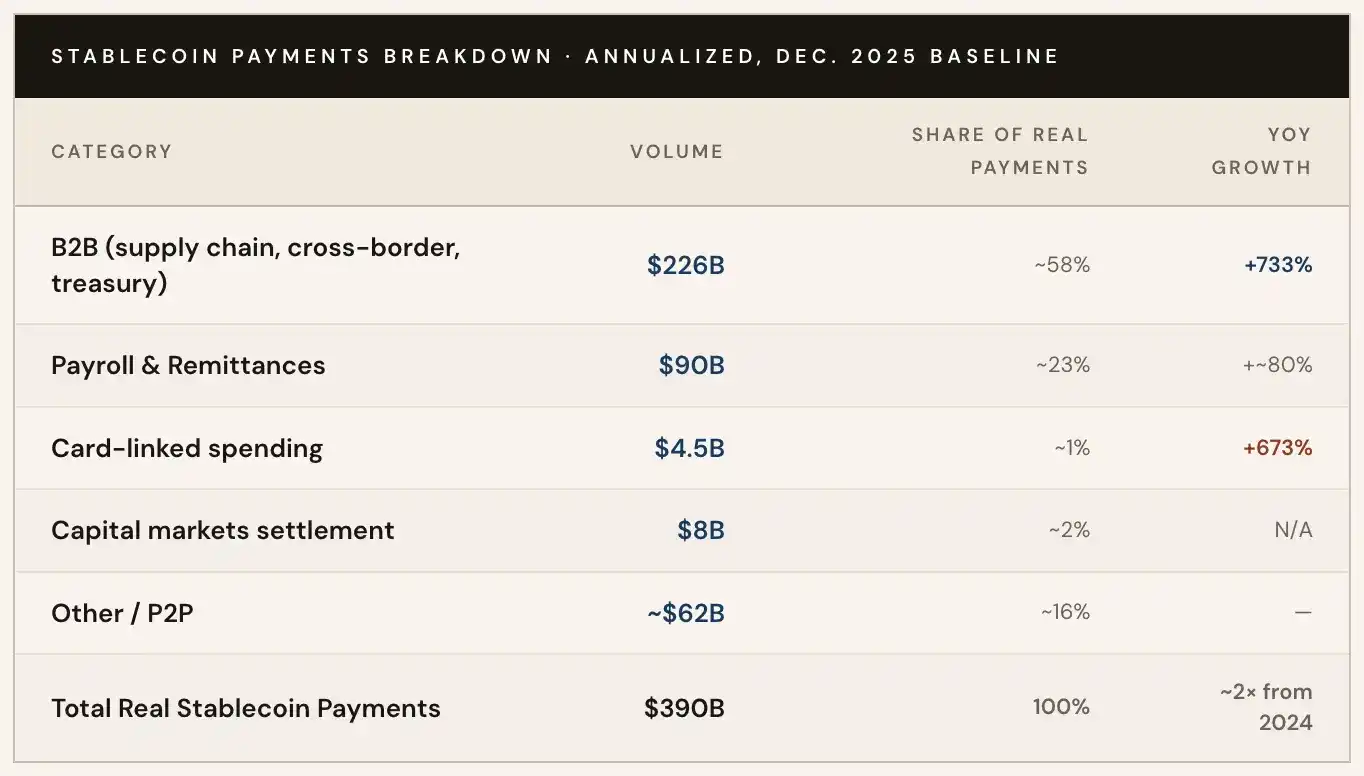
For reference: this total of $390 billion represents only 0.02% of McKinsey's estimated global annual payment volume of over $2 quadrillion. Specifically, B2B stablecoin flow accounts for about 0.01% of the global $160 trillion B2B payment market.

These numbers are large in the context of stablecoins, but still minuscule in the context of the global financial system.

Monthly run-rate data更直观地 shows where the momentum is. According to data cited by BVNK from the McKinsey/Artemis report, in January 2024, monthly stablecoin payment volume was only $5 billion; by early 2026, this figure had exceeded $30 billion—a six-fold increase in less than two years, with the steepest acceleration occurring in the second half of 2025.

Annualized, this run rate now exceeds $390 billion.

"The fact that real stablecoin payments are far lower than conventional estimates does not diminish the long-term potential of stablecoins as a payment rail; it simply establishes a clearer baseline for evaluating where the market stands." — McKinsey/Artemis Analytics, February 2026

Why the Gap Exists: Five Structural Forces Excluding Retail

The divergence between the explosive adoption in B2B and the negligible consumer usage is no coincidence, but the product of structural asymmetries that systematically favor enterprise use cases over retail ones.

Here are the five forces driving the institutional gap:

1) Financial Efficiency Beats Consumer Convenience

Corporate treasurers are driven by specific, quantifiable pain points: SWIFT correspondent banking chains that take one to five business days to settle, currency exchange windows that tie up working capital, and intermediary fees叠加 at every transaction point.

Stablecoins solve all three problems simultaneously. For a company paying suppliers in fifteen countries, the economic case is clear; for a consumer buying coffee, it is not. The incentive to switch is orders of magnitude greater on the enterprise side than for individual users.

2) Programmability Has No Equivalent Value on the Retail Side

The B2B explosion is partly a story of programmable payments. Smart contracts enable conditional logic—invoice triggering, delivery confirmation, escrow release—that can automate entire accounts payable processes at scale.

This naturally fits corporate financial operations, as high-value, structured, repetitive payment processes benefit immensely from automation. Retail payments lack similar trigger scenarios at any scale.

Consumers buying groceries don't need programmable conditions; they need something that works like swiping a card. The cognitive complexity of blockchain-native payments remains a barrier on the retail side, and programmability does nothing to help that.

3) Regulatory Architecture Favors Institutions

Post the GENIUS Act, institutional operators have adapted their compliance architecture for AML/CFT, Travel Rule, licensing requirements, etc., and have built legal infrastructure they can operate within confidently.

Corporate finance teams have dedicated compliance functions that can absorb onboarding friction; individual consumers cannot. The result is that, in most jurisdictions, on-ramps for stablecoins remain operationally complex for retail users, and the merchant acceptance gap persists globally.

Every frictionless B2B payment today is a data point institutions use to justify further investment; the consumer ecosystem, meanwhile, waits for a compliant, user-experience-smooth entry point that has not yet emerged at scale.

4) Closed-Loop Advantage

B2B stablecoin payments succeed precisely because they are closed-loop: business sends to business, both have wallets, both have compliance infrastructure, and neither needs a universal merchant network.

Consumer payments face the classic chicken-and-egg problem: merchants won't invest in stablecoin acceptance infrastructure until consumers demand it; consumers won't enable wallets until they can spend widely.

The institutional world completely bypasses this issue by operating in bilateral or consortium environments, without any open merchant network required.

5) Institutional Incentives Point Upstream

Corporate treasurers holding stablecoins gain access to yield, reduced FX exposure, and improved liquidity management—advantages that accrue internally, while sharing them downstream introduces complexity or competitive fragility.

Extending stablecoin usage to a supplier's suppliers, employees, or end consumers requires building a network that benefits those downstream parties, which is not necessarily where the originating finance team's收益 lies.

In the absence of a clear ROI driving network expansion outward, enterprises rationally choose to consolidate internal gains.

Market Context

BVNK's own infrastructure data corroborates the dominance of B2B from an operator's perspective. The company processed $30 billion in annualized stablecoin payment volume in 2025, a 2.3-fold year-on-year increase, with one-third of the volume coming from the US market.

Its client list (Worldpay, Deel, Flywire, Rapyd, Thunes) consists of leaders in cross-border B2B and payroll infrastructure, not consumer applications.

As BVNK stated in its 2025 year-end review:

"The initial assumption that remittances and consumer transfers would lead stablecoin growth did not materialize as the primary driver; B2B has instead assumed that role."

When Will Retail Catch Up—If Ever

The McKinsey/Artemis baseline makes the status quo清晰可辨. What it cannot answer is whether the institutional gap will narrow, widen, or become permanently entrenched.

Here are three possible scenarios for the next 18 months:

Near Term 2026—The Gap Widens Further

B2B momentum shows no signs of slowing. The monthly run rate of $30+ billion continues its trajectory as more enterprises adopt stablecoin rails for cross-border accounts payable and financial operations. Consumer stablecoin card spending grows slightly, but remains微不足道 in absolute terms compared to B2B flow. Even if retail adoption advances slowly in percentage terms, the gap widens in absolute dollar terms.

Medium Term Late 2026 to 2027—Inflection Points Begin to Appear

Several catalysts could begin to bridge the gap: bank-issued multi-currency stablecoins reduce retail on-ramp friction; programmable features extend to consumer applications via AI Agent payment delegation; gig economy wages paid in stablecoins create downstream spending balances for employees.

US Treasury Secretary Scott Bessent predicted that the stablecoin supply could reach $3 trillion by 2030, a trajectory that implies consumer network effects will eventually emerge.

Counter View—Retail May Never "Catch Up," and That Might Be the Point

The most honest reading of the McKinsey data is that stablecoins may be evolving into what the report faintly hints at: a programmable settlement layer on the internet for machines, finance departments, and institutions, with consumer adoption being an indirect, embedded benefit, not the primary use case.

If this framework holds, then the institutional gap is not a failure of adoption, but a feature of the technology's natural architecture. Corporate wages paid in stablecoins may eventually create downstream consumer spending, but the path from B2B infrastructure to retail wallets is long and迂回, and dependent on user experience breakthroughs that have not yet emerged at scale.

An Honest Baseline

The McKinsey/Artemis report did something more valuable than recording stablecoin growth: it established an honest baseline the industry has been明显缺失.

Stripping away the trading noise, internal shuffling, and automated smart contract loops reveals a genuinely growing payment market—real payment volume doubled from 2024 to 2025—but one that is highly concentrated on the institutional side in a structural, non-accidental way.

The 733% growth in B2B is not a deferred consumer story; it is a financial story coming of age.

The enterprises building on stablecoin rails today are solving real operational problems—cross-border friction, correspondent banking inefficiencies, working capital delays—problems that have nothing to do with whether consumers hold stablecoin wallets. They will continue to build regardless.


Пов'язані питання

QAccording to the McKinsey/Artemis report, what percentage of the $35 trillion annual stablecoin transaction volume represents real payments?

AApproximately 1% of the $35 trillion annual stablecoin transaction volume represents real payments, amounting to about $390 billion.

QWhich sector dominates the real stablecoin payment volume, and what is its annual growth rate?

AThe Business-to-Business (B2B) sector dominates the real stablecoin payment volume, accounting for 58% ($226 billion) of the total, with an annual growth rate of 733%.

QWhat are the five structural reasons cited in the article for the gap between institutional and consumer adoption of stablecoins for payments?

AThe five structural reasons are: 1) Financial efficiency beats consumer convenience, 2) Programmability has no equivalent value in retail, 3) Regulatory architecture favors institutions, 4) Closed-loop advantages, and 5) Institutional incentives point upstream.

QHow does the real stablecoin payment volume of $390 billion compare to the total global payment market?

AThe $390 billion in real stablecoin payments represents only 0.02% of the global annual payment market, which is estimated to be over $2 quadrillion.

QWhat does the article suggest might be a more honest interpretation of the stablecoin market's evolution, based on the McKinsey data?

AThe article suggests that stablecoins may be evolving into a programmable settlement layer for machines, finance departments, and institutions on the internet, with consumer adoption being an indirect, embedded benefit rather than the primary use case.

Пов'язані матеріали

The More It Rises, the More Dangerous? The Systemic Risks Behind SpaceX's Soaring Valuation

Summary: The article raises concerns about the systemic risks posed by SpaceX's skyrocketing valuation, arguing that modern market mechanics, rather than fundamentals, are driving its price discovery. Following SpaceX's market capitalization surpassing $3 trillion in after-hours trading, the author contends that the market is no longer functioning properly. The core issue is not SpaceX's business prospects but the unhealthy market structure surrounding it. With limited float and the imminent launch of options trading, the stage is set for a potential "gamma squeeze"—a feedback loop where market makers hedging call options are forced to buy shares, pushing the price higher and attracting more speculative momentum traders. This mechanism, seen previously with Tesla and meme stocks, can decouple valuation from financial reality. The danger escalates as extreme valuations force passive funds, ETFs, pensions, and major indices to hold the stock. If SpaceX grows large enough—hypothetically reaching $5 or even $10 trillion—its performance would increasingly dictate broader market indices, embedding systemic risk. The author warns that when price appreciation itself becomes the primary bullish thesis, the market transforms from a capital allocation mechanism into a self-reinforcing speculative machine, endangering the retirement savings of ordinary investors tied to passive strategies. The piece questions whether such a system can still perform its fundamental role of price discovery.

marsbit5 хв тому

The More It Rises, the More Dangerous? The Systemic Risks Behind SpaceX's Soaring Valuation

marsbit5 хв тому

How Much of the Subscription Fee You Pay to Claude Can Optical Module Companies Get?

How much of your $20 Claude Pro subscription actually goes to AI model companies like Anthropic? A viral breakdown image highlights the fundamental valuation challenge for AI applications versus traditional SaaS. Unlike SaaS with high software margins, AI subscriptions face variable "inference costs": every user query consumes GPU time, power, and cloud resources. This creates a tension between fixed subscription fees and usage-driven expenses. While the specific dollar splits are illustrative, the core question is whether AI revenue can achieve SaaS-like margins as usage scales. Currently, infrastructure providers (cloud platforms, GPU makers like Nvidia, HBM suppliers, power/data centers) capture more certain revenue from growing AI usage. Their financials reflect pricing power and faster earnings validation. The bullish case hinges on efficiency improvements: model optimization, caching, smaller models, and custom chips could lower per-token costs over time. The key debate is whether cost declines can outpace increases in user workload complexity and volume. Ultimately, for AI companies to command high SaaS-like valuations, they must demonstrate not just user growth but also improving gross margins after accounting for inference costs. Investors will scrutinize not just subscriber numbers, but usage patterns, enterprise pricing tiers, and real efficiency gains.

marsbit15 хв тому

How Much of the Subscription Fee You Pay to Claude Can Optical Module Companies Get?

marsbit15 хв тому

OpenAI's Hyperliquid Pre-IPO Pricing Venture: Why Did It Last Only Half a Year?

The article discusses the rise and fall of Pre-IPO pricing markets on the Hyperliquid blockchain. Trade.xyz, an anonymous team, successfully built the largest pre-market for SpaceX (SPCX) by launching a contract with a clear anchor: the eventual Nasdaq listing price. This provided inherent price stability and validation. In contrast, Ventuals, a team backed by Paradigm, failed despite holding exclusive contracts for highly sought-after companies like OpenAI and Anthropic. Its key mistake was its pricing mechanism. For companies with no near-term IPO date, Ventuals' oracle relied partly on opaque private market transactions and, critically, partly on its own contract's moving average price. This created a self-referential feedback loop where prices were artificially propped up and detached from genuine supply and demand, leading to illiquid markets. Ventuals shut down after nine months, settling positions at final prices of $1,341.80 for OpenAI and $1,618.90 for Anthropic. Ironically, some employees and late-stage investors of these very companies reportedly used these flawed Ventuals prices for valuation reference, highlighting the acute demand for any price signal in illiquid private markets. The article concludes that while demand for pre-IPO trading is real and growing, with players like Coinbase now entering the space, the fundamental challenge remains: without a public listing to provide a definitive price anchor, these markets struggle to establish truly accurate and liquid pricing. The need for a transparent, self-correcting market is the critical lesson from Ventuals' failure.

marsbit31 хв тому

OpenAI's Hyperliquid Pre-IPO Pricing Venture: Why Did It Last Only Half a Year?

marsbit31 хв тому

With Daily Active Users Reaching 3-4 Times That of the Industry's Second Place, Which Crack in the Office Agent Market Has Tencent's WorkBuddy Torn Open?

Tencent's AI office assistant, WorkBuddy, has achieved daily active users (DAU) 3-4 times that of the industry's second-place product, primarily driven by non-technical users like HR, operations, and administrative staff. Its rapid growth, starting with a public beta in March 2026, highlights a key strategic divergence from competitors like OpenAI's Codex and Anthropic's Claude Code. Unlike those tools, which originated as developer-focused assistants (in command lines or IDEs) and are now expanding towards office scenarios, WorkBuddy was built from the ground up for non-technical office workers. Its development was user-driven, initiated after腾讯云's team observed non-technical employees using their CodeBuddy coding tool for general tasks. WorkBuddy's design is defined by three core decisions aimed at lowering barriers: 1) Using natural language instead of technical concepts, so users describe their goal without needing to understand prompts or agents. 2) Providing pre-packaged "Skill" templates for common office tasks like data processing, content creation, and research. 3) Natively integrating into existing腾讯 ecosystems like腾讯 Docs and WeChat, making the agent a seamless part of the user's workflow rather than a separate tool. This "scenario encapsulation" approach, prioritizing the shortest path for users to get work done, contrasts with the "underlying capability" focus of Codex and Claude, which offer more flexibility but require more technical setup. Analysts confirm WorkBuddy's leading market position in China by mid-2026, with massive user and request growth following its launch. Recognizing the same trend of surging non-technical adoption, OpenAI and Anthropic are now pivoting their products with features like role-based plugins (Codex) and a simplified desktop interface (Claude Cowork). However, adapting tools built for developers requires significant changes to interaction models and integrations. WorkBuddy currently holds an estimated six-month lead in delivering a complete solution for non-technical office users. Its recently launched enterprise version aims to solidify this advantage. The competition underscores two valid paths: embedding agent capabilities directly into familiar work environments versus building powerful, general-purpose agents that users must learn to access. WorkBuddy's early success demonstrates the effectiveness of the former strategy for mainstream office adoption.

marsbit40 хв тому

With Daily Active Users Reaching 3-4 Times That of the Industry's Second Place, Which Crack in the Office Agent Market Has Tencent's WorkBuddy Torn Open?

marsbit40 хв тому

Торгівля

Спот
Ф'ючерси
活动图片




