Author:Rita
Trend Highlights
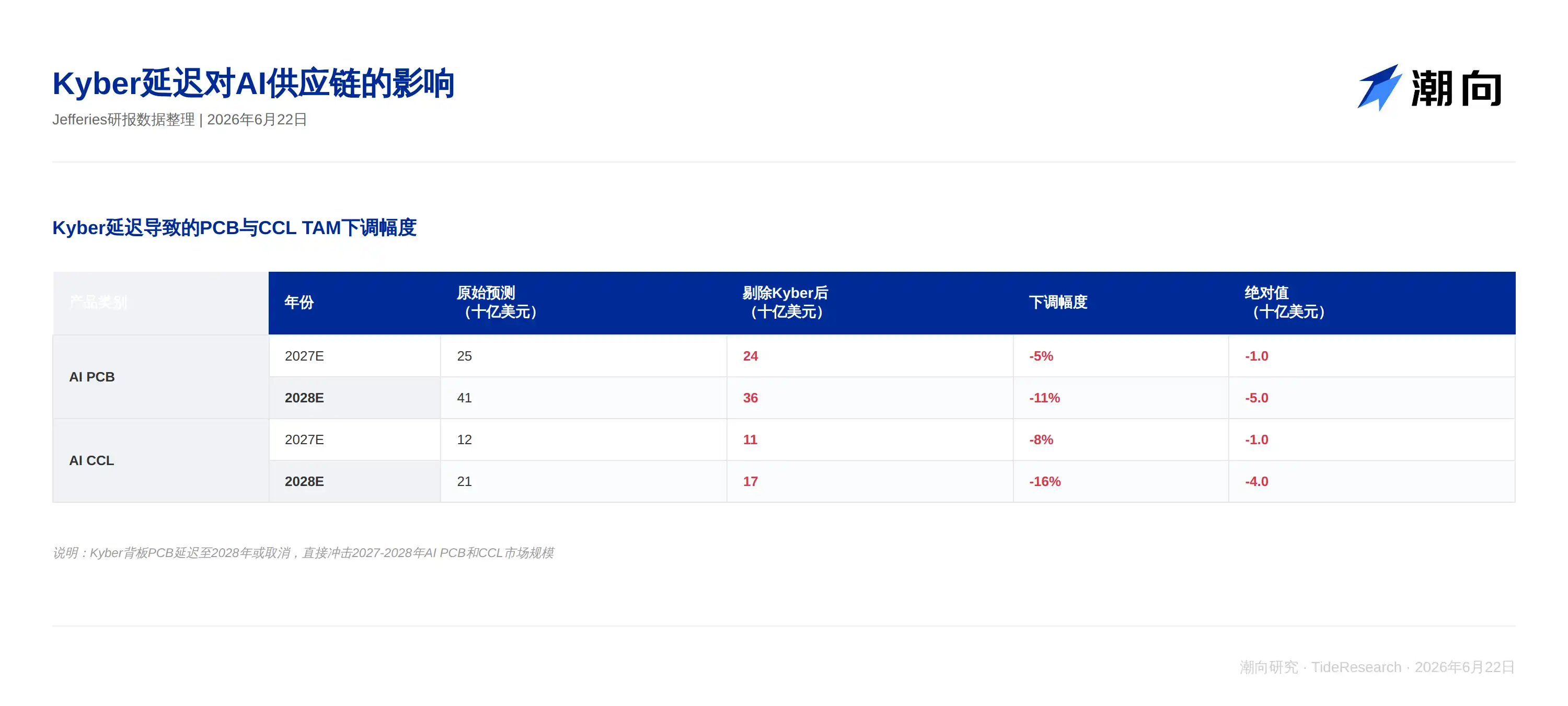
Jefferies issued a research report on NVIDIA on June 22, maintaining a Buy rating and raising the target price to $300 (implying a 42% upside from the current $210.69). The core view is surprising: while bullish on NVIDIA, it pours cold water on the AI server PCB supply chain. The backplane PCB product Kyber is highly likely to be delayed until 2028 or even canceled entirely, leading to a downward revision of the global AI PCB market size by 5% and 11% for 2027/2028 respectively, and the CCL (Copper Clad Laminate) market by 8% and 16% respectively. This adjustment might seem like bad news, but it is reshaping the list of winners in the AI server supply chain.
What the Kyber Delay Means
Jefferies believes the Kyber delay is essentially confirmed. Rubin Ultra was originally planned to use orthogonal backplane PCB (Kyber architecture), but due to bottlenecks in intra-rack connectivity technology, the Oberon architecture will still be used in 2027. Kyber is postponed to 2028 at the earliest, and could be canceled in the worst-case scenario. This change directly impacts the PCB iteration timeline.
However, delay does not mean regression. Switch boards and midplane boards continue to migrate towards high-end materials, with M9/10 grade CCL and PTFE processes becoming industry standards. CoWoP (Chip-on-Wafer-on-Substrate interconnect technology) penetration will begin earliest in 2027. The trend of rising unit value remains unchanged, only the timeframe has been extended.
Therefore, the biggest winners of this delay are not in manufacturing, but upstream. Upstream material suppliers like glass fiber cloth and CCL are already facing tight supply, with strong ability for sustained price increases and cost pass-through. PCB manufacturers face more direct pressure from order contraction. Copper cable suppliers benefit from the extended lifecycle of Oberon, reducing the risk of being replaced by PCB.
Why Focus on Specs, Not Just TAM
On the surface, the Kyber postponement led to significant downward revisions of the AI PCB and CCL market size estimates. But looking closely, this adjustment reflects a reshuffling of the pace of specification upgrades, not a disappearance of demand.
From the data, the original global AI PCB market expectation for 2027 was $25 billion; after excluding Kyber it's $24 billion, a 5% decrease. This is not a "shrinkage" but a "rescheduling." Kyber's order volume won't vanish; it will simply shift from 2027 to 2028. During this shift, the order volume left in 2027 will be used for Oberon upgrades, actually raising the specification standards.
This means the value per PCB doesn't change linearly. Lower-end products are revised down, higher-end products revised up. Within this mixed structure, there is room for total value recombination. Those who will profit are players positioned in high-end specifications and upstream materials, while manufacturers relying entirely on low-end capacity expansion will passively bear the pressure.
Supply Chain Divergence: Who's Out, Who's In the Inner Circle
The most direct impact of the Kyber delay is the acceleration of the elimination race in the PCB industry. Mid-tier manufacturers face the greatest pressure. High-end players have technical depth and customer stickiness, enabling them to follow NVIDIA's upgrade rhythm for spec iterations; low-end capacity has cost advantages, allowing them to quickly follow basic demand. But manufacturers stuck in the middle, unable to handle high-end complexity nor compete on cost, will be squeezed out.
Upstream material suppliers see structural opportunities. Glass fiber cloth and CCL suppliers face industry-wide demand. Kyber's cancellation won't reduce demand for glass fiber and CCL; it will only change the structure. The tight supply situation won't ease in the short term, with pricing power in the hands of material suppliers.
Copper cable suppliers gain a "reprieve" from the Kyber delay. Before Kyber's launch, copper cables faced the risk of gradual replacement by high-speed PCB interconnects. The extended lifecycle of the Oberon architecture means copper cables remain useful.
Why NVIDIA is Still Worth $300
Although Jefferies revised down the TAM expectations for PCB and CCL, it is not pessimistic about NVIDIA's prospects. The Kyber delay does not affect NVIDIA's core GPU competitiveness, nor does it change the growth trajectory of AI server shipments.
Kyber aims to further optimize rack efficiency in 2028 and beyond. Its delay means NVIDIA has one less innovation story for 2027, but it doesn't mean chip sales in 2027 will decline. Specification upgrades (M9/10, CoWoP) are still progressing as planned, and the unit value of AI servers continues to rise.
From a financial perspective, the CY28E NVIDIA EPS estimate is $14.14, leading to a $300 target price based on a 21x P/E ratio. This valuation level considers the certainty of long-term AI demand, not the timeline of a specific product generation.
What the Analysts are Betting On
Jefferies' final judgment points to: Upstream Materials > NVIDIA > Copper Cables > PCB Downstream.
They are bullish on the "high value-added end" and "supply bottleneck end" of the AI industry chain. GPU chips, as the core computing resource, have the highest value and most certain demand. Upstream materials are the bottleneck; scarcity determines premium. Copper cables get breathing room due to the delay. PCB manufacturing is most adversely affected because it is neither the bottleneck nor the core competency, just an executor.
This delay in PCB specification upgrades is not bad news, but a process of realignment. After the realignment, the profitability of players inside the inner circle and those positioned correctly will be higher, while those waiting on the sidelines will be left out.
Disclaimer
This article is a third-party brokerage research report summary and interpretation by Trend Research. The ratings, target prices, earnings forecasts, and related judgments cited are the views of that brokerage's analysts, representing only the position of their affiliated institution. They do not represent the views of Trend Research, nor constitute any investment advice.
Please note three points while reading: First, target prices are analysts' expectations for the next approximately 12 months, representing forecasts not promises, and are subject to frequent adjustments based on performance and market conditions. Second, sell-side research reports are inherently biased towards bullishness, and some covered companies may have investment banking relationships with the brokerage. Third, the value of a research report lies in its mainline logic and its underlying assumptions, not just a specific target price. Focus on the logic, not just the price.
The market carries risks; decisions should be made independently. This article should not serve as the basis for trading any securities.
Data Sources: Jefferies Research Report (Jacky He et al., June 22, 2026) · Prismark · NVIDIA Public Financial Reports
Tide Research · TideResearch · June 2026