Report Interpretation: J.P. Morgan Details Micron's Pre-Earnings Sentiment, Current Hardware Sector Dynamics

marsbitОпубліковано о 2026-06-22Востаннє оновлено о 2026-06-22

Анотація

Morgan Stanley analyst Joshua Meyers' report (June 21, 2026) highlights key trends in the hardware and semiconductor sector ahead of Micron's earnings. The core takeaways are: 1. **Micron & Memory:** Memory remains a high-conviction long theme, driven by strong AI demand and rising ASPs. However, investor focus is shifting to the sustainability of Micron's >80% gross margins and the specifics of potential new long-term supply agreements (SCAs). 2. **Hardware Supply Chain:** AI-related demand for servers, networking, and storage remains robust, but company performance is diverging. Celestica (CLS) shows improved margin confidence, Western Digital and Seagate benefit from pricing, Fabrinet (FN) sees predictable AI optics growth, and Teradyne (TER) anticipates a new Google customer. 3. **AI Capex & WFE Forecasts:** JPMorgan increased its Wafer Fab Equipment (WFE) market growth forecasts to 28% in 2026 and 29% in 2027. AI infrastructure financing is evolving, with higher project-level debt reducing constraints on capex expansion. The report signals that while the AI-driven hardware cycle is strong, the market is entering a phase focused on execution verification (e.g., Micron's SCA details, Fabrinet's ramp with Amazon) and valuation sustainability. Key near-term signals include Micron's guidance, Arista Networks' outlook, and the pace of demand normalization post potential tariff-related pull-ins.

Written by: TideResearch

Author: Rita

TideResearch Insights

J.P. Morgan expert Joshua Meyers released a report on June 21, synthesizing findings from a survey of buyer sentiment ahead of Micron's earnings, feedback from pre-earnings checks with hardware companies, updated AI capital expenditure forecasts, and key developments for several major companies. The core message conveyed in the report: The memory sector where Micron operates remains the most consensus-driven long position within the AI segment, but the sustainability of high gross margins and valuation methodologies are sparking discussion. Within the hardware supply chain, AI-related demand for servers, networking, and storage remains robust, but divergence is emerging among individual stocks. Suitable for investors tracking the U.S. stock hardware and semiconductor sectors.

Three Key Takeaways

1 Buyer sentiment remains strong ahead of Micron's earnings, but two issues are simmering.

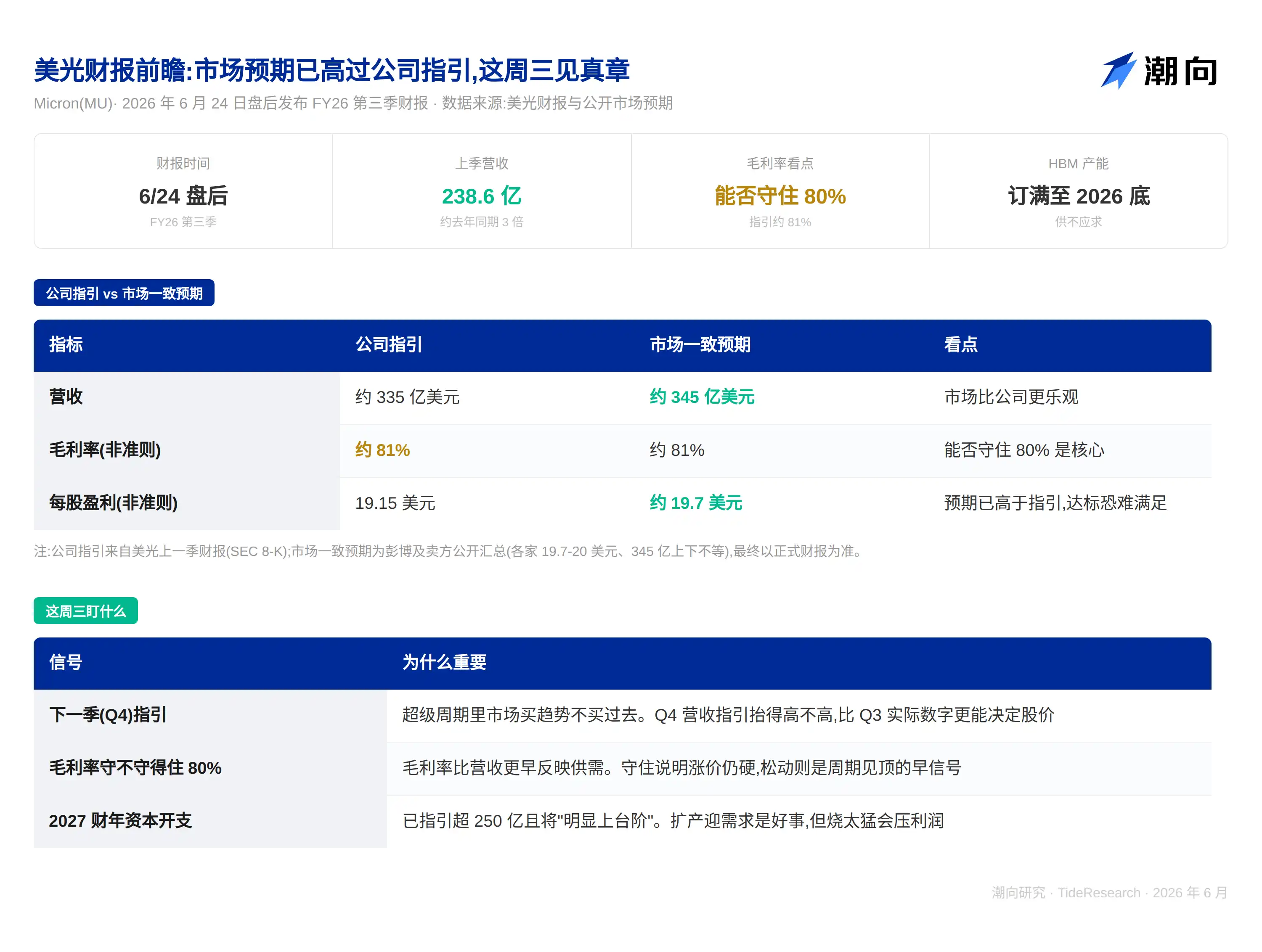
Meyers notes that memory is one of the most consensus-driven long positions in the tech sector and across the broader market. AI demand continues to improve, recently buoyed by unexpected growth in demand for agent CPUs, and the average selling price (ASP) has been ticking up with each industry survey. Demand has indeed been somewhat disrupted, but supply-side responses remain relatively measured. The market generally expects Micron to announce more Supply Commitment Agreements (SCAs) in this earnings report, with roughly 75% of surveyed buyers anticipating new contracts. The market's focus is on: Micron's gross margins have exceeded 80%, sparking debate; how the company views the room for AI applications to further drive ASPs; and the level of detail that can be disclosed regarding the specific terms of the long-term agreements.
2 Pre-earnings checks with the hardware supply chain: AI-related demand robust, clear stock divergence.

Meyers summarizes pre-quarter communications with hardware and networking equipment companies. Celestica's (CLS) margin outlook has improved, showing greater confidence in AI networking projects. Western Digital and Seagate benefit from continued pricing improvements, with no need to concede pricing during product generation transitions in a supply-constrained environment. Fabrinet's (FN) visibility on growth in its AI optical module business has increased, with Amazon-related products starting to contribute revenue this quarter and gradually ramping up. Teradyne's (TER) revenue is expected to decline sequentially in the second half of the year, but Google is likely to become a new VIP compute customer by year-end, representing a significant incremental contributor for the following year.

3 AI capital expenditure forecasts raised again, 2027 WFE market growth seen at 29%.

J.P. Morgan's global semiconductor team has raised its 2026 Wafer Fab Equipment (WFE) market growth forecast from 21% to 28% (equivalent to $155 billion) and its 2027 forecast from 18% to 29% (equivalent to $200 billion). DRAM, TSMC, Intel Foundry, and Samsung Foundry are the primary sources of the increase. The investment and financing model for AI infrastructure is also evolving, with the debt financing proportion at the project level having risen to over 85%. Considering that the market value of projects post-construction significantly exceeds their build cost, the actual loan-to-value (LTV) ratio is only about 60%, indicating that financing constraints on the expansion of AI capital expenditures are weakening.

The Supply Chain Signal Behind Celestica's Improving Margins

Among the pre-quarter communications with the hardware supply chain, Celestica's (CLS) feedback deserves special attention.

Meyers points out that Celestica had previously expressed concerns about Tomahawk (Broadcom switch chip) pricing, but its tone was noticeably more positive during this communication. The company is more confident in its ability to pass on costs through price increases and is also vying for more rack-based AI networking projects, which offer thicker margins. The market expects its FY26 operating margins to continue expanding, possibly by 10 to 20 basis points. The outlook for FY27 is even more optimistic, with the potential for stable margins combined with operating leverage to prompt more positive guidance in the next earnings report.

Regarding AI chip supply, Celestica works with both Broadcom and MediaTek, and its confidence in the supply chain is markedly stronger than that of Arista Networks, as hyperscale customers are receiving higher supply priority. This signal suggests that demand dynamics for AI networking equipment are still consolidating around leading suppliers, with supply chain allocation capabilities becoming a competitive moat.

Short-Term Focus on Earnings Validation, Long-Term Focus on Valuation Anchors

Micron's earnings report is the most immediate catalyst. Market consensus has largely priced in a strong quarter. The real variable lies in the level of detail provided about long-term agreement disclosures. If the coverage ratio of SCAs allows the market to gain clarity on future revenue visibility, Micron's valuation logic could undergo further reshaping.

Another key variable for the hardware sector is the pace of demand. Distributors like CDW report that a significant portion of the current robust demand for servers and networking equipment stems from customers placing advance orders due to concerns about potential further tariff hikes. How long this pull-forward demand can persist is the biggest uncertainty for the hardware sector in the second half of the year.

Three Signals to Track:

The level of detail in Micron's SCA disclosures and its gross margin outlook. Whether Arista Networks can raise its full-year guidance in its next earnings report. Whether Fabrinet's Amazon optical module revenue can ramp up as expected to $250 million per quarter within a year.

Disclaimer

This article is TideResearch's compilation and interpretation of a third-party brokerage research report. The ratings, price targets, earnings forecasts, and related judgments cited herein represent the views of that brokerage's analyst, reflecting solely the position of their affiliated institution. They do not represent TideResearch's views and do not constitute any investment advice.

Please note three points while reading: First, price targets are analysts' expectations for approximately the next 12 months; they are predictions, not promises, and will be adjusted repeatedly based on performance and market conditions. Second, sell-side research reports inherently lean bullish, and some covered companies may have investment banking relationships with the brokerage. Third, the value of a research report lies in its core logic and underlying assumptions, not solely in a specific price target. Focus on the logic, not just the price.

The market carries risks; decisions should be made independently. This article should not be used as the basis for trading any securities.

Data source: J.P. Morgan Research Report (Joshua Meyers et al., June 21, 2026) · Company public disclosures

TideResearch · June 2026

Пов'язані питання

QWhat are the three key conclusions from J.P. Morgan's report regarding Micron and the hardware sector?

A1. Strong bullish sentiment on Micron ahead of earnings, but questions are emerging about the sustainability of high gross margins (over 80%) and the details of potential long-term agreements (SCAs). 2. AI-related demand in the hardware supply chain remains robust, but performance is diverging among individual companies (e.g., Celestica, Western Digital, Seagate, Fabrinet, Teradyne). 3. AI capital expenditure forecasts have been raised again, with the wafer fabrication equipment (WFE) market expected to grow 28% in 2026 and 29% in 2027. The financing model for AI infrastructure is also evolving, easing constraints on capex expansion.

QWhat signals regarding the AI hardware supply chain can be drawn from Celestica's (CLS) improved margin outlook?

ACelestica's improved confidence in passing on costs (like Tomahawk chip pricing) and securing more rack-based AI networking projects (which offer better margins) signals a strengthening position for leading suppliers. Their stronger supply chain confidence compared to Arista Networks also suggests that supply allocation capabilities are becoming a competitive moat, with hyperscale customers getting priority.

QWhat is a key uncertainty for the hardware sector in the second half of the year, according to the report?

AA key uncertainty is the duration of the current strong demand for servers and networking equipment. Distributor feedback (e.g., from CDW) indicates that a significant portion of this demand is due to customers placing orders early to avoid potential tariff-related price increases. How long this front-loaded demand can last is the sector's biggest uncertainty for H2.

QWhat are the three specific signals the report suggests investors should track?

A1. The level of detail disclosed in Micron's earnings regarding its long-term agreements (SCAs) and its gross margin outlook. 2. Whether Arista Networks can raise its full-year guidance in its next earnings report. 3. Whether Fabrinet's revenue from Amazon optical modules can ramp up as expected to $250 million per quarter within a year.

QAccording to the report, what is the primary catalyst for Micron and what could reshape its valuation logic?

AMicron's upcoming earnings report is the most immediate catalyst. The key variable is the detailed disclosure of its long-term supply and capacity agreements (SCAs). If the coverage and terms of these SCAs provide clear visibility into future revenue, it could significantly reshape Micron's valuation logic by offering more predictable, contracted income streams.

Пов'язані матеріали

Blood Loss of $55 Million Selling 3,588 BTC, Strategy Becomes a Literal Scumbag

On July 6th, Strategy (formerly MicroStrategy) disclosed in an SEC filing that it sold 3,588 Bitcoin (BTC) between June 29th and July 5th for approximately $216 million, at an average price of ~$60,200. This marked the company's largest net sale since initiating its Bitcoin strategy in 2020 and its first institutionalized reduction of its core holding. The sale resulted in a realized loss of about $54.8 million, as the selling price was below its average cost basis of ~$75,476 per BTC. The proceeds were used to pay preferred stock dividends and replenish USD reserves. This move follows a new "Digital Credit Capital Framework" approved on June 29th, authorizing the sale of up to $1.25 billion in Bitcoin. The sale consumes roughly 17% of this authorized amount in its first week. Strategy's foundational narrative, built by founder Michael Saylor, was a commitment to "never sell" Bitcoin. The recent institutionalized selling framework and these substantial sales represent a significant shift from that original promise. While the amount sold is only 0.4% of Strategy's total holdings of 843,775 BTC, the action challenges the premium at which its stock (MSTR) trades relative to its Bitcoin holdings. Investors had priced in the "never sell" narrative. The company now faces a contradiction: it sells Bitcoin at a loss to pay dividends on the preferred stock it issued to fund Bitcoin purchases. Saylor has framed selling as a tool for future strategic purchases, but each sale erodes the credibility of the original commitment, potentially threatening the premium valuation of MSTR shares.

Foresight News55 хв тому

Blood Loss of $55 Million Selling 3,588 BTC, Strategy Becomes a Literal Scumbag

Foresight News55 хв тому

JP Morgan Tokenized Fund Surges 250% in TVL in One Month, Institutional Funds Are Treating Ethereum as the Default Underlying Layer

JPMorgan's tokenized money market fund, JLTXX, has seen its on-chain total value locked (TVL) surge approximately 250% in a month, reaching nearly $700 million from an initial $200 million since its launch seven weeks ago. The fund, which invests in short-term U.S. Treasuries and repos, operates exclusively on the public Ethereum mainnet, signaling growing institutional acceptance of Ethereum as a foundational layer for compliant financial products. A key driver of this growth is its inclusion as reserve assets for stablecoins like USDG, meeting requirements under U.S. stablecoin legislation. Simultaneously, despite a significant price decline—ETH has fallen over 50% from its 2025 high—institutional accumulation continues. BitMine Immersion Technologies, led by Tom Lee, purchased an additional $73 million worth of ETH last week, bringing its holdings to roughly 4.8% of Ethereum's circulating supply. The article highlights a divergence: while the tokenization of real-world assets and stablecoin reserves is driving long-term institutional adoption of Ethereum's infrastructure, short-term price action remains pressured by market sentiment and ETF outflows. This suggests that institutional on-chain activity, though a positive fundamental development, may not serve as a reliable signal for near-term price bottoms.

marsbit59 хв тому

JP Morgan Tokenized Fund Surges 250% in TVL in One Month, Institutional Funds Are Treating Ethereum as the Default Underlying Layer

marsbit59 хв тому

Dialogue with Yihui Capital, SoundAI Technology, Ling Universe, and Zhongbo Jili: Opportunities and Challenges in the AI Smart Hardware Track

On June 28, 2026, an event titled "New Opportunities in AI Hardware: The Battle for Interactive Entry Points Begins" was held in Beijing. It featured a report from ITJuzi and discussions with experts from SoundAI, Ling Universe, One Reed Capital, and Zhongbo Juli on the opportunities and challenges in China's AI hardware sector. Key report findings highlight the sector's intense activity: 327 out of 431 startups founded post-2023 have secured funding, with 179 investments in H1 2026 alone. The landscape is dominated by embodied intelligent robots, while wearable tech like smart rings and AI glasses shows rapid growth. Geographically, Shenzhen leads, leveraging its superior hardware supply chain, followed by Beijing and Shanghai. The overarching trend is for companies to focus on micro-innovations within specific scenarios rather than reinventing foundational technology. Industry leaders shared several critical insights: 1. **Balancing Innovation & Market Readiness**: Entrepreneurs face the "hammer looking for a nail" dilemma. Success requires balancing technical capability with user acceptance, cost control, and incremental design improvements rather than chasing disruptive innovation. 2. **Competitive Landscape**: The future interactive entry point may not be a single super-device but a mix of universal terminals and specialized, scenario-specific hardware. While large companies have ecosystem advantages, startups can win by deeply targeting vertical markets and specific user groups. 3. **Core Challenges & Business Models**: Key hurdles include deep understanding of AI models and navigating non-transparent hardware supply chains. Viable business models may involve selling hardware at cost and generating revenue through software subscriptions, but this requires tight control over both hardware BOM and model inference costs. 4. **The Road to Commercialization**: The ultimate test is market validation—achieving sales growth and sustainable cash flow. Companies must find the right application scenario, use edge computing effectively, and close the loop from technology to commercial success. 5. **The Future of Interaction**: Proactive, context-aware interaction is the next frontier, though it's currently limited by issues like model hallucinations and environmental perception. The near-term focus should be on identifying target users and creating a coherent experience in specific domains, such as health wearables. In summary, to succeed in the competitive AI hardware arena, companies must strategically choose their niche, build a team with the right geographical advantages (e.g., leveraging Shenzhen's supply chain), and most importantly, execute a flawless commercialization strategy that translates technology into market-accepted products and sustainable business growth.

marsbit1 год тому

Dialogue with Yihui Capital, SoundAI Technology, Ling Universe, and Zhongbo Jili: Opportunities and Challenges in the AI Smart Hardware Track

marsbit1 год тому

Торгівля

Спот
活动图片