Redemption Wave Meets Credit Withdrawal Wave, US Private Credit Industry Faces 'Run Storm'

marsbitОпубліковано о 2026-03-12Востаннє оновлено о 2026-03-12

Анотація

US private credit industry faces a liquidity crisis as investor redemptions surge and major banks tighten financing. Cliffwater and Morgan Stanley restricted withdrawals from multi-billion-dollar funds after redemption requests spiked to 14% and 10.9% of assets respectively in Q1, forcing partial payouts to avoid fire sales of illiquid assets. Simultaneously, JPMorgan reduced collateral values for software-sector loans in fund portfolios, curtailing future leverage availability. The squeeze stems from a net asset value (NAV) arbitrage dynamic: while public market software assets plummeted, private credit valuations remained inflated, prompting investors to redeem at above-market prices. This triggered a bank-run-like cycle where remaining investors face diluted values. Apollo plans to boost transparency with monthly NAV reporting. The $1.8 trillion industry, which expanded rapidly during the pandemic using bank leverage, now confronts underlying assets originated at peak valuations. Despite claims of continued software sector growth, pressure mounts as institutions reassess liquidity risks and valuation opacity.

Original Author: Ye Zhen

Original Source: Wall Street News

The US private credit industry is facing a dual squeeze of liquidity contraction and asset revaluation. As investors rush to withdraw funds and major Wall Street financial institutions reduce credit lines, this massive market worth $1.8 trillion is teetering.

According to the Financial Times, private credit giants Cliffwater and Morgan Stanley have recently imposed redemption restrictions on their multi-billion-dollar funds. In the first quarter, these semi-liquid funds faced a surge in withdrawal requests, with the scale of outflows forcing management to trigger "gates" to avoid fire sales of underlying illiquid assets.

While the funding side is under pressure, private credit institutions are also facing tightening from large banks on the financing side. JPMorgan Chase recently notified relevant institutions that it has downgraded the collateral value of some software-related loans in their portfolios. Although this move did not immediately trigger margin calls, it directly reduced the future financing scale available to the relevant funds, marking a comprehensive reassessment of risk exposure in this sector by the traditional banking system.

The core of this two-way squeeze lies in the net asset value (NAV) arbitrage logic. As the value of related assets in public markets plummeted, private credit institutions failed to synchronously mark down their holdings, prompting investors to rush to cash out at the book value, which is higher than the market fair value. This chain reaction, similar to a bank run, not only intensifies the liquidity pressure on funds but also forces the market to re-examine the true pricing of private credit assets.
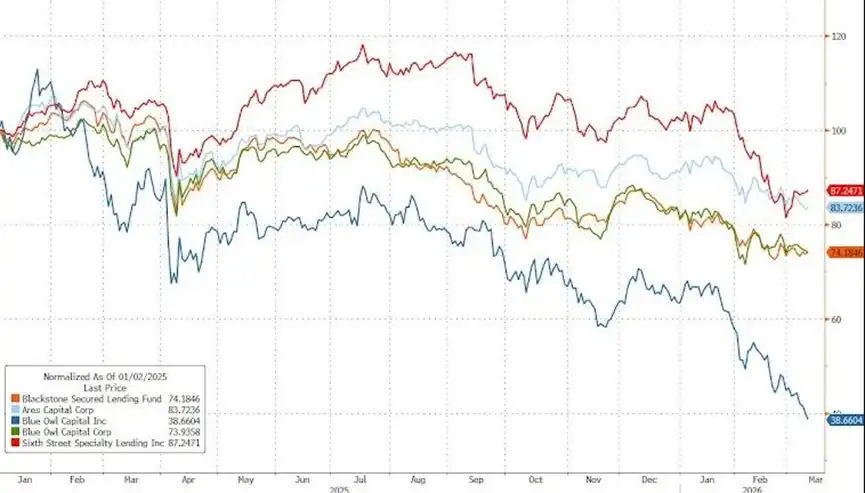
(Private credit company stock prices continue to decline)

Redemption Wave Spreads, Semi-Liquid Funds Face Major Test

According to the Financial Times, Cliffwater restricted redemptions from its $33 billion flagship fund (CCLFX) in the first quarter. The fund received redemption requests accounting for 14% of its total shares, ultimately approving only about half and repurchasing 7% of the shares.

Just hours after Cliffwater took action, Morgan Stanley also notified investors in its $7.6 billion North Haven Private Income Fund that it would limit withdrawals. The fund saw redemption requests jump to 10.9% in the first quarter, ultimately fulfilling only 45.8% of those shares.

This trend has been spreading across the industry in recent months. HPS recently set a 5% redemption cap for its flagship fund targeting high-net-worth clients. Blackstone's Bcred fund fully paid out after redemption requests reached 7.9% of net asset value, while Blue Owl and Ares previously also met high redemption requests, although Blue Owl has imposed a permanent redemption restriction on another fund this year.

Cliffwater raised $16.5 billion last year, expanding at a pace on par with industry giant KKR. However, this model, which relies on independent brokers to manage retail funds, makes it more vulnerable to market sentiment fluctuations.

To address the situation, the report stated that Cliffwater is raising $1 billion by selling loan portfolios and expects to attract $3 billion in new commitments this quarter to offset outflows. The company emphasized in a letter to investors that the fund generated an 8.9% return in 2025 and has a net leverage ratio of only 0.23x, far lower than most similar vehicles.

This capital outflow highlights the risks faced by many new semi-liquid funds, which were originally promoted as a way to invest in private credit but, because their underlying assets are rarely traded, can only offer selling opportunities occasionally.

Overvaluation Triggers Arbitrage, Run Risk Highlighted

The core driver behind investors rushing to withdraw is net asset value arbitrage.

According to a Bloomberg column analysis, software stocks and related debt in public markets have fallen sharply this year, but private credit institutions, which tend to hold loans to maturity, have not synchronously marked down their portfolio valuations.

This lag in pricing creates an arbitrage opportunity. If a fund claims its loan is worth $100, but investors believe its actual market value is only $98, investors will try to redeem and cash out at the $100 book value.

This operation logic triggers dynamics similar to a bank run: if the fund pays out at $100, the asset value of the remaining investors will be further diluted, prompting more people to join the redemption queue. This puts immense pressure on interval funds that promise partial liquidity when facing investors.

To alleviate concerns about opaque valuations, some institutions are trying to increase transparency. John Zito, co-president of the asset management division at Apollo Global Management, said the company is preparing to start reporting the net asset value of its credit funds monthly, with the ultimate goal of achieving daily NAV reporting and introducing third-party valuations.

JPMorgan Takes Proactive Action, Tightens Leveraged Financing

As internal funds drain, the external leverage sources for private institutions are also being tested. According to the Financial Times, JPMorgan proactively downgraded the valuation of some corporate loans in the portfolios of private institutions, primarily concentrated in the software sector, which is considered particularly vulnerable to the impact of artificial intelligence.

JPMorgan has a special clause in its private credit financing business that reserves the right to revalue assets at any time, whereas most other banks typically wait for trigger conditions like interest defaults before taking action. Media analysis indicates this move aims to preemptively compress the available credit lines to these funds, allowing for timely action if necessary, rather than waiting until a crisis erupts.

This tightening action was foreshadowed. JPMorgan CEO Jamie Dimon has repeatedly expressed a cautious stance towards the private credit sector publicly. The bank's executive Troy Rohrbaugh said in February this year that, compared to peers, JPMorgan is becoming more conservative regarding private credit risk. A fund manager also confirmed that JPMorgan has been "significantly tougher" in providing back-end leverage over the past three months.

Industry Expansion Logic Damaged, Subsequent Risks Questioned

The rapid expansion of the private credit industry heavily relies on leveraged financing provided by regulated banks. Since the end of 2020, private institutions have raised hundreds of billions of dollars, quickly gaining the ability to compete directly with banks for large-scale leveraged buyout financing.

However, a large number of underlying assets were formed during the work-from-home boom when software company valuations were high. As corporate cash flow expectations are revised downward, related debts will come due over the next few years, by which time the market environment will be vastly different from when they were issued.

Currently, private credit institutions insist that enterprise software companies are still growing and expect loans to continue performing normally. Although no other banks have explicitly followed JPMorgan's tightening stance, with major banks leading the reassessment of asset values and retail redemption pressure remaining high, the market's scrutiny of the industry's liquidity and valuation transparency is expected to continue intensifying.


Пов'язані питання

QWhat is the core reason behind the surge in redemption requests in the US private credit industry?

AThe core reason is NAV (Net Asset Value) arbitrage. Public market assets like software stocks and related debt have fallen sharply, but private credit funds have not marked down their portfolios accordingly. This creates an arbitrage opportunity where investors redeem at the higher book value to realize a profit, leading to a bank-run-like dynamic.

QWhich two private credit giants recently imposed redemption restrictions on their multi-billion dollar funds?

ACliffwater and Morgan Stanley recently imposed redemption restrictions on their funds. Cliffwater restricted its $33 billion flagship fund (CCLFX), and Morgan Stanley restricted its $7.6 billion North Haven Private Income Fund.

QWhat action did JPMorgan take that signifies a tightening of leverage for private credit funds?

AJPMorgan proactively marked down the value of collateral for some software sector loans within private credit fund portfolios. This action reduces the amount of future financing available to these funds, representing a significant reassessment of risk exposure by the traditional banking system.

QHow did the redemption requests in the first quarter compare to what was ultimately paid out by Cliffwater and Morgan Stanley's funds?

ACliffwater received redemption requests for 14% of its fund's shares but only paid out approximately half, repurchasing 7% of the shares. Morgan Stanley received requests for 10.9% of its fund's shares but only fulfilled 45.8% of those requests.

QWhat long-term factor from the pandemic era is contributing to the current stress in the private credit market?

AA significant amount of the underlying assets were originated during the work-from-home boom when software company valuations were high. As expectations for these companies' cash flows are revised downward, the debt issued during that period is maturing into a much less favorable market environment, creating potential stress.

Пов'язані матеріали

Annual Salary of Millions Competing for Electricians, Meta Rushes to Open Its Own Technical School

The AI boom is facing an unexpected bottleneck: a severe shortage of skilled construction workers and electricians. As tech giants like Meta, OpenAI, and Alphabet race to build massive data centers—such as OpenAI's $16 billion "Stargate" project—they are hitting a critical labor wall. The U.S. needs an estimated 130,000 more electricians, 240,000 construction workers, and 150,000 supervisors by 2030 for AI infrastructure alone, but tens of thousands of electrician jobs go unfilled each year. While AI companies offer high premiums, with electricians earning up to $280,000 annually, worker scarcity still causes massive losses—delays on a single project can cost $14.2 million per month. The complexity of building AI data centers, which require immense power (equivalent to powering hundreds of thousands of homes), sophisticated electrical systems, and advanced liquid cooling solutions, demands highly skilled technicians who are in short supply. To combat this, companies are investing heavily in training. Meta has committed $115 million to a free training school offering tuition, housing, and stipends, targeting 5,000 new workers. OpenAI is partnering with unions to secure skilled labor. These efforts are paying off, with a significant rise in Gen Z interest in trade schools over college. However, the power demands are staggering. AI data centers are driving a rapid surge in electricity consumption, projected to account for up to 12% of U.S. power use by 2028 and raising costs for consumers. Furthermore, the construction boom is project-based, leading to a potential future glut of trained workers once building peaks, which could depress wages industry-wide. The race for AI supremacy now depends as much on skilled hands as on advanced chips.

marsbit9 хв тому

Annual Salary of Millions Competing for Electricians, Meta Rushes to Open Its Own Technical School

marsbit9 хв тому

OpenAI No Longer Sells Its Most Expensive Model for Profit

OpenAI is shifting its business strategy away from promoting its most expensive, flagship models for every task. Recent price cuts—80% for GPT-5.6 Luna and 20% for Terra—signal a deeper change: the company now actively advises users that many tasks don't require the most powerful model. Instead, OpenAI recommends a tiered approach: use the high-end GPT-5.6 Sol for complex planning and analysis, then delegate execution to cheaper models like Luna. This mirrors moves by Anthropic, which recently launched Claude Opus 5 at half the price of its top model, Fable 5. Both companies are de-emphasizing flagship models as primary revenue drivers, using them instead for brand prestige and technological showcases. The industry is entering a "mass-market" phase, similar to automotive, where high-volume, cost-effective models handle daily operations and drive scale. OpenAI's price reductions are partly enabled by AI models themselves optimizing underlying code and infrastructure, creating a self-reinforcing cycle of efficiency gains and cost reduction. Competition is shifting from "who is smartest" to "who offers the best value." The goal is no longer selling individual models but fostering widespread API adoption and ecosystem lock-in. By making AI calls cheap and ubiquitous, companies like OpenAI aim to become the indispensable, utility-like infrastructure powering automated workflows—the "water and electricity" of software, quietly embedded everywhere.

marsbit9 хв тому

OpenAI No Longer Sells Its Most Expensive Model for Profit

marsbit9 хв тому

Will the Fed Definitely Raise Interest Rates in September? How Will Crypto and U.S. Stocks Withstand the Pressure?

The market's expectation for a September Fed rate hike surged dramatically in early August, jumping from under 50% to over 80% within a week. This shift followed a contentious July FOMC meeting, where a 9-3 vote to hold rates revealed growing dissent from hawkish members advocating for an immediate hike to combat persistent inflation. The primary catalyst for this repricing is rising oil prices, driven by renewed geopolitical tensions around the Strait of Hormuz, which threaten global supply. Energy costs directly influence inflation metrics, making the upcoming July CPI report (due August 12th) a critical data point. If it shows inflation reaccelerating, the probability of a September hike will solidify. For Bitcoin and crypto assets, this is typically bearish news. Bitcoin continues to behave as a high-beta, liquidity-sensitive risk asset. A rate hike raises the opportunity cost of holding non-yielding assets and could drive capital toward money markets, pressuring crypto prices in the short term. However, historical patterns suggest that if a hike is perceived as the end of a tightening cycle rather than the start, any negative price impact may be brief. U.S. stocks, particularly crypto-linked equities like Coinbase and growth-oriented tech stocks, are also vulnerable. Higher rates increase discount rates in valuation models, putting pressure on high-multiple companies. This coincides with a pivotal tech earnings season where investor focus has shifted from massive AI capital expenditure to tangible revenue and cash flow generation. Companies with negative cash flow and weak growth narratives could face heightened volatility if borrowing costs rise in September. In summary, a September Fed hike has evolved into a mainstream market scenario. Key factors to watch are oil prices, the July CPI report, and Fed communications, which will determine the final decision and its impact on volatile crypto and equity markets.

marsbit19 хв тому

Will the Fed Definitely Raise Interest Rates in September? How Will Crypto and U.S. Stocks Withstand the Pressure?

marsbit19 хв тому

Торгівля

Спот
活动图片




