Reddit Weekly Hot Stock Watch: RKLB/LUNR/ASTS Plunge Collectively, Is the Space Sector Still Worth Considering?

marsbitОпубліковано о 2026-06-08Востаннє оновлено о 2026-06-08

Анотація

Reddit's stock communities witnessed a concentrated surge in discussion around space stocks last week, with SPCE, RKLB, LUNR, and ASTS leading the chatter. This often signals an underlying catalyst for investor attention. However, despite being grouped as "space plays," these companies have vastly different fundamentals and recent performances. While SPCE (Virgin Galactic) saw a 22% single-day surge—potentially fueled by short covering and fallout from Blue Origin's rocket test anomaly—the other three stocks declined sharply. RKLB dropped 15%, LUNR fell 13%, and ASTS was down 7%. This divergence highlights they are not a monolithic sector. The downturn for RKLB, LUNR, and ASTS stemmed from multiple headwinds converging: Blue Origin's New Glenn rocket explosion (directly impacting ASTS's launch plans), anticipation of SpaceX's massive IPO drawing funds away from these "alternative" public space stocks, and insider selling at RKLB after significant rallies. A closer look reveals key differences: RKLB stands out with substantial, growing revenue ($113.9M in Q1) and a $2.2B backlog, though its high valuation (~80x Forward P/S) prices in success for its upcoming Neutron rocket. LUNR's reported revenue growth is largely acquisition-driven, with its core moon landing business facing a crucial test with the upcoming IM-3 mission. ASTS has a large potential market in space-based cellular connectivity but faces significant execution risk, especially after the Blue Origin launch setb...

Author: David, Deep Tide TechFlow

On Reddit's stock subreddit communities, stocks with skyrocketing discussion volume aren't necessarily worth buying, but they are definitely getting attention because there's usually a catalyst behind the discussions.

Our monitoring tools scan daily changes in discussion volume and sentiment distribution across several major stock communities on Reddit, fishing out abnormal signals for further analysis.

Last week's hot discussion signals were concentrated in the space sector:

SPCE (Virgin Galactic) topped the hot list with 2,828 discussion threads in 24 hours; meanwhile, RKLB (Rocket Lab) discussion volume surged 3.3 times, and LUNR (Intuitive Machines) and ASTS (AST SpaceMobile) also appeared frequently in the hot discussion zone.
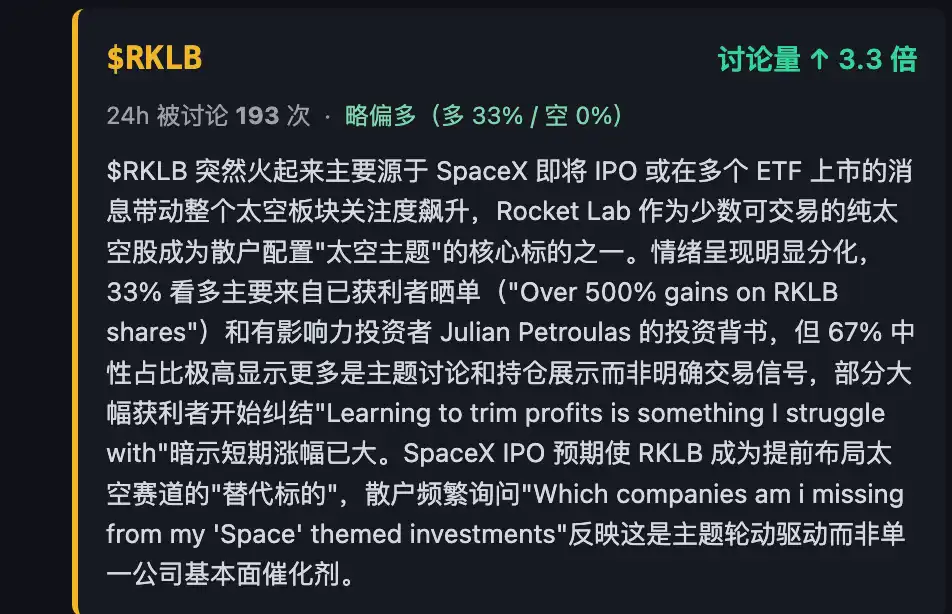
These four stocks are often bundled together on Reddit because they are among the few pure-play space stocks accessible to retail investors. In the years before SpaceX goes public, these are the substitutes for retail investors to allocate to a 'space theme'.

Currently, common discussions in Reddit's US stock communities include "Which companies am I missing from my space themed investments?", which to some extent reflects the spillover effect of SpaceX sentiment and the expectation among foreign retail investors that it will ignite the space concept, prompting them to position themselves early.

Looking at the current trends of these stocks, they have moved in completely opposite directions within the same sector: SPCE soared 22% in a single day, while RKLB fell 15%, LUNR fell 13%, and ASTS fell 7%.

Therefore, in the current hot discussions, SPCE attracted new attention due to its profit-making effect, while RKLB/LUNR/ASTS generated discussions from existing holders due to price declines or loss anxiety.

If you are also watching the space sector or have corresponding holdings, the following analysis of the recent developments of these 4 US stocks might provide some assistance for decision-making.
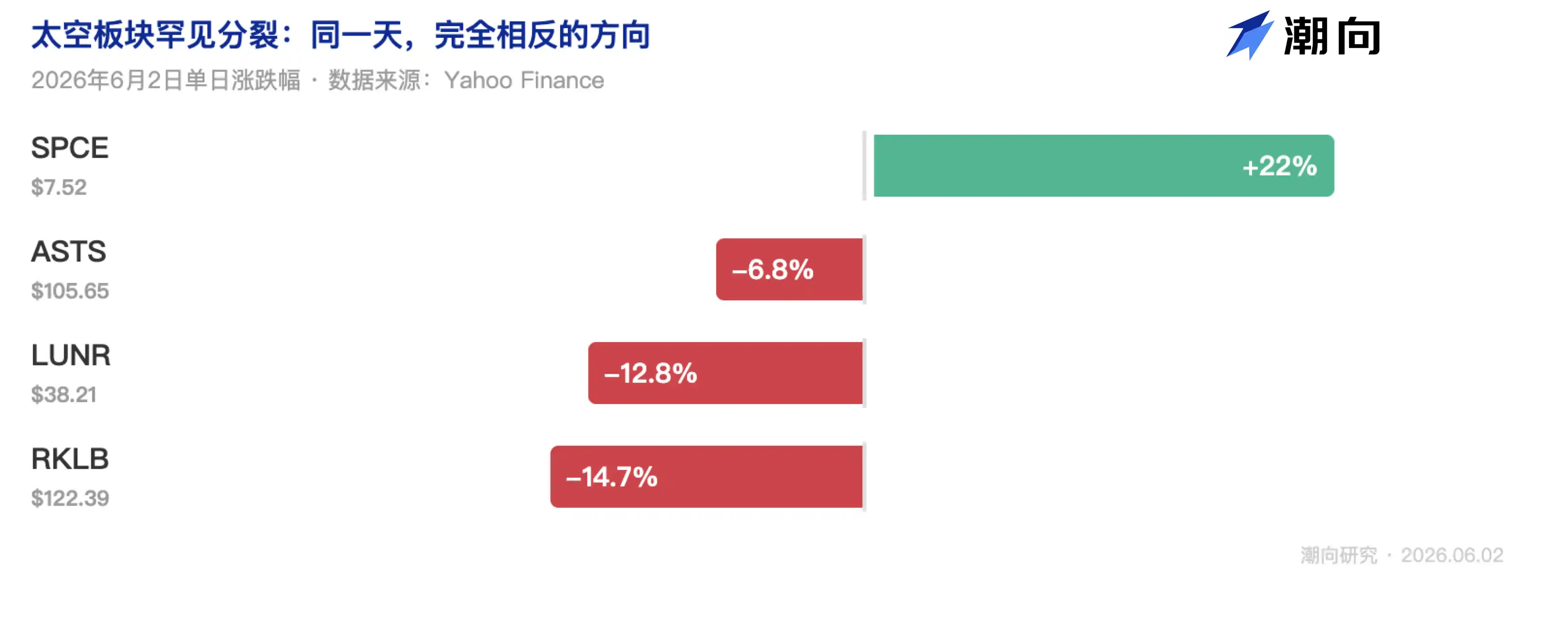
Most Space Stocks Fell, Impacted by Overlapping Negative Events

Except for $SPCE, this wave of decline in space stocks involved at least 3 negative events that happened to coincide in the same week.

Blue Origin Rocket Explosion.

Blue Origin is the space company founded by Amazon's Jeff Bezos. Its New Glenn heavy-lift rocket competes in the same market as SpaceX's Falcon Heavy and Rocket Lab's Neutron, which is under development. On May 29, during a static fire test at Cape Canaveral, the New Glenn rocket exploded, prompting the FAA (Federal Aviation Administration, which must approve all commercial launches) to immediately ground it.

This event had the biggest impact on $ASTS:

The company plans to launch 45-60 satellites into orbit before the end of the year, and Blue Origin is one of its primary launch suppliers. The grounding directly eliminates one launch pathway.

$RKLB itself doesn't use New Glenn for launches, but its own Neutron under development is a competitor. The explosion reminded investors that building rockets really can lead to explosions. Another space stock, $LUNR, was affected more by sector-wide sentiment spillover.

However, $SPCE actually benefited. Virgin Galactic operates suborbital space tourism, directly competing with Blue Origin's New Shepard business. After the New Glenn explosion, market funds flowed out of Blue Origin-related stocks, with some moving into SPCE. Additionally, SPCE has a relatively smaller market cap, making its price more prone to volatile swings.

SpaceX IPO Pricing Could Happen as Early as June 11.

SpaceX confidentially submitted its S-1 filing in April, targeting a valuation of $1.8 trillion and raising up to $75 billion, potentially the largest IPO in Wall Street history. Over the past few years, RKLB, LUNR, and ASTS were popular partly because SpaceX wasn't public, making them the only entry points for retail investors into space. Now that the main player is arriving, some capital will naturally move out of these substitutes to make room for SpaceX.

Insiders Themselves Are Selling.

Public data shows RKLB's CEO Peter Beck sold approximately 2.51 million shares over the past 6 months, cashing out about $142 million. The President, COO, and General Counsel also recently reduced their holdings, totaling about $18 million.

Some of this was part of pre-arranged 10b5-1 plans (a preset trading arrangement for compliant CEO selling), but the timing was chosen near historical highs. Over the past year, RKLB rose 412%, ASTS rose 437%, and LUNR rose 267%, so profit-taking pressure was already relatively loose.

The Four 'Space Companies' Are Not Doing the Same Thing

Retail investors tend to treat SPCE, RKLB, LUNR, and ASTS as one sector and trade them together, but these four companies have completely different businesses, revenue stages, and risk profiles.
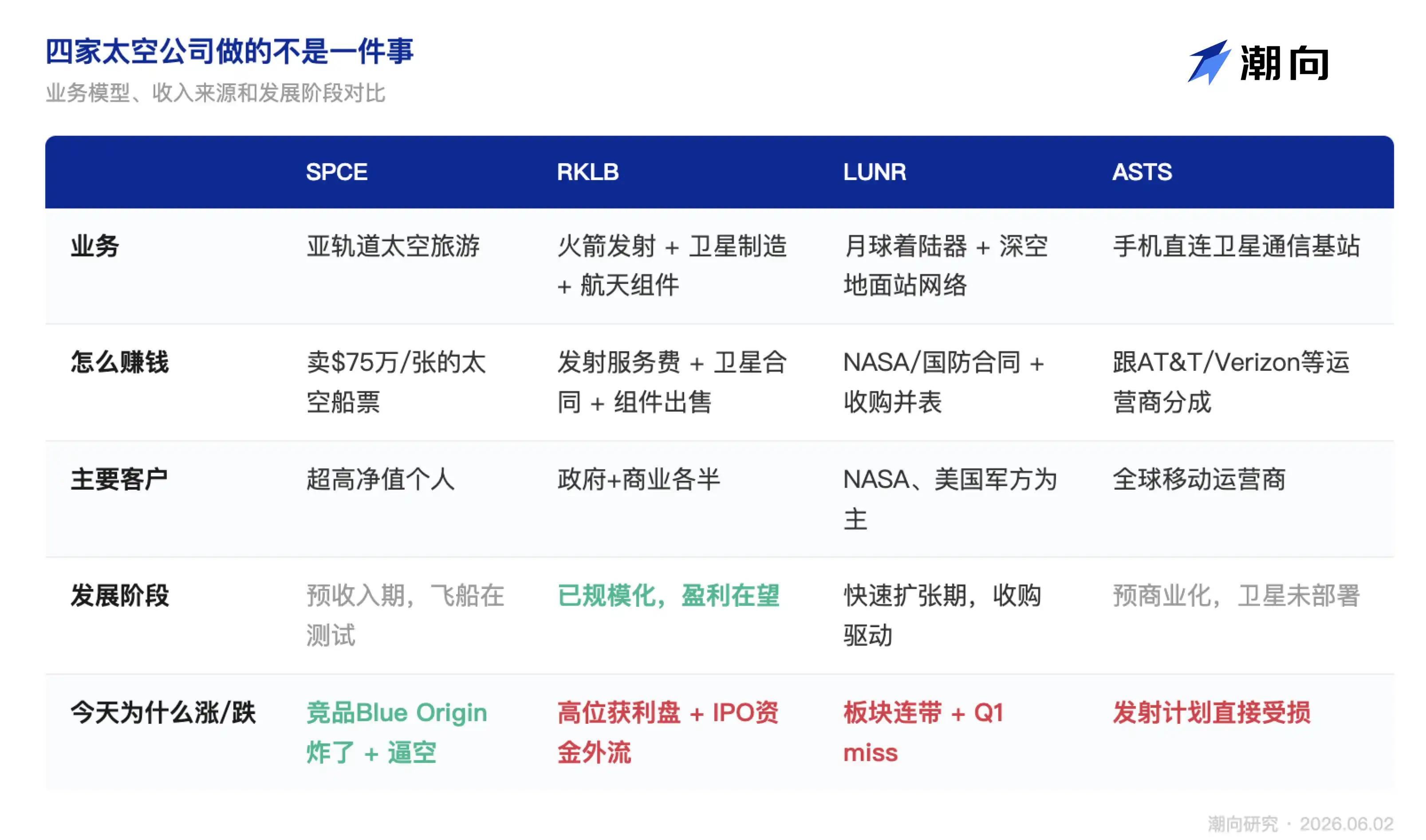
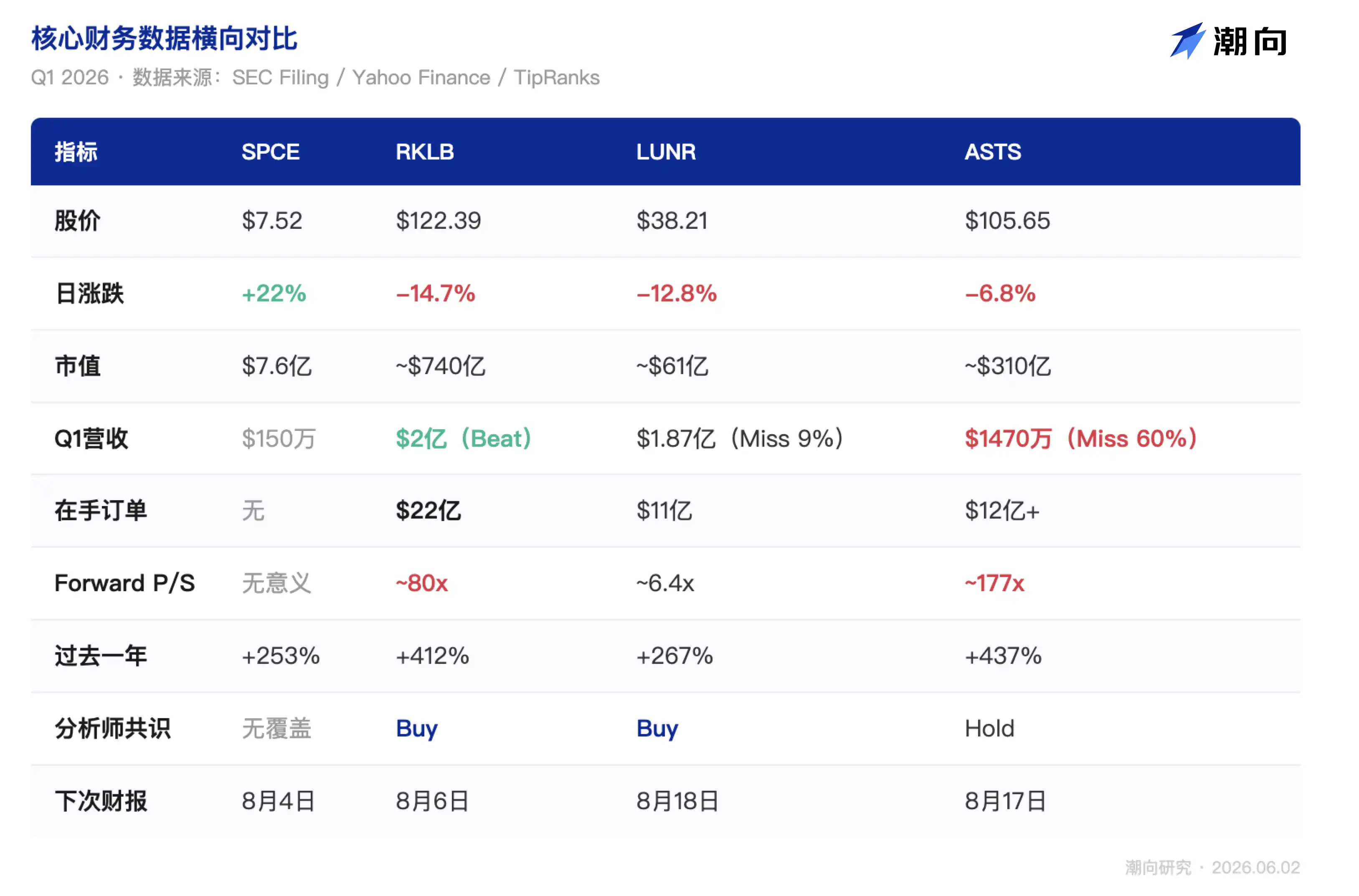
From the table above, RKLB is the only one among the four with substantial and accelerating revenue.

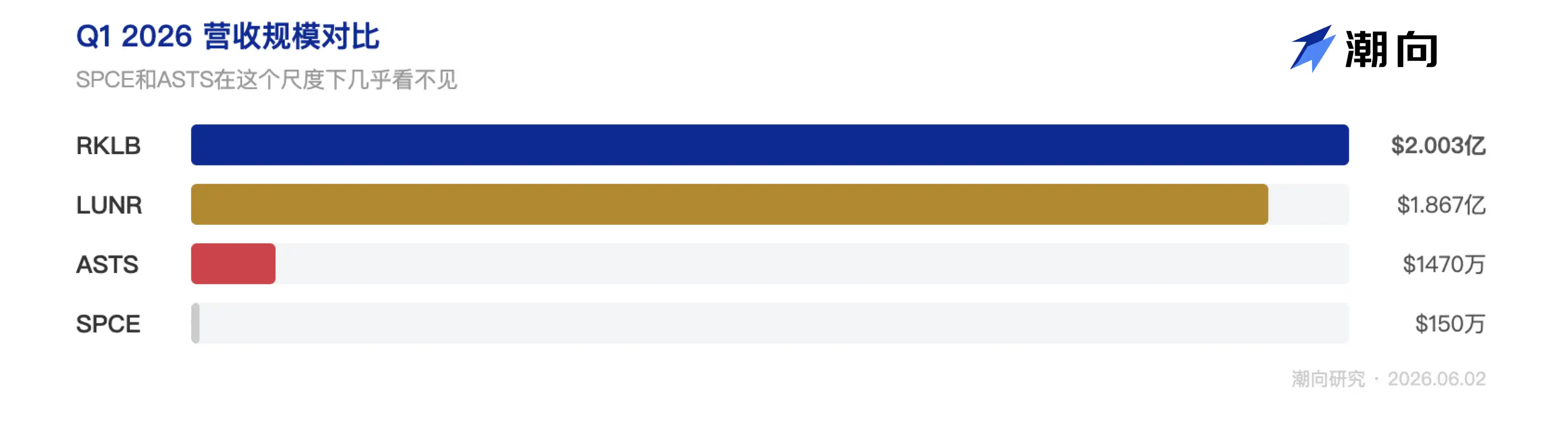
Looking at this year's Q1 revenue for these companies, RKLB's revenue was earned deal by deal, increasing 63.5% year-over-year, beating analyst expectations. LUNR's number is similar in size, but a large portion comes from consolidating the revenue of Lanteris, a company it acquired for $800 million this year. Excluding that part, its organic growth is less dramatic, and its final revenue still missed analyst expectations by 9%.

ASTS and SPCE's revenue bars are almost invisible in this chart; their revenue scale is negligible compared to the first two.
RKLB: The Only One with Accelerating Fundamentals, But $122 Is No Longer Cheap

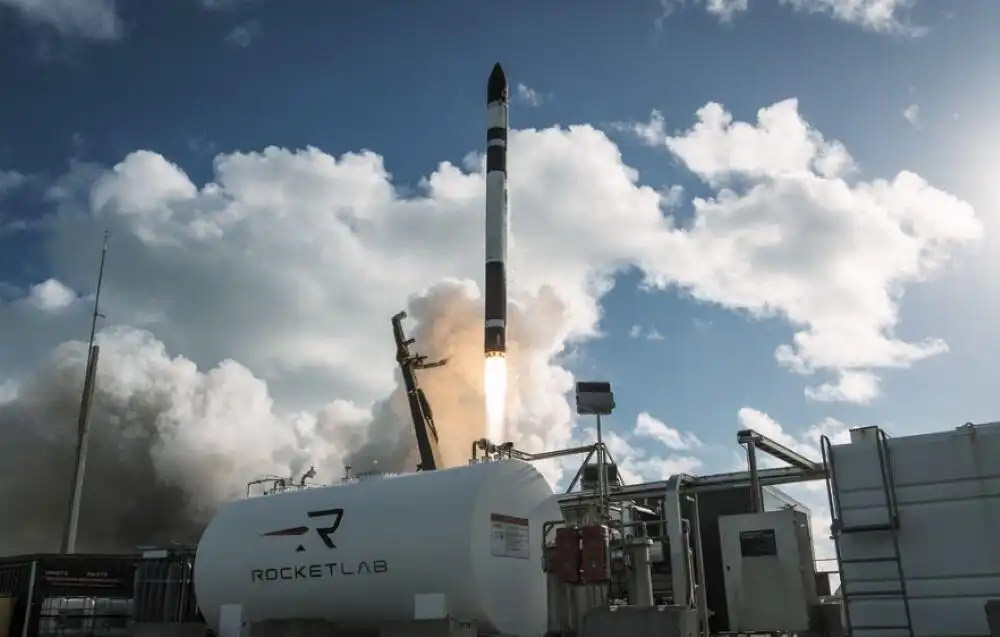
Rocket Lab is the second-largest US rocket company. Its self-developed Electron small rocket has completed over 50 launches, while also building satellite platforms and space components sold to NASA, the Department of Defense, and commercial customers. Government and commercial revenues are roughly split, making its customer base much more diversified than the other three.

The company's biggest variable is the Neutron medium-lift launch vehicle currently under development. Neutron is positioned as a direct competitor to SpaceX's Falcon 9. If its maiden flight succeeds, RKLB would upgrade from a 'small launch service provider' to 'the only listed company besides SpaceX capable of launching medium payloads.' The target for the first flight is Q4 2026, but it has been delayed twice before (due to a first-stage tank test failure causing schedule adjustments). This also means valuations differ vastly between success and failure scenarios.
Regarding this company's Q1 financial figures, they are visible in the charts later. Here are three things the table doesn't show:

First, within its $2.2 billion backlog, there's an $816 million SDA (Space Development Agency) satellite contract, the largest single order in Rocket Lab's history, indicating the company is transitioning from a launch service provider to a 'full-stack space supplier.'

Second, Q1 saw the signing of 5 exclusive Neutron launch contracts, meaning customers booked flights before the rocket even flew, showing increasing market confidence in Neutron.

Third, CEO Peter Beck cashed out $142 million over the past six months. Although part of a 10b5-1 plan, this level of selling is not insignificant within the aerospace industry.

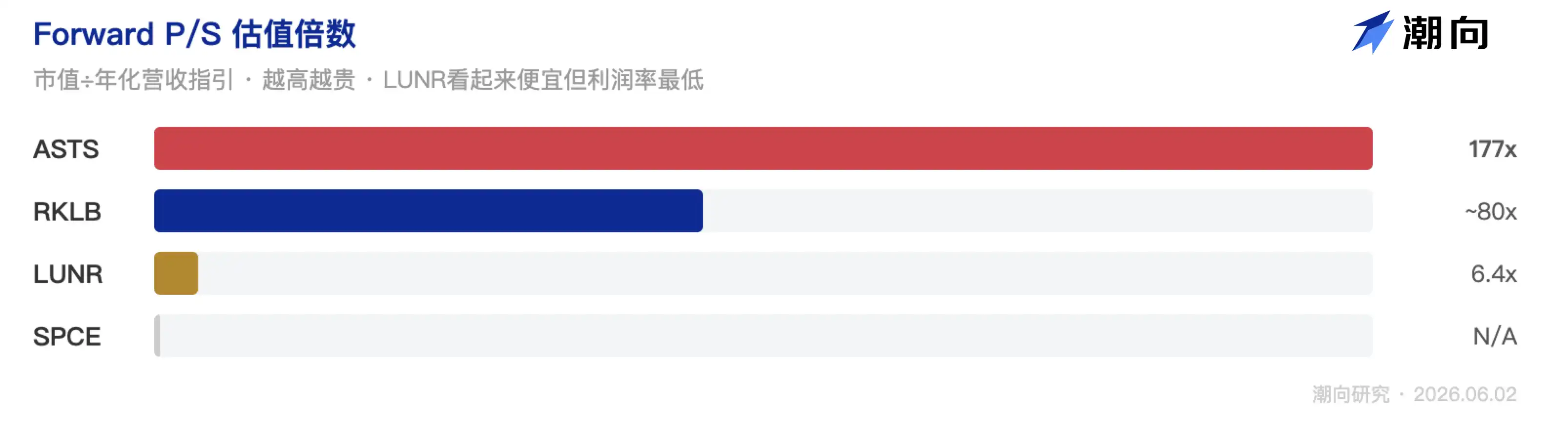
In terms of valuation, the company's Forward P/S is around 80x. This multiple embeds three assumptions: Neutron's success, continued growth in defense contracts, and further gross margin expansion. Any failure to meet these could challenge sustaining this valuation.

Overall, the current price of $122 has already priced in good news relatively fully. A return to the $96~$102 range (near the 50-day moving average) would offer a much better risk-reward ratio.

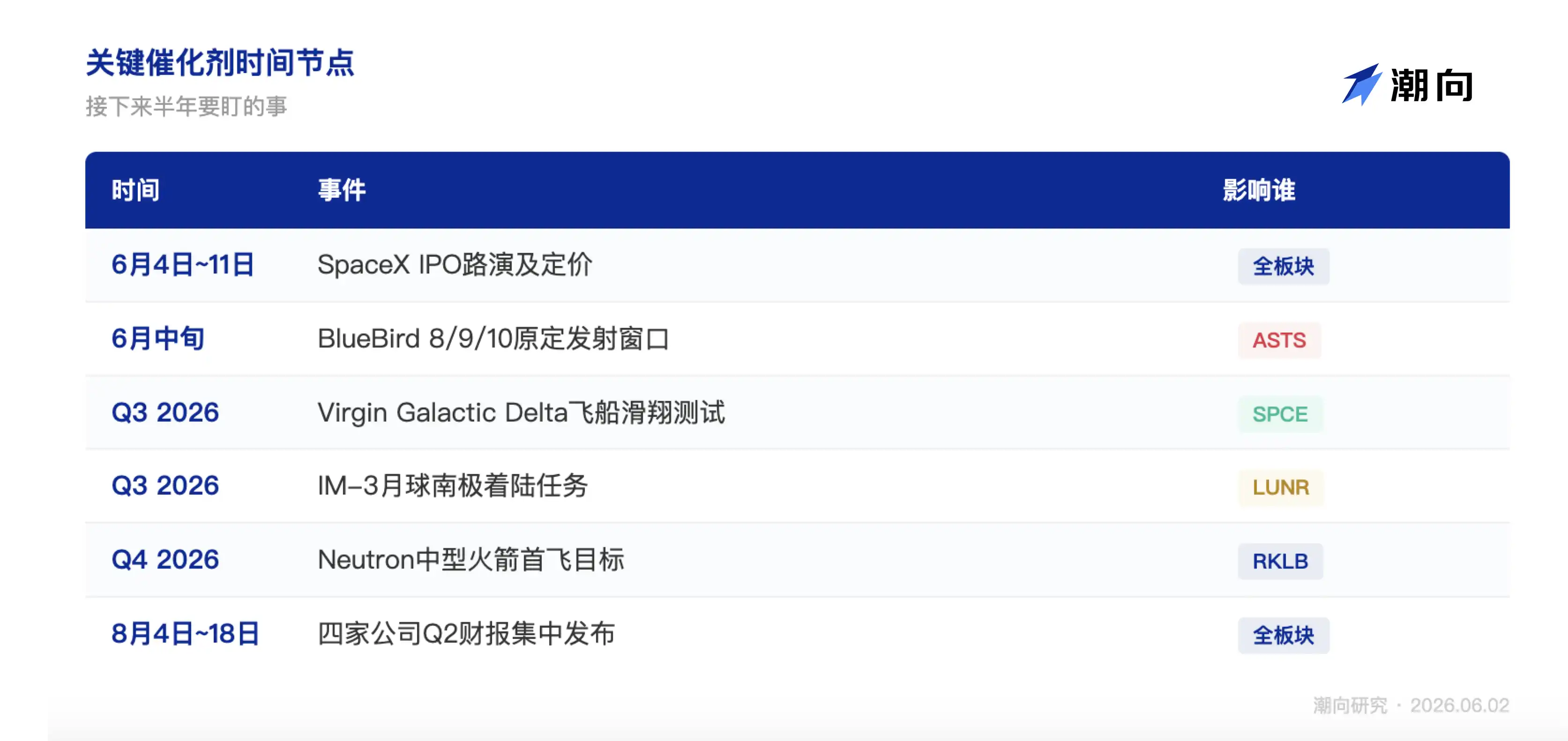
Tide Direction Judgment: Leaning bullish, but waiting for a better price is advisable. Core catalysts are Q4 Neutron maiden flight progress and the Q2 earnings report on August 6.

The Other Three: Need to Wait for More Catalysts, Beware of Squeeze Rallies

We can pull the core financial metrics of these 4 hot space stocks together for a more intuitive view:
LUNR: $187M Revenue Tripled, But Mainly from Acquisitions

Intuitive Machines delivers NASA equipment to the lunar surface and is a core contractor for NASA's CLPS (Commercial Lunar Payload Services) program. The Q1 revenue tripling looks impressive, but the $800 million acquisition of Lanteris and its consolidation was the primary contributor; organic growth is far from the stated 199%.

On the other hand, revenue missed expectations by 9%, and EPS missed by four times.

The IM-3 lunar landing mission in the second half of the year is the decisive milestone. The previous IM-1 lander tipped over, and IM-2 landed but had limited communication. If IM-3 can achieve a soft landing at the lunar South Pole, follow-on NASA contracts are likely; failure would significantly discount the whole story.

A Forward P/S of 6.4x appears the cheapest, but gross margin is only 19%, so a low P/S doesn't equal undervaluation. The analyst target price is $40.78, and the current $38.21 is already close.

Tide Direction Judgment: Neutral to slightly bearish. Wait for IM-3 results.

ASTS: The Biggest Story, But Blue Origin Grounding Directly Disrupts the Script

AST SpaceMobile is building a space-based cellular network, allowing standard phones to connect directly to satellites for internet without modification. The 4 billion people worldwide without signal are the potential market. AT&T and Verizon have signed cooperation agreements, and the FCC has issued licenses.
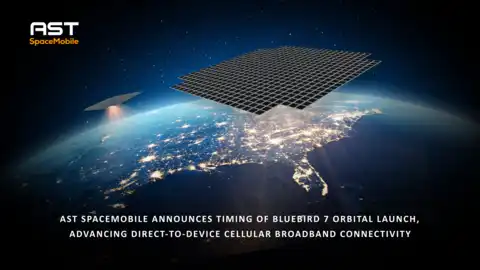
The story framework is not the problem; the issue may lie in the execution timeline. To achieve meaningful coverage, it needs to launch 45-60 BlueBird satellites into orbit before year-end, but Blue Origin's grounding directly eliminated one launch pathway.

Satellite analyst Tim Farrar warned that realistically only 3-5 Falcon 9 launches might be available this year. Deutsche Bank has already downgraded its rating to Hold. The average analyst target price is $82.24, 22% lower than the current price.

The company holds $3.5 billion in cash, so it's not short on funds in the near term. However, a Forward P/S of 177x prices in all satellites launching on time.

Tide Direction Judgment: High risk. Wait for Blue Origin's return-to-flight schedule to become clear before considering.

SPCE: The Most Discussed on Reddit, Beware of Short Squeeze

Virgin Galactic operates suborbital space tourism, with tickets costing $750,000. After pausing commercial flights in 2024 to focus on developing the Delta spacecraft, Q3 plans include glide tests and Q4 power tests. Q1 revenue was $1.5 million (not billion), with a market cap of $760 million.

The driving forces behind this surge are: Blue Origin competitor's incident + short interest of 23.2% triggering a short squeeze + retail FOMO. Trading volume reached 12 times the daily average, triggering a volatility halt intraday.

The RSI has reached 90 (this indicator fluctuates between 0 and 100; exceeding 70 is considered overbought, and 90 is an extreme state...).

Tide Direction Judgment: Avoid. No revenue support, no profitability timeline. Highest Reddit discussion volume does not equal the highest investment value.
Has It Fallen into a Golden Pit? Still Too Early to Say

Answering the article's title question: We believe it's not a golden pit yet, but if the decline continues, RKLB might be approaching a reasonable entry range.

The Blue Origin explosion is a material negative (directly impacting ASTS's launch plans). The SpaceX IPO is a short-term capital flow shock (sector attention might actually rise post-listing). High-level profit-taking itself is healthy.

The long-term logic for the sector isn't broken, but short-term pricing has indeed run ahead of fundamentals.

If we must rank these four. RKLB is the only one worth seriously tracking. With its $2.2 billion backlog, 43% gross margin, and continuous beats, its scarcity as the 'only listed full-stack space company' might actually become more pronounced after SpaceX goes public.

But the current $122 is probably still expensive; $96~$102 looks more like a reasonable range.
-----
This article is based on public information and independent analysis, for reference only, and does not constitute investment advice. Investing involves risks, caution is advised when entering the market.

Data Sources: Yahoo Finance · SEC Filing · TradingView · Reddit/ApeWisdom · Stocktwits · CNBC · TipRanks · Simply Wall St

Tide Research · TideResearch · June 2, 2026

Трендові криптовалюти

Пов'язані питання

QAccording to the article, what were the three main negative events that impacted the space stocks RKLB, LUNR, and ASTS in the same week?

AThe three main negative events were: 1) The explosion and subsequent FAA grounding of Blue Origin's New Glenn rocket, which is a launch supplier for ASTS. 2) The impending SpaceX IPO, which could draw capital away from these 'substitute' space stocks. 3) Insider selling, particularly by RKLB's CEO Peter Beck, which raised concerns among investors.

QHow does the business model and revenue stage of Rocket Lab (RKLB) differ from the other three space companies (SPCE, LUNR, ASTS) discussed in the article?

ARocket Lab (RKLB) is fundamentally different as it is the only one with substantial and accelerating revenue, primarily from launch services and aerospace components for government and commercial clients. The other three are in earlier, more speculative revenue stages: SPCE has negligible revenue from space tourism, LUNR's recent revenue surge is largely from an acquisition, and ASTS is pre-revenue, focused on building a satellite-to-phone network.

QWhat is the single biggest upcoming catalyst and risk factor for Rocket Lab (RKLB), as highlighted in the article?

AThe biggest upcoming catalyst and risk factor for Rocket Lab is the first launch of its medium-lift Neutron rocket, targeted for Q4 2026. Success would elevate RKLB to the only other public company capable of medium payload launches alongside SpaceX, greatly increasing its valuation potential. However, failure or further delays could jeopardize this valuation. Its current high Forward P/S ratio of around 80 heavily depends on this success.

QWhy does the article advise caution regarding Virgin Galactic (SPCE) despite its recent 22% surge in price?

AThe article advises caution regarding Virgin Galactic because its recent surge is primarily driven by a short squeeze (23.2% short interest), spillover from Blue Origin's competitor failure, and retail FOMO, not fundamental business strength. With negligible revenue ($1.5M in Q1), no clear timeline for profitability, and technical indicators like RSI reaching 90 (extreme overbought), the stock lacks a fundamental basis for the rally.

QWhat is the article's overall conclusion about the current investment attractiveness of the space sector, specifically regarding whether a 'golden buying opportunity' has emerged?

AThe article concludes it is not yet a 'golden buying opportunity' for the space sector overall. While the long-term logic remains intact, short-term prices have outpaced fundamentals due to the recent negative events. Among the four stocks, RKLB is considered the most worthy of tracking, but its current price of $122 is seen as expensive. The article suggests a more reasonable entry point for RKLB would be in the $96-$102 range. For the others, it advises waiting for more definitive catalysts.

Пов'язані матеріали

Securitize's First Post-IPO Financial Report Bombshell: Is the 'Compliant Tokenization' Narrative Failing to Sell?

Securitize, a tokenization platform, released its first earnings report since going public in July 2026, revealing disappointing Q2 results. Revenue fell 5% year-over-year to $14.43 million, missing estimates, while the net loss widened significantly to $21.68 million. Despite achieving record tokenized assets under management of $4.3 billion and a 147% surge in platform trading volume, overall assets under administration declined by 20%. The company's stock (SECZ) dropped over 20% in after-hours trading following the report. The article highlights a key concern: Securitize's revenue declined despite substantial trading growth, suggesting either compressed fees or an unclear business model. While Securitize maintains its focus on regulatory compliance—securing key partnerships with entities like Computershare and NYSE, and obtaining an SEC investment advisor registration—its tangible progress in the new tokenized stock business has been slow. Apart from tokenizing its own stock (SECZ) upon listing, it has not launched other tokenized equities. Analysts note that SECZ's high on-chain market capitalization is misleading, as it resulted from a one-time distribution to shareholders rather than organic investor demand. The market's patience is waning as investors prioritize real business metrics like market share and user adoption over the "compliant tokenization" narrative. Securitize's market value has fallen 36% from its debut, reflecting growing concerns over its shrinking revenue and the delayed execution of its tokenized stock initiatives.

Odaily星球日报9 хв тому

Securitize's First Post-IPO Financial Report Bombshell: Is the 'Compliant Tokenization' Narrative Failing to Sell?

Odaily星球日报9 хв тому

Why Every Investor Needs to Pay Attention to the Federal Reserve

Why Every Investor Should Follow the Federal Reserve Key developments on August 12, 2026, demonstrate how crucial the Fed is. Following the CPI report that matched expectations, markets instantly repriced stocks, bonds, and currencies, adjusting the probability of a September Fed rate hike. The Federal Reserve controls the federal funds rate, the anchor for all borrowing costs. Its "dual mandate" is to maintain stable prices and maximum employment. The current policy rate is 3.50%-3.75% after a series of cuts from 2024-2025. Understanding Fed actions is vital for your portfolio: - **Rate Hikes:** Slow the economy to fight inflation. They pressure growth/tech stocks (due to higher discount rates) and lower bond prices but can initially benefit banks. - **Rate Cuts:** Stimulate the economy. They typically boost growth stocks and bond prices while lowering borrowing costs for consumers and businesses. - **Holding Steady:** Still impactful. Current restrictive policy, with positive real interest rates, continues to weigh on the economy. Market-moving signals now come more from economic data than official guidance. A key change is new Fed Chair Kevin Warsh, who has reduced forward guidance, making each data release (CPI, PCE, jobs reports, GDP) more critical for predicting Fed moves. In this environment, investors should track key reports, compare data to market expectations, and understand what is already "priced in." The focus now is on the September 15-16 FOMC meeting. The August CPI (due Sep 11) and jobs report (Sep 5) will be decisive. Ultimately, interest rates are a powerful, continuous force on all assets. Learning to interpret the data that drives Fed policy is an essential skill for navigating today's markets.

marsbit13 хв тому

Why Every Investor Needs to Pay Attention to the Federal Reserve

marsbit13 хв тому

MicroStrategy Sells BTC Without a Price Drop, Is STRC's Rebound Truly Good News?

The cryptocurrency market is currently experiencing extreme quiet, with BTC weekly trading volume at its lowest since 2023 and implied volatility hitting bottom. Liquidity is thin, as evidenced by a muted price reaction to CPI data. The market's primary issue is a lack of active participants, not just news. Options data shows traders are pricing in higher short-term downside risks. Market makers' gamma positioning suggests a critical support zone between $61,000 and $60,000; a break below could accelerate a downturn. Two developments are being interpreted bullishly: MicroStrategy (MSTR) selling a small portion of its BTC without causing a price crash, and the rebound of its preferred shares (STRC) from lows near $73 to over $95. However, an alternative bearish interpretation exists. The low liquidity means large entities cannot exit sizable positions easily. A STRK recovery towards $100 could provide the buying pressure these sellers need to finally offload BTC, making the apparent利好 (positive news) actually improve selling conditions. STRC faces a structural ceiling at $100 because MSTR has signaled it will issue new shares around that price, capping upside and inviting short sellers. While recent buybacks boosted the price, they haven't solved this core problem. If STRK cannot sustainably break $100, concerns will grow about MSTR needing to sell BTC for funding. Finally, the Bitfinex Long positions indicator, which typically moves inversely to BTC price, has become ineffective and flat-lined near multi-year lows, offering no directional signal. Large traders are not accumulating on dips as they once did.

marsbit14 хв тому

MicroStrategy Sells BTC Without a Price Drop, Is STRC's Rebound Truly Good News?

marsbit14 хв тому

Silicon Valley Tech Giants No Longer Need Ethicists

Silicon Valley tech giants are once again sidelining ethicists. Chloé Bakalar, OpenAI's dedicated AI Ethics Lead, left the company in July, a departure emblematic of a broader trend where ethics teams are being disbanded or marginalized in the race for AI dominance. Bakalar's career highlights the tensions between ethical governance and commercial speed. She first made her mark at Meta (formerly Facebook), where she pioneered "embedded ethics," developing tools like checklists to translate abstract principles like fairness and transparency into concrete engineering steps. Her framework aimed to embed ethical considerations throughout a product’s lifecycle—from initial design and data handling to user interaction and deployment. However, this approach faced significant internal resistance. At Meta, her Responsible AI team was eventually disbanded as the company prioritized rapid development, especially in the generative AI race with OpenAI. Bakalar then joined OpenAI in 2025, hoping to influence cutting-edge model development directly. Yet, as the company's sole dedicated ethicist, she reportedly struggled with limited influence and resources amidst intense commercial pressures, leading to her departure after roughly a year. Her exit is not isolated. Similar patterns have emerged across Silicon Valley, with ethics and safety teams at Twitter (post-Musk acquisition) and OpenAI's own "superalignment" team being dissolved. These departures reveal five core, unresolved tensions: 1) the fatal conflict between commercialization speed and ethical caution; 2) the role mismatch where ethicists have prestige but little real decision-making power; 3) the dilution of responsibility when ethics is decentralized as "everyone's job"; 4) the inevitable "translation loss" when complex philosophical values are reduced to quantifiable engineering metrics; and 5) the fundamental clash between academic independence and corporate secrecy. Bakalar’s trajectory suggests that embedding meaningful ethical oversight within hyper-competitive tech companies is profoundly difficult. Lasting change may require external regulatory pressure, like the EU's AI Act, or a fundamental reimagining of the ethicist's role from an internal auditor to a cross-disciplinary builder with genuine authority.

marsbit43 хв тому

Silicon Valley Tech Giants No Longer Need Ethicists

marsbit43 хв тому

Торгівля

Спот

Популярні статті

Що таке $S$

Розуміння SPERO: Комплексний огляд Вступ до SPERO Оскільки ландшафт інновацій продовжує еволюціонувати, виникнення технологій web3 та криптовалютних проектів відіграє ключову роль у формуванні цифрового майбутнього. Один з проектів, який привернув увагу в цій динамічній сфері, — це SPERO, позначений як SPERO,$$s$. Ця стаття має на меті зібрати та представити детальну інформацію про SPERO, щоб допомогти ентузіастам та інвесторам зрозуміти його основи, цілі та інновації в рамках web3 та крипто-сектору. Що таке SPERO,$$s$? SPERO,$$s$ — це унікальний проект у криптопросторі, який прагне використати принципи децентралізації та технології блокчейн для створення екосистеми, що сприяє залученню, корисності та фінансовій інклюзії. Проект розроблений для полегшення взаємодії між користувачами новими способами, надаючи їм інноваційні фінансові рішення та послуги. У своїй основі SPERO,$$s$ прагне надати можливості індивідам, забезпечуючи інструменти та платформи, які покращують користувацький досвід у криптовалютному просторі. Це включає в себе можливість більш гнучких методів транзакцій, сприяння ініціативам, що підтримуються спільнотою, та створення шляхів для фінансових можливостей через децентралізовані додатки (dApps). Основна концепція SPERO,$$s$ обертається навколо інклюзивності, прагнучи зменшити розриви в традиційній фінансовій системі, використовуючи переваги технології блокчейн. Хто є творцем SPERO,$$s$? Особистість творця SPERO,$$s$ залишається дещо невідомою, оскільки є обмежені публічно доступні ресурси, що надають детальну інформацію про його засновників. Ця відсутність прозорості може бути наслідком зобов'язання проекту до децентралізації — етики, яку багато проектів web3 поділяють, ставлячи колективні внески вище за індивідуальне визнання. Зосереджуючи обговорення навколо спільноти та її колективних цілей, SPERO,$$s$ втілює суть наділення без виділення конкретних осіб. Таким чином, розуміння етики та місії SPERO є більш важливим, ніж ідентифікація єдиного творця. Хто є інвесторами SPERO,$$s$? SPERO,$$s$ підтримується різноманітними інвесторами, починаючи від венчурних капіталістів до ангельських інвесторів, які прагнуть сприяти інноваціям у крипто-секторі. Зосередження цих інвесторів зазвичай узгоджується з місією SPERO — пріоритет надається проектам, які обіцяють технологічний прогрес у суспільстві, фінансову інклюзію та децентралізоване управління. Ці інвесторські фонди зазвичай зацікавлені в проектах, які не лише пропонують інноваційні продукти, але й позитивно впливають на спільноту блокчейн та її екосистеми. Підтримка з боку цих інвесторів підкріплює SPERO,$$s$ як значного конкурента в швидко змінюваній сфері крипто-проектів. Як працює SPERO,$$s$? SPERO,$$s$ використовує багатогранну структуру, яка відрізняє його від традиційних криптовалютних проектів. Ось деякі ключові особливості, які підкреслюють його унікальність та інноваційність: Децентралізоване управління: SPERO,$$s$ інтегрує моделі децентралізованого управління, надаючи користувачам можливість активно брати участь у процесах прийняття рішень щодо майбутнього проекту. Цей підхід сприяє відчуттю власності та відповідальності серед членів спільноти. Корисність токена: SPERO,$$s$ використовує свій власний криптовалютний токен, розроблений для виконання різних функцій в екосистемі. Ці токени дозволяють здійснювати транзакції, отримувати винагороди та полегшувати послуги, що пропонуються на платформі, підвищуючи загальну залученість та корисність. Шарова архітектура: Технічна архітектура SPERO,$$s$ підтримує модульність та масштабованість, що дозволяє безперешкодно інтегрувати додаткові функції та додатки в міру розвитку проекту. Ця адаптивність є надзвичайно важливою для збереження актуальності в постійно змінюваному крипто-ландшафті. Залучення спільноти: Проект підкреслює ініціативи, що підтримуються спільнотою, використовуючи механізми, які стимулюють співпрацю та зворотний зв'язок. Підтримуючи сильну спільноту, SPERO,$$s$ може краще задовольняти потреби користувачів та адаптуватися до ринкових тенденцій. Фокус на інклюзію: Пропонуючи низькі комісії за транзакції та зручні інтерфейси, SPERO,$$s$ прагне залучити різноманітну базу користувачів, включаючи осіб, які раніше не брали участі в крипто-просторі. Це зобов'язання до інклюзії узгоджується з його загальною місією наділення через доступність. Хронологія SPERO,$$s$ Розуміння історії проекту надає важливі уявлення про його розвиток та етапи. Нижче наведено пропоновану хронологію, що відображає значні події в еволюції SPERO,$$s$: Етап концептуалізації та ідеації: Початкові ідеї, що стали основою SPERO,$$s$, були сформовані, тісно пов'язані з принципами децентралізації та фокусом на спільноті в індустрії блокчейн. Запуск білого паперу проекту: Після концептуального етапу був випущений комплексний білий папір, що детально описує бачення, цілі та технологічну інфраструктуру SPERO,$$s$, щоб залучити інтерес та зворотний зв'язок від спільноти. Створення спільноти та ранні залучення: Активні зусилля були спрямовані на створення спільноти ранніх прихильників та потенційних інвесторів, що полегшило обговорення цілей проекту та отримання підтримки. Подія генерації токенів: SPERO,$$s$ провів подію генерації токенів (TGE) для розподілу своїх рідних токенів серед ранніх прихильників та встановлення початкової ліквідності в екосистемі. Запуск початкового dApp: Перший децентралізований додаток (dApp), пов'язаний з SPERO,$$s$, став доступним, дозволяючи користувачам взаємодіяти з основними функціями платформи. Постійний розвиток та партнерства: Безперервні оновлення та вдосконалення пропозицій проекту, включаючи стратегічні партнерства з іншими учасниками блокчейн-простору, сформували SPERO,$$s$ у конкурентоспроможного та еволюціонуючого гравця на крипто-ринку. Висновок SPERO,$$s$ є свідченням потенціалу web3 та криптовалют для революціонізації фінансових систем та наділення індивідів. Завдяки зобов'язанню до децентралізованого управління, залучення спільноти та інноваційно спроектованих функцій, він прокладає шлях до більш інклюзивного фінансового ландшафту. Як і з будь-якими інвестиціями в швидко змінюваному крипто-просторі, потенційним інвесторам та користувачам рекомендується ретельно досліджувати та обдумано взаємодіяти з поточними подіями в SPERO,$$s$. Проект демонструє інноваційний дух крипто-індустрії, запрошуючи до подальшого дослідження його численних можливостей. Хоча подорож SPERO,$$s$ ще триває, його основні принципи можуть справді вплинути на майбутнє того, як ми взаємодіємо з технологією, фінансами та один з одним у взаємопов'язаних цифрових екосистемах.

310 переглядів усьогоОпубліковано 2024.12.17Оновлено 2024.12.17

Що таке $S$

Що таке AGENT S

Агент S: Майбутнє автономної взаємодії в Web3 Вступ У постійно змінюваному ландшафті Web3 та криптовалюти інновації постійно переосмислюють, як люди взаємодіють з цифровими платформами. Один з таких новаторських проектів, Агент S, обіцяє революціонізувати взаємодію людини з комп'ютером через свою відкриту агентну структуру. Прокладаючи шлях для автономних взаємодій, Агент S прагне спростити складні завдання, пропонуючи трансформаційні застосування в штучному інтелекті (ШІ). Це детальне дослідження заглиблюється в складності проекту, його унікальні особливості та наслідки для сфери криптовалюти. Що таке Агент S? Агент S є революційною відкритою агентною структурою, спеціально розробленою для вирішення трьох основних викликів в автоматизації комп'ютерних завдань: Набуття специфічних знань у галузі: Структура інтелектуально навчається з різних зовнішніх джерел знань та внутрішнього досвіду. Цей подвійний підхід дозволяє їй створити багатий репозиторій специфічних знань у галузі, покращуючи її продуктивність у виконанні завдань. Планування на довгих горизонтах завдань: Агент S використовує планування з підкріпленням досвіду, стратегічний підхід, який полегшує ефективний розподіл та виконання складних завдань. Ця функція значно підвищує її здатність ефективно та результативно управляти кількома підзавданнями. Обробка динамічних, неоднорідних інтерфейсів: Проект представляє Інтерфейс Агент-Комп'ютер (ACI), інноваційне рішення, яке покращує взаємодію між агентами та користувачами. Використовуючи багатомодальні великі мовні моделі (MLLMs), Агент S може безперешкодно орієнтуватися та маніпулювати різноманітними графічними інтерфейсами користувача. Завдяки цим новаторським функціям Агент S надає надійну структуру, яка вирішує складнощі, пов'язані з автоматизацією людської взаємодії з машинами, прокладаючи шлях для численних застосувань у ШІ та за його межами. Хто є творцем Агент S? Хоча концепція Агент S є фундаментально новаторською, конкретна інформація про його творця залишається невідомою. Творець наразі невідомий, що підкреслює або початкову стадію проекту, або стратегічний вибір зберегти засновників у таємниці. Незважаючи на анонімність, акцент залишається на можливостях та потенціалі структури. Хто є інвесторами Агент S? Оскільки Агент S є відносно новим у криптографічній екосистемі, детальна інформація про його інвесторів та фінансових спонсорів не задокументована. Відсутність публічно доступних відомостей про інвестиційні фонди або організації, що підтримують проект, викликає питання щодо його фінансової структури та дорожньої карти розвитку. Розуміння підтримки є критично важливим для оцінки стійкості проекту та потенційного впливу на ринок. Як працює Агент S? В основі Агент S лежить передова технологія, яка дозволяє йому ефективно функціонувати в різних умовах. Його операційна модель побудована навколо кількох ключових функцій: Взаємодія з комп'ютером, подібна до людської: Структура пропонує розширене планування ШІ, прагнучи зробити взаємодії з комп'ютерами більш інтуїтивними. Імітуючи людську поведінку при виконанні завдань, вона обіцяє підвищити досвід користувачів. Наративна пам'ять: Використовується для використання високорівневого досвіду, Агент S використовує наративну пам'ять для відстеження історій завдань, тим самим покращуючи свої процеси прийняття рішень. Епізодична пам'ять: Ця функція надає користувачам покрокові інструкції, дозволяючи структурі пропонувати контекстуальну підтримку в міру виконання завдань. Підтримка OpenACI: Завдяки можливості працювати локально, Агент S дозволяє користувачам зберігати контроль над своїми взаємодіями та робочими процесами, узгоджуючи з децентралізованою етикою Web3. Легка інтеграція з зовнішніми API: Його універсальність і сумісність з різними платформами ШІ забезпечують те, що Агент S може безперешкодно вписатися в існуючі технологічні екосистеми, роблячи його привабливим вибором для розробників та організацій. Ці функціональні можливості колективно сприяють унікальному положенню Агент S у крипто-просторі, оскільки він автоматизує складні, багатоступеневі завдання з мінімальним втручанням людини. У міру розвитку проекту його потенційні застосування в Web3 можуть переосмислити, як відбуваються цифрові взаємодії. Хронологія Агент S Розробка та етапи Агент S можуть бути узагальнені в хронології, яка підкреслює його значні події: 27 вересня 2024 року: Концепція Агент S була представлена в комплексній науковій статті під назвою “Відкрита агентна структура, яка використовує комп'ютери як людина”, що демонструє основи проекту. 10 жовтня 2024 року: Наукова стаття була опублікована на arXiv, пропонуючи детальне дослідження структури та її оцінки продуктивності на основі бенчмарку OSWorld. 12 жовтня 2024 року: Було випущено відеопрезентацію, що надає візуальне уявлення про можливості та особливості Агент S, ще більше залучаючи потенційних користувачів та інвесторів. Ці маркери в хронології не лише ілюструють прогрес Агент S, але й вказують на його прихильність до прозорості та залучення громади. Ключові моменти про Агент S У міру розвитку структури Агент S кілька ключових характеристик виділяються, підкреслюючи її новаторський характер та потенціал: Інноваційна структура: Розроблена для забезпечення інтуїтивного використання комп'ютерів, подібного до людської взаємодії, Агент S пропонує новий підхід до автоматизації завдань. Автономна взаємодія: Здатність автономно взаємодіяти з комп'ютерами через GUI означає стрибок до більш інтелектуальних та ефективних обчислювальних рішень. Автоматизація складних завдань: Завдяки своїй надійній методології він може автоматизувати складні, багатоступеневі завдання, роблячи процеси швидшими та менш схильними до помилок. Безперервне вдосконалення: Механізми навчання дозволяють Агенту S покращуватися на основі минулого досвіду, постійно підвищуючи свою продуктивність та ефективність. Універсальність: Його адаптивність до різних операційних середовищ, таких як OSWorld та WindowsAgentArena, забезпечує його здатність служити широкому спектру застосувань. Оскільки Агент S займає своє місце в ландшафті Web3 та криптовалюти, його потенціал покращити можливості взаємодії та автоматизувати процеси означає значний прогрес у технологіях ШІ. Завдяки своїй інноваційній структурі Агент S є прикладом майбутнього цифрових взаємодій, обіцяючи більш безперешкодний та ефективний досвід для користувачів у різних галузях. Висновок Агент S представляє собою сміливий крок вперед у поєднанні ШІ та Web3, з можливістю переосмислити, як ми взаємодіємо з технологією. Хоча проект все ще на ранніх стадіях, можливості для його застосування є величезними та переконливими. Завдяки своїй комплексній структурі, що вирішує критичні виклики, Агент S прагне вивести автономні взаємодії на передній план цифрового досвіду. У міру того, як ми заглиблюємося в сфери криптовалюти та децентралізації, проекти, подібні до Агент S, безсумнівно, відіграватимуть ключову роль у формуванні майбутнього технологій та співпраці людини з комп'ютером.

923 переглядів усьогоОпубліковано 2025.01.14Оновлено 2025.01.14

Що таке AGENT S

Як купити S

Ласкаво просимо до HTX.com! Ми зробили покупку Sonic (S) простою та зручною. Дотримуйтесь нашої покрокової інструкції, щоб розпочати свою криптовалютну подорож.Крок 1: Створіть обліковий запис на HTXВикористовуйте свою електронну пошту або номер телефону, щоб зареєструвати обліковий запис на HTX безплатно. Пройдіть безпроблемну реєстрацію й отримайте доступ до всіх функцій.ЗареєструватисьКрок 2: Перейдіть до розділу Купити крипту і виберіть спосіб оплатиКредитна/дебетова картка: використовуйте вашу картку Visa або Mastercard, щоб миттєво купити Sonic (S).Баланс: використовуйте кошти з балансу вашого рахунку HTX для безперешкодної торгівлі.Треті особи: ми додали популярні способи оплати, такі як Google Pay та Apple Pay, щоб підвищити зручність.P2P: Торгуйте безпосередньо з іншими користувачами на HTX.Позабіржова торгівля (OTC): ми пропонуємо індивідуальні послуги та конкурентні обмінні курси для трейдерів.Крок 3: Зберігайте свої Sonic (S)Після придбання Sonic (S) збережіть його у своєму обліковому записі на HTX. Крім того, ви можете відправити його в інше місце за допомогою блокчейн-переказу або використовувати його для торгівлі іншими криптовалютами.Крок 4: Торгівля Sonic (S)Легко торгуйте Sonic (S) на спотовому ринку HTX. Просто увійдіть до свого облікового запису, виберіть торгову пару, укладайте угоди та спостерігайте за ними в режимі реального часу. Ми пропонуємо зручний досвід як для початківців, так і для досвідчених трейдерів.

2.0k переглядів усьогоОпубліковано 2025.01.15Оновлено 2026.06.02

Як купити S

Обговорення

Ласкаво просимо до спільноти HTX. Тут ви можете бути в курсі останніх подій розвитку платформи та отримати доступ до професійної ринкової інформації. Нижче представлені думки користувачів щодо ціни S (S).

活动图片